











Material Issues and Promotion Framework
Kewpie Group Approach to Sustainability
Kewpie Group aims to be a company that continues to contribute to society by enriching global food culture and health of the world through "great taste, empathy, and uniqueness." We position sustainability activities as an important activity and will promote these activities as a foundation for the sustainable growth of the Group, while contributing to the realization of a sustainable society through the practice of our group philosophy and policies.
Kewpie Group Basic Policy on Sustainability
「愛は食卓にある。」への想いを大切に、
さまざまな課題に対して「おいしさ・やさしさ・ユニークさ」をもって取り組み、
解決をめざします。そして商品の設計、原料調達から、生産、販売、消費までの
バリューチェーン全体を通じて人と環境をおもいやり、
笑顔の溢れる未来を創ります。
With an emphasis on the aspiration for "love around the kitchen table,"
we aim to address and resolve various issues through
"great taste, empathy and uniqueness."
We will create a future full of smiles by caring for people
and the environment throughout the value chain,
from product design and raw material procurement,
to production, sales and consumption.
Contributing to Food Culture and Health
- Focusing on salads and eggs as key components of dietary habits, we contribute to extending the healthy life expectancy of people around the world through the pursuit and global promotion of nutrition and health benefits.
- Through food, we support the mental and physical health of children who will create the future.
Effective Use and Recycling of Resources
- As the only manufacturer in the world that makes effective use of the entire egg, we will continue to refine our technologies and create value.
- In proposing ways of eating and utilizing uneaten portions, we aim to become a globally unique "vegetable utilization manufacturer."
- To realize a recycling-oriented society in plastics, we will promote environmentally friendly product design and collaboration with external parties.
- Recognizing that water is a limited and precious resource, we will use it efficiently and reduce the environmental impact of water intake and discharge.
- We will develop extensive technologies matching demand information with transportation and delivery data information to eliminate food loss.
Deal with Climate Change
- We aim to reduce CO2 emissions throughout the value chain, from the procurement of raw materials to product consumption.
Conservation of Biodiversity
- We will strive to minimize negative impacts on biodiversity and restore and regenerate ecosystems.
Sustainable Procurement
- In addition to safety, we will collaborate with business partners to promote stable procurement that takes into consideration environmental impacts and human rights.
Respect for Human Rights
- We promote employee diversity and inclusion, protecting the human rights of everyone involved in our business.
Established in 2022, revised in December 2024
Sustainability Promotion System
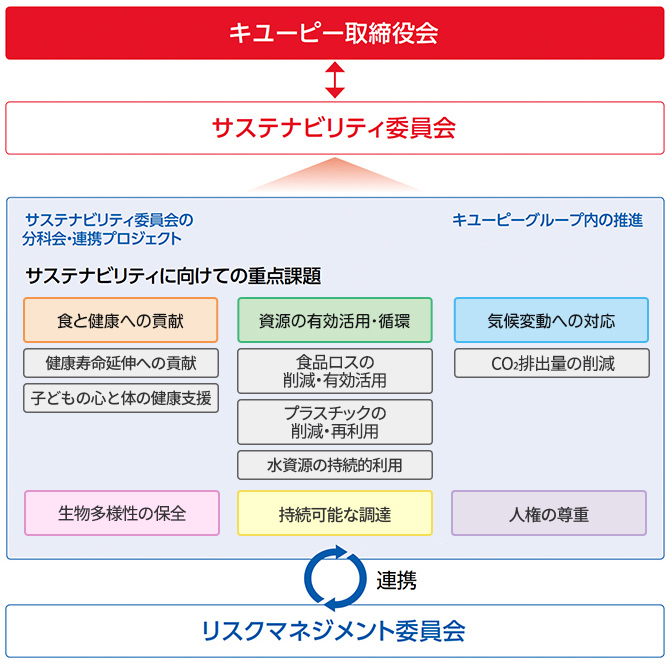
Kewpie Board of Directors ←→ Sustainability Committee
Subcommittees and collaborative projects of the Sustainability Committee
Promotion within Kewpie Group
Material Issues toward Sustainability
- Contributing to Food Culture and Health
- Contribution to Extending Healthy Life Expectancy
- Mental and Physical Health Support for Children
- Effective Use and Recycling of Resources
- Elimination and Effective Utilization of Food Loss
- Reduction and Reuse of Plastic Emissions
- Sustainable Use of Water Resources
- Deal with Climate Change
- Reduction of CO2 emissions
- Conservation of Biodiversity
- Sustainable Procurement
- Respect for Human Rights
Collaboration: Risk Management Committee
The Sustainability Committee, chaired by the responsible director, promotes the formulation of policies and plans and initiatives toward achieving sustainability targets, and holds meetings four times a year.
We discuss goals and initiatives for material issues in subcommittees and collaborative projects, and work to ensure they are understood and established within the group.
Furthermore, we will work in cooperation with the Risk Management Committee to respond to environmental changes and strengthen our management foundation.
Material Issues toward Sustainability
Kewpie Group has been considering the realization of the "Kewpie Group 2030 VISION" and contributions to the SDGs* by working backward from 2030, and has identified the following material issues for sustainability.
- Contributing to Food Culture and Health
- Effective Use and Recycling of Resources
- Deal with Climate Change
- Conservation of Biodiversity
- Sustainable Procurement
- Respect for Human Rights
We believe that material issues toward sustainability are important for both our business and society, as they contribute to the realization of a sustainable society and aim for the sustainable growth of the group. We will periodically review material issues in response to changes in society and the global environment.
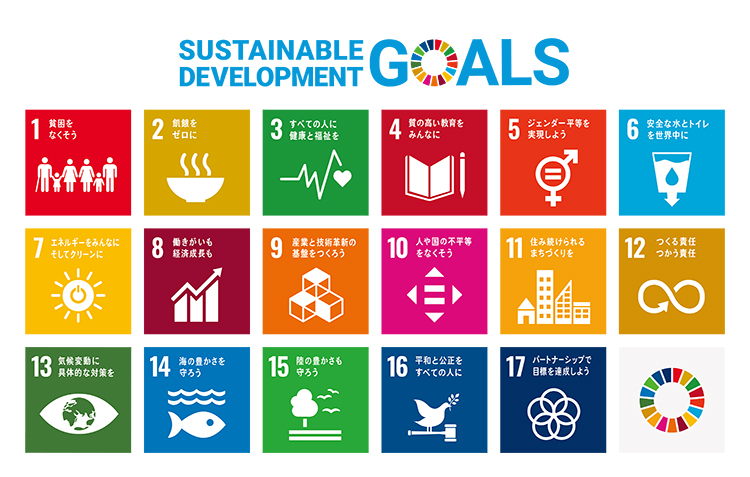

*Sustainable Development Goals (SDGs)
The SDGs (Sustainable Development Goals) are a set of common goals for the international community adopted by the United Nations in 2015. They consist of 17 goals to be achieved by 2030 in order to realize a sustainable society.
SDGs Targets that Kewpie Group Contributes to
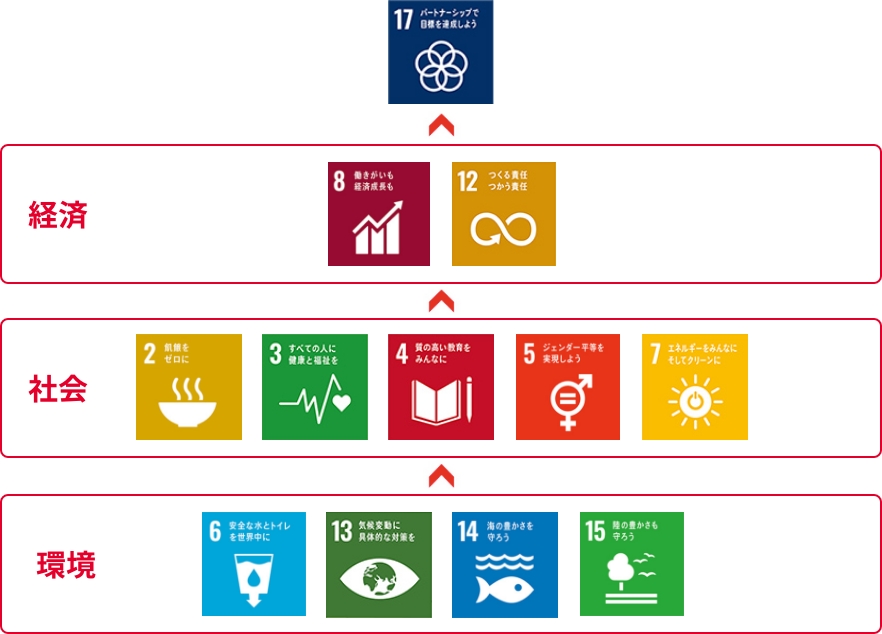
Process for Identifying Material Issues
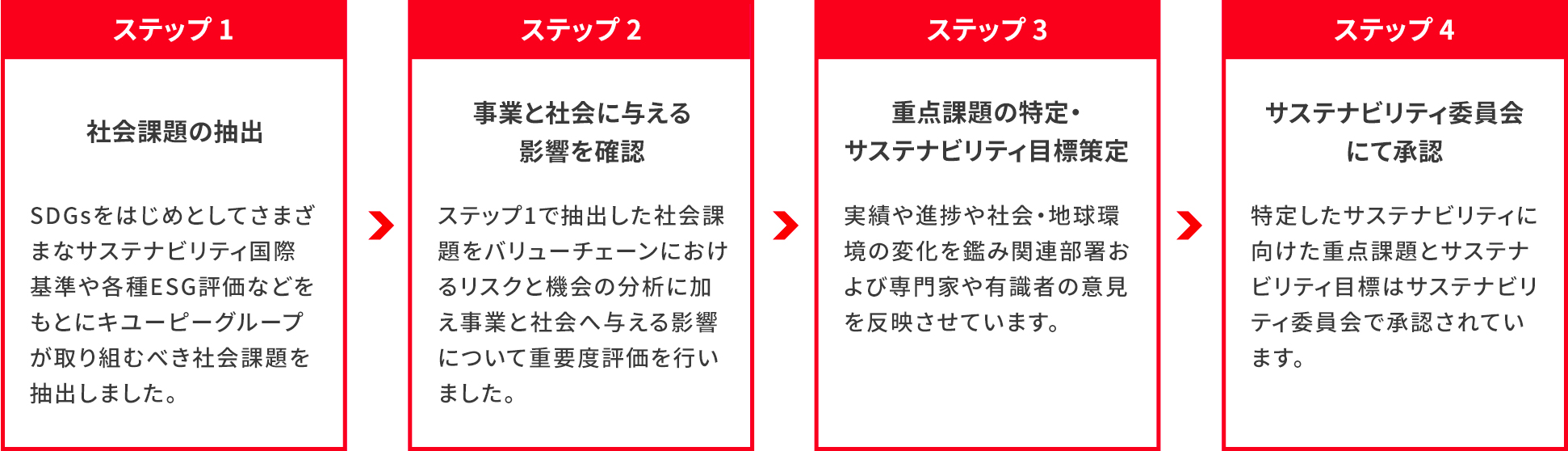
Identifying Social Issues that Kewpie Group Should Address
The social issues that Kewpie Group should address through its business activities are identified by referencing the Sustainable Development Goals (SDGs), the international sustainability standard GRI, ISO 26000, SASB, and various ESG evaluations.
Impact on Business and Society
By comprehensively considering the entire value chain and its stakeholders, we analyzed risks and opportunities within the value chain, and for each social issue, we evaluated the magnitude of stakeholder expectations and the impact the group has on society to identify material issues toward sustainability.
Risks and Opportunities in the Value Chain
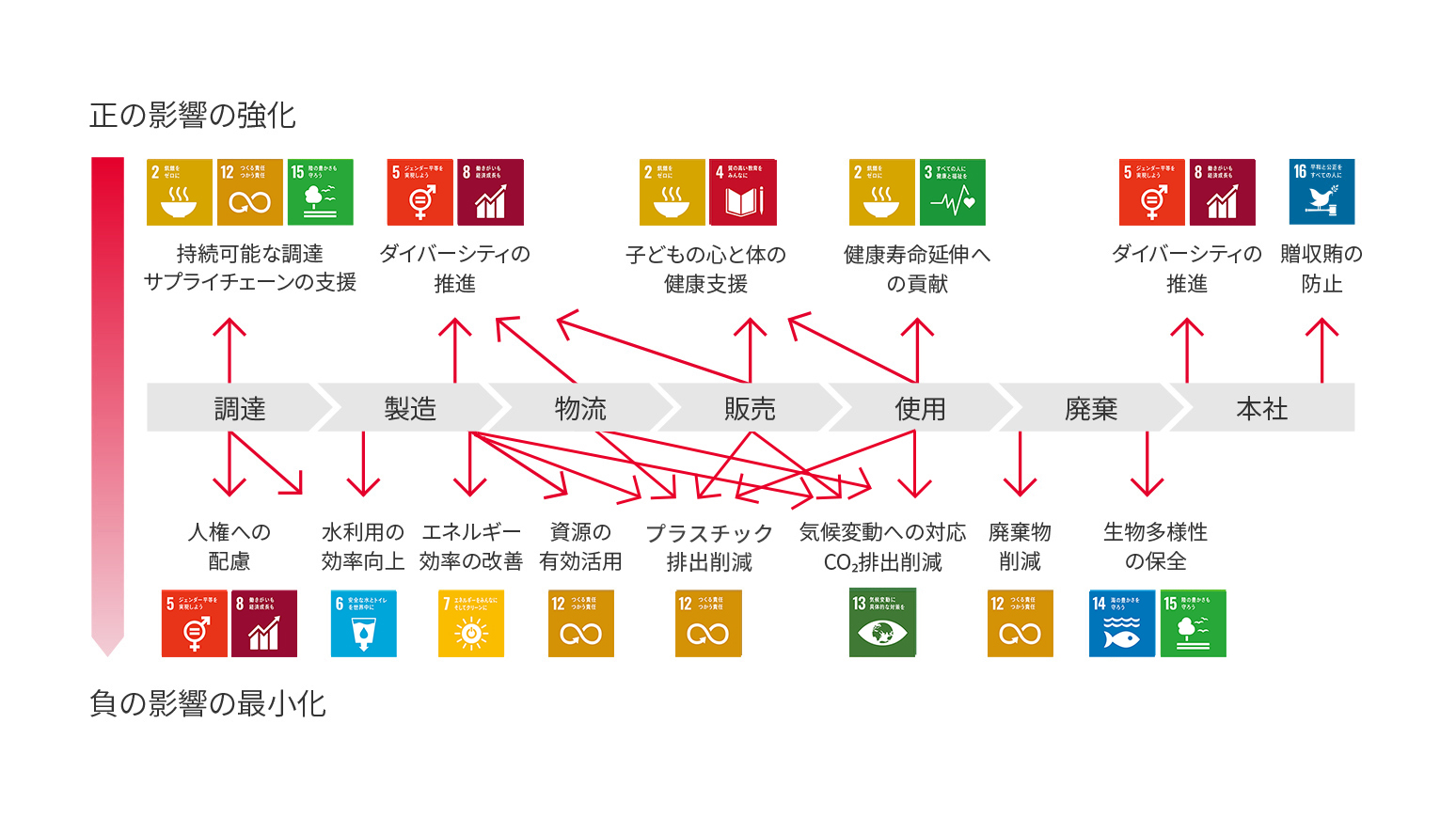
Strengthening of positive impacts
- Procurement
- Support for sustainable procurement and supply chains
- SDG Goal 2: Zero Hunger
- SDG Goal 12: Responsible Consumption and Production
- SDG Goal 15: Protect life on land.
- Manufacturing, logistics, and sales
- Promoting diversity
- SDG Goal 5: Achieve gender equality
- SDG Goal 8: Decent Work and Economic Growth
- Sales and Use
- Mental and Physical Health Support for Children
- SDG Goal 2: Zero Hunger
- SDG Goal 4: Quality Education for All
- Use
- Contribution to Extending Healthy Life Expectancy
- SDG Goal 2: Zero Hunger
- SDG Goal 3: Ensure good health and well-being for all.
- Main office
- Promoting diversity
- SDG Goal 5: Achieve gender equality
- SDG Goal 8: Decent Work and Economic Growth
- Main office
- Prevention of bribery and corruption
- SDG Goal 16: Peace, Justice and Strong Institutions
Minimizing negative impacts
- Procurement
- Consideration for human rights
- SDG Goal 5: Achieve gender equality
- SDG Goal 8: Decent Work and Economic Growth
- Procurement and Manufacturing
- Improving the efficiency of water use
- SDG Goal 6: Clean Water and Sanitation for All.
- Manufacturing
- Improving energy efficiency
- SDG Goal 7: Affordable and Clean Energy
- Manufacturing
- Effective use of resources
- SDG Goal 12: Responsible Consumption and Production
- Manufacturing, logistics, sales, and use
- Plastic waste reduction
- SDG Goal 12: Responsible Consumption and Production
- Manufacturing, logistics, sales, and use
- deal with climate change Reducing CO2 emissions
- SDG Goal 13: Take concrete action to combat climate change.
- Discard
- Waste reduction
- SDG Goal 12: Responsible Consumption and Production
- Discard
- Conservation of Biodiversity
- SDG Goal 14: Protect the richness of the oceans, seas and marine resources.
- SDG Goal 15: Protect life on land.
Identifying Material Issues for Sustainability
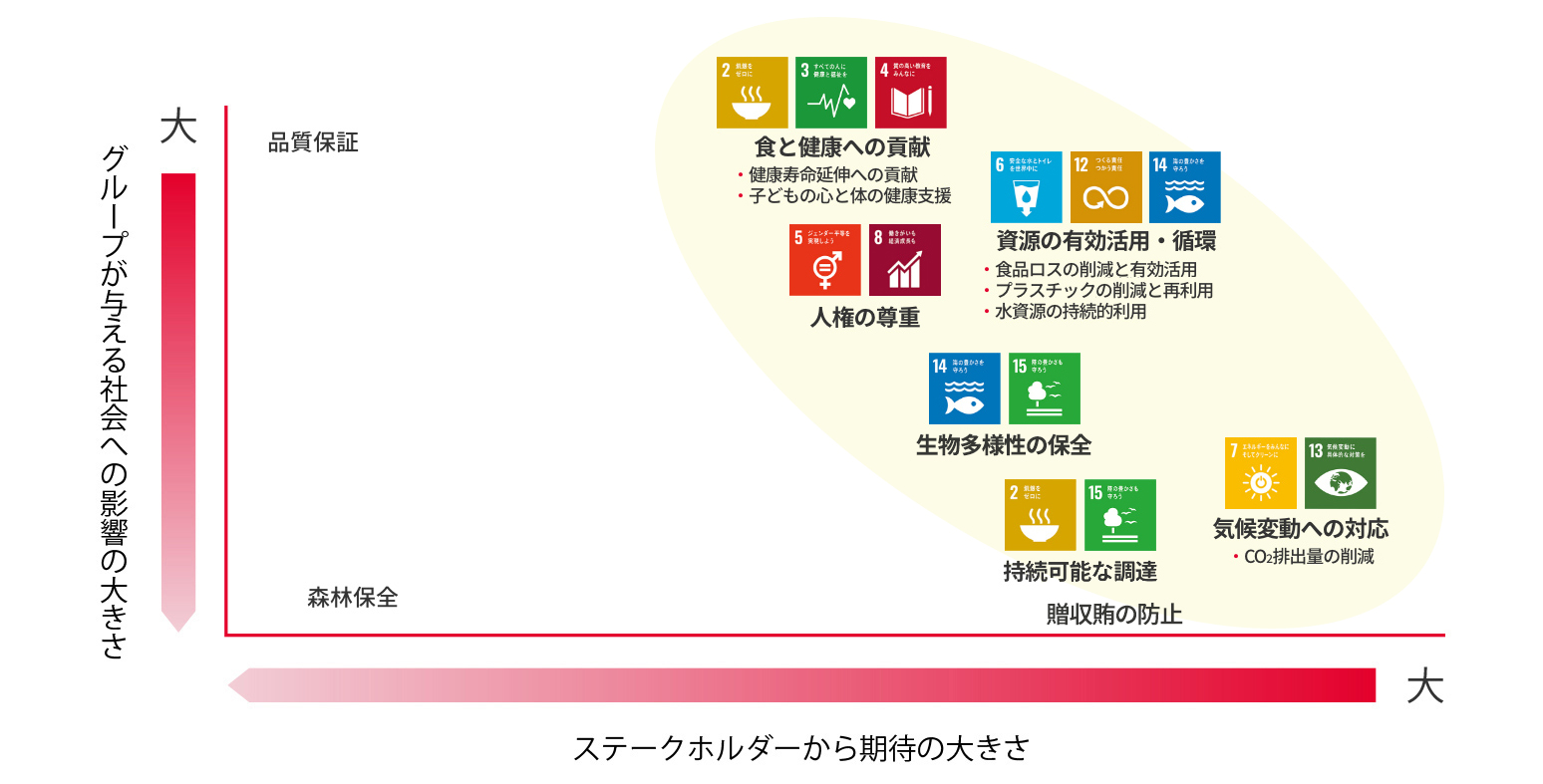
Sustainability Targets
sustainability targets are linked to material issues and represent indicators of the themes that Kewpie Group is working on.
Each employee will embrace sustainability awareness and perspective, and work towards achieving our goals by putting Kewpie Group's philosophy and policies into practice.
Sustainability Targets and Performance
| Material Issues | Initiative Theme | Indicators |
2025 年度 実績 |
2028 年度 目標 |
2030 年度 目標 |
|
|---|---|---|---|---|---|---|
 |
Contributing to Food Culture and Health 

|
To contribute to our customers' healthy eating habits, we are promoting initiatives centered on the expansion of opportunities to eat salads and enhancing the added value of eggs. | ||||
| 私たちの活動で創る 子どもの笑顔の数 (cumulative since FY2019) |
603 thousand children |
At least 800 thousand |
At least 1 million |
|||
| Effective Use and Recycling of Resources 
|
食品残さ 削減率 (compared to FY2015) |
61.4% | At least 63% |
At least 65% |
||
| 野菜未利用部 有効活用率 主要野菜: キャベツなど (当年) |
84.3% | At least 88% |
At least 90% |
|||
| 商品廃棄量 削減率 (compared to FY2015) |
53.1% | At least 70% |
At least 70% |
|||
| プラスチック 排出量削減率 (compared to FY2018) |
26.9% | At least 25% |
At least 30% |
|||
|
Water usage (basic unit) reduction rate (compared to FY2020) |
9.7% | At least 8% |
At least 10% |
||
| Deal with Climate Change 
|
CO2排出量 削減率 (compared to FY2013) |
50.6% | At least 46% |
At least 50% |
||
|
生物多様性 の保全
|
100% sustainable paper procurement by FY2025 (Containers and packaging, booklets, promotional products, office supplies) |
100.0% | 100% | 100% | ||
| Sustainable Procurement
|
Promote Fundamental Policy for Sustainable Procurement in cooperation with business partners |
|||||
Respect for Human Rights
|
Promote the Kewpie Group Human Rights Policy to respect the human rights of all people involved in our business |
|||||
The "food waste reduction rate" indicator includes the "effective utilization rate of unused portions of vegetables."
Sustainability targets are domestic figures.
Figures are rounded to the nearest specified unit.
Incorporation into Employees
We believe that for the sustainability of society and the sustainable growth of our company, it is essential that every employee understands and empathizes with our policies.
Internal Communications
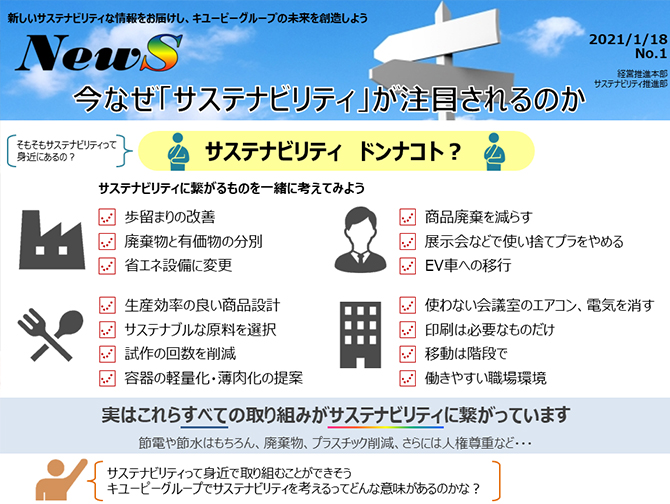
We utilize integrated reports and other materials for employee training. Furthermore, we disseminate sustainability information through Kewpie Group's internal newsletter.
Integrated Report
Kewpie Group
Official Blog
The "Kewpie Group Official Blog," launched in March 2007, aims to foster a sense of shared responsibility for sustainability among all employees by having group employees who are actually involved in these initiatives write the articles.