










Environmental Management
- Policy for Environmental Management
- Kewpie Group Environmental Policy
- Environmental Management Promotion Structure
- Environmental Management System
- Compliance with Environmental Laws and Regulations
- Environmental Audit
- Environmental Impacts of Business Activities
- Environmental Considerations for the Local Community
- Environmental Communication
Policy for Environmental Management
Kewpie Group's business is supported by the blessings of abundant nature. However, environmental problems such as global warming, plastic pollution in the oceans, and loss of biodiversity are becoming more serious and are having a significant impact on corporate activities. For many years, Kewpie Group has been working to reduce the environmental impact of its business activities based on the principle of "Quality-First."
Environmental Vision
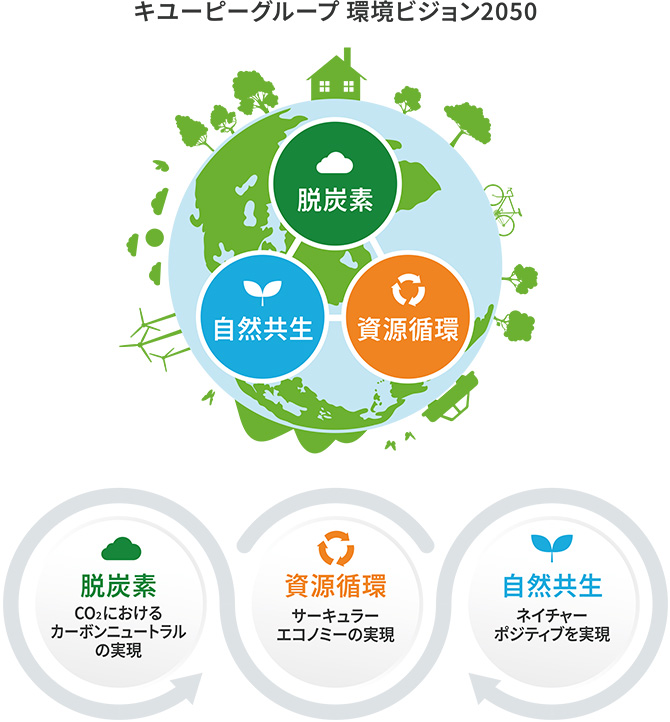
To coincide with the start of our 11th Medium-Term Management Plan in 2025, we have formulated the "Kewpie Group Environmental Vision 2050." We will promote environmental activities centered on realizing a decarbonized society, building a circular economy, and conservation of biodiversity, thereby contributing to the realization of a sustainable society.
Kewpie Group Environmental Policy
Kewpie Group Environmental Policy, consisting of environmental philosophy and action guidelines, was established in response to the growing awareness of environmental conservation both domestically and internationally. It will be implemented in conjunction with Kewpie Group Basic Policy on Sustainability to promote our initiatives.
キユーピーグループ 環境方針
Kewpie Group
Environmental Policy
We strive to be environmentally friendly in our business activities throughout the value chain,
from product design and raw material procurement to production, sales, and consumption.
- 1.We strive to conserve resources, save energy, reduce waste, promote recycling and develop recycling technologies.
- 2.We promote the development of environmentally conscious products and the optimization of containers and packages.
- 3.We voluntarily set standards and strive to preserve the environment, abide by legal regulations, and furthermore, prepare and enhance an environmental management structure that allows us to respond to social demands.
Established in 1998, revised in 2022
Material Issues and Targets
Kewpie Group has established indicators (sustainability targets) for each of its key priorities in addressing global material issues, namely "effective use and recycling of resources," "deal with climate change" and "conservation of biodiversity" and is putting these into practice.
Environmental Management Promotion Structure
Kewpie Group holds a Sustainability Committee chaired by the Executive Officer in charge of Sustainability. In terms of environmental issues, we have established subcommittees and collaborative projects for each theme to address material issues, and we are promoting initiatives to ensure their widespread adoption and establishment throughout the entire group.
Environmental Management System
Kewpie Group has implemented ISO 14001 or a similar proprietary system at each of its business locations as a fundamental tool for running the PDCA cycle of environmental conservation activities.
ISO14001 Certification Status
As of the end of November 2025, 15 out of 65 domestic group production sites have obtained ISO 14001 certification.
Compliance with Environmental Laws and Regulations
Each business location within Kewpie Group not only complies with environmental laws and regulations, but also manages and responds appropriately based on its own standards.
Environmental Audit
Kewpie Group has established standards for compliance with relevant laws and regulations, the development of management promotion systems, and facility management status, and conducts regular internal audits to ensure thorough compliance while also promoting environmental conservation activities. In addition, ISO 14001 certified facilities undergo audits by external organizations based on the standard to confirm that their systems and operations conform to the requirements.
Environmental Impacts of Business Activities
The production process of our products consumes resources such as raw materials, supplies, and water, as well as energy such as electricity, gas, and heavy oil, and generates industrial waste, water, and CO2 emissions. In addition, there is an environmental burden associated with the energy used during product transportation, and the containers and packaging of products used by customers become waste.
We recognize the environmental impact of our business activities and, throughout our entire value chain—from product design and raw material procurement to production, sales, and consumption—we prioritize a sustainable global environment. We promote environmental conservation activities such as energy and resource conservation, waste reduction, improved packaging, efficient transportation, and pollution prevention.
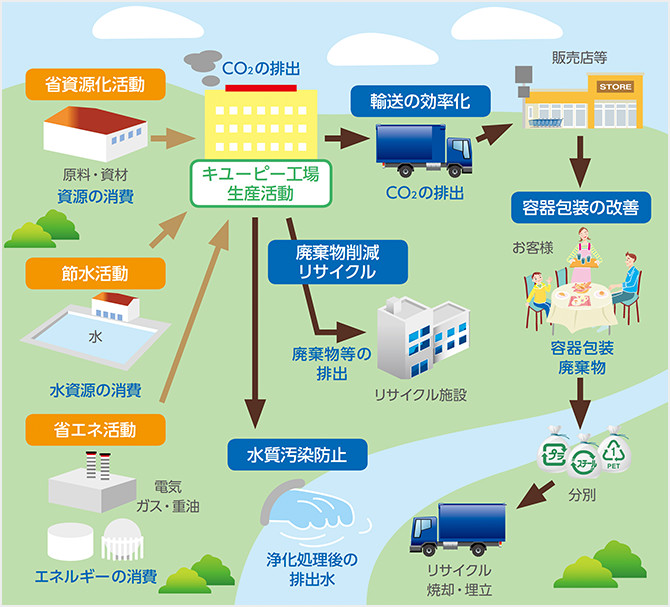
Flow of materials and energy in the production division of Kewpie Group
Flow of Materials and Energy in the Production Division of Kewpie Group (FY2025)
Input
| Energy use | Purchased electricity | 1,701 thousand GJ (196,917 thousand kWh) |
|---|---|---|
| Fuel*1 | 955 thousand GJ | |
| Total energy | 2,671 thousand GJ | |
| Water usage | Water (Groundwater, tap water) |
6,938 thousand m3 |
Output
| Emissions to Air | CO2 | 117.6 thousand tons |
|---|---|---|
| NOx | 33.1 tons | |
| SOx | 5.4 tons | |
| Discharge into water bodies*2 | Emissions | 5,259 thousand m3 |
| Waste disposal | Emissions (recycling rate) | 34.5 thousand tons (95.4%) |
*1Includes fuel for power generation
*2Including rivers and public sewer systems
Target: Group domestic production plants
Reduction of Waste Generation
Waste Reduction Targets
- Year-on-year decrease in both total volume and unit intensity per production output
The main types of waste generated from Kewpie Group factories include food waste and waste plastics from the manufacturing process and packaging materials, as well as sludge from wastewater treatment facilities.
Our primary focus is on reducing waste generation through improvements in manufacturing yield and packaging.
Furthermore, we are working towards a 100% recycling rate for waste generated at our factories (zero simple incineration and landfill disposal) by recycling eggshells into fertilizer and food waste, including unused vegetable parts, in-house (composting and turning into animal feed), as well as by outsourcing the recycling (composting) of waste to external parties.
Waste generation*
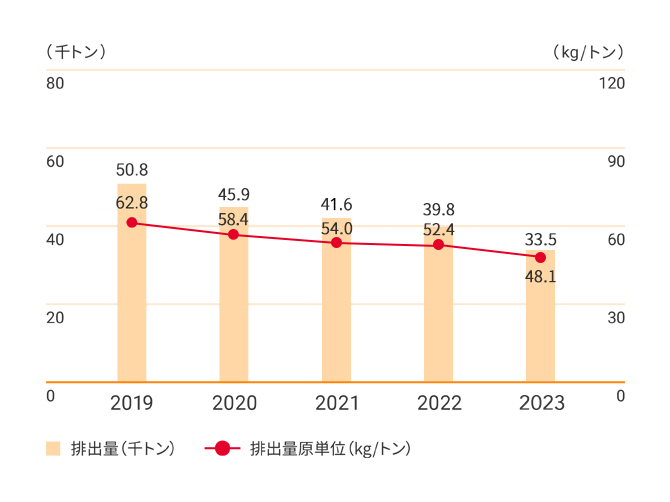
Target: Kewpie Group production plants
*Excluding by-products recycled within the group.
Environmental Considerations for the Local Community
At Kewpie Group's facilities, we operate with consideration for the residents of the surrounding area and the local environment.
Prevention of Water Pollution
After treatment at our wastewater treatment facilities, we manage the treated water quality according to our own established standards, and we comply with regional standards. In addition, we install leak prevention equipment in tanks for liquid raw materials and fuels, and we conduct training to prepare for potential discharge into public waters or groundwater infiltration.
Prevention of Air Pollution
We strive to ensure proper operation and management of boilers, cogeneration systems, and other equipment, and we conduct regular inspections, maintenance, and soot measurements. Furthermore, we are promoting the conversion of fuels used in boilers and other equipment to gases that produce less particulate matter and sulfur oxides.
Noise Reduction and Odor Control
To address odors generated during wastewater treatment and cooking, we are implementing process improvements and installing deodorizing equipment. Furthermore, to prevent noise pollution, we are installing soundproof walls, conducting noise assessments before equipment installation, and providing guidance to employees and suppliers.
Environmental Communication
Kewpie Group's business activities are based on the abundant blessings of nature, including raw materials. In order to pass on a sustainable society, we give full consideration to the impact of our business activities on nature, strive to enhance our environmental impact reduction and conservation activities, and endeavor to communicate with our stakeholders through our environmental activities.
Kewpie Group Eco-Label
Since February 2024, Kewpie Group has been displaying its own eco-label. With the aim of clearly communicating to customers that our products are environmentally conscious, we have established environmental standards for packaging and attach the label to products that meet these standards.
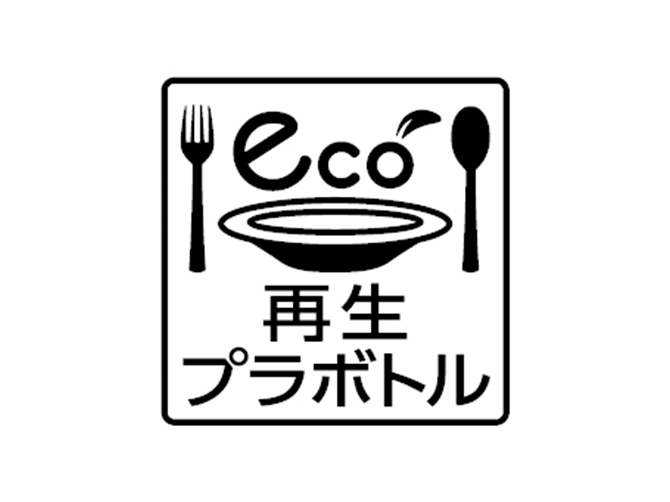
Example label
The Thoughts Behind the Design
Kewpie Group cherishes its motto, "love around the kitchen table." and strives to solve various challenges with "great taste, empathy, and uniqueness." As part of this effort, the Eco-Labels attached to environmentally friendly products also embody the sentiment of "love around the kitchen table."
The design features a plate, spoon, and fork—essential items for the dining table—and the "eco" logo in the center to convey a message of "kindness to the environment," with a leaf added as an accent to the letter "o."
Kewpie Group Eco Label Award Criteria
| Assigned items | Labeling Criteria |
|---|---|
| Plastic Reduction | Reduce plastic use by 5% or more (based on 2018 levels) |
| Recycled plastic | Use of recycled plastic materials accounting for 25% or more by weight of total plastic usage. |
| Biomass plastics | Use of biomass plastic materials accounting for 10% or more by weight of total plastic usage. |
Labeling Example
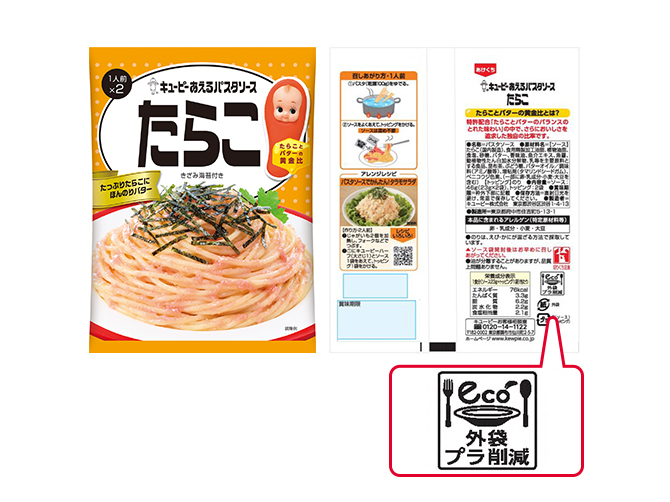
Environmental Education
Kewpie Group conducts environmental education to raise employees' awareness of environmental conservation and to promote related initiatives.
We collaborate with relevant departments to conduct requested courses that are relevant to practical environmental work.
We regularly conduct training on wastewater treatment management, waste management, and other related topics.
Each of our business locations also conducts general education on environmental issues and training exercises to prepare for emergencies.