









Reduction and Reuse of Plastic Emissions
Approach to Reduction and Reuse of Plastic Emissions
Kewpie Group uses the most plastic in its food containers and packaging. While plastic has advantages such as being lightweight and durable, its impact on the global environment, including marine plastic waste, has been pointed out.
Kewpie Group recognizes that plastic waste is a problem that affects ecosystems and the environment, and is working to reduce the use of petroleum-derived virgin plastics and promote resource recycling.
Participating in the Ministry of the Environment's Plastic Smart Campaign
Kewpie Group Plastics Policy
Kewpie Group has formulated the "Kewpie Group Plastics Policy" and will accelerate efforts to reduce the amount of plastic used in its business activities, aiming to contribute to the creation of a circular economy.
Kewpie Group Plastics Policy
We will help realize a sustainable circular economy by implementing 3R+Renewable.
- We consider reducing environmental impact in design from the development stage.
- We cooperate and promote this throughout the value chain.
Adopted 2019, revised 2022
Main Initiatives to be Promoted Going Forward
- Further reduction of plastic usage, primarily through weight reduction
- Introduction of recycled plastics and biomass plastics
- Easy-to-separate container and packaging design
- Participating in industry initiatives to promote plastic collection and recycling
Lightweighting of
Mayonnaise cap
Using containers with
recycled plastic content
Reducing Plastic Use in Container and Packaging Design
Product packaging is essential for maintaining the quality and taste of products, but it consumes energy during production and becomes waste after use.
Under the "Kewpie Group's Basic Policy for Container and Packaging Selection," we are promoting the adoption of packaging materials that have a low environmental impact by developing lightweight and simplified containers and packaging, as well as biomass materials and recycled materials.
Lighter and Simpler Containers and Packaging
| Start time |
Targets | Actions |
|---|---|---|
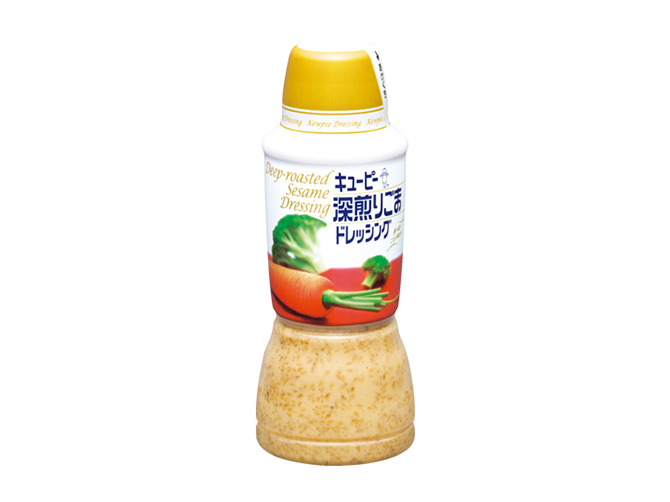
| January 2026 | retail market Deep-Roasted Sesame Dressing 1000ml |
By adopting paper packaging, plastic usage has been reduced by approximately 75%. |
| November 2025 | KEWPIE MAYONNAISE 700g | By adopting a lightweight cap, the amount of plastic used has been reduced by approximately 17%. |
| September 2025 | GREEN KEWPIE Plant-based sesame dressing | By switching to paper packaging for small bags, the amount of plastic used per bag has been reduced by 44%. |
| February 2024 | food service products Hoshienu Pasta Sauce PAKITTE Series |
Plastic usage reduced by 25% by changing container size. |
| July 2023 | food services products New Exter |
Lighter bottles by reducing the amount of plastic used. |
| January 2023 | food service products Kewpie 's Hoshienu brand products are available in 1000ml and 500ml bottle containers. |
Lightweight design reduces the amount of plastic used in the cap by approximately 9%. |
| September 2022 | KEWPIE Aeru Pasta Sauce Series (Sauce Type) | We've slimmed down the individual packaging size and reduced plastic usage by approximately 7%. |
| August 2022 | Verde Toast Spread Series | By reducing the thickness of the material used for the laminated tubes of the containers, the amount of plastic used was reduced by approximately 10.9%. (Used in all 2023 series) |
| March 2022 | KEWPIE Baby Snacks Soft rice crackers with vegetables |
We changed the materials used for the outer packaging, individual packaging, and trays, reducing plastic usage by 35%. Furthermore, by switching to a single material, we also considered ease of recycling. |
| February 2022 | Verde Whip Series | By making the containers thinner, the amount of plastic used was reduced by approximately 9.3%. |
| February 2022 | Salad Club, Inc. packaging film | Changes in specifications for the film used in packaged salads, such as reducing the size and thickness of the film. |
| January 2022 | Salad Club, Inc. Package Salad Tray | The trays used for packaged salads are approximately 10% lighter compared to conventional products. |
| March 2021 | KEWPIE Smile Cup Series, KEWPIE Gentle Menu | By removing the outer lid that was attached to the top, the amount of plastic used is reduced. |
| March 2021 | KEWPIE Baby Snacks Tamago Tappuri Boro (round biscuits with plenty of egg) |
Reduced plastic usage in exterior and interior surfaces by approximately 25%. |
Environmentally Friendly Packaging
| Start time |
Targets | Actions |
|---|---|---|
| August 2025 | retail market salad dressings in 380ml size | The bottle is made from 100% recycled plastic. |
| July 2024 | 180ml size of retail market salad dressings | The bottle uses 30% recycled plastic. |
| February 2024 | Kewpie Aeru Pasta Sauce Series | The outer packaging has been changed to paper packaging. |
| February 2024 | Kewpie 3-Minute Cooking: Let's Eat Vegetables! Soup Base | The outer packaging has been changed to paper packaging. |
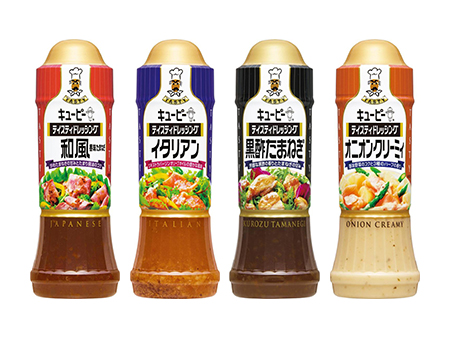
| July 2023 | Kewpie Tasty Dressing, Functional Food Dressing | The bottle is made from 100% recycled plastic (first condiments in Japan: according to Kewpie). |
| May 2023 | Verde PAKITTE Series | By incorporating biomass plastic into a portion of the container (the part containing the contents), the amount of petroleum-derived plastic used is reduced by 40%. |
| June 2021 | Kewpie Tasty Dressing | Bottles containing 30% recycled plastic* are used. *This plastic is recycled using a method called "mechanical recycling" (physical regeneration method), which involves collecting PET bottles, mainly for soft drinks, crushing and washing them, and then treating them at high temperatures for a certain period of time to remove contaminants and improve their quality. |
| August 2020 | Salad Club, Inc. Ingredient Pouch Series | plant-derived plastics* Pouches using this material are used in 12 out of the 19 products. (Used in all 2022 series) *Plant-derived plastics: Biomass plastics made from renewable organic resources (plants such as sugarcane by-products). |
| February 2020 | Kewpie Dressing Stick Type | Approximately 15% of the exterior is made from recycled plastic. |
Reducing Plastic Use in Manufacturing and Distribution
In addition to reducing plastic use in product packaging, Kewpie Group is working to reduce plastic emissions throughout the entire value chain, from procurement and manufacturing to distribution and consumption.
Recycling of Product Distribution Containers
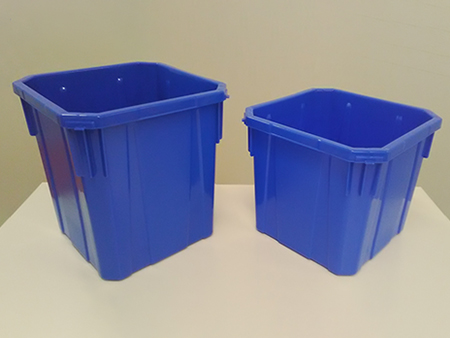
Left: Recycled product Right: Existing product
Plastic Container for Liquid Eggs
Kewpie Egg Corporation is implementing an initiative* to recycle plastic containers used for egg products such as liquid eggs and to use recycled products. By recycling plastic containers that were previously discarded, this initiative helps to reduce plastic waste.
*Started in 2020
Collaborative Efforts for Resource Recycling
PET Bottles with Oil (e.g., Dressing Bottles)
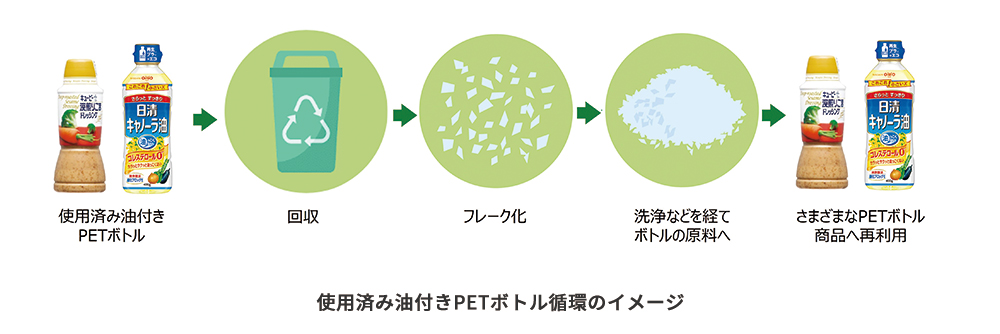
Kewpie has begun collaborating with The Nisshin OilliO Group, Ltd. to promote resource recycling of PET bottles used in salad dressings and edible oils.
There are concerns that oil-contaminated PET bottles will leave oil residue during the recycling cleaning process, affecting the quality of recycled PET, and a socially implemented recycling system has not yet been established. By collaborating with companies that handle oil-based products, we aim to create a society where PET bottles from oil-based products can be recycled as resources.
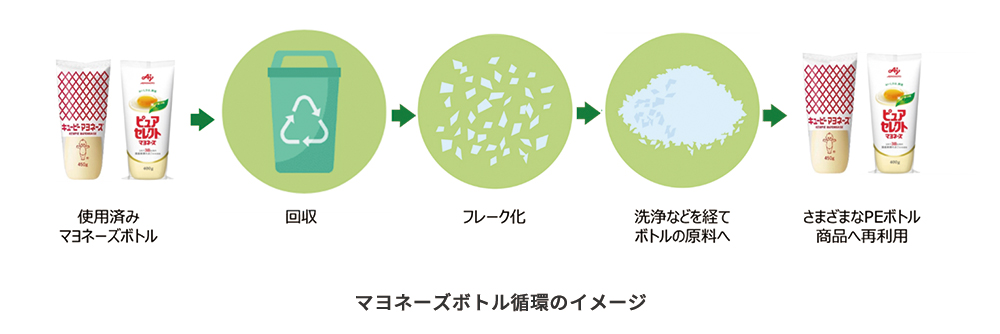
Mayonnaise Bottle
Kewpie Corporation and Ajinomoto Co., Inc. have begun collaborating on resource recycling for mayonnaise bottles as part of CLOMA (Clean Ocean Material Alliance), a cross-industry platform in which both companies are working in public-private partnerships to solve the problem of marine plastic waste.
Mayonnaise bottles in Japan are primarily made of polyethylene (PE), a type of plastic. While PE is widely used in food packaging, due to its variety and the fact that it is often combined with other materials, a horizontal recycling system*1, similar to that used for PET beverage bottles, has not been socially implemented.
Furthermore, in order to achieve horizontal recycling through material recycling*2, it is important to collect plastic made from the same material as mayonnaise bottles, thoroughly clean them, and then recycle them. By collaborating across company boundaries to address these challenges, we aim to create a society where mayonnaise bottles can be recycled as a resource.
In fiscal year 2025, we collaborated with Ito-Yokado Co., Ltd. to conduct a pilot project to collect used mayonnaise bottles at three Ito-Yokado stores in Kawasaki City.
*1Horizontal recycling is a method of recycling used product containers and packaging as raw materials to manufacture the same type of product containers and packaging again, in order to make effective use of limited resources.
*2Material recycling is a recycling method in which waste is reused as raw material without changing its properties.
Pla-Relay Project
On February 14, 2025, six parties—Kashima City in Ibaraki Prefecture, REFINVERSE, Inc., Mitsubishi Chemical Corporation, Toyo Seikan Group Holdings, Ltd., KASUMI CO., LTD. and Kewpie—signed a comprehensive cooperation agreement with the aim of promoting the circular economy of plastic containers within Ibaraki Prefecture. This initiative, called the "Pla-Relay Project," is a demonstration project in which each of the six parties will leverage their strengths to connect plastics in a relay format and aim for circularity.
Through this project, Kewpie aims to recycle used plastics and contribute to the creation of a circular economy.
鹿嶋市、リファインバース、三菱ケミカル、東洋製罐グループ、キユーピー、カスミの6者連携で、プラスチック容器の循環を目指す包括連携協定を締結(339KB)

Recycling of Used Plastics
Kewpie (hereinafter referred to as "R-Plus Japan") will take a stake in R Plus Japan, Ltd. and engage in the business of recycling used plastics in order to realize a sustainable society. By participating in this joint venture, we will further promote the recycling of used plastics and contribute to the realization of a sustainable society as a member of the value chain.