











IR Events
2Q Financial Results Briefing
2026年7月9日開催(2026年11月期 上期)
Materials
-
上期(中間期) 決算説明会資料(3.05MB) FY2026 1H (Interim Period) Financial Results Briefing Materials(2.8MB)
-
上期(中間期) 決算説明会資料(スクリプト付き)(2.26MB) FY2026 1H (Interim Period) Financial Results Briefing Materials (script)(7.57MB)
-
上期(中間期) 決算説明会質疑応答(196KB) FY2026 1H (Interim Period) Financial Results Briefing Key Q&A(72.1KB)
Video Presentation (Japanese only)
Videos by Topic (Japanese only)
Results for the first half of FY2026 and performance forecast for FY2026
Director, Senior Managing Executive Officer
Shinichiro Yamamoto
Outlook for the second half of the year and beyond
President
Mitsuru Takamiya
Year-End Financial Results Briefing
2026年1月14日開催(2025年11月期)
Materials
Video Presentation (Japanese only)
Videos by Topic (Japanese only)
FY2025 Performance and FY2026 Plan
Director, Senior Managing Executive Officer
Shinichiro Yamamoto
Outlook for fiscal year 2026
President
Mitsuru Takamiya
2Q Financial Results Briefing
2025年7月3日開催(2025年11月期 上期)
Materials
Video Presentation (Japanese only)
Videos by Topic (Japanese only)
First-half and full-year earnings forecasts for FY2025
Director, Senior Managing Executive Officer
Shinichiro Yamamoto
Progress of the Medium-Term Management Plan Strategy (Future Outlook)
President
Mitsuru Takamiya
Year-End Financial Results Briefing
2025年1月9日開催(2024年11月期)
2Q Financial Results Briefing
2024年7月4日開催(2024年11月期 上期)
Year-End Financial Results Briefing
2024年1月11日開催(2023年11月期)
2Q Financial Results Briefing
2023年7月6日開催(2023年11月期 上期)
Year-End Financial Results Briefing
January 11, 2023 (term ending November 2022)
-

2022年度 決算説明資料
-
-
2022年度の概要について
-
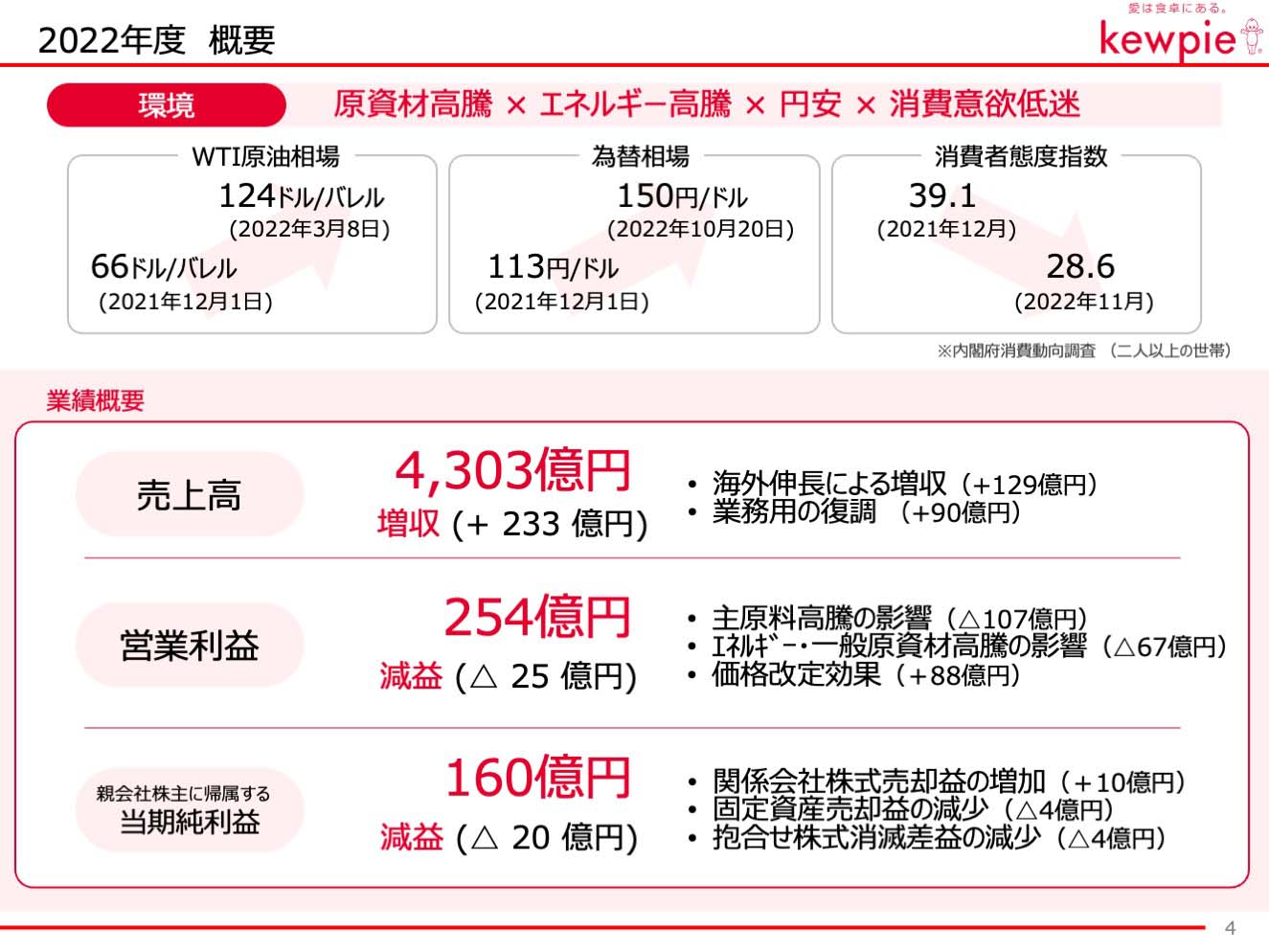
2022年度は、原資材、エネルギー価格の高騰や急速な円安進行、消費意欲の低迷など、事業を取り巻く経営環境が大きく変化する1年となりました。
そのような中、当社の業績は売上高では233億円の増収となりましたが、営業利益は25億円の減益となりました。売上高は、海外の売上伸長に加え、国内業務用で外食需要が回復し増収に貢献しました。また為替影響や価格改定効果も増収要因となっています。
営業利益については、主原料やエネルギー、一般原資材の高騰影響に対し、価格改定や付加価値化に取り組みましたが、減益となりました。
親会社株主に帰属する当期純利益は、事業利益の減少に加え、資産売却益の減少などにより、20億円減益の160億円となりました。
-
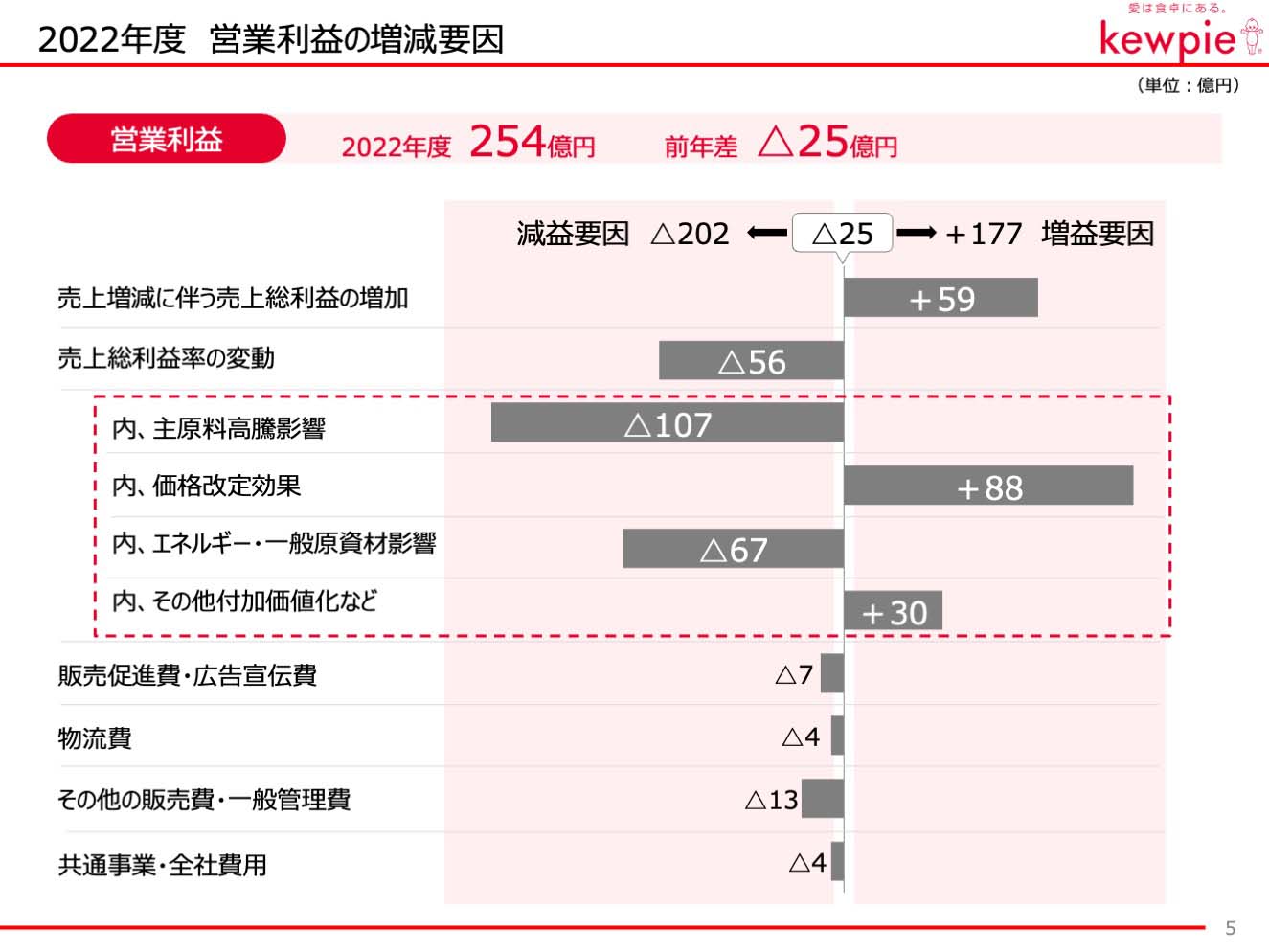
営業利益の増減要因について
「売上増減に伴う売上総利益の増加」については、海外や業務用の他、ファインケミカルが堅調に推移したことにより、59億円の増益要因となりました。
「売上総利益率の変動」では、増益要因として価格改定で88億円、付加価値化などで30億円の効果がありましたが、主原料高騰影響の107億円、エネルギー、一般原資材影響の67億円が逆風となり、合計で56億円の減益要因となりました。
その他の販売費・一般管理費は、基幹システムの更新に伴う費用などにより13億円の減益となりました。
-
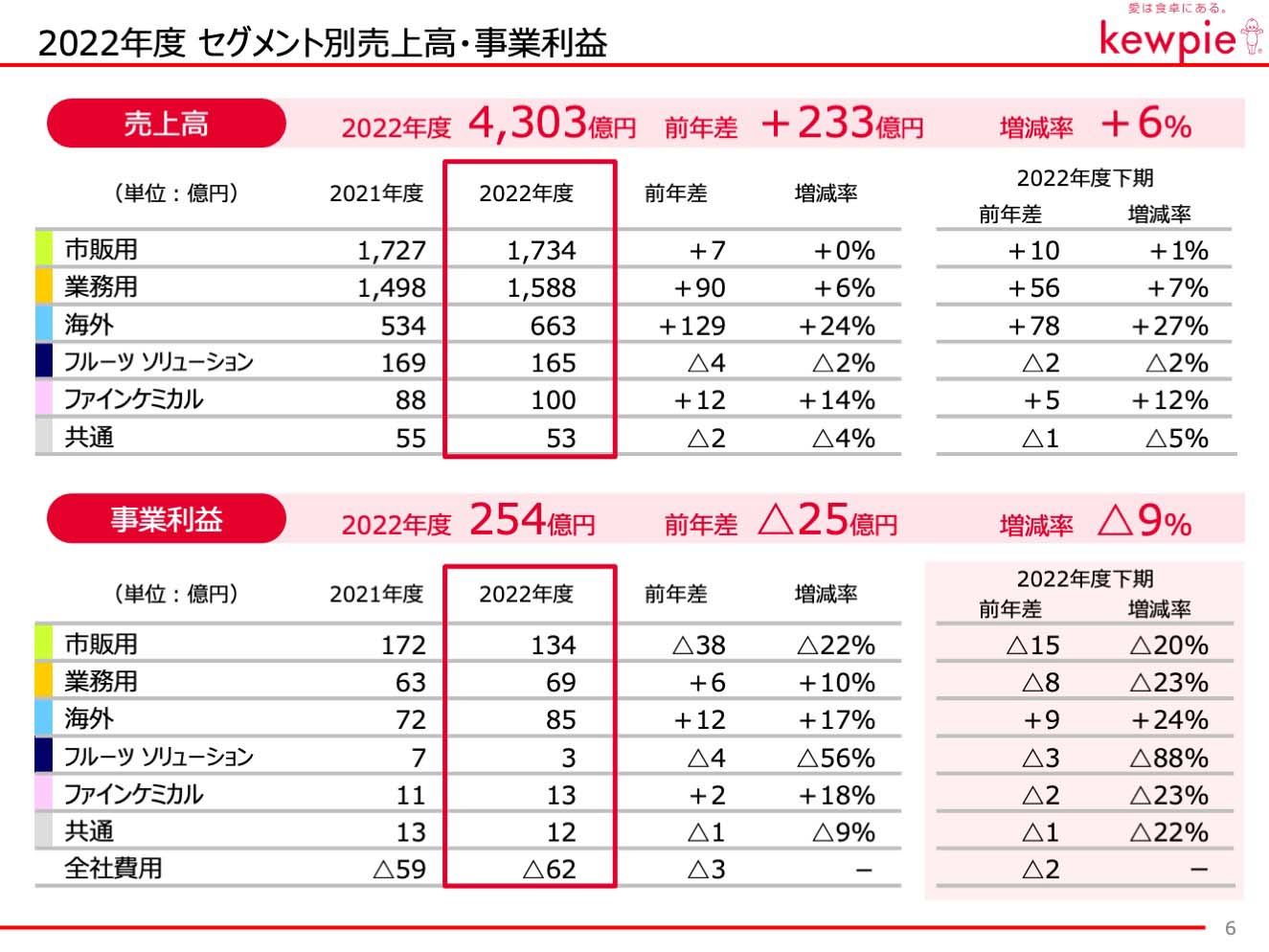
セグメント別の売上高・事業利益について
売上高については海外・業務用が大きく伸長しました。
ファインケミカルは通販事業で主力商品が堅調に推移したことから増収となりました。事業利益については海外・業務用・ファインケミカルで増益となりましたが、市販用、フルーツ ソリューション、共通事業で減益となりました。
また、下期については主原料や一般原資材の高騰影響が一段と強まり、海外以外のセグメントで減益となりました。 -
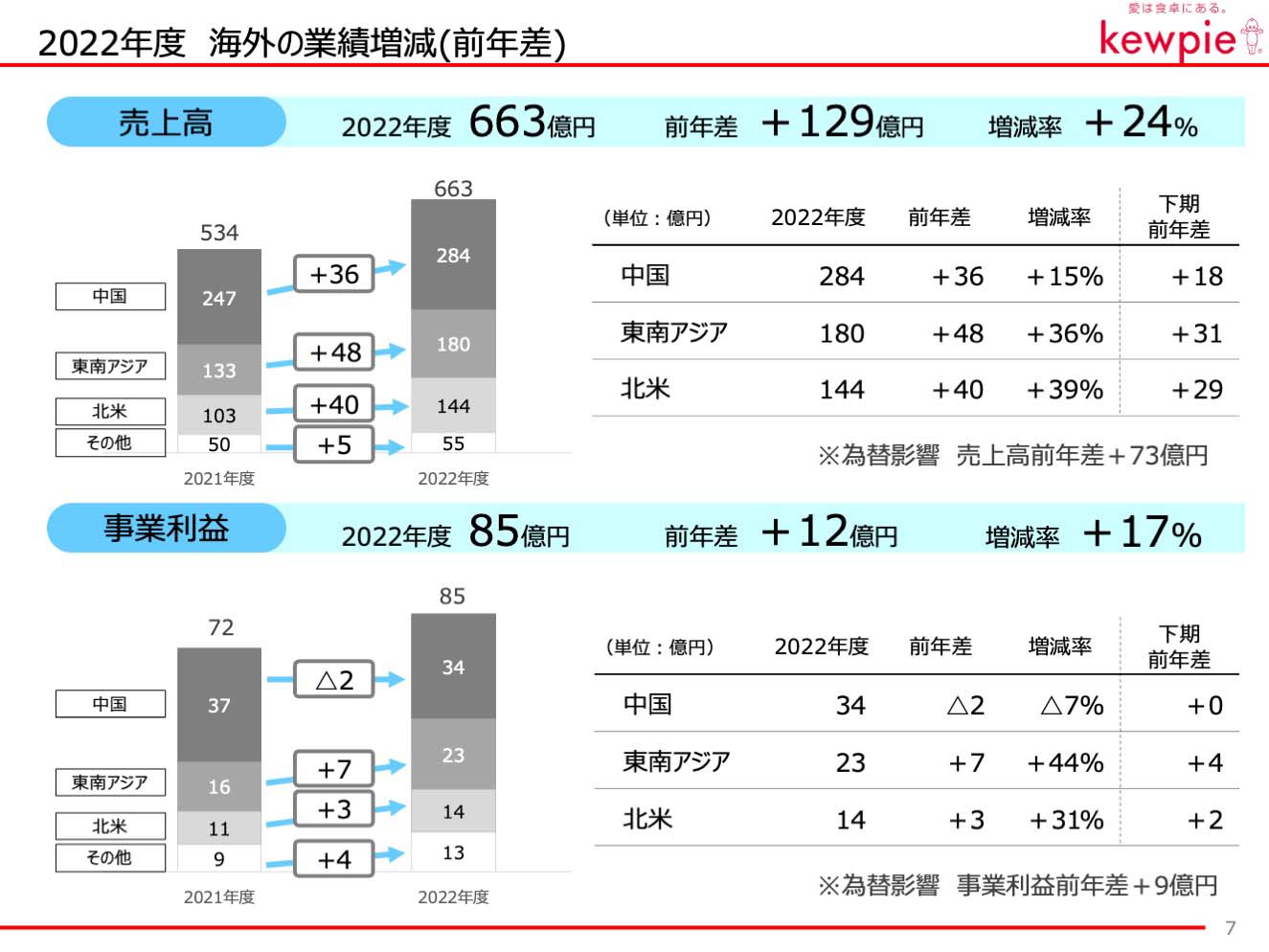
主要セグメントの売上高・事業利益の状況について
海外は129億円の増収となりました。
中国は、上期に北京市での移動制限などゼロコロナ政策の影響、下期に上海エリアでのロックダウンの影響を受けましたが、現地通貨ベースで前年を維持し、円貨では為替の影響から増収となりました。
東南アジアについては、コロナからの回復により、業務用商品が好調に推移、北米はブランド品・OEM・業務用ともに好調を維持したことから、海外トータルの現地通貨伸長率は110%となりました。事業利益については12億円の増益となりました。中国は減益でしたが、東南アジア・北米が全体の利益を支えました。
なお、海外の売上高にはプラス73億円、事業利益ではプラス9億円の為替影響が含まれています。
-
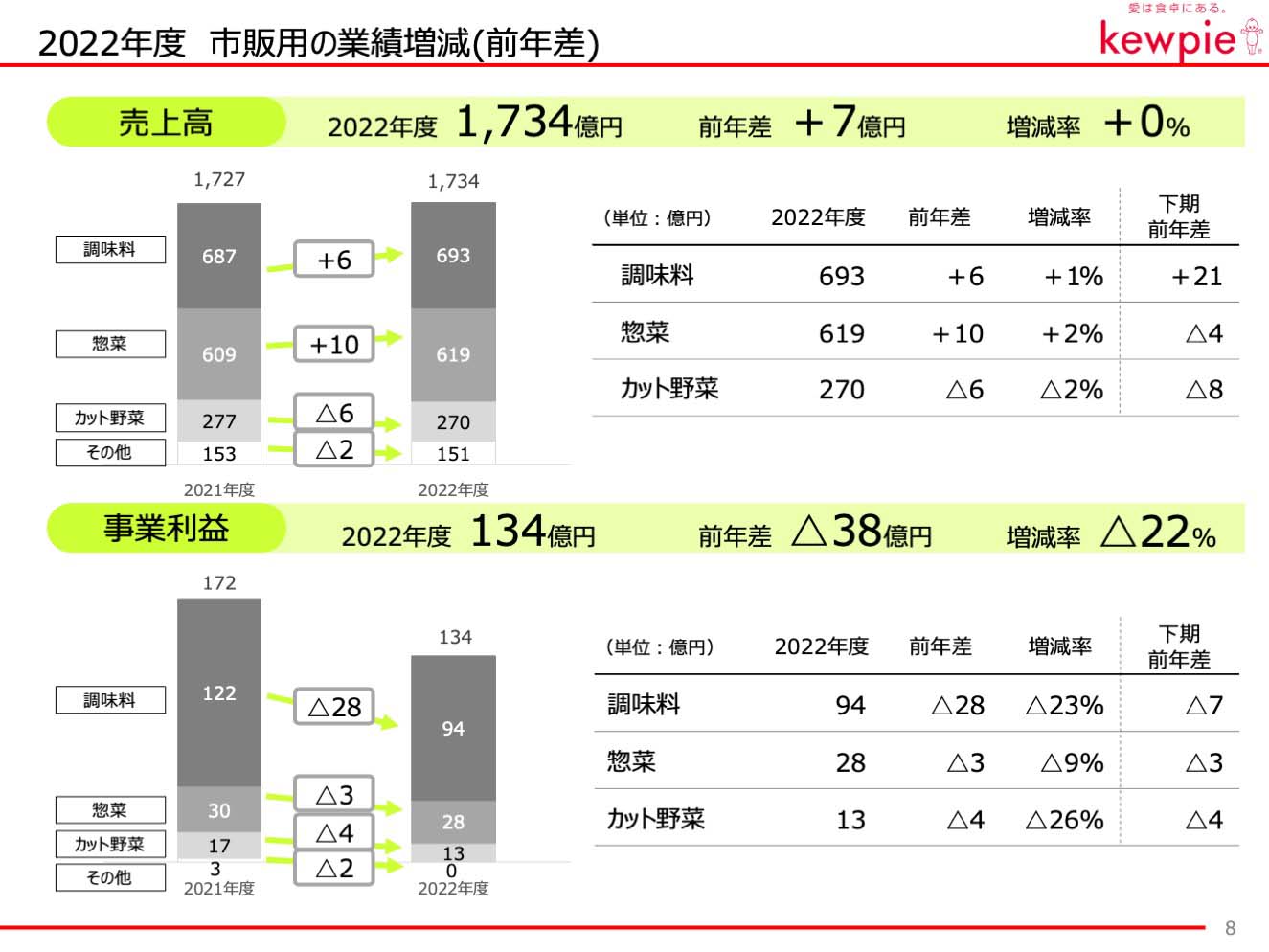
市販用は、増収減益となりました。
調味料は3度の価格改定から需要が減少しましたが、単価の上昇効果により増収となりました。
惣菜は、主力のポテトサラダや宅配向け商品が堅調に推移したことから増収となりました。
カット野菜は、前年の巣ごもり特需の反動に加えて、葉物野菜の相場が安かった影響から減収となりました。事業利益については、調味料で主原料高騰の影響、惣菜・カット野菜は、下期から一般原資材・エネルギーコストの上昇影響が強まり、減益となりました。
-
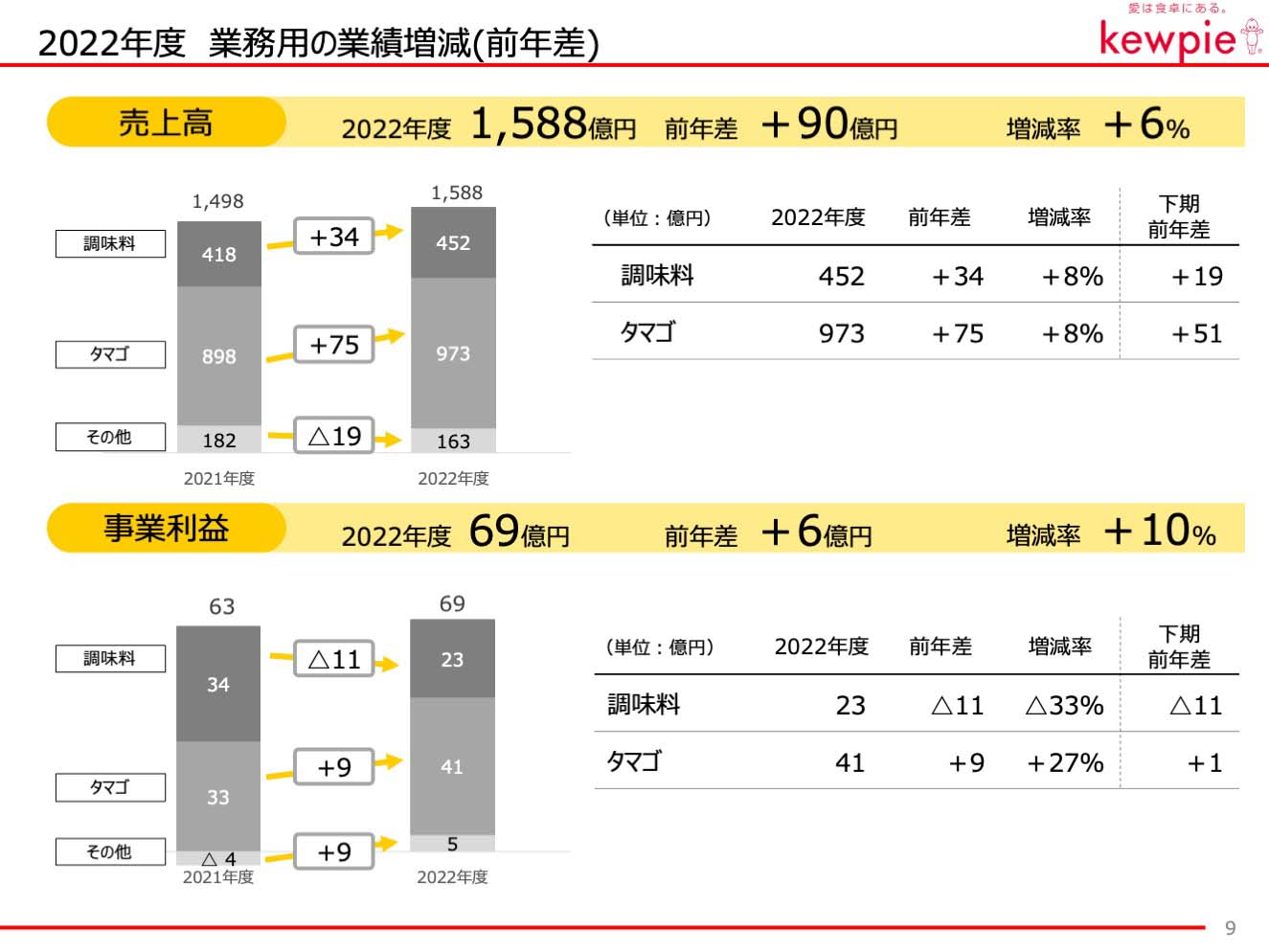
業務用は、増収増益となりました。
調味料は外食需要の回復と価格改定により、増収となりました。タマゴは調味料と同様に外食需要が回復したことや加工メーカー向けの新規採用などから、増収となりました。
事業利益については、調味料で主原料高騰影響を受け減益となったものの、タマゴでの増収効果、付加価値品の伸長、ノンコアカテゴリーの峻別により、増益となりました。
-
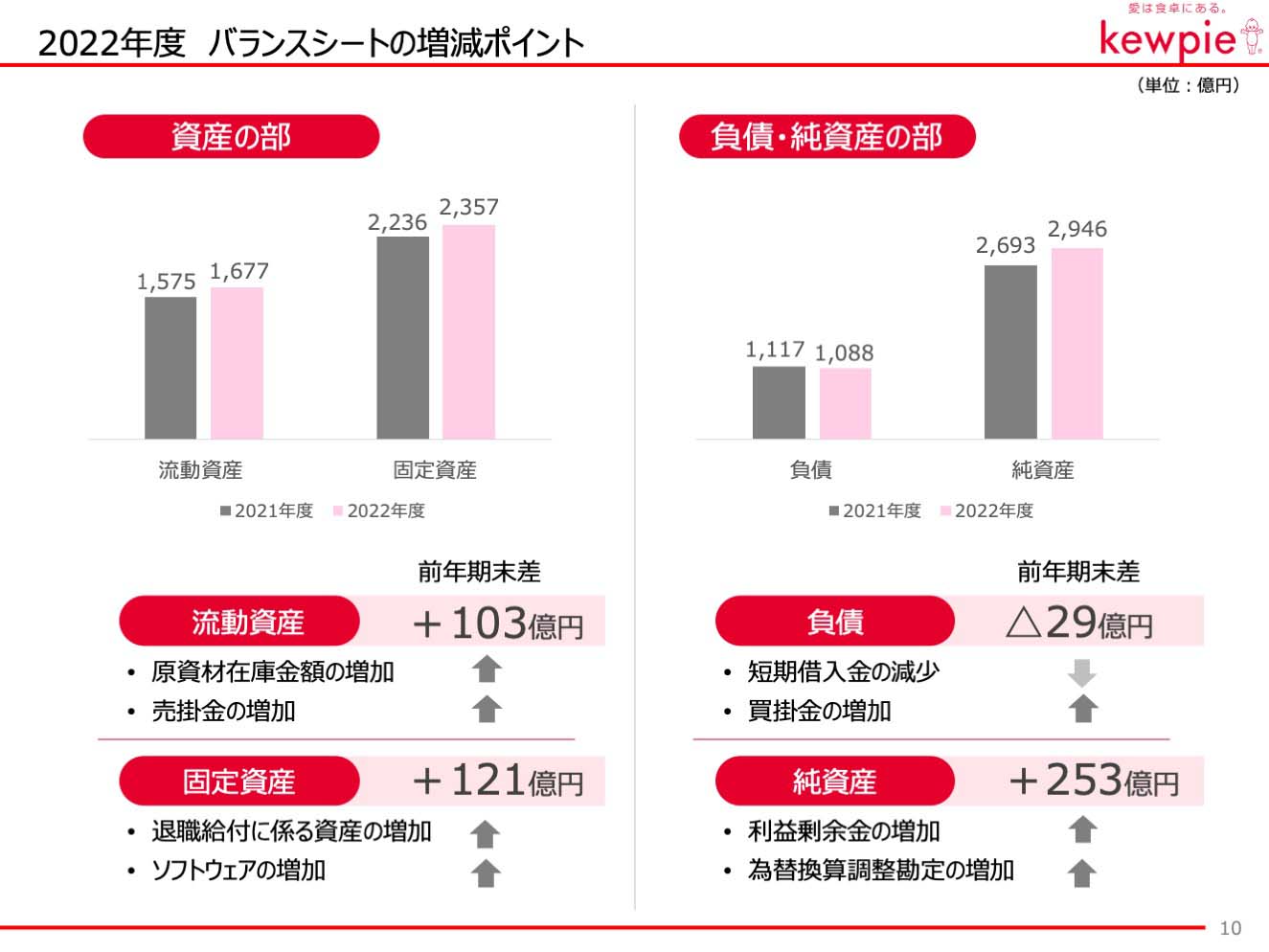
次に、バランスシートの増減についてですが、記載の通り、コスト高の影響を受け、原資材・商品などの流動資産が増加したほか、固定資産も増加しました。
負債については短期借入金の返済により減少し、純資産については利益剰余金と為替の円安影響により増加しました。
-
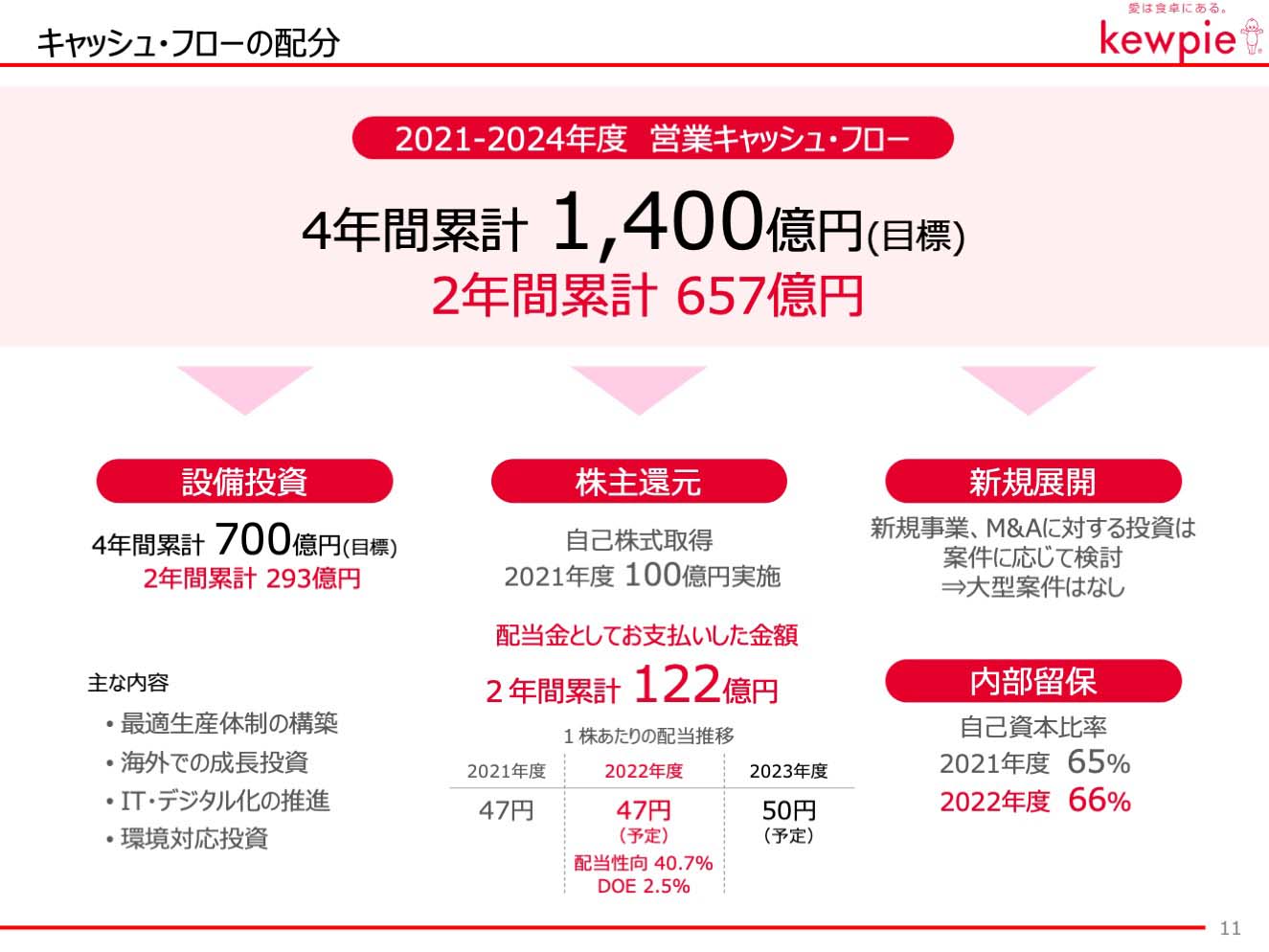
次に営業キャッシュ・フローについては、中計で示した4年間累計1,400億円の目標に対して、2年間累計で657億円となっています。
設備投資は2年間で293億円と計画通りの進捗となっています。
配当金は2年間で122億円となり、22年度の配当金については47円を予定しております。 -
2023年の計画について
-
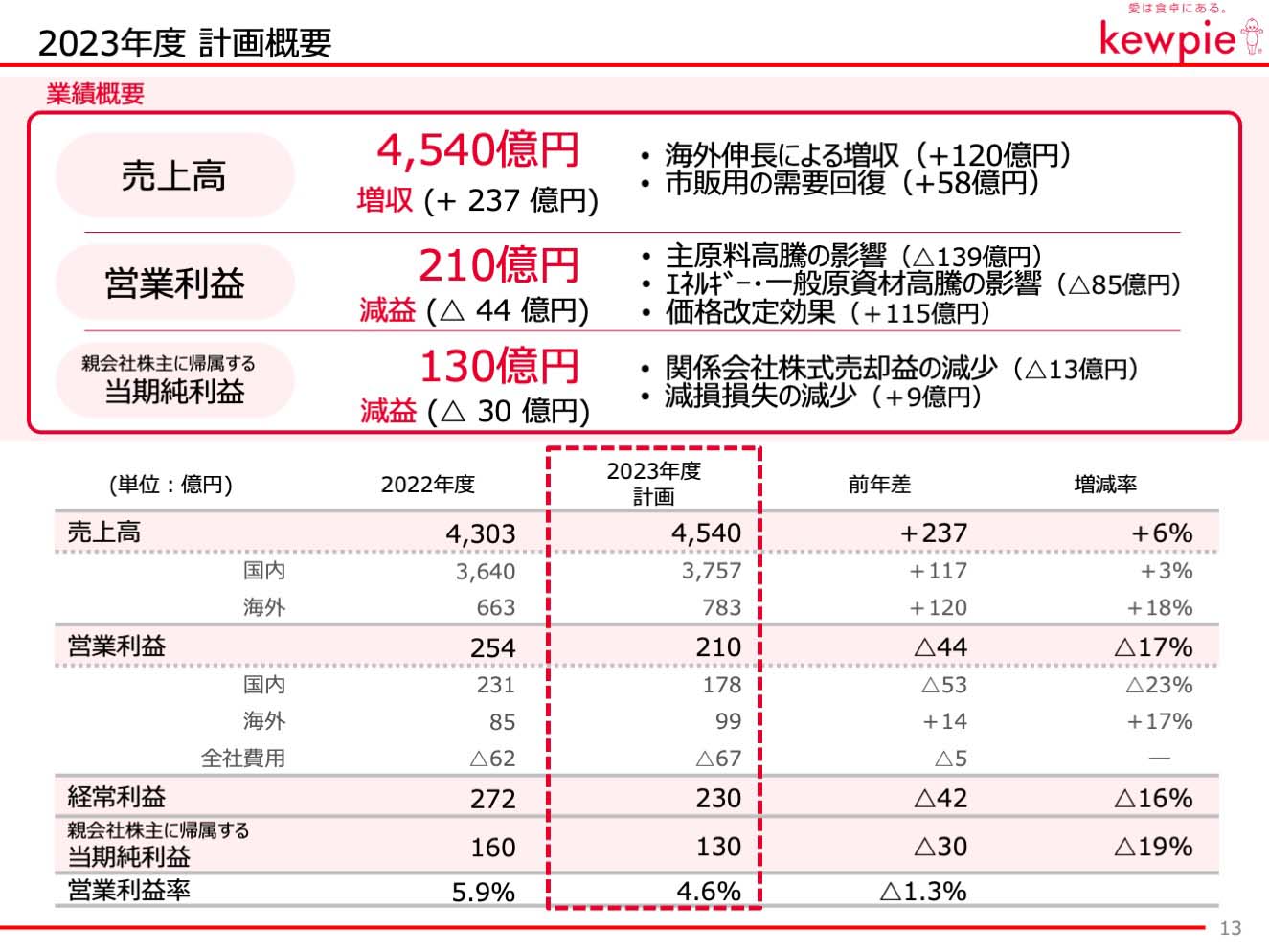
売上高については237億円の増収となる4,540億円、営業利益については44億円の減益となる210億円を計画しています。
親会社株主に帰属する当期純利益は30億円の減益となる130億円を計画しています。 -
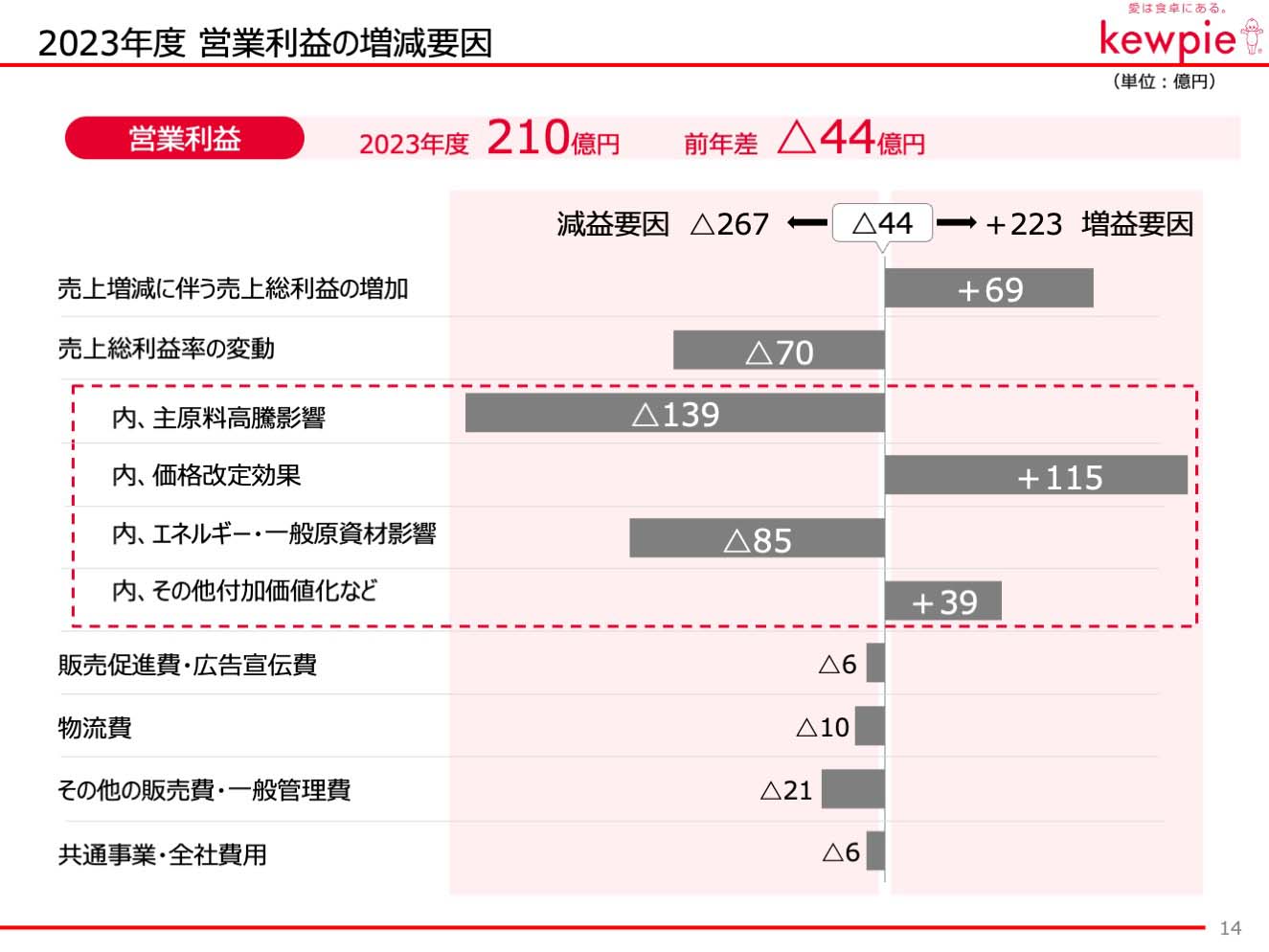
営業利益の増減要因について
海外を中心とする増収効果で69億円を見込んでいます。売上総利益率の変動では主原料高騰影響139億円に加え、エネルギー・一般原資材影響85億円と大きな逆風を想定しています。
価格改定や付加価値化で154億円の増益効果を見込んでいますが、合計で70億円の減益要因となります。 -
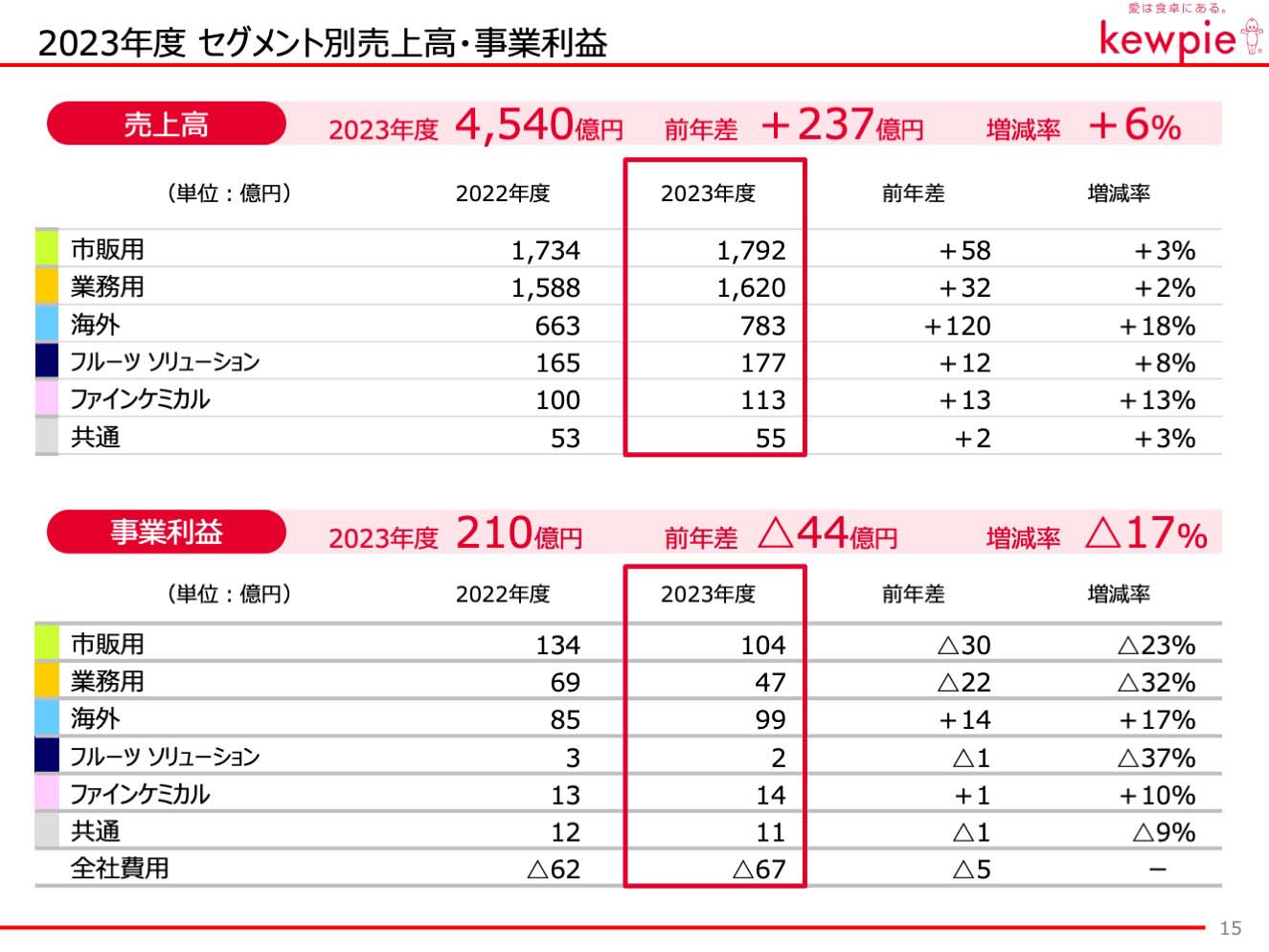
セグメント別の計画について
売上高については、海外は為替影響の38億円を含めて120億円の増収を計画しています。中国は引き続きコロナ感染拡大のリスクがありますが、現地通貨ベースの伸長率を115%としています。
市販用・業務用については需要回復策を推進していきますが、23年度の効果は限定的と考え、2~3%の増収としています。事業利益については、海外・ファインケミカルで増益を計画していますが、その他のセグメントについては主原料やエネルギー、一般原資材の高騰が大きく影響することから減益計画としています。
各カテゴリーの計画数値については決算説明会参考資料および決算短信補足資料に記載しておりますので、ご参照ください。
-
取り組みについて
昨年度は、大きな環境変化の影響を受け、市販用で減益になったものの、海外は計画通りに伸⾧し、業務用・ファインケミカルは、増益の着地となりました。
今年度は、さらなる逆風で厳しさが増すことになります。
増収を見込む一方、減益の計画となっており、株式市場の皆さまにはご心配をおかけすることになります。
現時点で計画に組み込んでいない追加の施策も、検討を続けており、皆さまからの信頼回復につながるような努力を続けていきます。 -
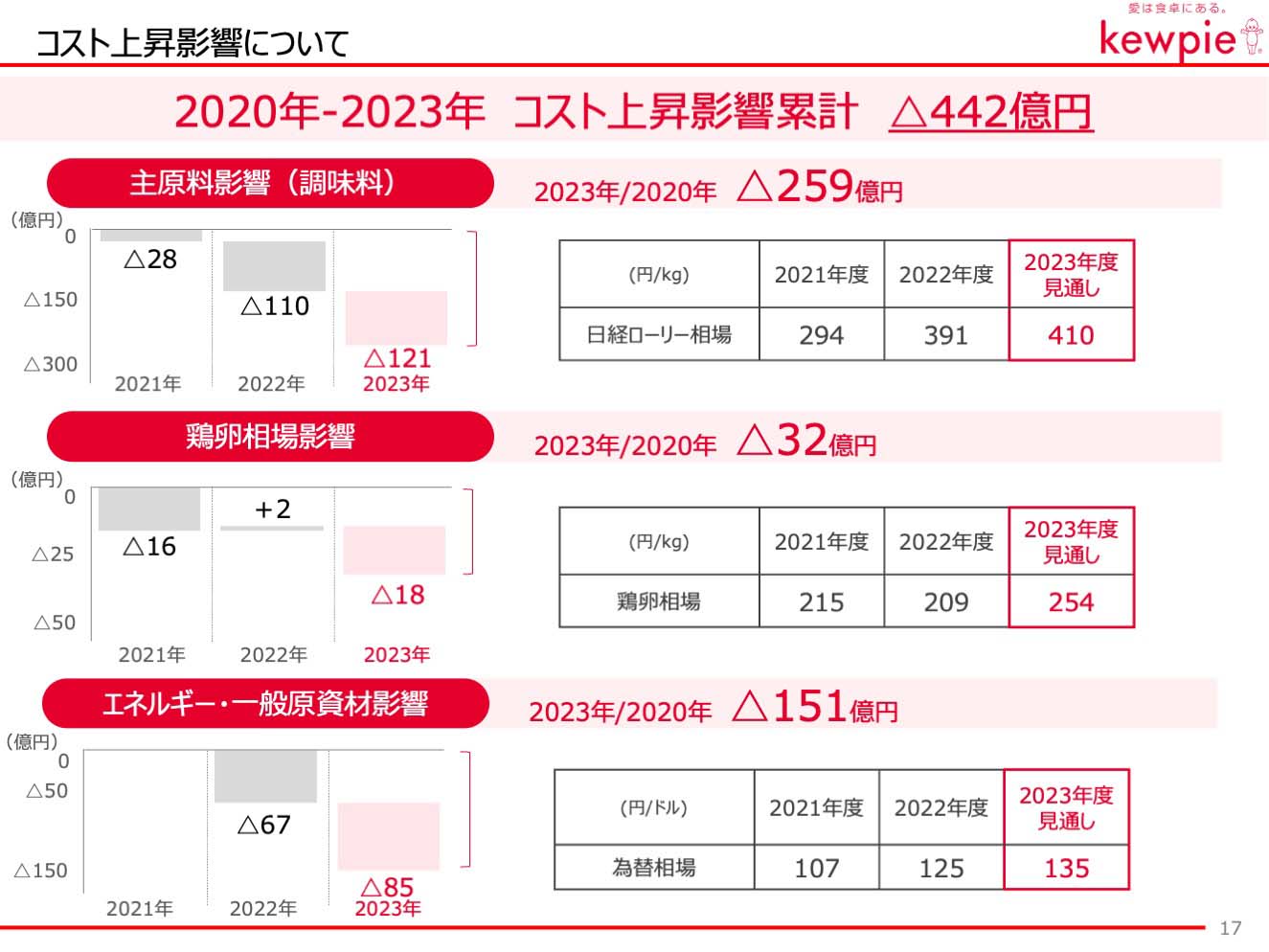
コスト上昇影響について
当社の業績に大きく影響する、主原料の状況ですが、食油は、一時のパニック相場からは脱却したものの、依然高止まりの状況が続いています。
鶏卵相場は、飼料の高騰に加え、直近でも鳥インフルエンザ感染拡大が続いており、相場が急騰しています。
終息の見通しも全く立っておらず、今後も予断を許さない状況です。
エネルギー・一般原資材コストも、しばらくは厳しさが続くことが予想されます。
この3年間のコスト上昇影響額は、累計442億円となり、大きなマイナス影響になる想定です。
この影響はいつまで続くのか、ということですが、主原料は先物購入を行っているため、2023年度上期に高騰影響と為替影響がピークを迎えることになります。下期からは前年差ではやわらいでいき、高騰の一巡は第4四半期以降と考えています。
不透明な要素が多い前提にはなりますが、2024年度以降は、穏やかに外的環境の回復が進み、経営にプラスに働いてくると予想しています。 -
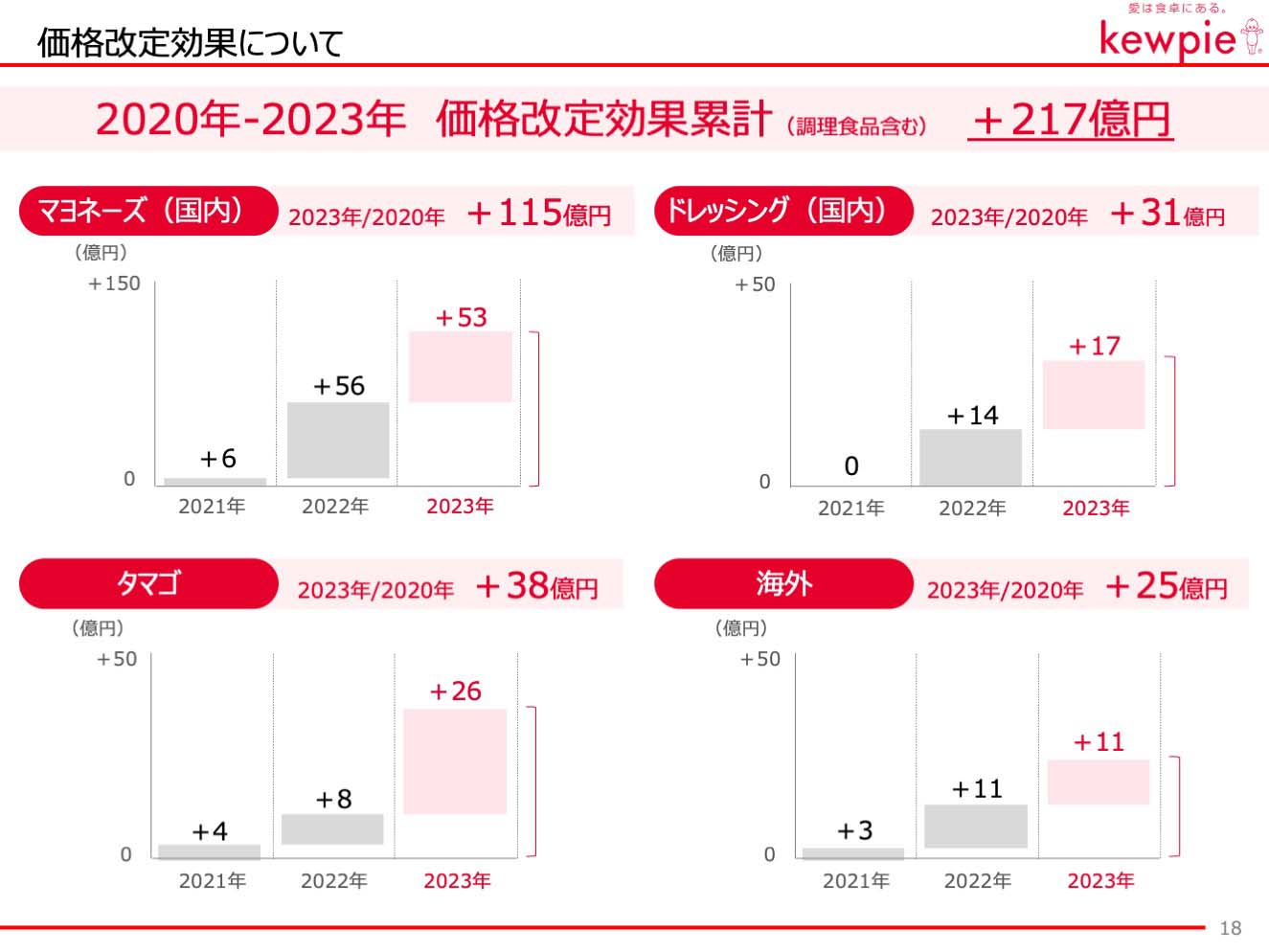
価格改定効果について
主力商品であり、また原料高騰の影響を最も大きく受けたマヨネーズ・ドレッシングは、過去からの値上げ、また2023年に予定している値上げにより、146億円の増益効果を見込んでいます。
その他のカテゴリーも、値上げの動きを進めており、合計で217億円の効果となる見通しです。
短期的にはコスト上昇影響のすべてを、値上げで吸収できていませんが、過去からの値上げはしっかりと市場価格に反映されており、長期的には経営にプラスに働いています。
また、今後の値上げについても、状況に応じ、柔軟に検討していきます。
一方で、当社の事業構造が、主原料の相場影響を受けやすいことは大きな経営課題であり、中期的には現在の構造からの脱却が必要である、と考えていますので、引き続き向き合っていきます。 -
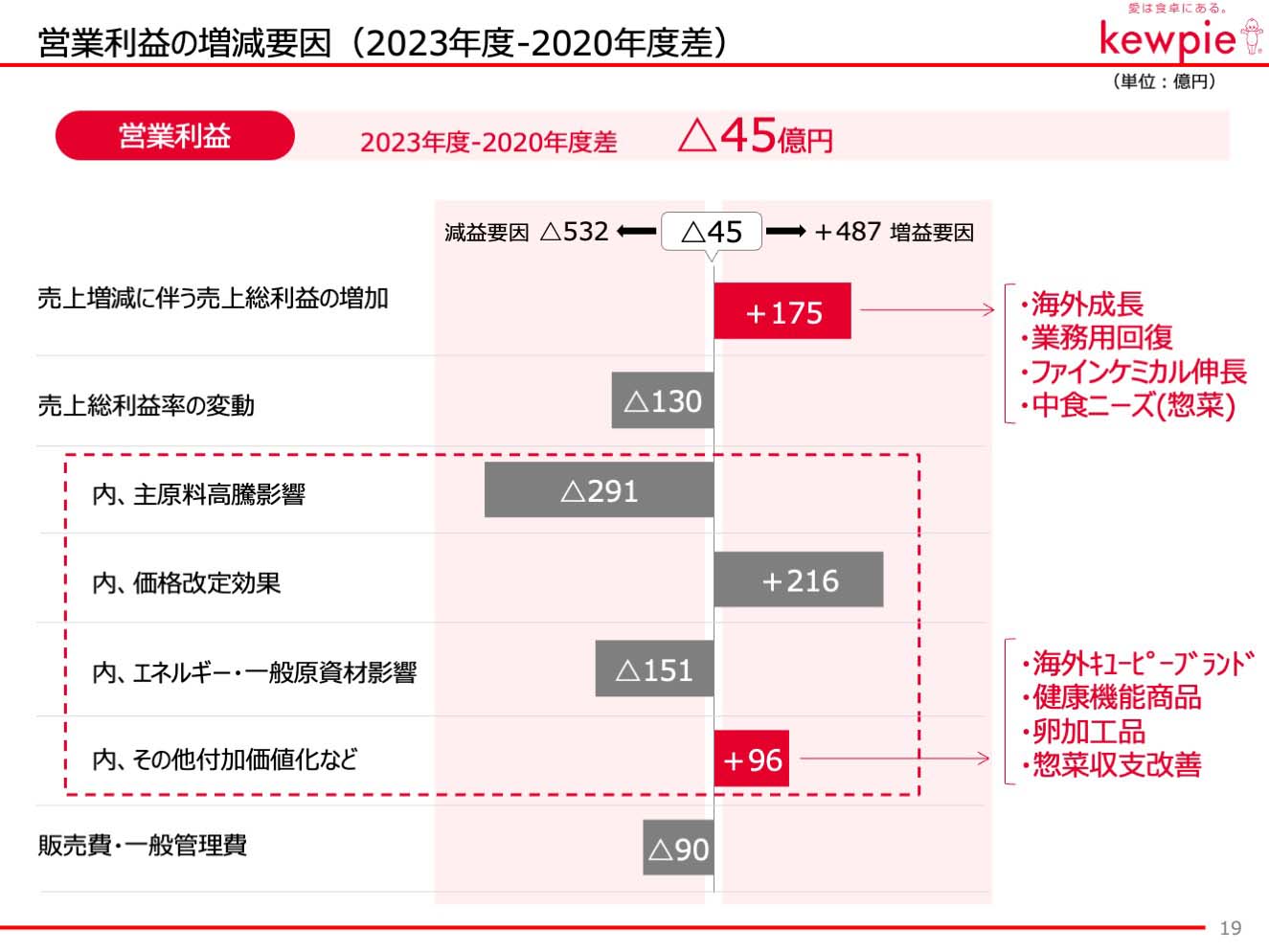
価格改定以外の収益改善施策として、増収効果と付加価値化、生産効率化などがあります。
売上拡大の中心は海外成長となりますが、コロナからの業務用の回復、ファインケミカルの通販事業、中食ニーズの伸長に伴う惣菜など、グループが持つ多様な機能が増収に貢献しています。
付加価値化についても、海外でのキユーピーブランドの展開が進んでいるほか、調味料や惣菜の機能性表示食品の拡大、卵加工品の簡便食材が、堅調に推移しています。
また、惣菜では、製造ラインの合理化を進め、収益性にこだわった、ものづくりを推進しています。 -
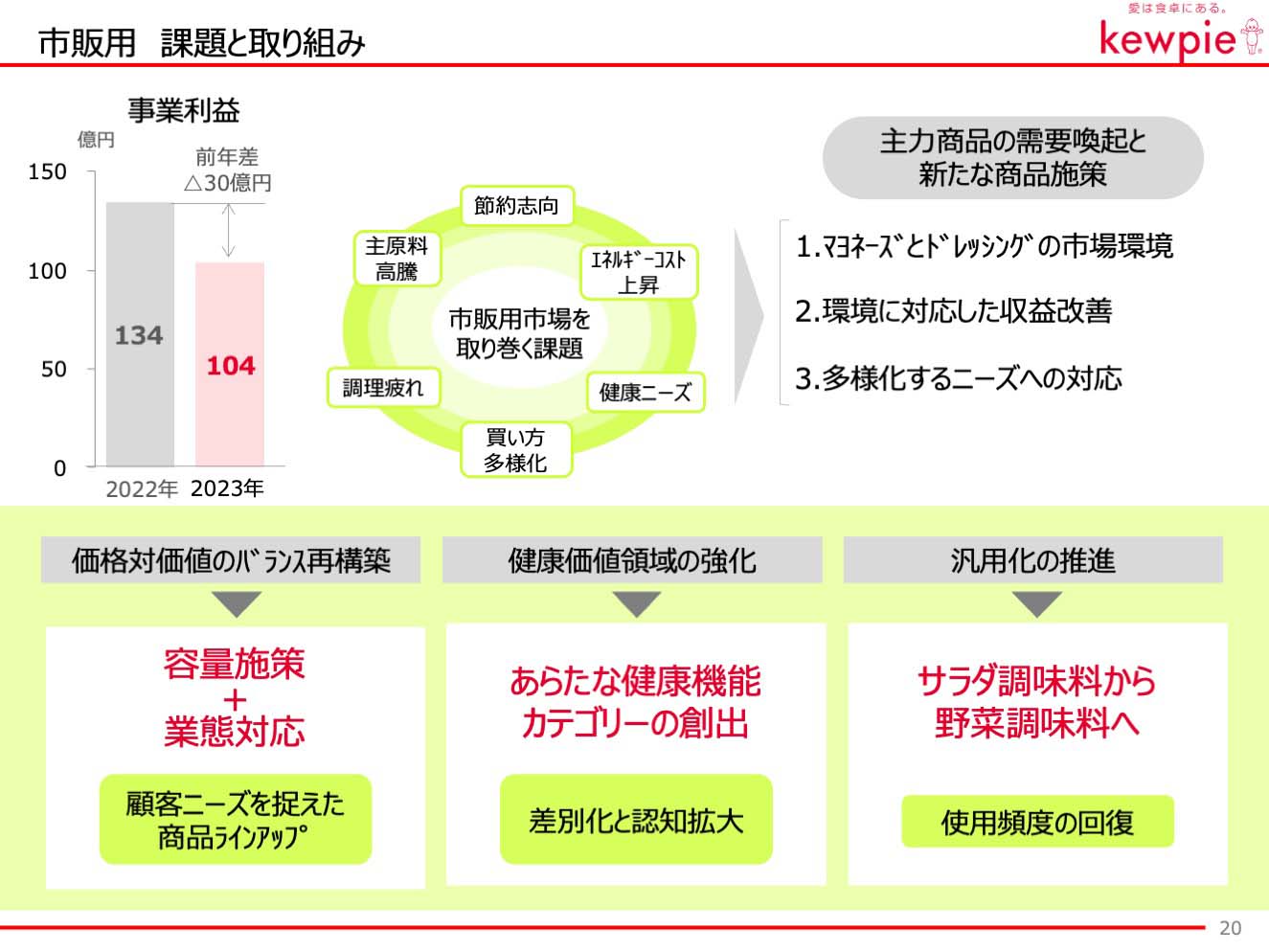
では、この大きな逆風に対して、国内市販用・業務用の2市場はどのように向き合うのか、これが足元の大きな課題となります。
これから説明する内容は、事業経営の根幹に関わる部分もあり、2024年度以降に、本格的な成果が出るものが多いですが、各々の取り組みについて、すでに具体的に動き始めています。まずは、市販用について
買い物行動の多様化、健康ニーズの高まり、節約志向など、市場を取り巻く環境変化は加速しています。
そこに対し、既存のビジネスモデルの改善ではなく、改めて主力商品の需要喚起と、新たな商品の施策を丁寧に考察し、取り組みテーマを3つ設定しました。
具体的な取り組みを説明します。1つ目が、価格対価値のバランス再構築です。
ドレッシングは、市場分析に基づき、売れ筋商品の強化を加速します。
たとえば、昨年秋に発売した深煎りごまドレッシング600mlは、しっかりと市場に受け入れられ、販売量増加に貢献することが確認できています。
現在、本格的な配荷を進めており、これからも確実なプラスオンが見込めます。
その他の売り上げ上位アイテムについても、容量施策を準備しています。併せて、価格重視など、多様化する顧客ニーズに合わせた商品の開発も進めています。
2つ目が健康領域の強化です。
マヨネーズ・ドレッシングともに、まだ規模は小さいものの、健康機能カテゴリーは、確実に伸長しています。
市場ニーズに合わせた新たな商品を上市する計画も進めています。あわせて、デザインや広告宣伝の仕方を工夫し、商品の特徴をより分かりやすい形で伝えていくように努めます。3つ目が汎用性の推進についてです。
市場の活性化と用途の拡大、これはカテゴリーリーダーの使命です。
お客様の野菜摂取の変化に合わせて、生野菜サラダに限らず、幅広く野菜を食べていただける商品やメニュー提案等を行っていきます。 -
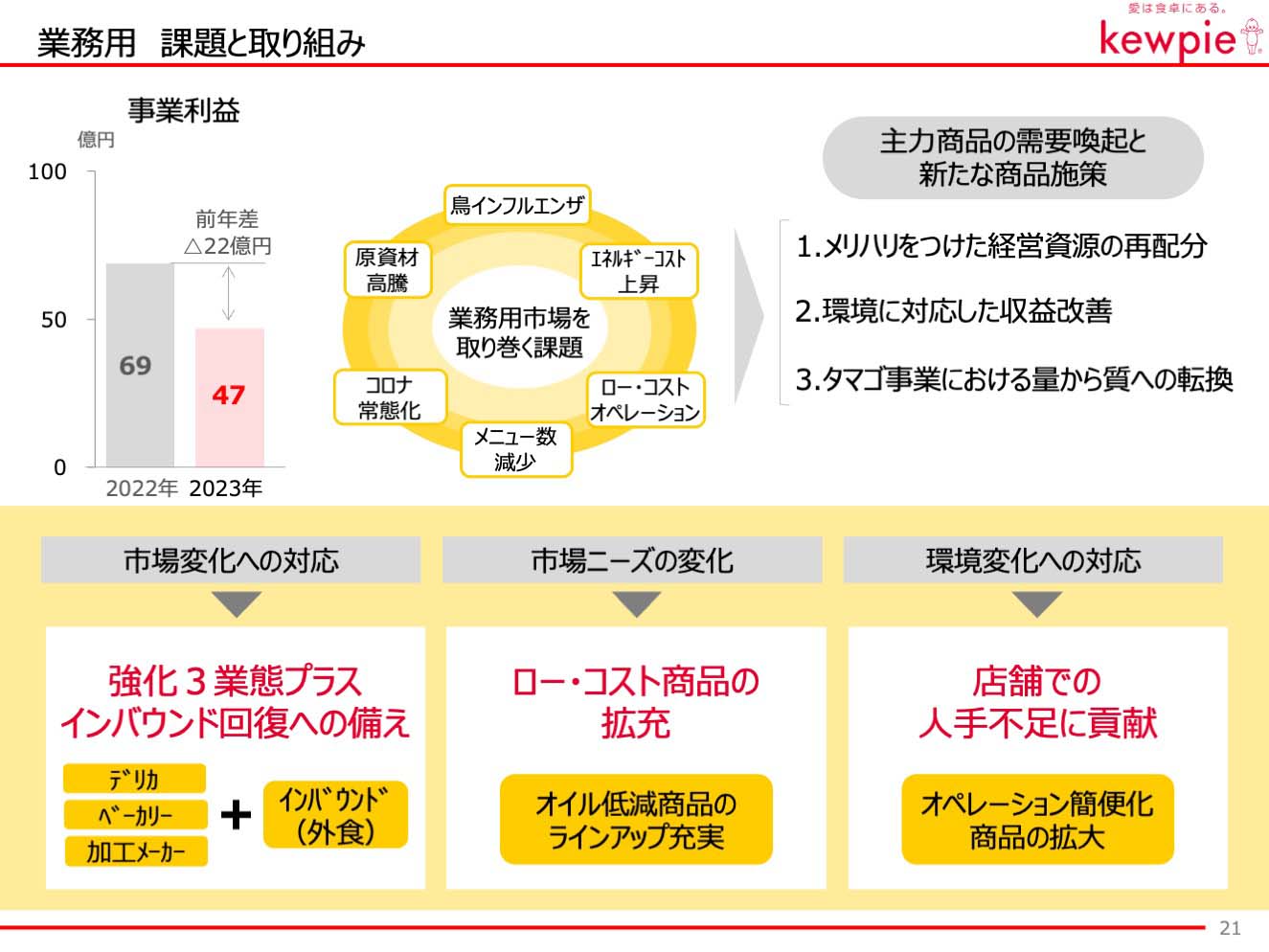
業務用市場については、コロナの発生から市場の変化が始まっており、そこに対応した取り組みが進んでいます。
具体的な取り組みを3つ説明します。1つ目が市場変化への対応です。
強化業態である「デリカ」「ベーカリー」「加工メーカー」への深耕は順調に進んでいます。
市場のニーズに対応した、商品の開発と提案によって、ますますの伸びを期待しています。 加えて、インバウンド含めて戻りつつある外食需要増への対応も進めていきます。2つ目が、市場ニーズの変化への対応です。
昨年オイルを低減したマヨネーズタイプの調味料を発売しました。食材原価の厳しさと向き合う市場への提案として発売しましたが、品位と価格のバランスが高い評価を受けており、このコンセプトの商品群の手ごたえを感じています。
ドレッシングを含め、オイルを低減した商品ラインアップの充実と、お客様に寄り添った提案強化を進めます。3つ目が環境変化への対応です。
業務用の物量が完全に戻り切らない要因の1つに、外食・中食市場の人手不足があります。
ここにはビジネスチャンスがあり、手間をかけずに、本格的な商品が作れるニーズが高まっています。
調理ソースとタマゴ加工品を中心に、多様な商品群を活用したメニュー提案、オペレーション提案を強化していきます。 -
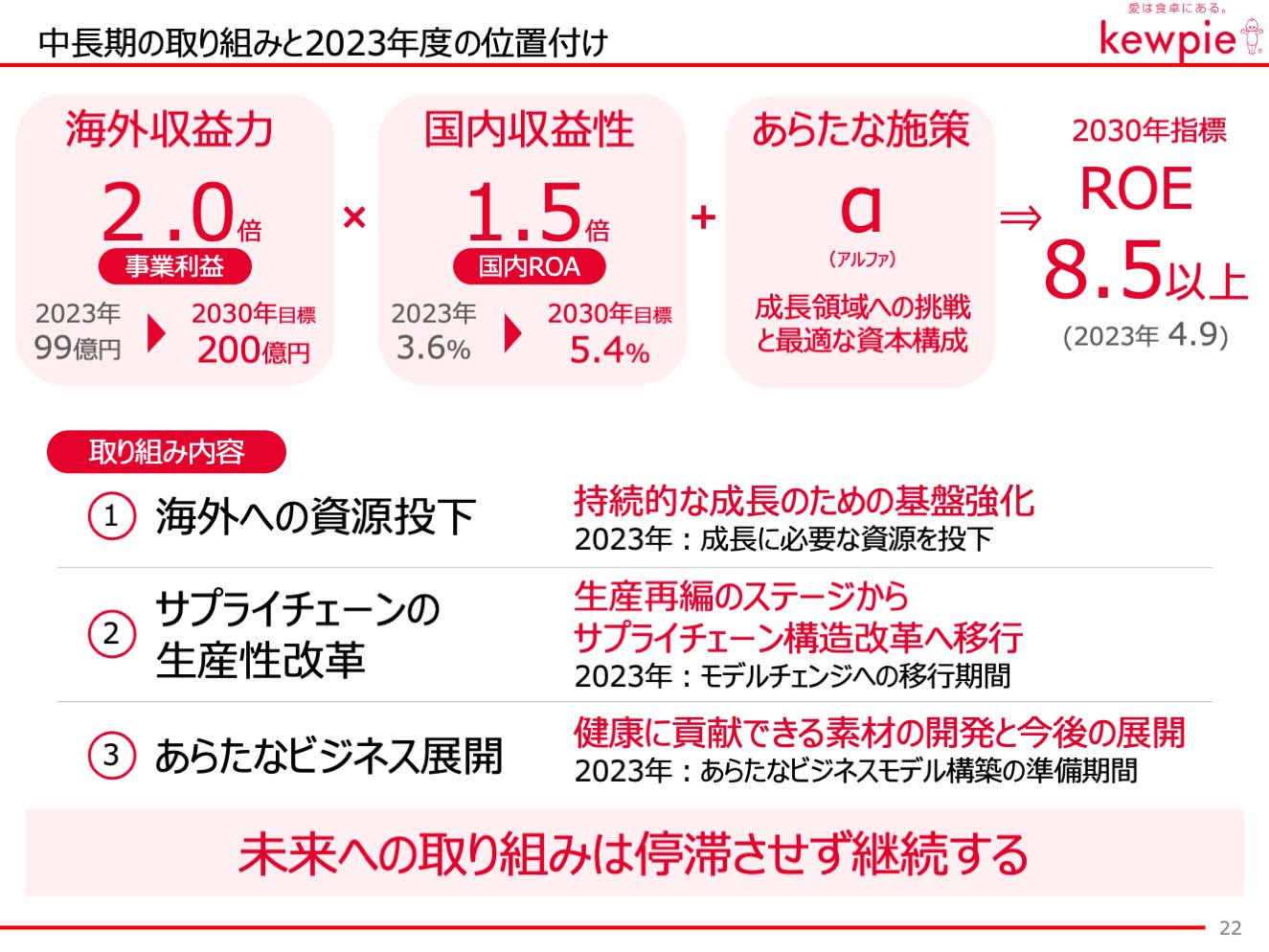
ここまでお話してきたように、足元の課題解決を進めるとともに、未来に向けた取り組みも強化します。
企業体質の転換を強く意識し、中長期の取り組みと2030年の経営数値目標を設定しました。
その上で、2023年度の取り組みを決めています。2030年には、海外収益力を現在の2倍、国内収益性を1.5倍にします。
海外は規模の拡大を進め、国内は事業規模を追うのではなく、その中身を変えていきます。
また、成長領域への挑戦として、市場ニーズに合致した新規のビジネスの創出で、プラスの経営貢献を生み出していきます。これらの取り組みによりROE 8.5%以上を達成させます。具対的な取り組み内容を3つお示しします。
取り組みを進める上で、2023年に一時的なコスト増やメリットの減少を想定していますが、未来への取り組みは停滞させず、強い意志を持って、継続して取り組んでいきます。 -
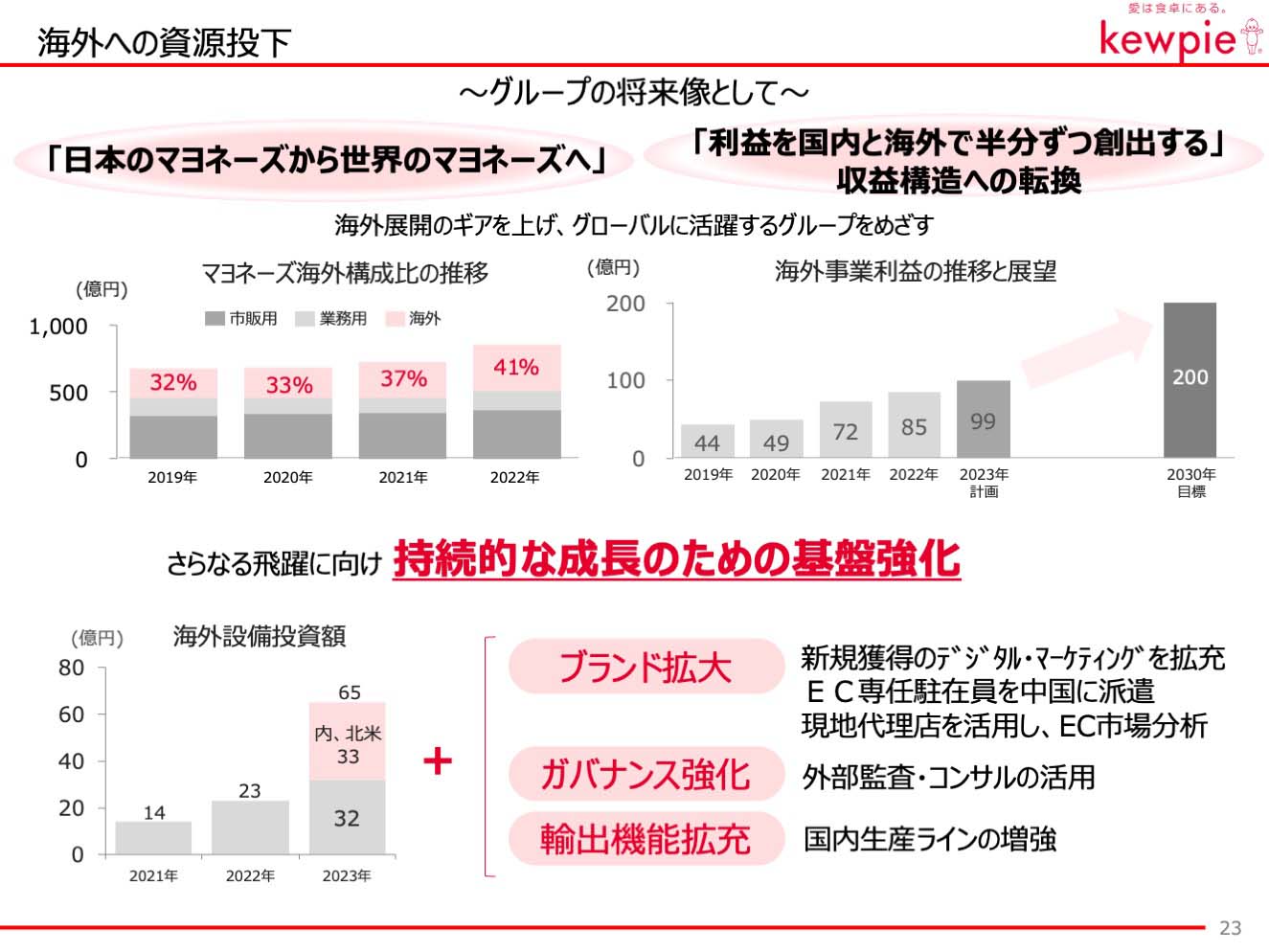
1つめが成長ドライバーである海外への資源投下です。
現在すでに、マヨネーズは、市販用と変わらない売上規模となっています。
世界市場からみれば、まだまだ小さなシェアですが、私たちから見た場合、日本のキユーピーマヨネーズから世界のキユーピーマヨネーズへと変貌している途上と言えることができます。中国・東南アジア・北米の3エリアをバランスよく成長させるため、生産設備の増強はもちろん、ブランド拡大、ガバナンス強化に積極的に経営資源を投下していきます。
昨年11月に発表した米国の大型新工場への投資はその一例です。
また、伸長している輸出に対して、国内生産ラインの増強を進めます。 -
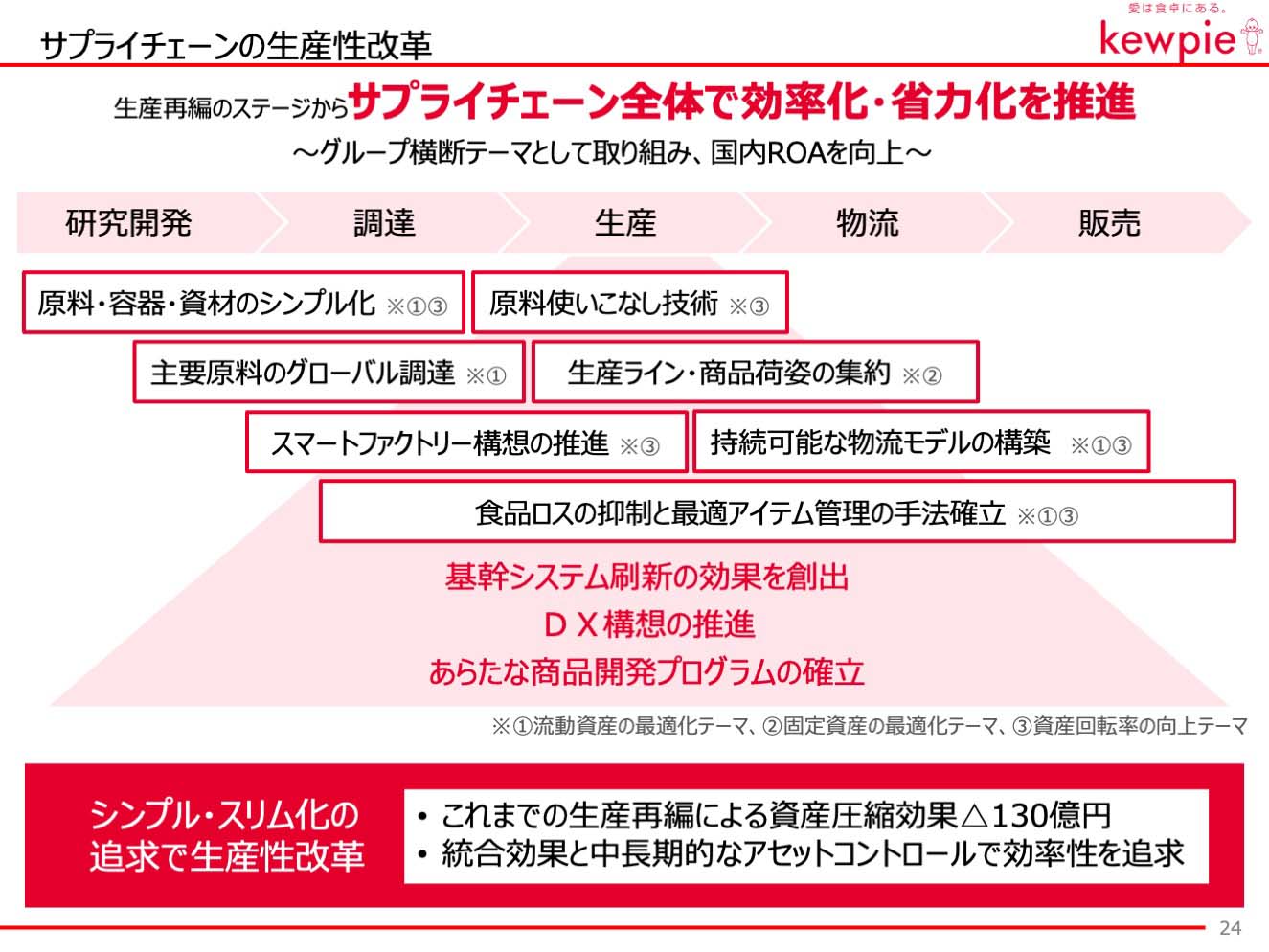
2つめはサプライチェーンの生産性改革です。
生産再編のステージから、サプライチェーン全体で価値を創出するステージへシフトします。
生産再編は計画通り進めてきましたので、今後は、資産を圧縮した上で効率化・省力化を進めていきます。そこに必要なツールが、デジタルです。
2023年には、基幹システムの導入が完了する予定ですので、2024年度以降は、効率化・省力化の成果が期待できます。
加えて、減価償却費のピークが過ぎることから、利益面でも業績に寄与すると考えています。
効率化や省力化で創出した、人材や生産スペースを、成長領域への挑戦に活用していきます。 -
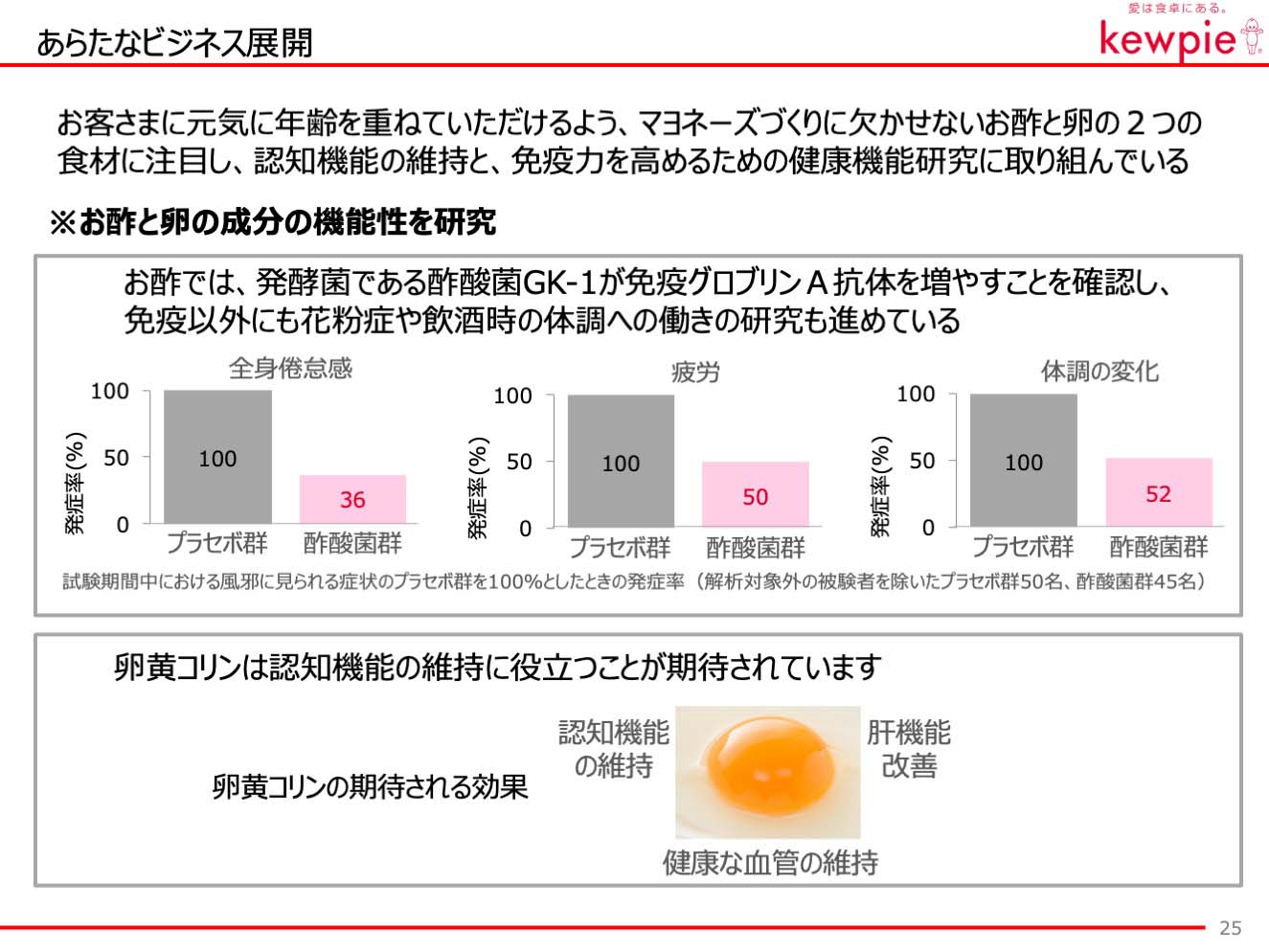
3つ目が、あらたなビジネス展開です。
マヨネーズの原料である、お酢とタマゴの素材研究には長い歴史があり、これまでもさまざまな有効成分を見出してきました。
現在、有力な素材が2つあり、1つが「酢酸菌 GK-1」、もう1つが「卵黄コリン」です。酢酸菌は、すでに花粉症に対する免疫に働きかけることを見出し、機能性表示食品として発売していますが、他の免疫機能を高めることも分かってきました。
また、卵黄コリンは認知機能の維持に役立つことが期待されています。
日本だけでなく、海外でも高齢化に伴う社会課題は今後ますます大きくなっていきます。
健康寿命の延伸に向けて、発病して治療をするから、未病・予防を重視する、に変化が起こっています。世界の食と健康へ貢献することをめざしている当社として、健康領域に対するさらなる商品やサービスの拡充を図り、経済性を伴いながら社会へ貢献していく動きを加速させていきます。
どちらの独自素材も、これからの世の中でお役に立てると確信していますので、大きく描き、大きく育てる覚悟を持って、経営資源を投下していきます。
楽しみにしていてください。 -
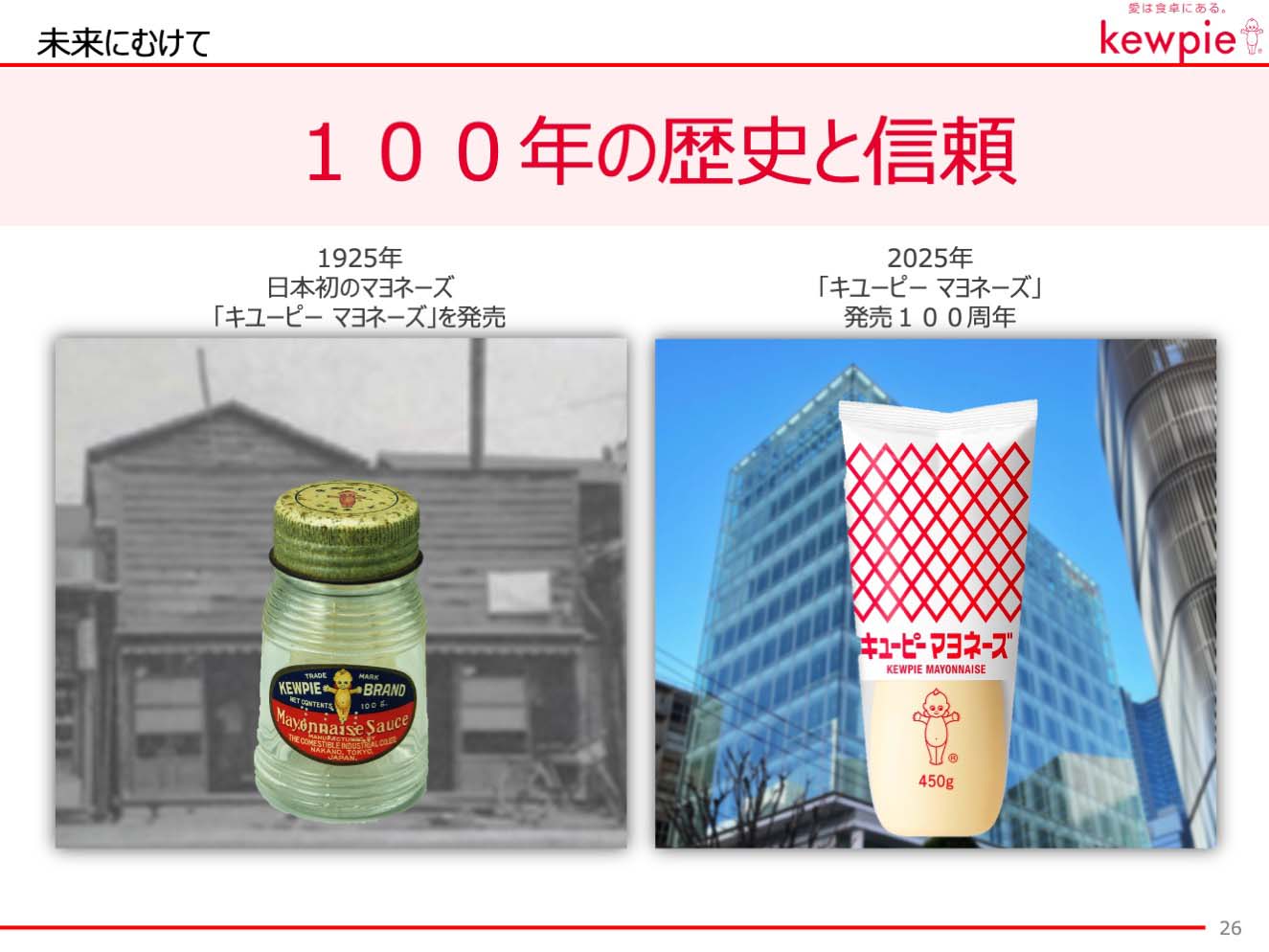
ここまで、足元の課題に対する向き合い方、中長期視点での成長に向けた構想、を説明しました。
課題の全てで成果を上げることは、簡単ではありませんが、覚悟を持って取り組んでいきます。
楽観視しているわけではありませんが、実は未来に向けた手ごたえを感じ始めています。この3年で約450億円の逆風を受けながら、体質の強化の取り組みを進め、2023年度210億円の営業利益を計画しています。
値上げ効果に加え、見えない部分での積み重ねが、体質強化につながり始めていることは、間違いありません。
後半紹介した未来への取り組みは、プラスオンの価値を生むと同時に、主原料の相場に大きく影響を受ける企業体質からの脱却にもつながっていきます。キユーピーは創業100年を超える歴史と実績があります。
過去にも、様々な危機に遭遇し、都度それを乗り越えて、事業を発展させてきました。
今回の危機は、過去に例を見ない過酷なものではありますが、これを乗り越えることが出来れば、その先の未来は明るいと確信しています。
Q&A (Japanese only)
-
We sincerely acknowledge that our ability to foresee changes in the external environment was insufficient, and this reflects our current capabilities.
We also acknowledge that we failed to adequately explain the impact of rising raw material costs on our company and that we purchase edible oil through futures contracts.
I believe we need to improve our predictive abilities regarding chicken eggs as well. I will use this experience to my advantage in the future. -
This time, we have implemented unprecedented price increases. This has made us realize the importance of fair pricing and the fact that our customers support our brand and products. As a result, we will reconsider our practice of limiting ourselves to a price that is perceived as affordable. Once the situation has settled down, we will consider the possibility of lowering prices, but we want to maintain the appropriate value that we believe our company should offer.
-
Up until now, the environment surrounding mayonnaise has been relatively stable, so we have increased sales volume as a commodity product and set a framework for the maximum price per bottle from the customer's perspective. Even with this approach, we have been able to increase Net sales and profits.
Therefore, although we initially hesitated to raise prices when raw material costs began to rise, taking the plunge allowed us to learn about market reactions and customer purchasing habits. Going forward, we will change our approach to aiming for a fair price while taking pride in our products and refining them. -
We recognize that being heavily influenced by raw material prices is a challenge, especially with edible oils and eggs. While these product lines have contributed to the company's growth, we are considering reassessing their weight in the future.
Regarding price revisions, we prioritized affordability, which resulted in multiple revisions. In the future, we intend to be more decisive in making price revisions as needed. -
While the outlook for energy is not entirely clear, crude oil and economic conditions are improving. Based on this premise, some believe that a gradual recovery is likely. The difficult situation is with eggs; production was already declining, but now bird flu is raging. An unprecedented number of chickens have been culled, making it difficult to predict the future, and there are still aspects that cannot be incorporated into plans.
We are currently working to secure the necessary supplies, but we will consider price increases and other options while exploring the optimal balance. While there are concerns about the actual volume, we are aiming to shift from a management style that pursues scale with a clear intention to one that operates at an appropriate scale. We plan to slightly reduce the volume, but we will proceed in a way that ensures profitability. -
Regarding the procurement of cooking oil, due to the situation in Ukraine and other factors, no one knew what the situation was, and the price seemed to have no upper limit. On the other hand, there was also the possibility of a sudden crash if the war ended quickly, so it was difficult to predict the future, and that's why I explained that we should buy in small increments. However, in the end, the market remained high, and the weak yen also had an effect, so overall, we ended up buying at a high price.
-
Edible oil prices peaked in the summer of 2022 and have been declining gradually since then, but they are still nearly double what they were before the COVID-19 pandemic and the situation in Ukraine. The high levels, coupled with exchange rate fluctuations, give the impression that the price will remain high for a while.
-
While we have been working to expand the uses of our dressings, the current market environment is characterized by the entry of various manufacturers and a wide variety of flavors, making it difficult for customers to choose Kewpie dressings. Data also shows that some customers check the price as well as the brand before purchasing. In addition to revitalizing the market, we will focus our efforts on ensuring that customers perceive value and deliciousness in Kewpie dressings and choose to buy Kewpie specifically. Furthermore, since many customers choose Kewpie Deep-Roasted Sesame Dressing, we will strengthen that aspect of our product line.
The delay in distribution is due to the new size, which is taking time. The 600ml size represents a shift from the traditional price and flavor-specific offerings to a more general-purpose product. While the number of distribution companies is still small, the explosive growth in sales at those that have adopted it suggests significant potential. We believe it will make a substantial contribution as distribution expands in the future. -
The environment in Japan has changed considerably due to COVID-19, and we are developing products to strengthen our approach to the growing e-commerce and drugstore markets. In the future, we would like to further deepen our understanding of our customers and pursue versatility, health-consciousness, a sense of premium quality, and value for money.
-
We maintain close communication with drugstores, and their strategy is to increase the number of customers who visit their stores. By having them stock everyday necessities like condiments and salads, we feel that our relationship with them is deepening in a multifaceted way.
-
The market is indeed recovering, but I'd say it's not fully recovered, only about 90%.
Our egg business is shifting from a focus on scale to a more appropriate management approach. We are also moving from raw egg products to processed products that offer greater added value. However, rising energy costs are weighing on our production processes. Furthermore, the significant impact of soaring egg prices, combined with the fact that we have incorporated the situation up to the end of 2022 into our 2023 plan, makes profit recovery seem difficult. -
While pricing varies by country, we are generally implementing price revisions overseas. However, with increasing competition, our priority is to reduce costs while simultaneously increasing our top line revenue. At the same time, we aim to improve the quality of our products and increase their value.
-
Because China was affected by the coronavirus in fiscal year 2022, its plans for fiscal year 2023 are based on the assumption that the situation will recover.
North America is currently facing tight production capacity, and we plan to make adjustments to our current production system in preparation for the new factory in Tennessee, which is scheduled to begin operations in 2025. -
There is no doubt that factory utilization rates are on a downward trend. We have been working on reorganizing our production bases over the medium term. As of 2017, we had 81 bases, but by 2022 we had reduced that number by 10, and we have been working to improve the utilization rate per factory. In 2022 we transferred the business of one of our group companies' factories, and in 2023 we completed the closure of the factory that manufactures condiments in the Chubu region. In fiscal year 2024 we expect the effects of the reorganization to be around 1 billion yen. We will continue to improve the efficiency of the entire supply chain, from procurement to sales.
-
A key characteristic of our business is the large number of product categories and production locations. We recognize the need to address this, so we are currently scrutinizing each category individually. We believe that consolidating into larger categories will increase our value. We have just begun this process internally, and we will explain it to you at some point.
-
Our space productivity has improved through the reorganization of production bases and the differentiation of product categories. Going forward, we will increase production capacity in growth and priority areas by automating existing products. Domestic investment will be curbed for large-scale infrastructure projects, while actively pursuing investments in productivity improvements and new technologies.
-
Given the challenging situation in fiscal year 2023, we believe it will be difficult to achieve our final target for fiscal year 2024. Currently, there are several uncertainties, so we would like to further refine our plans and provide an explanation at some point.
Even now, the outlook for egg prices is uncertain due to the recent bird flu outbreak. We anticipate that various external factors will peak from the first half of fiscal year 2023 through the third quarter, and then decline in the fourth quarter.
Therefore, we believe that we will be able to demonstrate our true potential in 2024. We also anticipate that the various initiatives we are currently pursuing will contribute to the business in fiscal year 2024. -
We anticipate that the current state of the chicken egg market will have a significant impact. It is true that there is uncertainty and anxiety about providing quantitative data at this point. We are currently considering how much the headwinds will subside by the end of the first half of the year.
-
For retail market, due to the established brand and system, we expect a minimum of 10% in sales, and even higher for value-added products, despite various environmental factors. The situation in fiscal year 2023 is challenging due to the impact of soaring raw material costs.
For food service, we aim to achieve a level that at least exceeds the group's profit margin. Currently, we are targeting a 5% margin and are working to improve it. -
That's not necessarily the case. While we might lower prices within a reasonable range if raw material conditions change, we want to use costs to enhance the absolute value of our products and ensure customer satisfaction. We also believe it's important to invest in future growth areas. We want to prioritize increasing customer satisfaction over maximizing profit margins.
-
As president, I'm able to view the group objectively. While we have a wonderful history and brand, we're doing too many different things, making it difficult to see our core focus. I also think that this diversity is slowing us down.
We have declared internally that we will be changing our organizational structure and resource allocation to increase speed.
Dressings are a very strong category, and we have continued to put effort into menu suggestions and other aspects of this, but we would like to re-evaluate the value of our own dressings.
The areas where we expect the most significant results are supply chain management, category differentiation, and value creation. We are making progress in all of these areas, so we expect to see tangible results from next year onwards. On the other hand, we also want to look beyond that and make investments for the future. We recognize that we must become a company that is not just like Kewpie Way, but a company that has the speed and agility that is common to the general public.
2Q Financial Results Briefing
July 8, 2022 (first half of the fiscal year ending November 2022)
-
-
-
上期の実績について
-
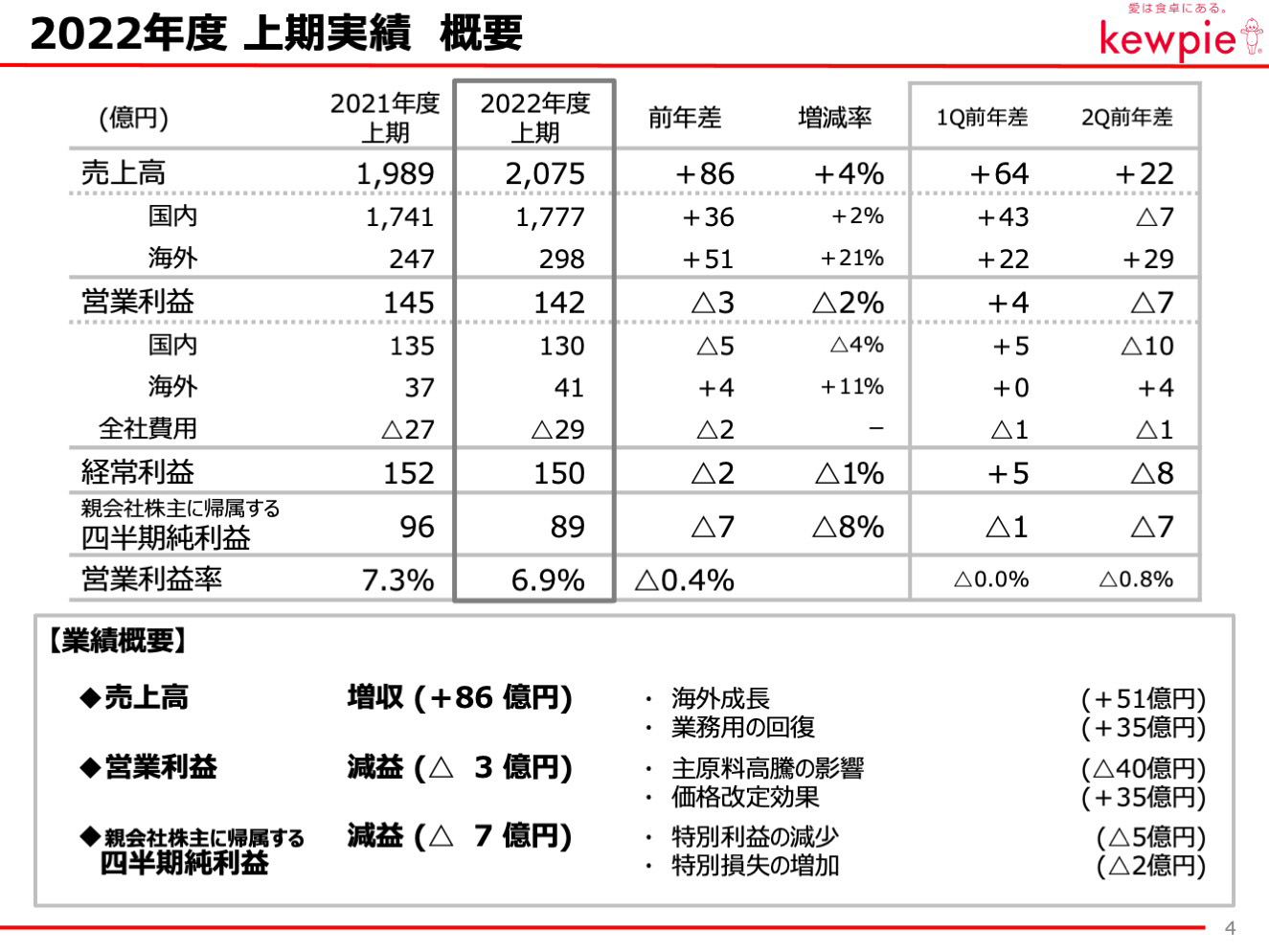
売上高は、前年に対して86億円の増収となる2,075億円となりました。
海外の売上伸長に加え、国内の外食需要が回復傾向にあったことから増収となりました。営業利益は、増収効果や昨年7月、本年3月に実施した価格改定の効果はありましたが、主原料高騰の影響を受け、前年に対して3億円減益の142億円となりました。
親会社株主に帰属する四半期純利益は、資産売却益の減少などにより、前年に対して7億円減益の89億円となりました。
-
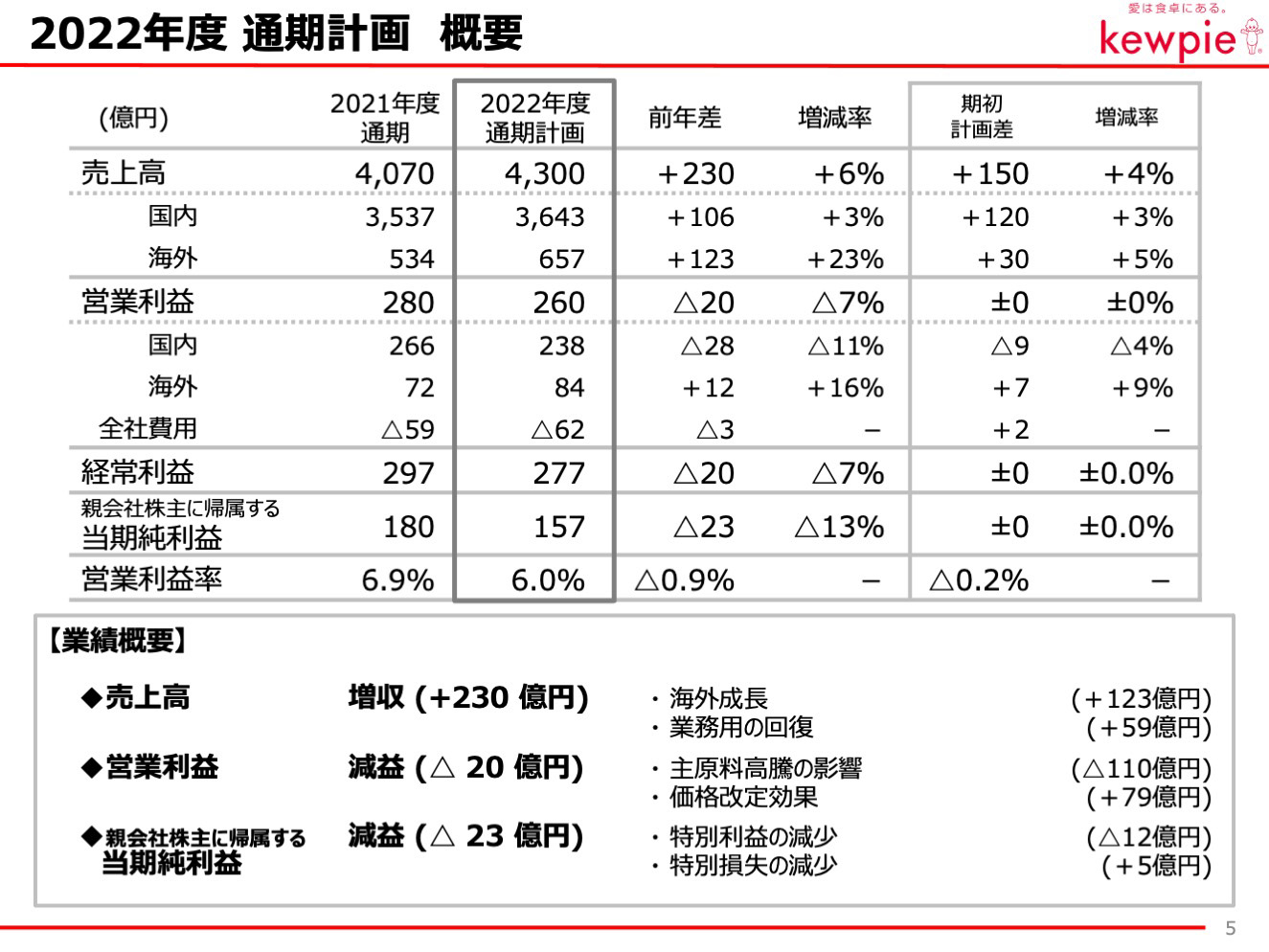
通期計画について
売上高は、期初計画から150億円上方修正し4,300億円としました。
市販用において価格改定による需要の減少が当初の想定ほどではなかったことに加え、海外・業務用での売上進捗が想定以上に進んでいることから今回見直しをしました。営業利益は、期初計画からの変更はありません。
主原料やエネルギーコストなどで、さらなる逆風を受ける見通しに対し、追加の増収効果や10月からの価格改定効果を踏まえて、260億円に据え置きました。 -
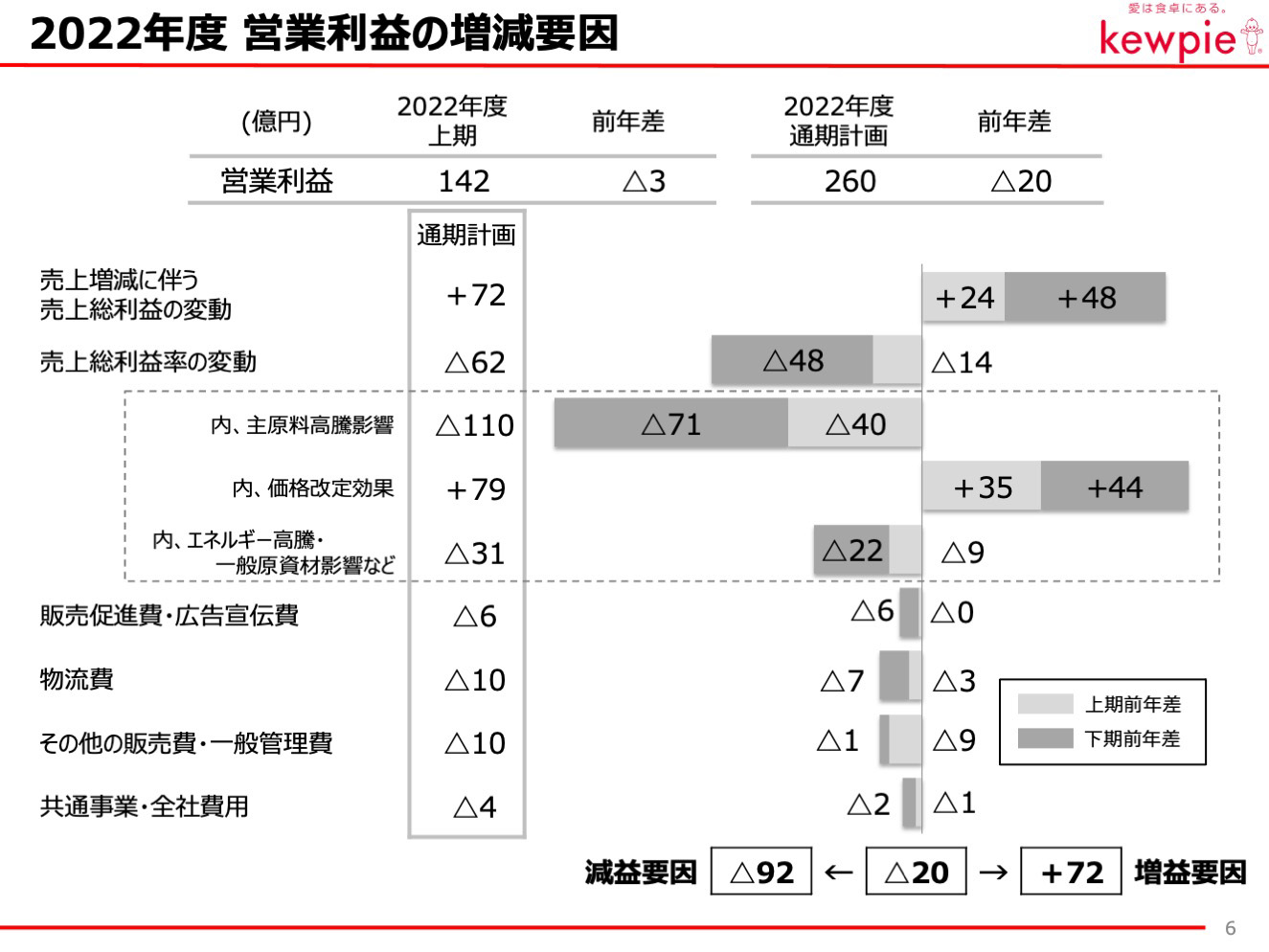
営業利益の増減要因について
「売上増減に伴う売上総利益の変動」は、海外や業務用の他、堅調に推移しているファインケミカルの増収効果により、上期は24億円の増益となり、今後も海外・市販用・業務用それぞれで増収を計画していることから、通期で72億円の増益要因となる見込みです。
「売上総利益率の変動」は、価格改定により通期で79億円の増益効果を見込んでいますが、主原料高騰の影響110億円に加えてエネルギー・一般原資材などのコストアップにより、通期で62億円の減益要因となる見通しです。
物流費は、海外の売上増加や業務用のコロナからの回復に伴う物量増加により10億円の減益要因となっています。
その他の販売費・一般管理費は、基幹システムの更新に伴う費用などにより10億円のコストの増加を見込んでいます。
-
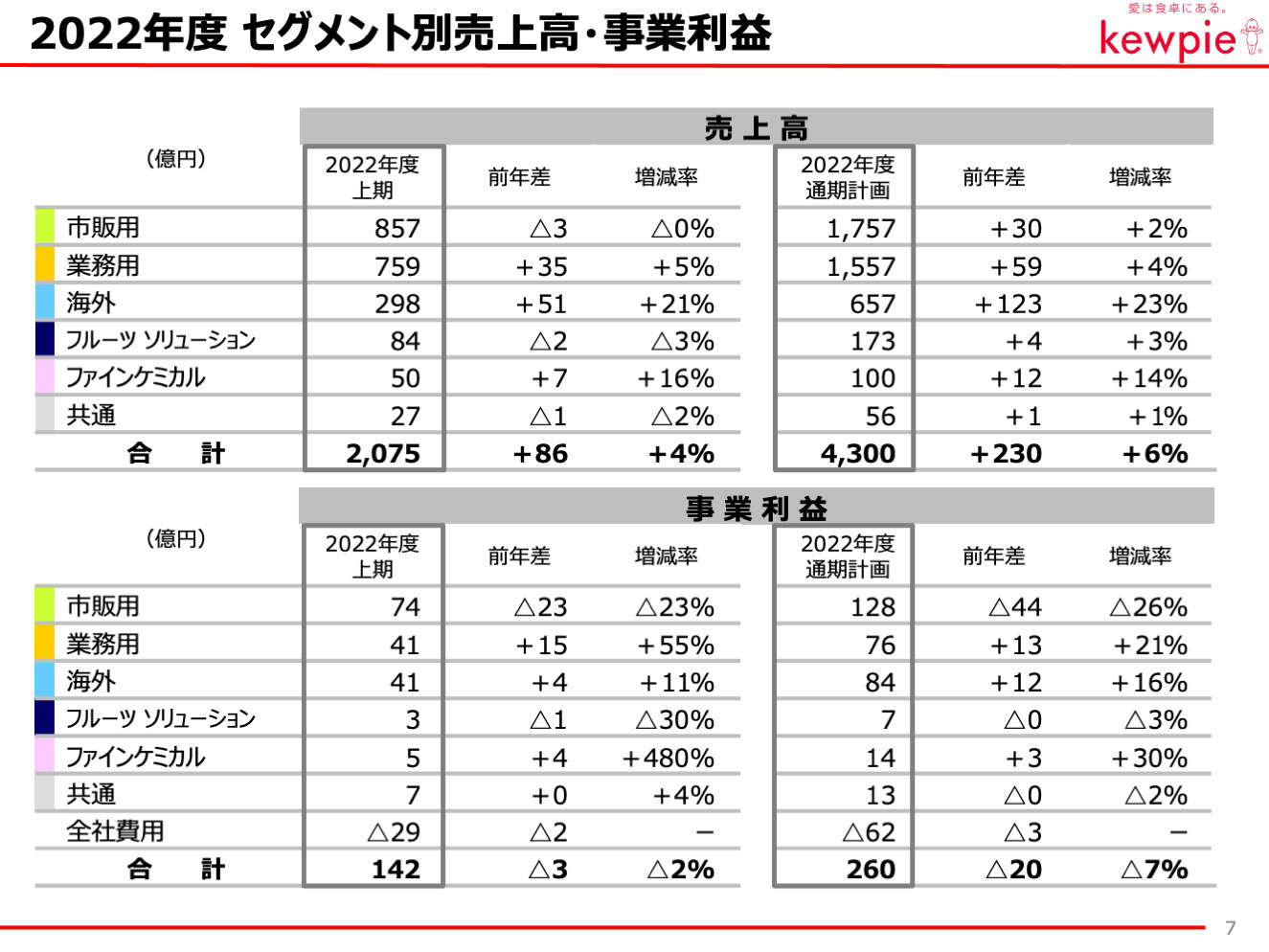
セグメント別では売上・利益ともに、海外と業務用がけん引する見通しです。
市販用は、上期は価格改定により調味料の需要が減少しましたが、下期から需要が回復することや、惣菜やカット野菜が引き続き堅調に推移していくことから、通期の売上高は増収を計画しています。ファインケミカルは、ヒアルロン酸の原料販売や通販ビジネスが堅調に推移し、上期は大幅な増益となりました。下期は輸入原料の単価上昇の影響を受け、利益面ではやや厳しくなりますが、売上は引き続き堅調に推移し、通期で増収増益を見込んでいます。
-
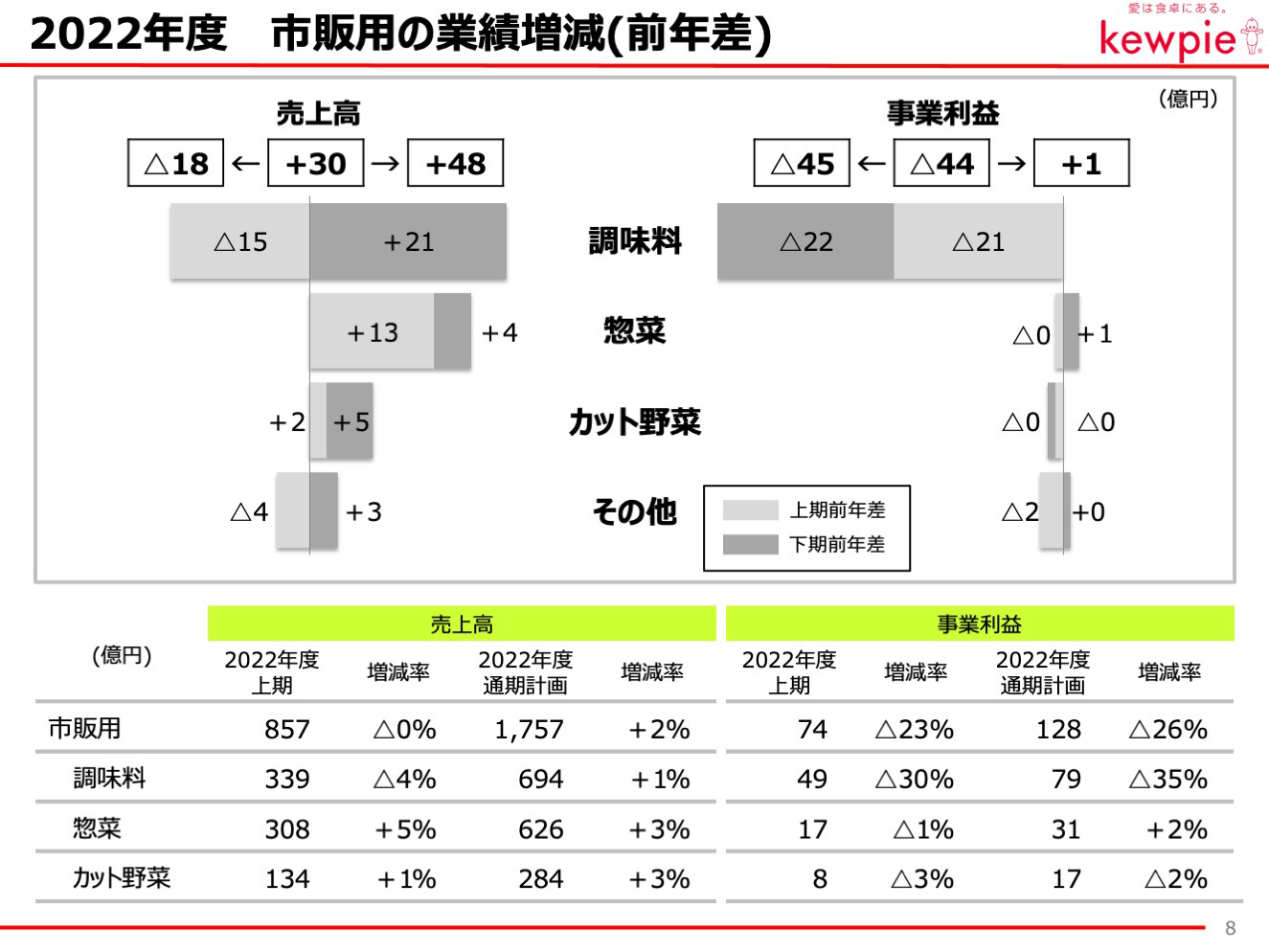
主要セグメントの売上高・事業利益の状況について
市販用は、上期に減収減益となり、通期では増収減益としています。調味料は、2度の価格改定から需要が減少し、上期は減収となりましたが、下期には昨年実施した7月の価格改定が一巡することや単価上昇の効果により通期では増収としています。利益は、上期・下期ともに主原料高騰の影響を受けることから、減益を計画しています。
惣菜は、主力のポテトサラダや宅配向け商品が堅調に推移したことから上期は増収となり、下期も引き続き堅調に推移する見込みです。利益は、原料の馬鈴薯の高騰影響を受け、上期は減益となりましたが、製造現場の改善やきめ細かい収支管理により通期では増益としています。 -
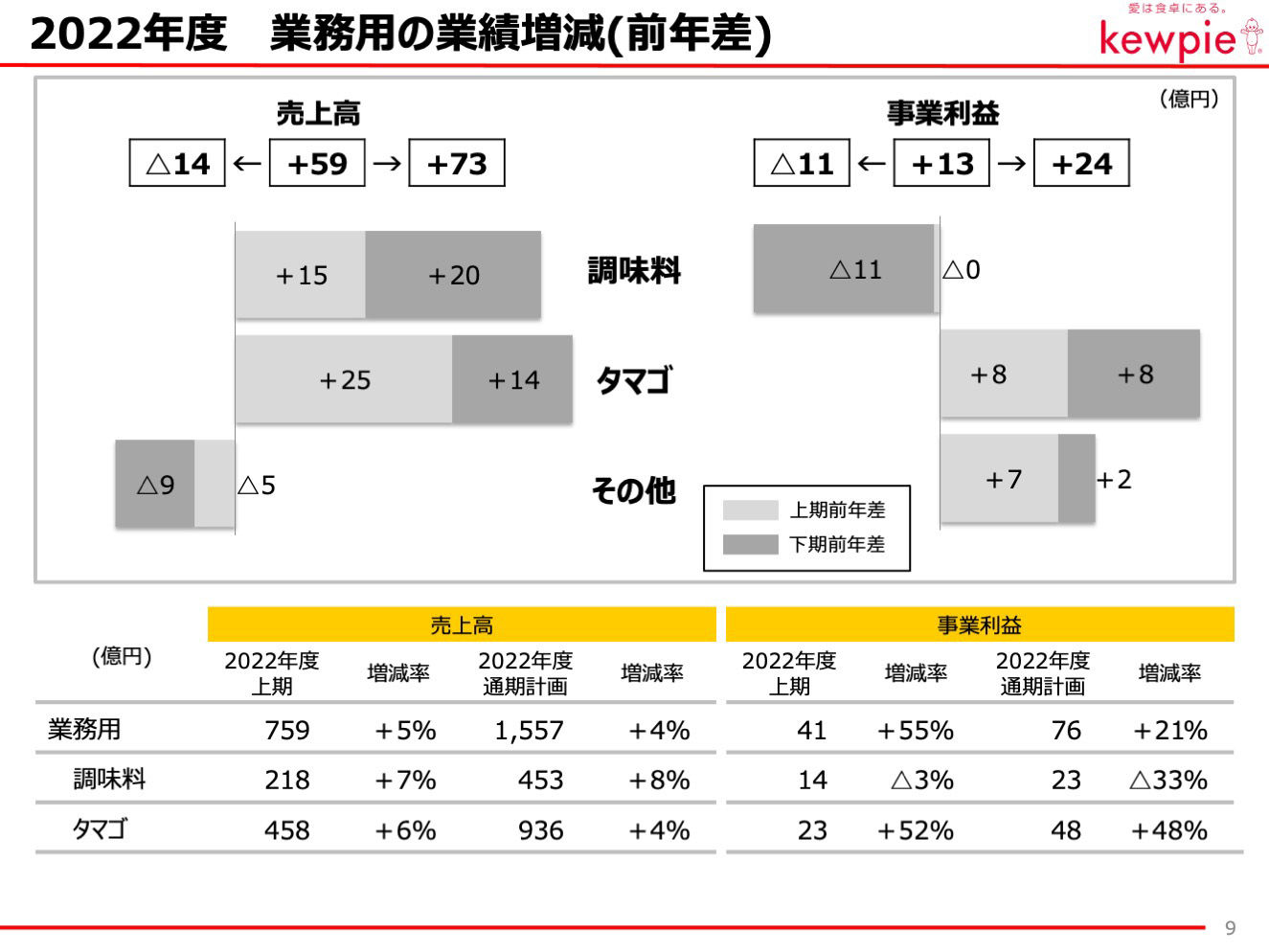
業務用は、上期で増収増益となり、通期でも増収増益を見込んでいます。
調味料は、外食需要が回復傾向にあったことから、上期は増収となりました。業態ごとのニーズをしっかり捉え、下期も引き続き増収を見込んでいます。利益は、主原料高騰の影響により上期・下期ともに減益としています。
タマゴは、調味料と同様に外食需要が前年度より回復したことにより、増収を見込んでいます。利益は、増収効果に加え、付加価値品の伸長から増益としています。
-
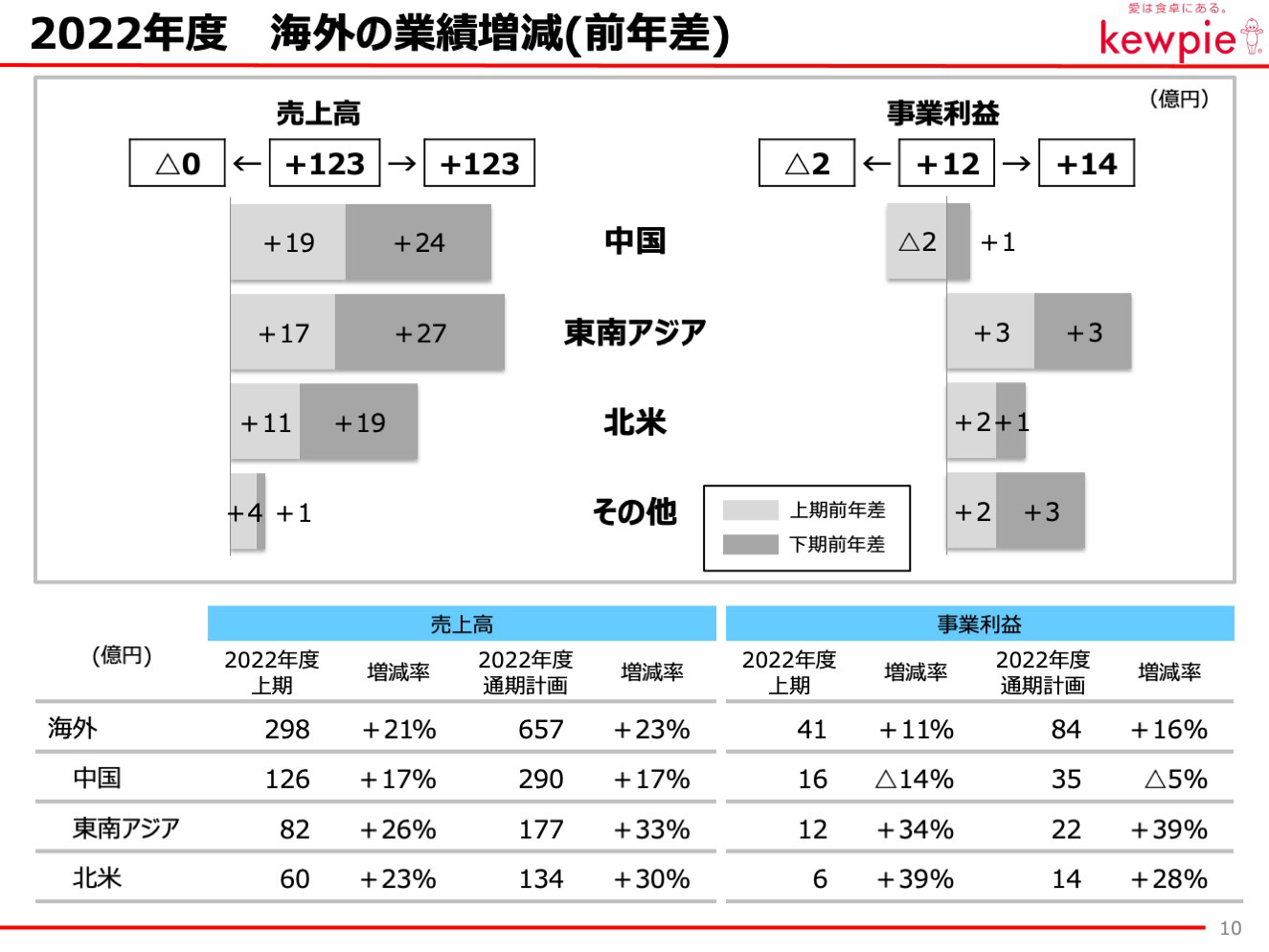
海外は、為替の影響もあり、上期は大幅な増収増益となり、通期も同様に推移する見込みです。
中国は、北京市での移動制限などゼロコロナ政策の影響を受けましたが、上海エリアなど他の地域が伸長し、上期は増収となりました。下期は、上海のロックダウンの影響を受ける見込みですが、北京を中心とした他の地域でカバーし、通期でも増収としています。利益については、昨年にコロナからの回復需要の恩恵がありハードルが高く、上期は減益となりましたが、下期では増益を計画しています。
東南アジア・北米はともに増収増益となり、通期も同様の推移となる見込みです。
-
下期および来期に向けた取り組みについて
-
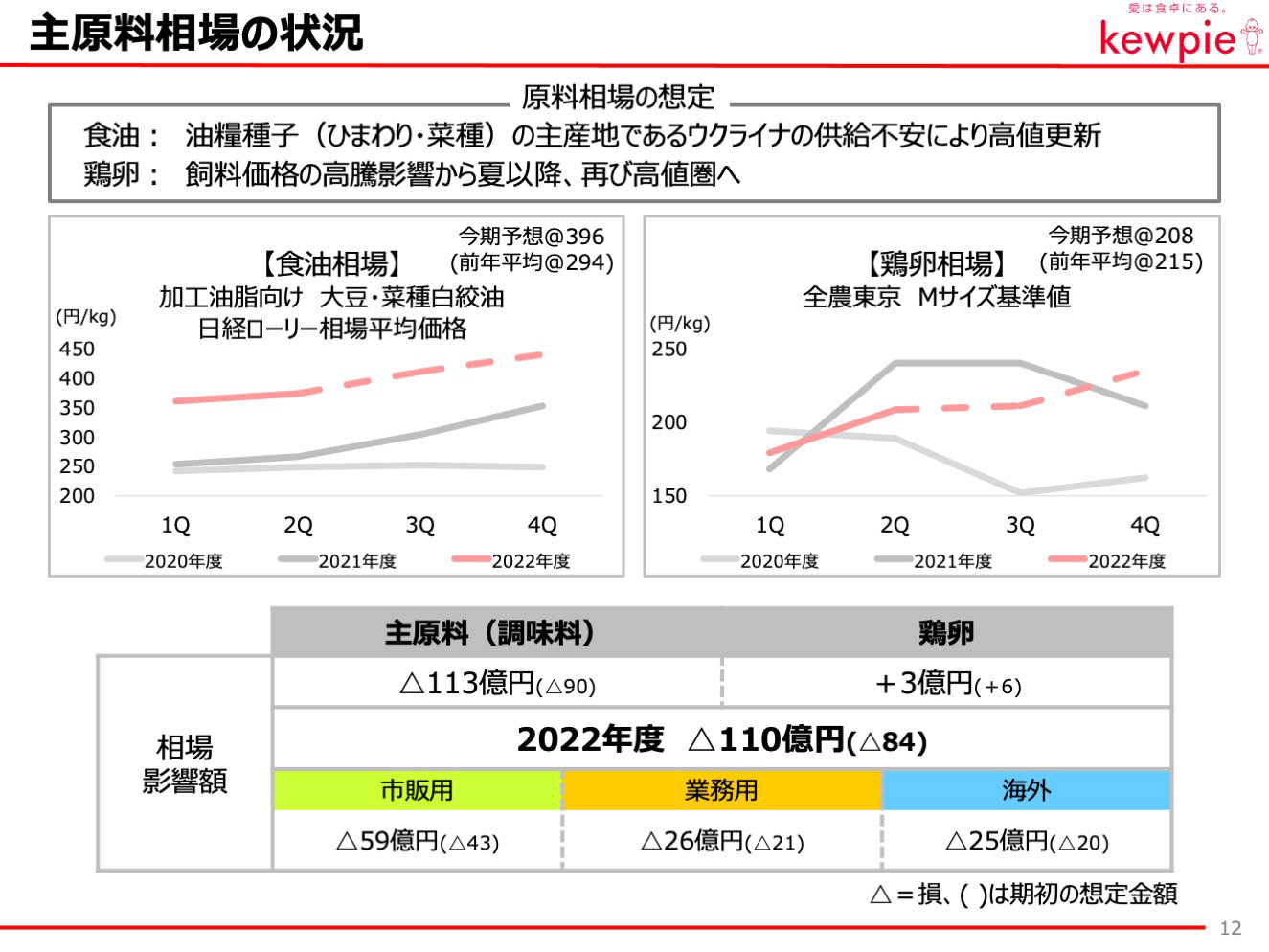
食油相場は、今年の3月から油糧種子の主産地であるウクライナの供給不安により価格が高騰し、高値を更新しています。さらにこの影響が穀物全般に広がり、国内の飼料価格も上昇していることから鶏卵相場も夏以降、昨年と同様の高値圏で推移するものとみています。
当初、主原料高騰の影響は今期84億円と見込んでいましたが、現時点では110億円まで増加し、未曾有のコストアップとなっています。
-
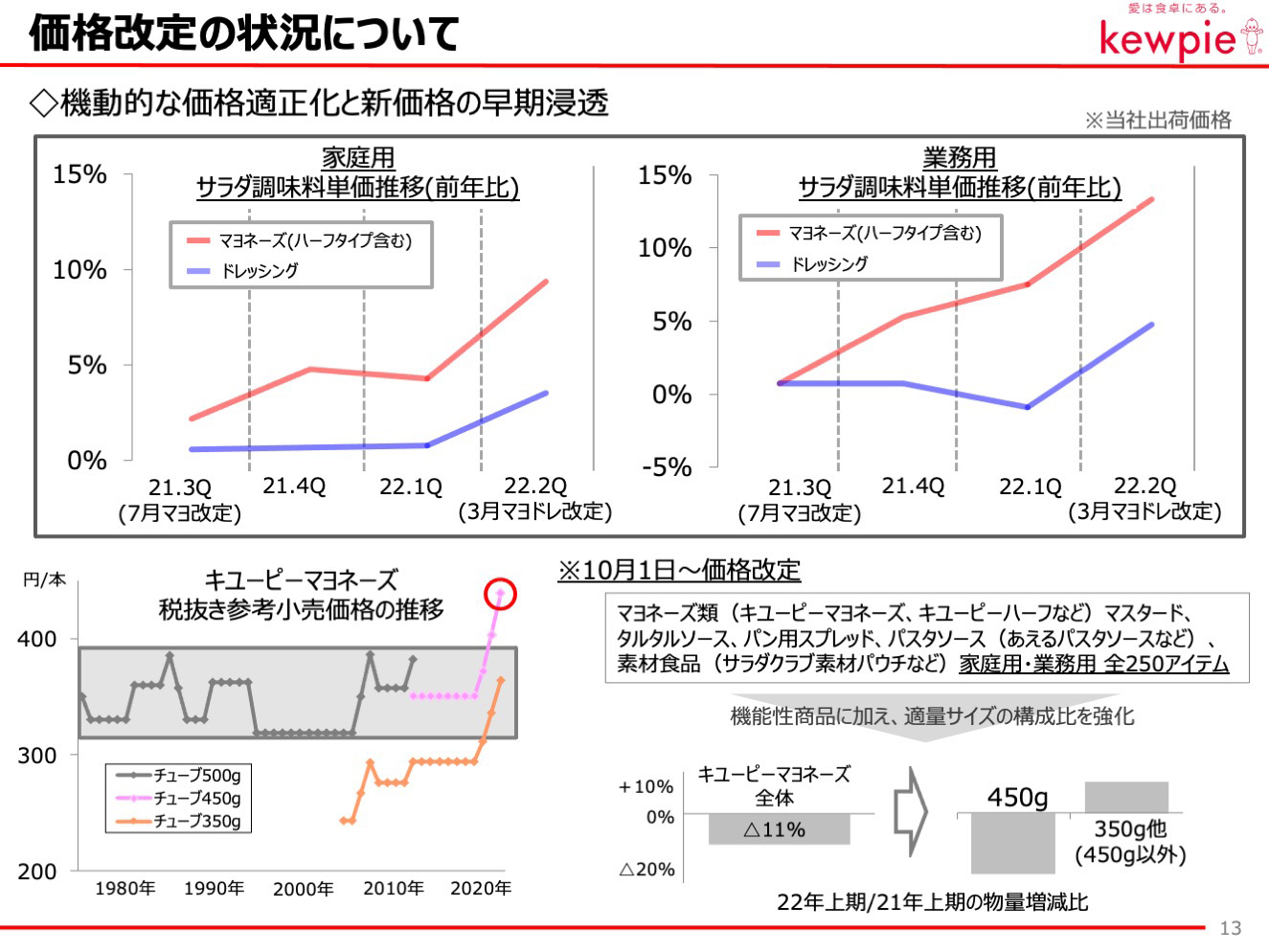
このような環境の中、当社では昨年7月に続き、今年3月に価格改定を実施しました。マヨネーズ・ドレッシングともにお客様からご理解をいただき、おおむね想定した単価で推移しています。
1月に長南からご説明した通り、マヨネーズの価格は過去50年間の価格帯から逸脱し、今までにない高い水準となっていますが、主原料のさらなる高騰を踏まえ、10月からの価格改定することをリリースしています。
今回の改定では、マヨネーズ、タルタルソースに加え、パスタソースや素材食品も対象にしており、主原料の他、エネルギーコスト・包材費の高騰を転嫁させていただきます。
マヨネーズについては、短期間で3回目の改定となるため、さらなる需要の減少を想定していますが、お客様の生活防衛の意識から購入サイズの多様化がみられており、容量のバラエティを持っていることを武器に物量の減少を一定程度緩和している状況になっています。このようなお客様の変化を素早く捉え、機動的な価格改定とともに需要の早期回復をめざしていきたいと考えています。
-
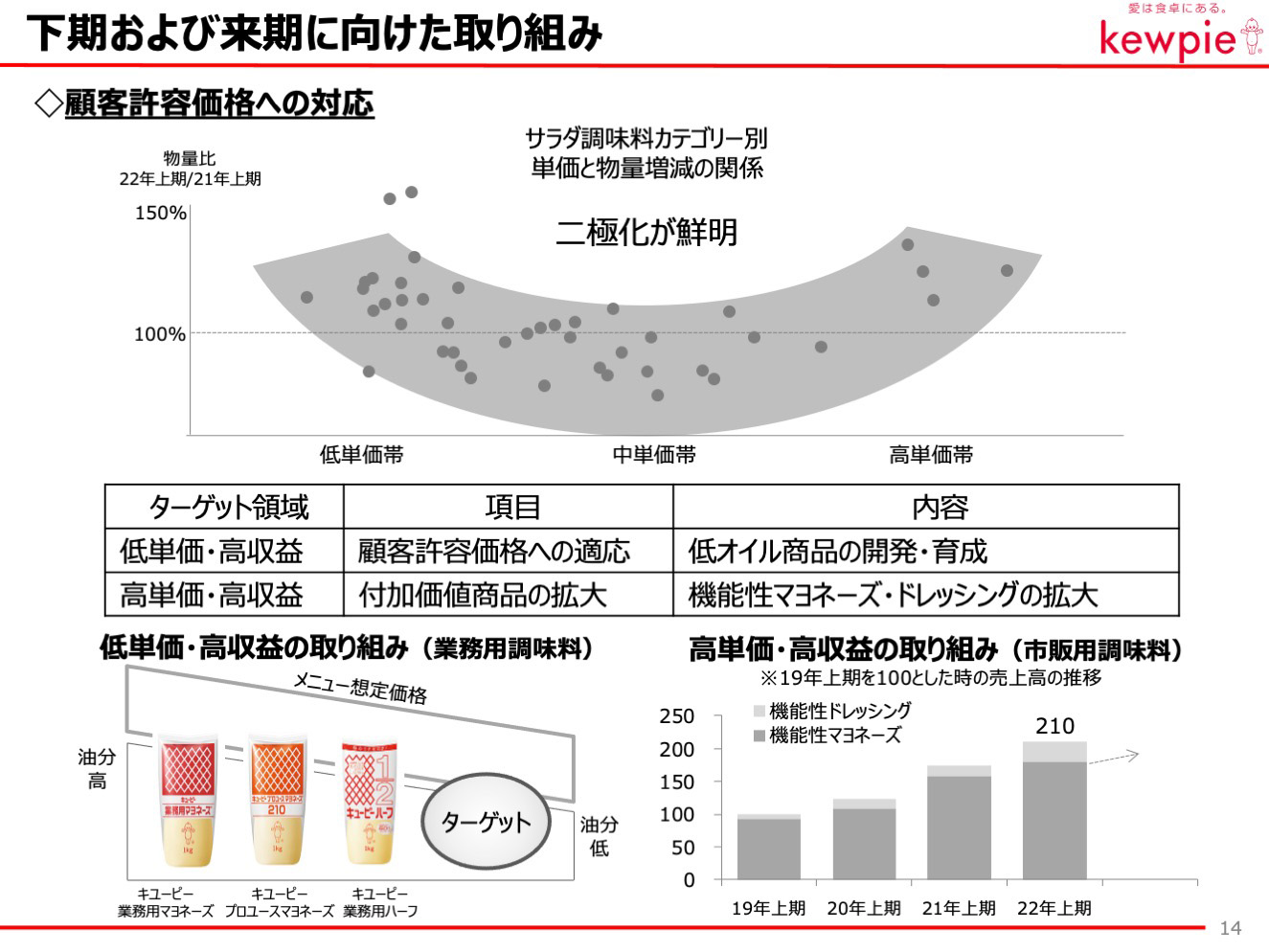
お客様のニーズの変化では、現在のような高インフレの環境下で、購入サイズだけではなく、許容価格の2極化が鮮明になってきています。当社のサラダ調味料をカテゴリー別にみた時、高単価帯と低単価帯のカテゴリーが比較的伸びている傾向がみられます。
低単価帯では、特に業務用において値上げをしていないノンオイルドレッシングへの切り替えやもともとの原料コストが安価な低オイル商品などが選ばれやすくなっています。これらのカテゴリーの中には低単価であってもしっかりと利益に貢献している商品もあります。この領域においてお客様のニーズが高まってきていることから、当社の強みである乳化安定技術により低オイルでも風味、物性を維持できるサラダ調味料の開発をスピーディーに行い、育成を進めていきます。
高単価帯で収益性の高い商品として機能性マヨネーズ・ドレッシングがありますが、機能性素材の使いこなし技術により、安定した品位を実現するなど他社との差別化を図りながら引き続き拡大をしていきます。お客様のニーズの変化をとらえ、時間軸を持って対応している事例として市販用では8月に深煎りごまドレッシングの新容量を発売します。過去からのお客様のご要望にいち早くお応えする施策のひとつとして進めていきます。
-
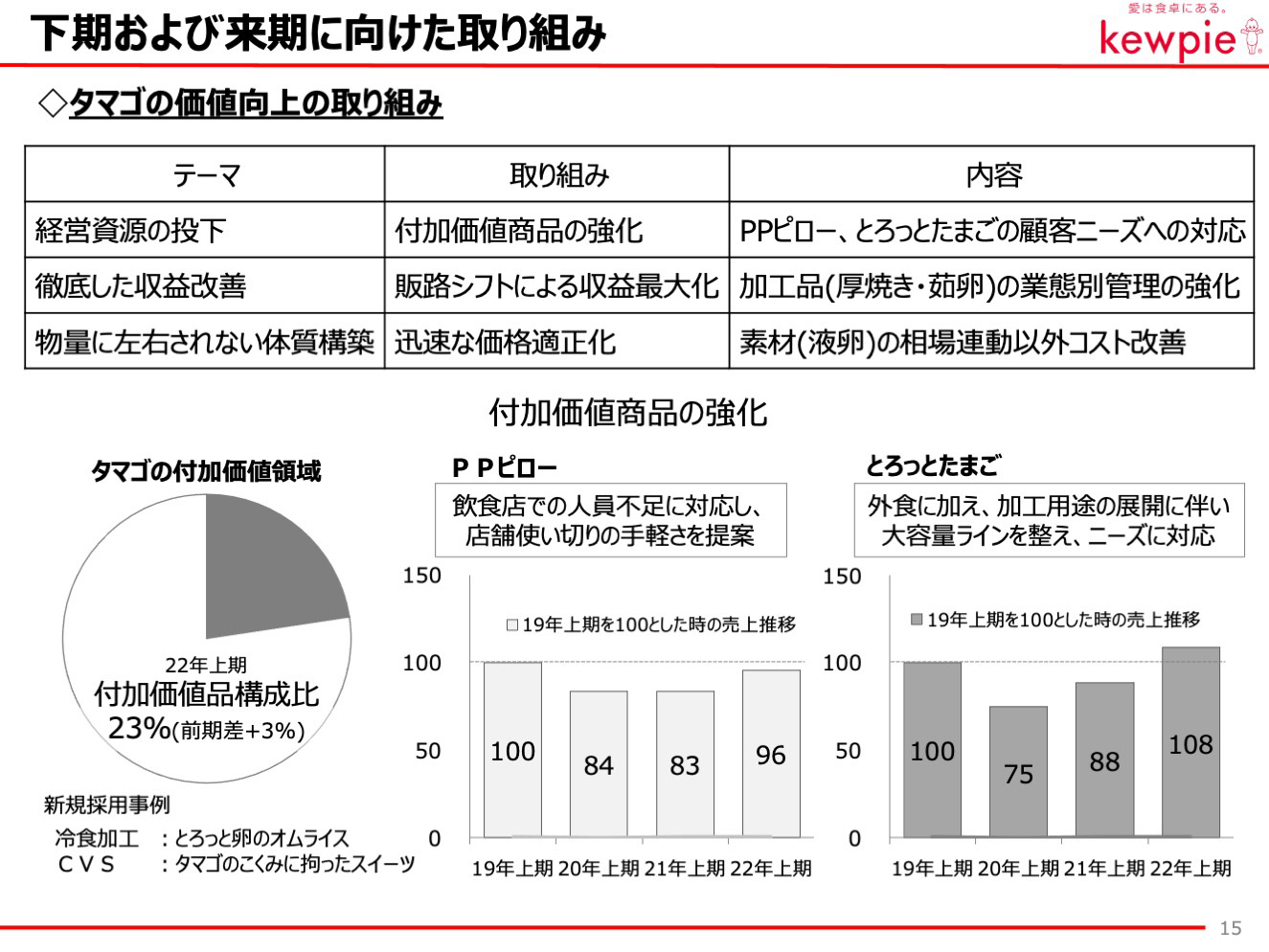
次にタマゴについてですが、2020年にコロナの影響を大きく受け、昨年は鶏卵相場の高騰影響により大変厳しい状況でしたが、今年に入りようやく回復の兆しが見えてきました。液卵を中心とした素材品についてはいまだ需要は戻っていませんが、当社が力を入れている付加価値品では、コロナ前の2019年とほぼ変わらないかそれを超える売上となってきました。
これもお客様の環境に合わせた提案や商品の使いやすさを価値として認めていただいたものと考えています。今後、この分野をさらに育成するとともに、素材商品の収益改善の面では相場変動に連動していなかったエネルギーコストや物流費の増加を販売価格に転嫁していきます。収益性を高めるために、物量を中心とした戦略から、価値や質を追う経営に転換をしていきます。
ひとつひとつ課題を解決し、事業構造の改革を進めていきます。 -
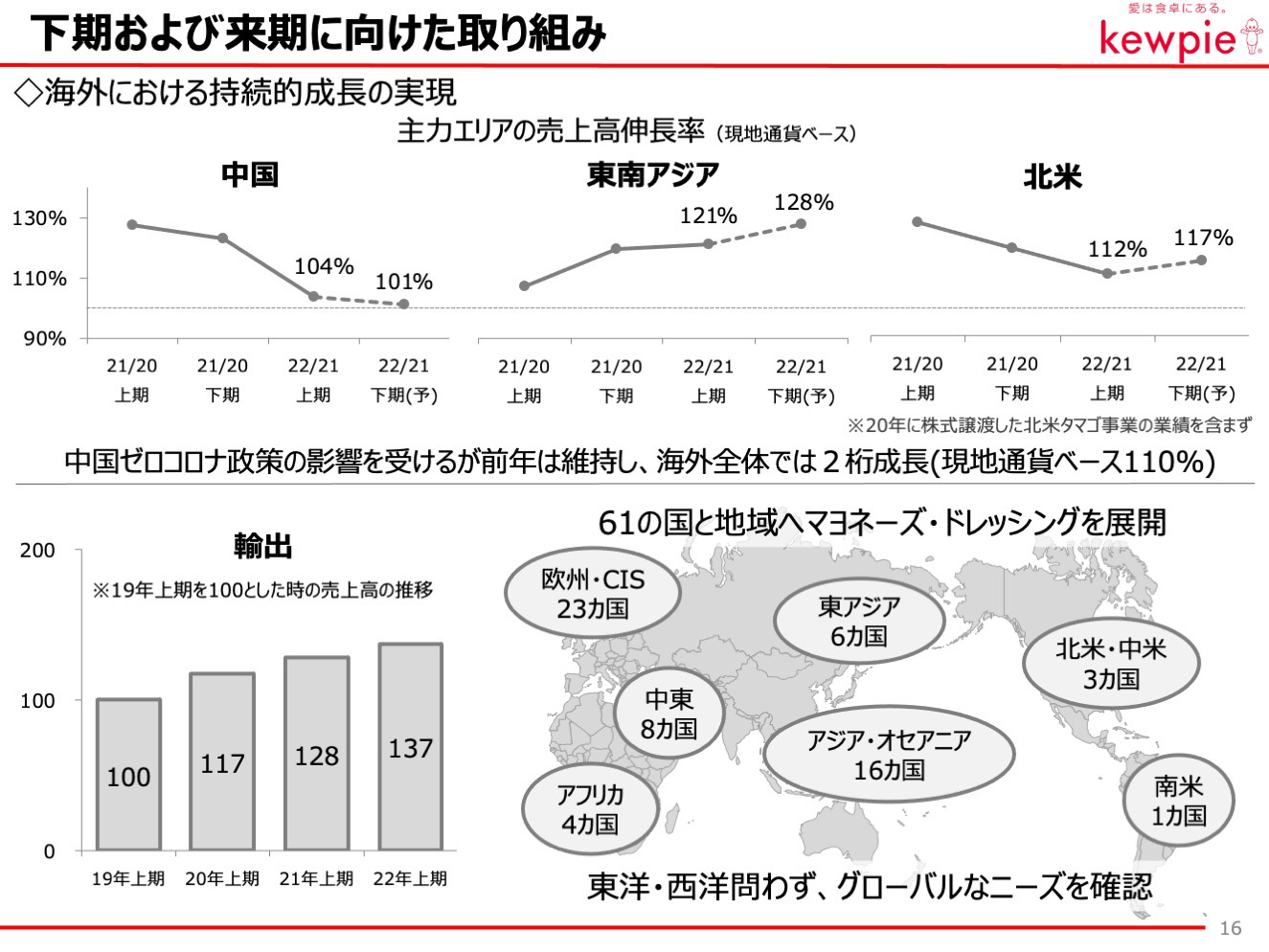
海外については、先ほどご説明したとおり、中国の一過性の成長停滞を東南アジアと北米でしっかり支える、強い構造になってきています。
現地通貨ベースの売上高伸長率を見ていただくとわかる通り、昨年の中国は上期・下期とも20%を超える伸長率であり、その高いハードルの中で、ゼロコロナ政策の影響があっても前年を超えることができています。このことからも大変な環境にあっても当社商品をご購入いただけるコアなお客様が定着しつつある、と受け止めています。東南アジアにおいては、国ごとに状況は違いますが、おおむね移動制限などが緩和し、外食需要が持ち直している環境の中、当社の業務用商品が採用され始めています。オンライン商談などを活用し、当社が得意とするきめ細かなメニュー提案により、お客様からの信頼が高まっています。
北米についてはブランド品・OEM品ともに堅調に推移しているのと同時に、業務用商品の需要も少しずつ拡大しています。
現地通貨ベースで海外全体の売上高伸長率は、通期で110%を見込んでいます。力強い成長期にシフトしていますので、この動きを止めないよう、経営資源を投下し、拡大を進めていきます。
また、世界的に長引くコロナ影響とグローバルな高インフレの環境においても、日本製商品の輸出が堅調に推移しています。輸出先は2018年に53の国と地域でしたが、現在は61まで増えており、東洋・西洋を問わずニーズが高まっています。キユーピーブランドがグローバルに広がりつつあることから、輸出で動向を掴み、将来の潜在ニーズを確認した上で、新たな国やエリアへの進出も検討していきます。
-
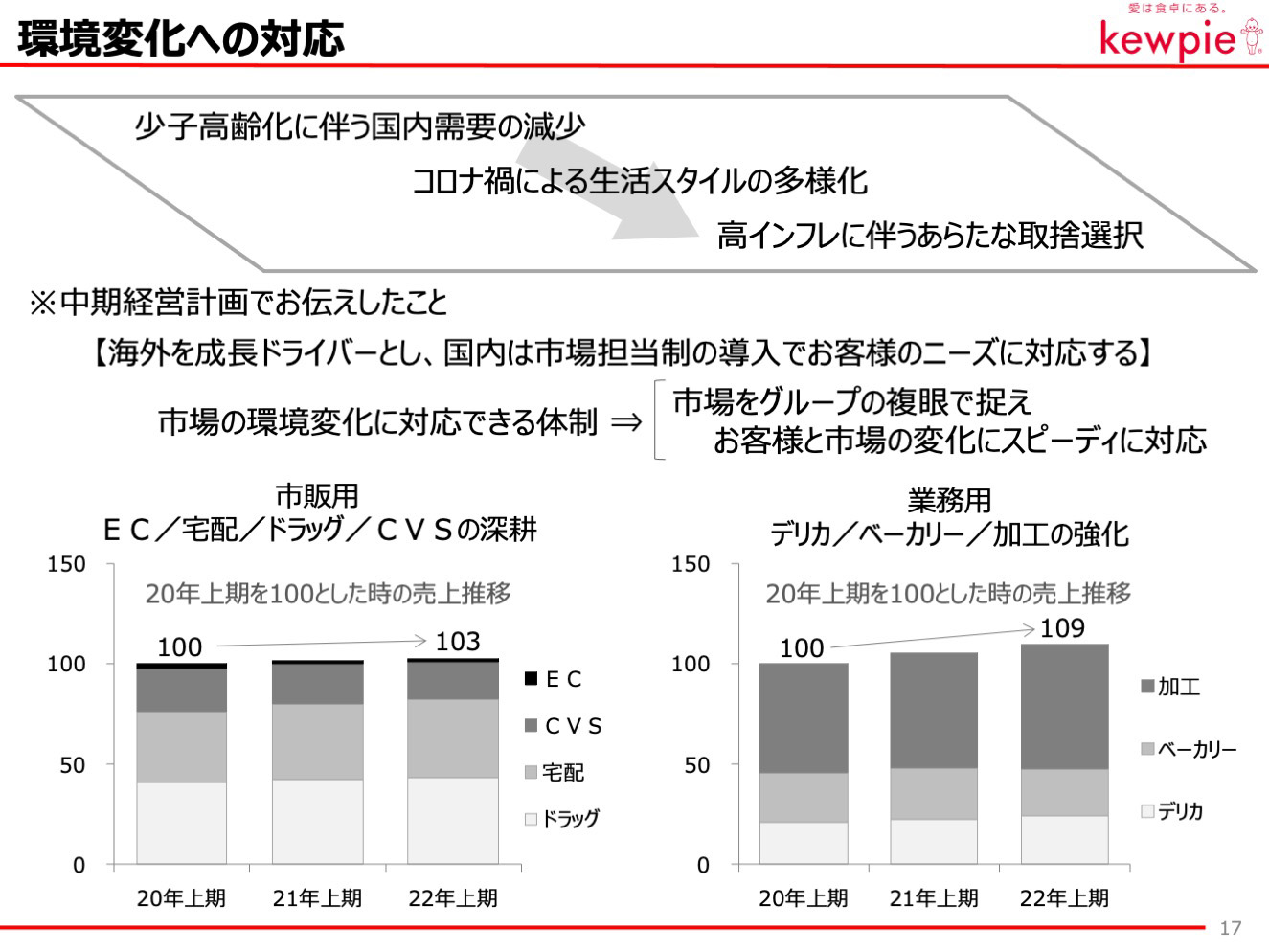
ここまでは足元の環境変化への対応をご説明してきましたが、当社は現在の中期経営計画の中で、もともと「変化への対応」を掲げていました。
取り組みの中には現在の環境変化でも有効なものがいくつかあります。
市販用と業務用それぞれで事例をご紹介します。市販用の事例について。もともとスーパーマーケット向けのグロッサリーと惣菜の売上構成が大きく、この市場は長期的には購買行動の変化や少子高齢化などにより縮小していくものと想定をしています。そこで、グループの販路を活用し、新たな市場での販売網を拡大することを中期経営計画の中でお伝えしておりました。ドラッグ・宅配・CVS・ECへの販路拡大の取り組みを着実に進めており、将来に向けて引き続き構成を高めていきます。
業務用では、デリカ・ベーカリー・加工を強化業態と位置づけ、グループ各社と連携して取り組みを進めてきました。こちらは現在業務用の売上の4割を超える構成比まで伸びてきており、今後外食需要の回復と合わせてさらに伸ばしていきます。
これらの取り組みは、現在の環境でも着実に売上を伸ばすことができており、この動きを継続させていくことで、逆風下でも安定した収益を確保できるものと考えています。
-
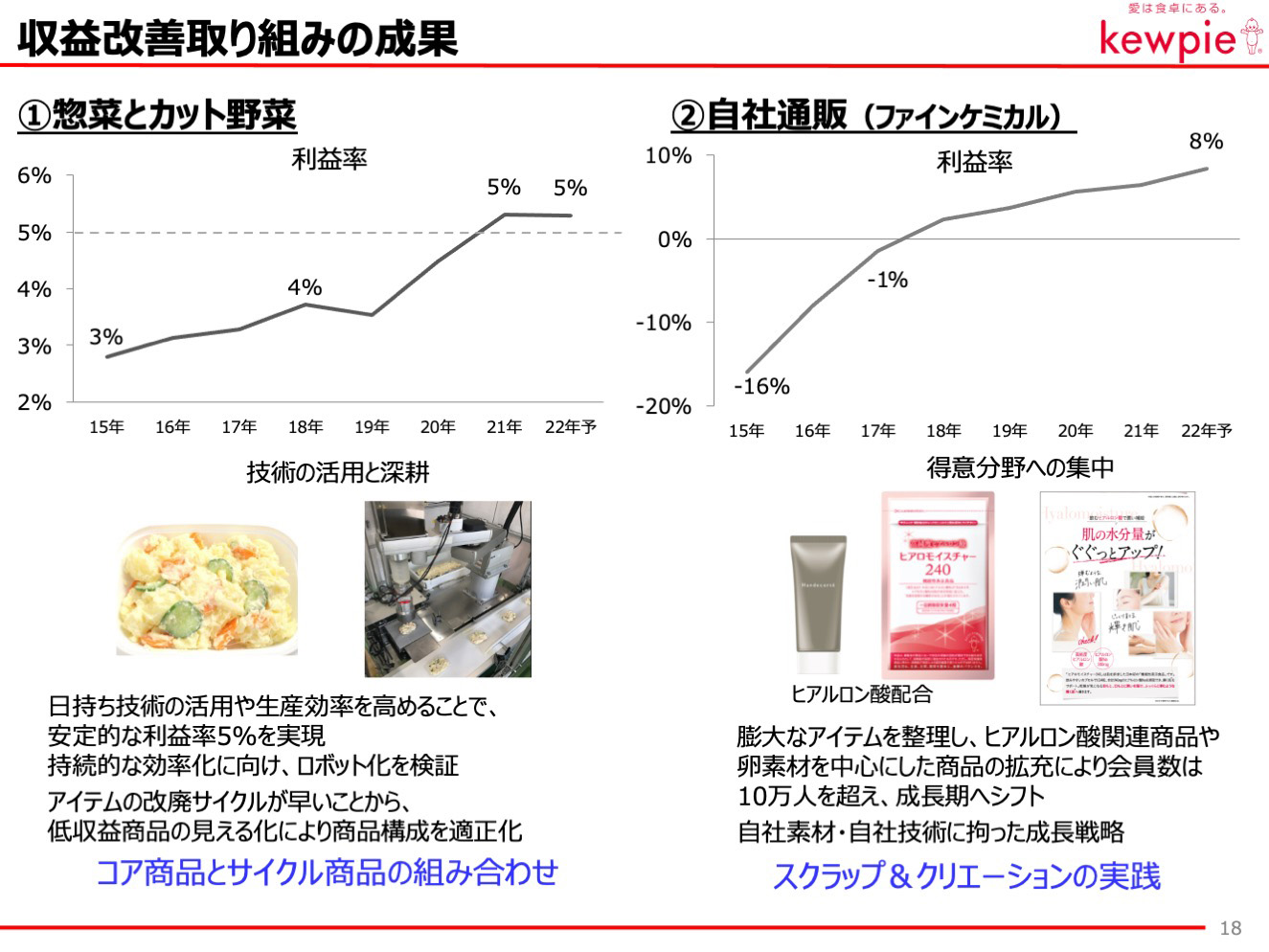
また、継続的な取り組みにより収益が改善した顕著な事例もでてきています。
惣菜・カット野菜のカテゴリーは、売上規模が大きいものの収益性に課題がありました。以前は概ね3~4%の利益率で推移していましたが、その後2018年にベンダー事業から撤退し、製造現場での改善ときめ細かい収支管理により、収益性は向上し、昨年は利益率5%を超えることができました。今年は馬鈴薯などの原料高騰を見込んでいますが、通期でも5%台を維持できる見込みであり、次の挑戦として6%台を狙っていきます。
次にファインケミルの通信販売は、資料にお示ししたとおり、2017年までは赤字事業でした。それまで増加傾向にあったアイテム数を、独自素材・自社技術に拘った商品に絞りこんだ上で、ラインナップの拡充を行った結果、売上も収益性も向上しました。グループ全体の利益率が6%の中、今年の自社通販は8%の利益率を見込んでおり、まだ規模は小さいものの収益の底上げに貢献ができていると考えています。
以上2つの事例は、時間をかけて取り組んだひとつひとつの積み重ねが成果となったものです。ここで身に着けた力は、たとえ逆風下であっても収益の持続性を維持できるものと考えています。これらの事例を水平展開させることでグループ全体をより強い体質に転換させていきます。
-
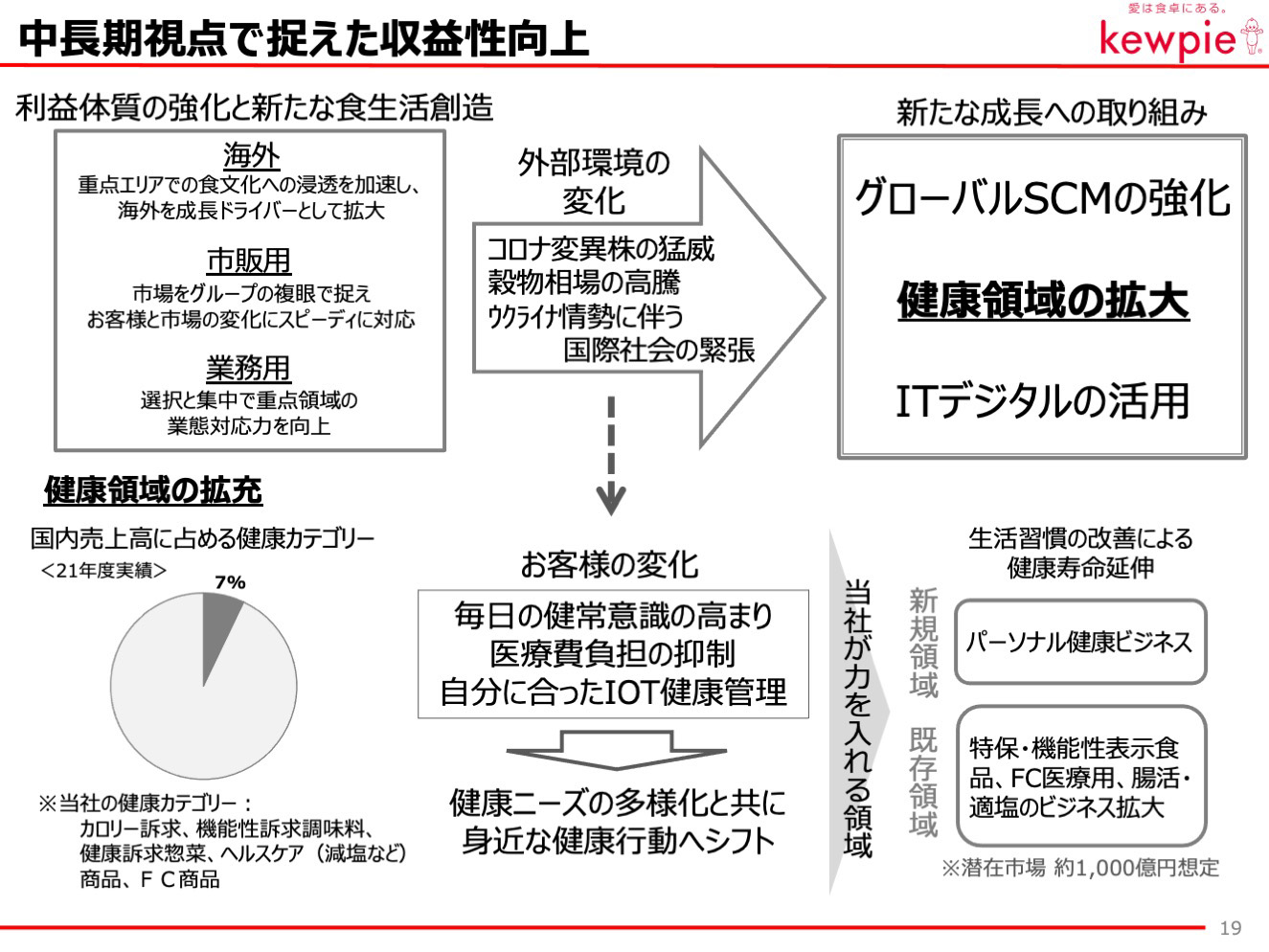
最後に、中長期視点で捉えた収益向上の取り組みについて。
当社が現在の中期経営計画を立案したのは2020年後半であり、初期のコロナ感染拡大を踏まえたものですが、その後変異株の猛威や穀物相場の高騰、そしてウクライナ情勢など様々な環境変化が起こっています。そのため、将来に向けた取り組みについては当初の想定に加えて、新たな経営の軸が必要だと考えています。
その中心として、グローバルな制限が増す中で安定成長を実現するための海外SCMの強化や付加価値化に欠かせない健康領域の拡大、そして様々な変化をより早く掴み、活用するためのITデジタル化の3つに取り組んでいきます。その中から健康領域の拡大の取り組みについてご説明します。
現在当社の国内売上高の約7%が健康に特化した商品の構成となっています。
当社における健康領域は、カロリーや機能性を訴求したサラダ調味料、GABAを配合したポテトサラダなどの機能性表示の惣菜、減塩やカルシウムなどに配慮したヘルスケア商品、そしてファインケミカル領域などがあります。
これらの領域は収益性も高く、今後の当社の付加価値戦略を考える上で欠かせない要素となってきています。
当社は長い間、食を通じてお客様の健康と向き合っていることもあり、この領域で貢献し、そして成長できることがまだまだあると考えています。加えて外部環境の変化によってお客様の意識も変化してきています。長引く行動制限の中で日常生活における健康意識が高まり、高インフレの環境では医療費の節約や抑制行動が生まれ、画一化していたこれまでの健康イメージが、個人個人にマッチする健康管理へとニーズが変わってきています。
当社はこのような変化に対して、食を中心とした生活習慣の改善をサラダとタマゴで提案し続けるとともに、新たな分野への挑戦も進めたいと考えています。マヨネーズの原料である食酢では、製造するのに必要な酢酸菌が人の免疫機能に及ぼす有効な効果を示すということがわかってきました。また、卵において認知機能を改善する成分を同定するなど、少しずつ研究が進んでいます。
このような将来のシーズをしっかりと温め育て、次世代の企業価値向上に貢献できる取り組みを進めていきます。 -
先ほどもお伝えした通り、現在の環境は当社にとって未曾有の危機と認識しており、私を含めたリーダーが緊張感をもって経営に向き合っています。
短期的な対応と中長期の対応、どちらも重要と考えており、未来に向けた企業価値の向上を一層推進していきます。
主原料高騰への対応、海外の持続的成長、国内の収益効率性の追求を経営の軸として、今後も様々な取り組みを進め、すべてのステークホルダーの皆様から信頼いただける企業をめざしていきます。
引き続きのご支援を賜りますようお願い申し上げます。
Q&A (Japanese only)
-
Firstly, we anticipate being more affected by rising raw material and energy prices in the second half of the year than in the first half. In response, we plan to mitigate the impact of these price increases through price revisions and value-added products.
Regarding the soaring raw material prices, while some prices have fallen recently, there are many uncertainties regarding how prices will fluctuate in the future due to the situation in Ukraine and other factors.
Given this external environment, we believe we need to continue monitoring the external environment closely before we can achieve Operating income target for fiscal year 2024.
For the next fiscal year, we anticipate being affected even more by rising prices of main raw materials and energy than this fiscal year. To mitigate these increases, we plan to prioritize initiatives in areas other than dressings and condiments, and work to ensure that the entire company can cope with these challenges. -
These past two years have been affected by unexpected factors. And the situation with COVID-19 remains uncertain. Amidst all this, the impact of the unusual outbreak of avian influenza, the surge in edible oil prices due to unfavorable weather, and the situation in Ukraine have all had a considerable impact compared to normal times in 2019.
Our Operating income exceeded 30 billion yen at its peak, but we are projecting it to be 26 billion yen this fiscal year. Our current goal is to mitigate this loss in profits as much as possible.
We don't know when things will return to normal, but when they do, I believe we will have even greater profit-generating capabilities than before. Our overseas operations are growing steadily, and we feel they are complementing our domestic performance. I feel that our previous measures are starting to bear fruit.
Regarding retail market condiments, there are various external factors at play, so we will provide further explanation once the situation becomes clearer.
We do not believe that things will return to normal in the next one to two years. Based on this premise, we believe our mission is to overcome these challenges and achieve even greater growth than before. However, given the uncertain situation in the near future, we would like to provide a more detailed explanation once we have a clearer picture of the situation. -
In the past, we have been implementing measures for the future amidst challenging circumstances, and we feel we are seeing positive results. We believe it is our responsibility to address challenges effectively while acquiring a stable corporate structure and a resilient position to market fluctuations.
Furthermore, while we have previously prioritized affordability, this third consecutive price revision is different from before. We feel that we are now able to take timely actions along with thorough explanations. We intend to continue to meet the expectations of our shareholders while maintaining a balance. -
Due to a combination of negative factors affecting the Japanese economy, I don't believe a recovery will occur within one to two years. I don't know if we'll return to pre-2019 levels, but I think there's a certain amount of pressure on the economy. The current situation is uncertain, and it's difficult to give a timeframe for quantitative analysis, so I will provide an explanation once the results of our measures become apparent and the accuracy improves.
-
The root cause is the high price of crude oil, a situation we did not anticipate at the beginning of the year. We are also starting to receive reports of price increases for logistics and materials, which are affecting the materials used in all our products. These factors are contributing to the deviation from our initial plan.
Up until now, we have passed on price increases based on the cost of our main raw material, edible oil, and have tried to absorb the increases in other costs through our own efforts. However, energy costs and other expenses are currently rising at a speed and scale that we did not anticipate. Based on the premise that we should prioritize what we can do to help our customers rather than passing on all of the increases, we have decided to pass on a portion of our costs to our customers in the price revision in October. -
We have secured our supply of cooking oil for this term. For the next term, we are currently in the process of determining when and how much to purchase.
-
To mitigate the impact of market fluctuations, high-value-added products are essential. Furthermore, it has become clear that products less susceptible to market fluctuations are those whose "function" is recognized by customers. One such function is health-related. Incorporating functional ingredients into edible oils requires technical expertise. Based on our experience researching emulsified condiments and functional ingredients, we believe we can offer a variety of functional condiments. We will continue to clearly communicate the value of our existing functional products and explore further needs. In addition, we are considering how to address needs from the perspectives of volume, container form, and sustainability.
On the other hand, we sell Kewpie Half and Kewpie Light, which use less oil, for people who are concerned about calories. However, we also want to convey that even with less oil, they taste and feel just as good as regular mayonnaise. We want to offer our customers choices, including controlling the amount of oil in food service to strike a balance between value and price.
Regarding edible oil procurement, we are working to develop global procurement routes and aim to improve our capabilities. -
Up until now, thanks to stable raw material prices and the effects of production rationalization, we have focused on offering our products at what could be called reasonable prices. However, in the current situation, we believe it is better not to be fixated on reasonable prices. We will accept that selling prices will increase and work to ensure that our products are still recognized as valuable. On the other hand, we believe that we must reflect any decrease in raw material prices in our pricing.
-
The overall market for salad dressings is shrinking to the mid-single digits. Until last year, demand home-cooked meals had increased due to the pandemic, but it had been on a downward trend even before the pandemic.
While mayonnaise is a staple condiments found in many households, salad dressings offer a wide variety of flavors, are highly subjective, and have seen increased competition from other manufacturers, which has slightly diminished our influence in this market. In this context, the price increase has resulted in a slower recovery in sales volume. Furthermore, a decline in salad consumption is also a contributing factor, so we will be implementing measures to boost salad sales. -
In food service, as the recovery from COVID-19 shows signs, we are seeing results by enhancing our menu suggestions and deepening communication with our customers. With increased demand for small packages in the delivery sector and the growing popularity of using dressings as a base seasoning in delicatessen foods, we aim to capture these new demands.
Since demand for retail market salad dressings has started to recover following price increases since June, we will be implementing four specific measures from the second half of the year through into the next fiscal year.
① Launch of 600ml Deep-Roasted Sesame Dressing: Deep-Roasted Sesame Dressing is a highly versatile product that is frequently kept in households. We have received requests for a larger size in the past, and we are now able to fulfill those requests. Furthermore, we believe that customers will feel the cost benefit as the unit price will also decrease with the larger size. We expect it to be a popular and versatile condiments in the future.
② Development of high-priced dressings: Tasty Dressings are popular with customers for their taste and quality. We will revitalize the dressing market by launching new products in the fall.
③ Enhancing our range of functional dressings: This is a category where sales are gradually increasing due to growing health consciousness. There are aspects that we haven't been able to adequately communicate to our customers, so we will focus on raising awareness and educating them.
④ Development of value-added dressings for e-commerce: In order to respond to changes in customer purchasing behavior, we will deliver value even through e-commerce.
As a category leader, we believe we have a responsibility to revitalize the salad market. Therefore, we will implement measures to increase the frequency of salads appearing on menus, both for retail market and food service.
Furthermore, we believe that communication regarding the appeal of our menus and salads is especially necessary for products retail market, so we will continue to disseminate information through social media and other channels. -
Since transitioning to a market-based system, we've seen positive results in responding to new sales channels for retail market and strengthening our business model for food service. Given the changing purchasing behavior and information-gathering habits of our customers, we are working closely with wholesalers and distributors to improve product delivery, information dissemination, and store layouts.
-
We are collaborating with some distributors to change how we deliver and sell our products, and we are seeing positive results. Dressings are highly subjective products, but we are focusing on selecting and analyzing delicious, versatile products that customers repeatedly buy and never tire of, and are trying out new ways to sell them.
-
There are three reasons for our success.
① Japanese food boom: The Japanese food boom continues worldwide. Recently, products are even being delivered to Africa.
② Shift to direct sales: By strategically expanding our sales network overseas, we have made direct sales possible. Even in trade conducted through agents, we proactively support local sales as much as possible, making it easier to convey the functionality and benefits of our products and expanding the opportunities for them to be used all over the world. This has also had a positive impact on profitability.
③ Compliance with export regulations: Our company's functions have been strengthened by proactively engaging in trade. With the support of the entire group, we have been able to produce products while complying with the laws and regulations of each country, which has led to the expansion of exports.
Exports also serve as a sounding board for developing new markets, so we intend to invest even more resources and establish a strong presence. Our goal is to deliver our products to 100 countries by 2030.
While the weaker yen has a positive impact on exports, we are struggling to secure tankers and containers. We believe that the effects of the weaker yen will become even more apparent once this situation stabilizes. -
I feel this fiscal year has been valuable for our overseas business. In the past, when China caught a cold, our overseas operations would also suffer, but this fiscal year, we have been able to cover the impact with Southeast Asia, North America, and exports, which gives me a sense of accomplishment as an overseas business manager.
In China, business profit was down 14% in the first half of the year. We struggled due to restrictions related to the Beijing Olympics and increased competition, but food service saw double-digit growth. In the second half, we expect to be affected by the lockdown in Shanghai in the third quarter, but we saw a recovery in June and believe we can achieve our full-year plan. In China, less than 20% of the population still consumes mayonnaise and salad dressing. We are promoting the use of digital technologies and strengthening e-commerce, and we believe we can achieve double-digit growth even after recovering from COVID-19 and returning to normal.
With most countries in Southeast Asia recovering from the pandemic, the demand food service products is growing. We are also actively engaged in exports within Asia, so we believe we can continue to grow steadily.
North America consumes 1.5 times more salad condiments than Japan and more than 40 times more than China. Our presence is growing in places like Costco, but we are currently unable to meet customer demand, so we are considering investing in increased production.
Year-End Financial Results Briefing
January 12, 2022 (term ending November 2021)
-
2021年度 決算説明資料
-
2021年度の業績について。
-
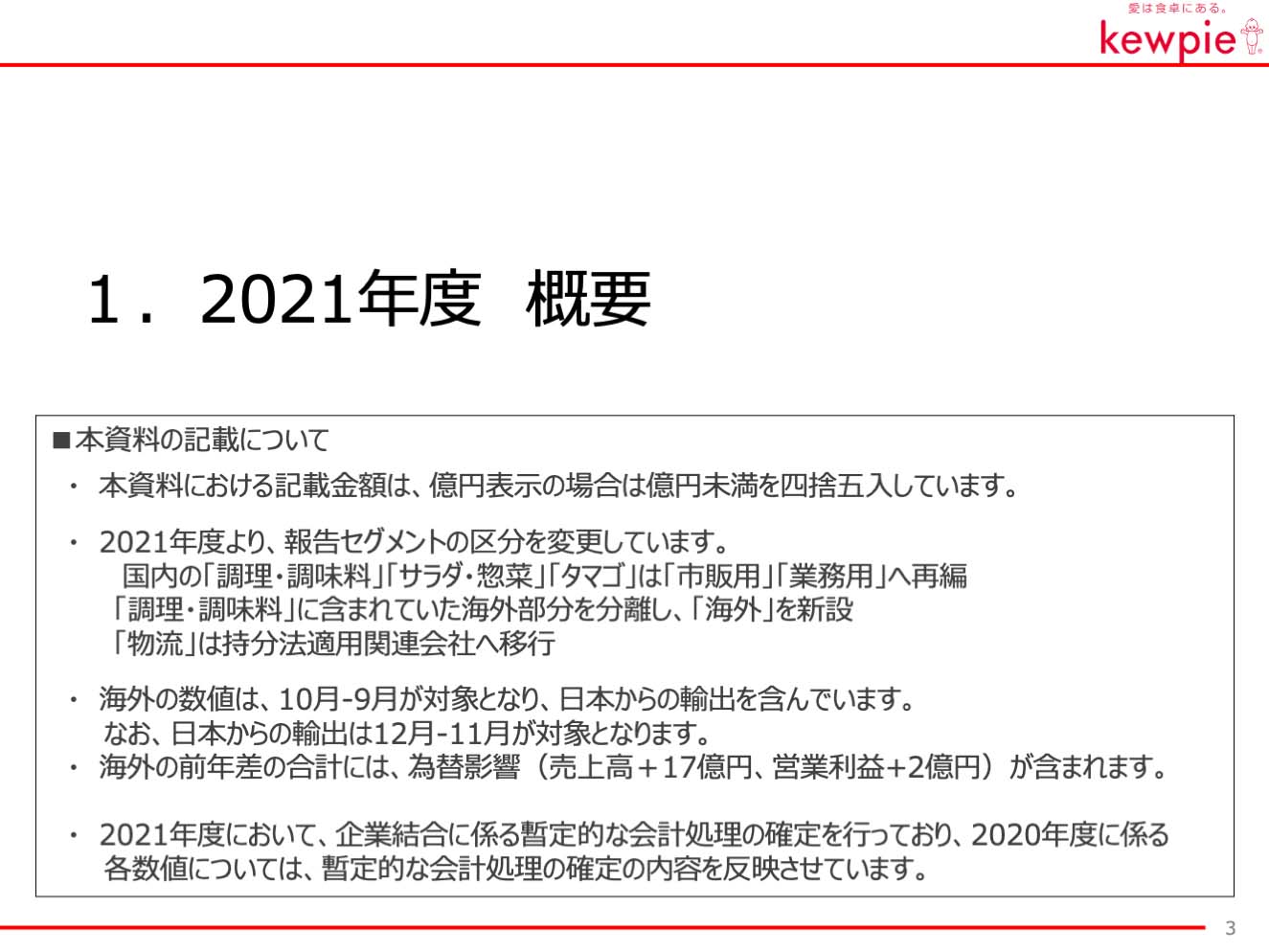
2021年度の業績について。
-
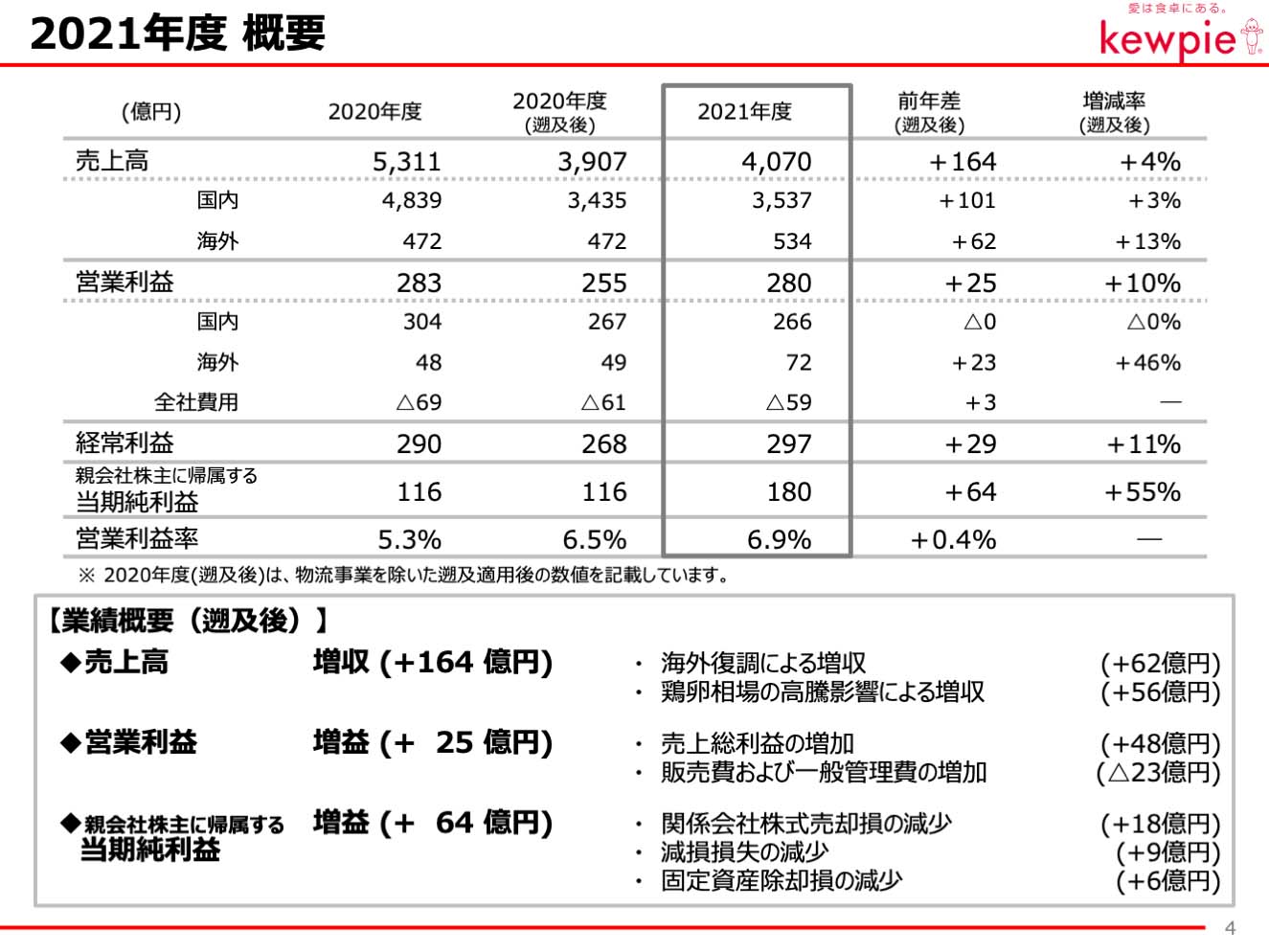
昨年1月に、連結子会社であったキユーソー流通システムの株式を一部譲渡し、同社を持分法適用関連会社へ移行しています。これからお話する内容は、物流事業を除いた遡及適用後の数値でご説明します。
まず売上高は、前年に対して164億円増収の4,070億円となりました。
海外では新型コロナウイルス感染症から回復基調にあったこと、国内では鶏卵相場高騰の影響や、中食市場の堅調な需要を捉えたことにより増収となりました。営業利益については、主原料高騰の影響を受け、国内ではほぼ前年並みとなりましたが、海外が堅調に推移したことから、前年に対して25億円増益の280億円となりました。
親会社株主に帰属する当期純利益は、前年からの業績の回復に加え、関係会社株式売却損の減少や、減損損失の減少により、前年に対して64億円増益の180億円となりました。
なお、経常利益と当期純利益については、物流を遡及する前の業績においても増益となっています。
-
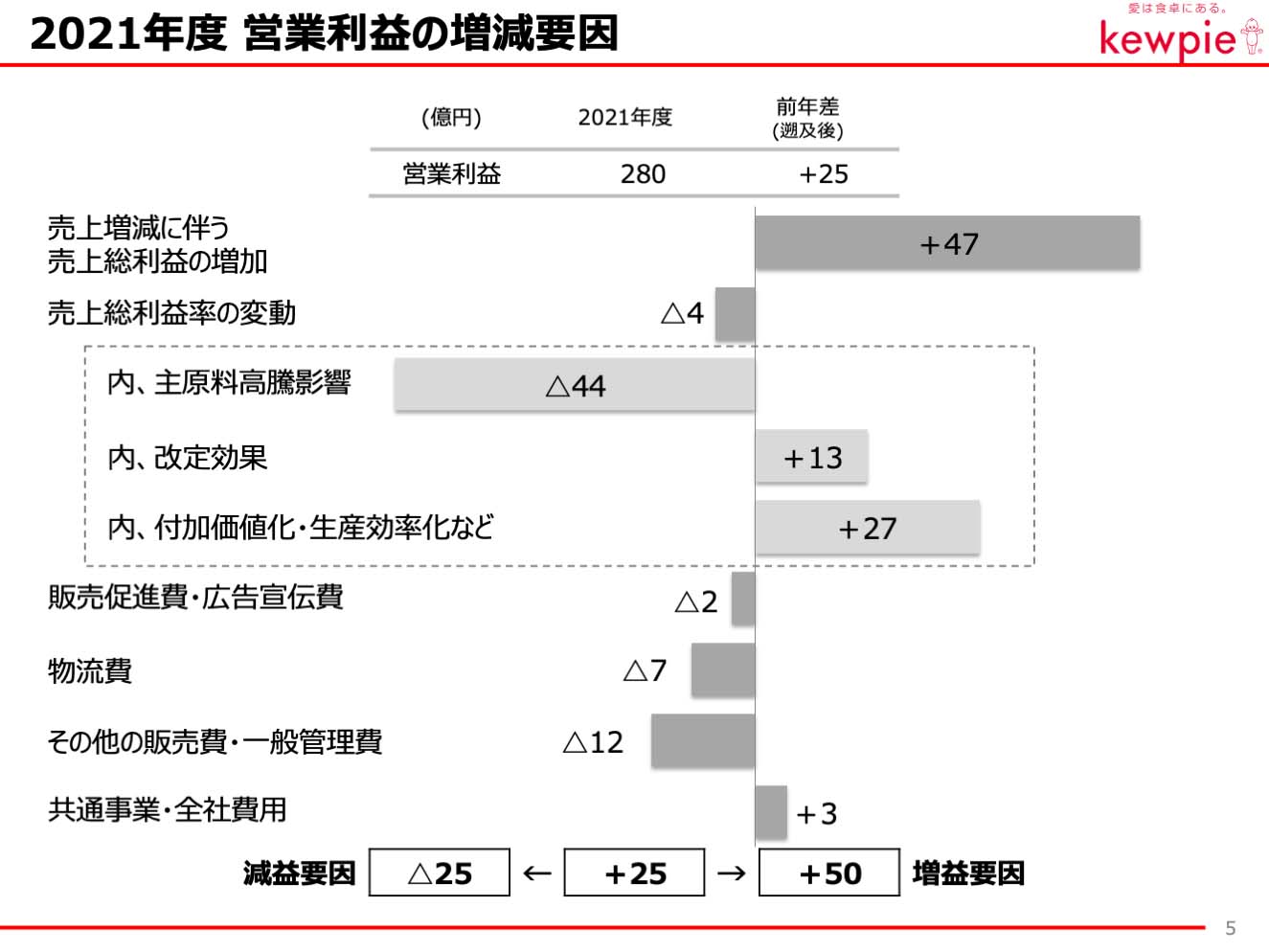
営業利益の増減要因について。
売上増減に伴う売上総利益の増加については、海外の売上増と、国内の市販用調味料および惣菜の売上増などにより、47億円の増益となりました。
売上総利益率の変動は、付加価値化や生産の効率化、価格改定などに努めましたが、主原料高騰の影響を吸収できず、4億円の減益となりました。
物流費増加の主な要因は、国内・海外の売上増に伴うものです。
その他の販売費・一般管理費は、海外で約7億円、国内では基幹システムの導入に伴う費用や、外部委託費を含めて約5億円の増加となっています。 -
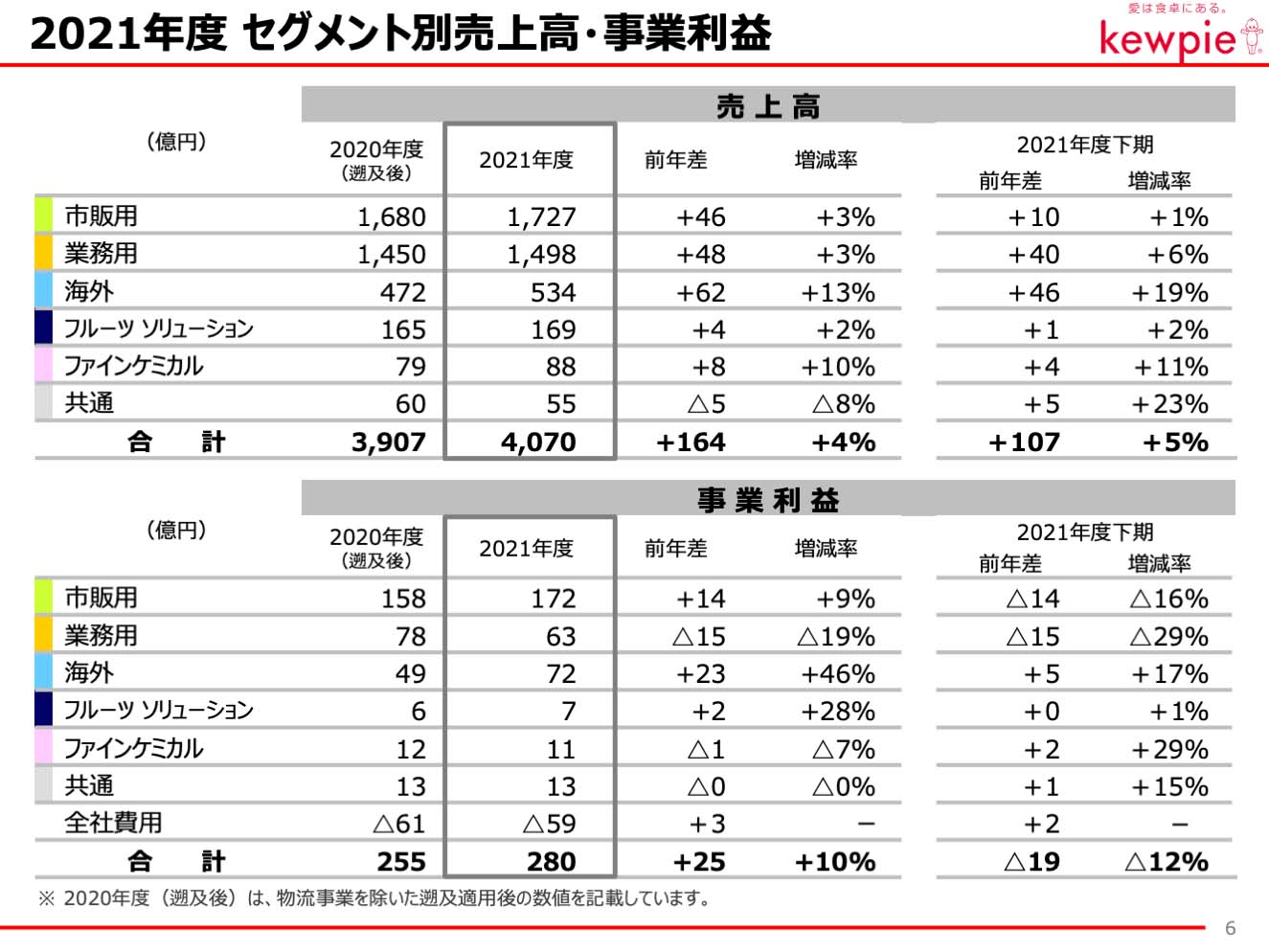
セグメント別の状況について。
売上高は、海外と国内業務用、市販用がけん引しました。なお、国内業務用の売上増の主な要因は、鶏卵相場の上昇によるものです。
利益は、海外と国内市販用がけん引して年間で増加しましたが、下期だけを捉えると、主原料高騰の影響などにより、減益となりました。
-
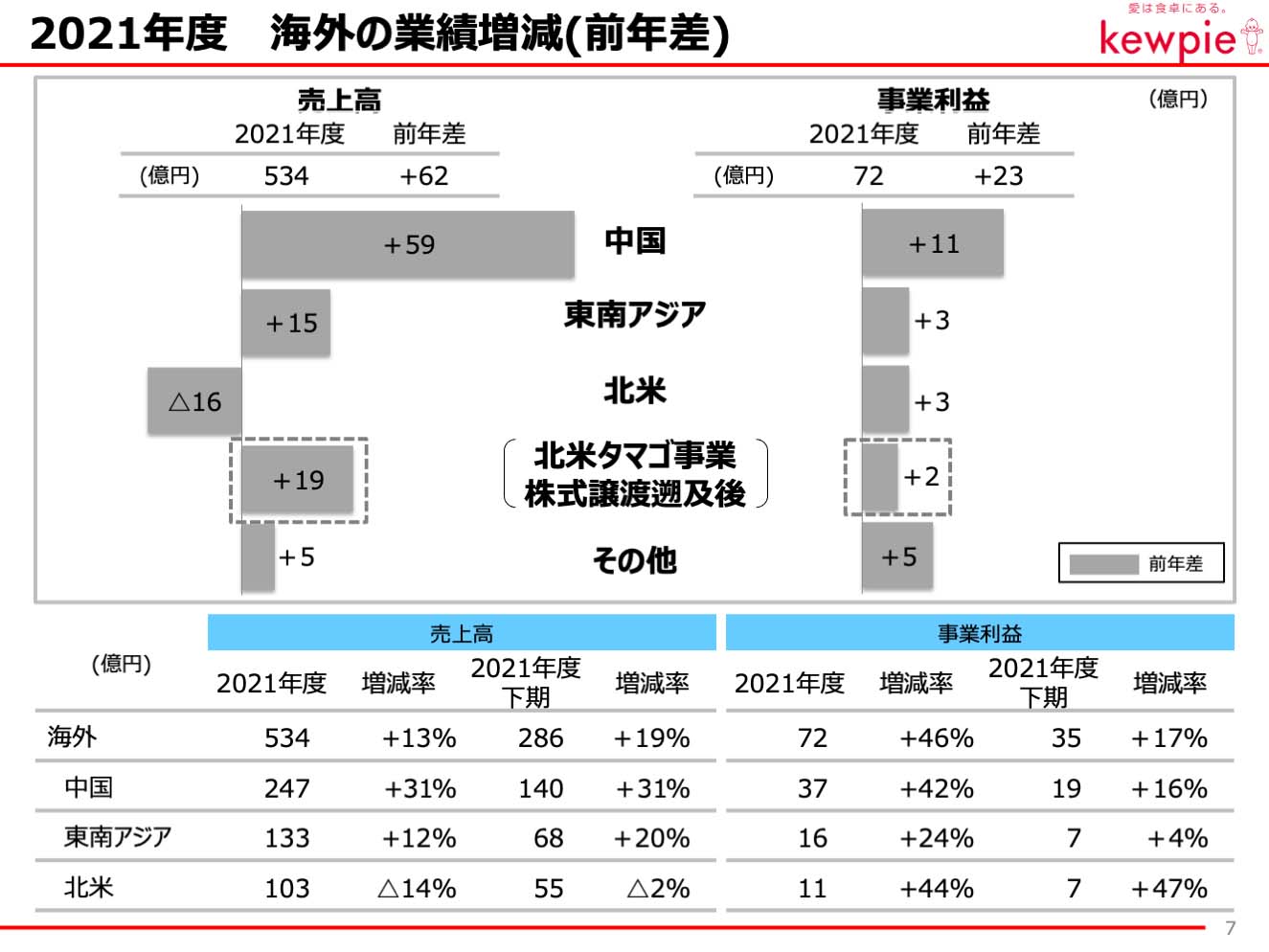
主要セグメントの概況について。
海外は、遡及後ベースで、各エリアともに増収増益となりました。なお、現地通貨ベースでの海外売上高伸長率は119%となっています。
中国は外食需要の回復に伴う業務用商品の増加が貢献しました。
北米のタマゴ事業遡及後は、調味料のブランド品が堅調に推移したことや、生産の効率化が寄与しています。
その他の利益増は、欧州での利益改善や輸出によるものです。
-
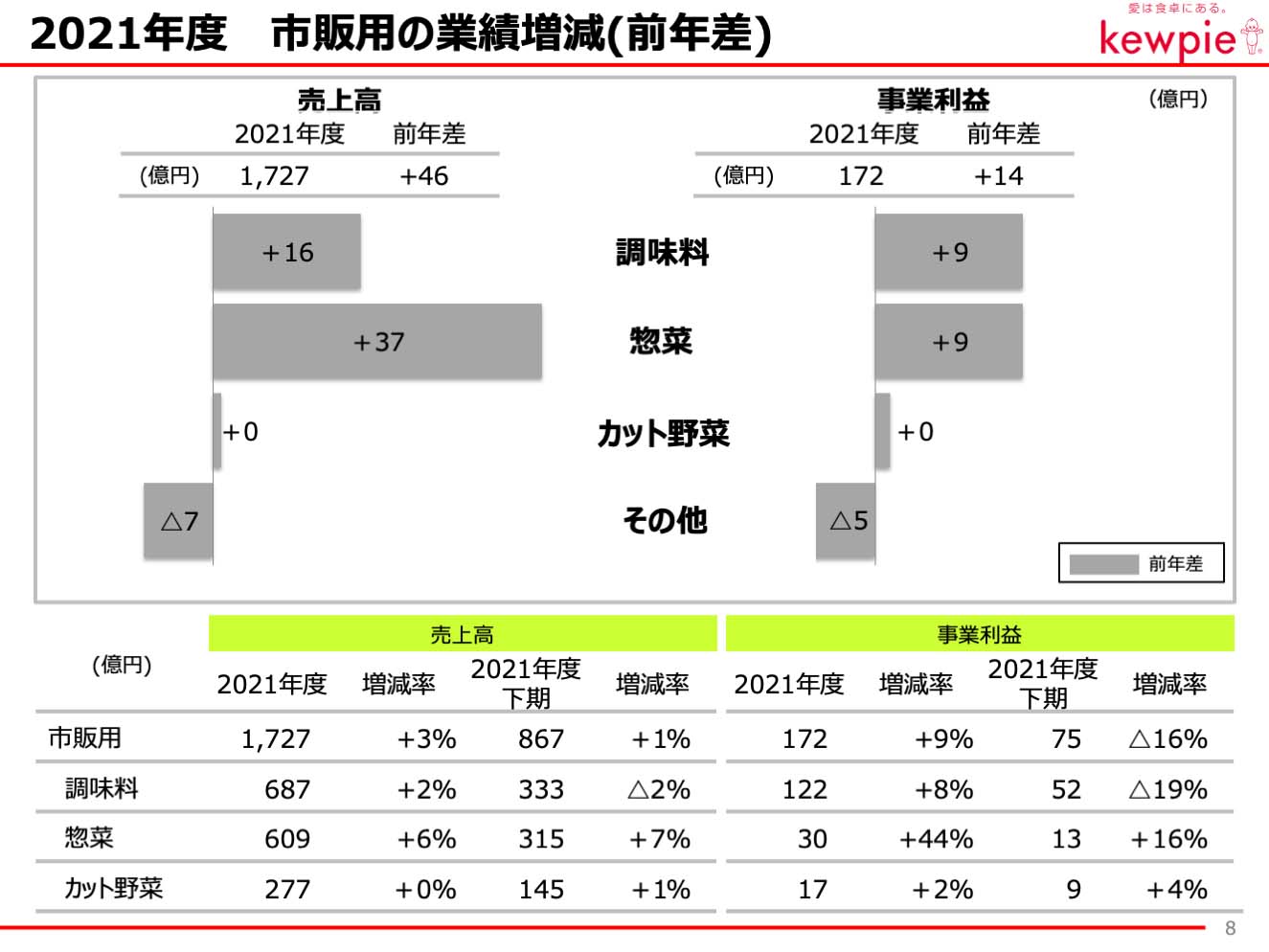
市販用について。
調味料の売上は7月のマヨネーズの値上げにより、一時的な需要の減少がみられ、下期は減収となりましたが、上期の巣ごもり需要効果もあり、通期では増収となりました。
利益についても下期は主原料高騰の影響を受け、減益となりましたが、通期では増益となっています。惣菜は、商品では主力のポテトサラダ、販路では宅配ルートが堅調に推移したことに加え、深夜作業の低減など生産性向上の効果により、増収増益となりました。
-
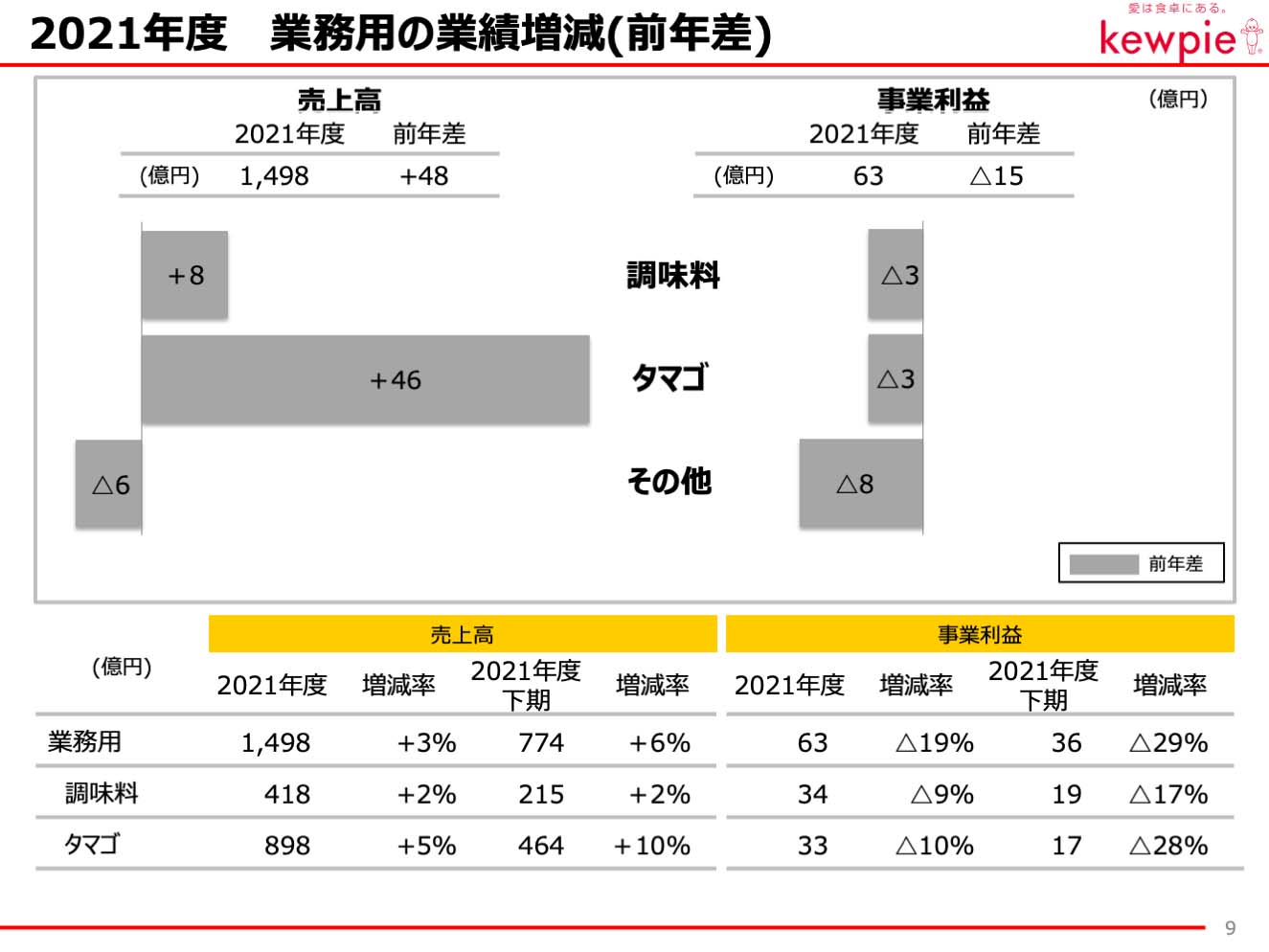
業務用について。
調味料は、外食需要がゆるやかに回復しており、マヨネーズの価格改定後も需要はそれほど変わらず、増収となりましたが、利益については主原料高騰の影響を受け、減益となりました。
タマゴは、想定ほどの鶏卵相場高にはなりませんでしたが、依然として前年より高い水準となっている影響から、増収減益となりました。
その他の減益は、現在進めている重点領域への集中に伴う商品整理の影響などによるものです。
-
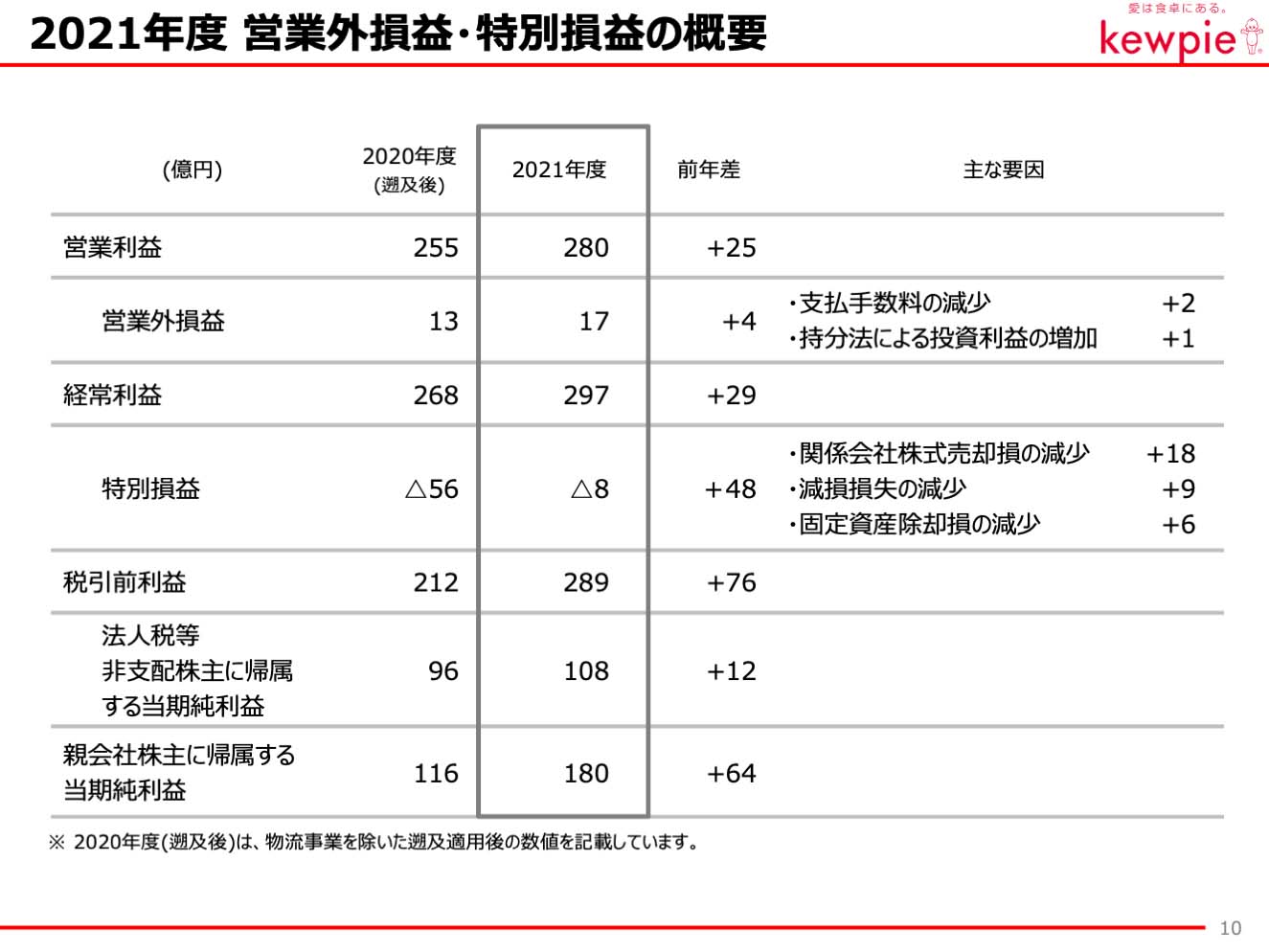
営業外損益、特別損益の概要について。
営業外損益は、支払い手数料の減少や投資利益の増加により4億円の増益となりました。
特別損益は、関係会社株式の売却損の減少や、減損損失の減少などにより48億円の増益となりました。
-
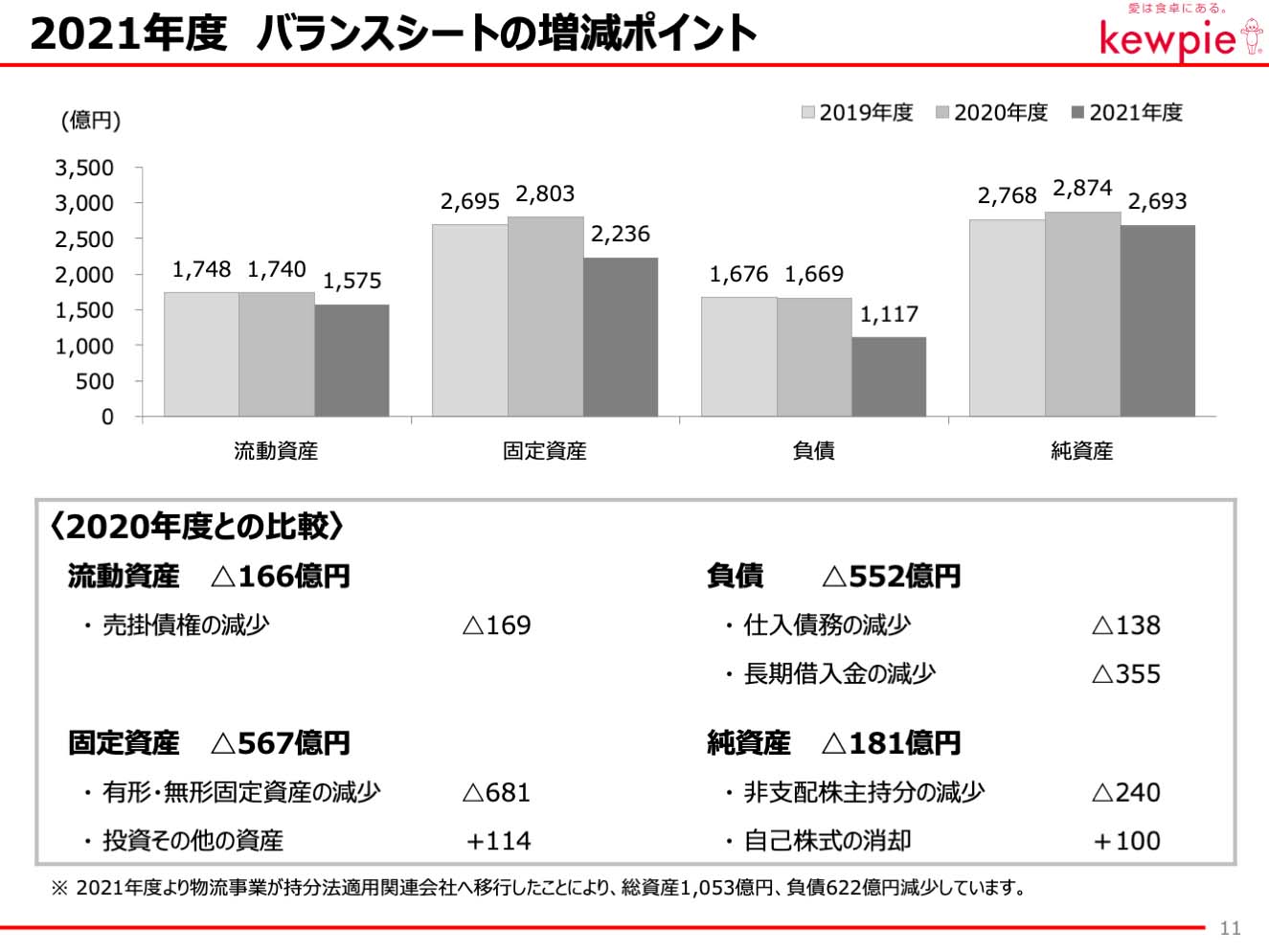
バランスシートですが、物流事業遡及前の数値を記載しています。
純資産の181億円減少には、自己株式の取得による100億円減少、自己株式の消却による200億円増加が含まれています。
なお、総資産は、物流事業の持ち分法化の影響を含めて733億円減少しています。 -
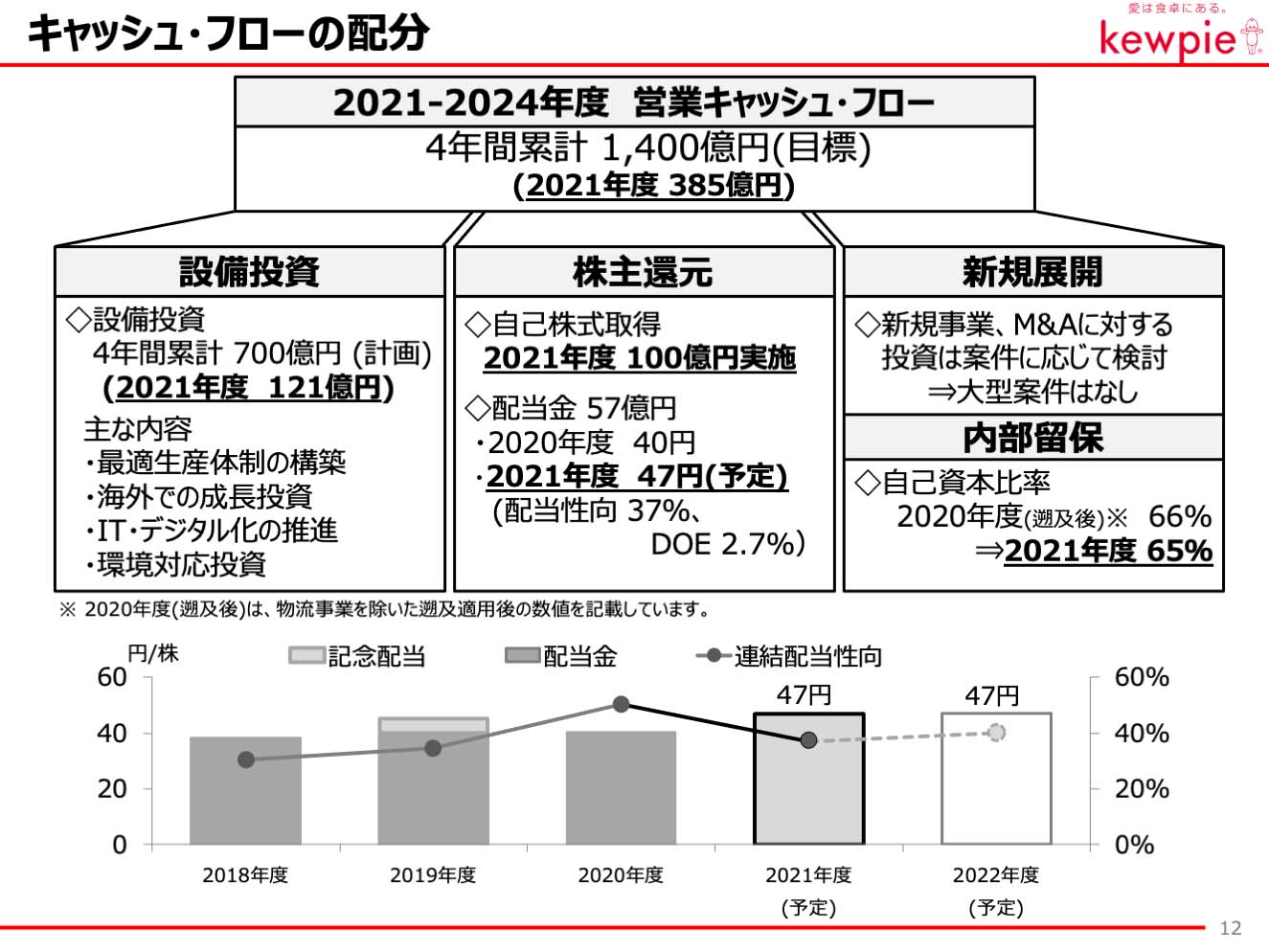
キャッシュ・フローの配分については、中期経営計画4年間累計の営業キャッシュ・フローを1,400億円と計画しており、1年目では385億円とほぼ計画通りに進んでいます。
2021年度の設備投資は121億円となりました。2022年度は191億円を予定しており、こちらも計画通りの状況です。
また12月27日にリリースした通り、2021年度の期末配当金については1株当たり27円を想定し、年間配当は7円増配の47円を予定しています。 -
2022年度計画の概要について。
-
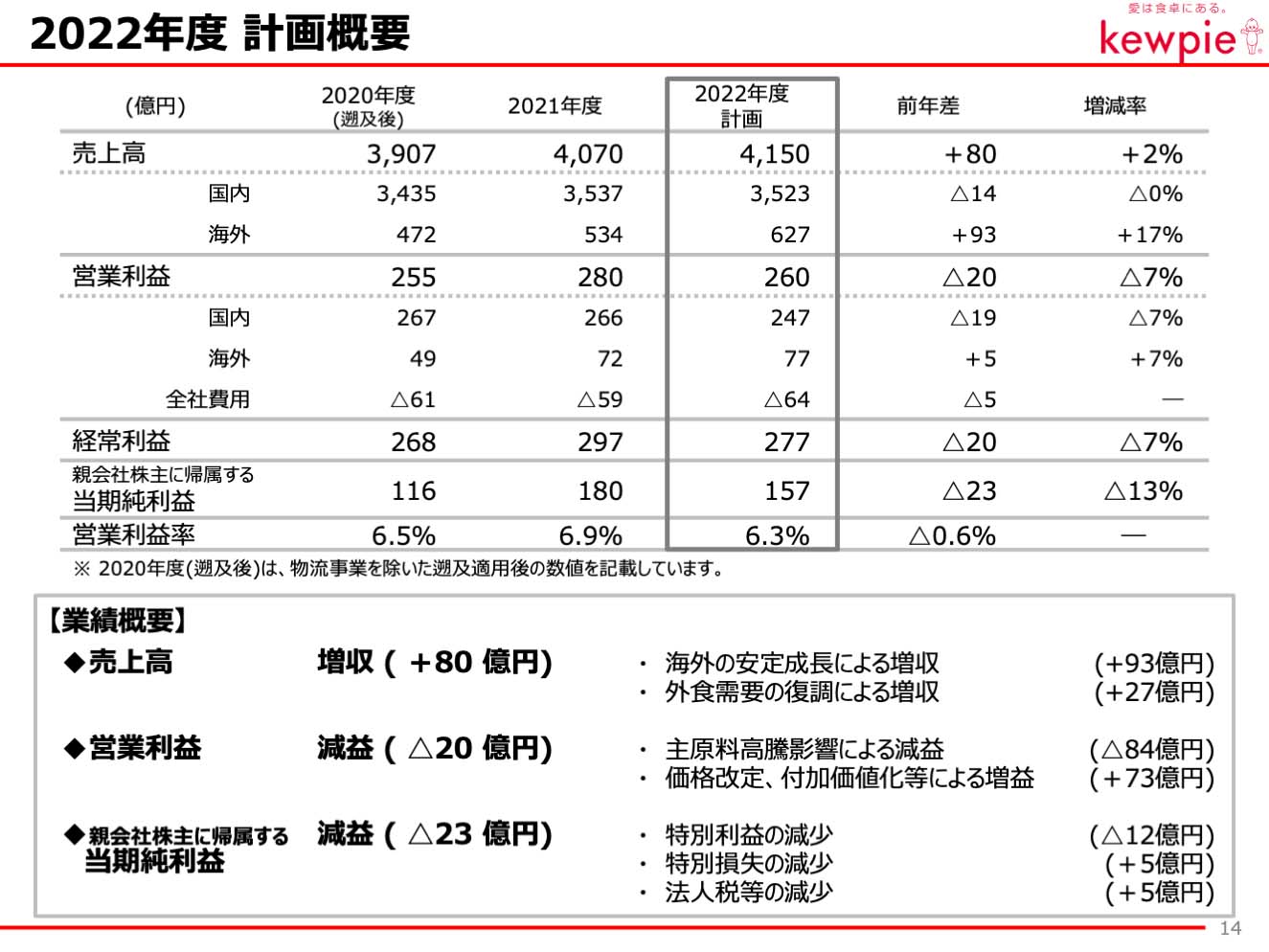
売上高は前年に対して80億円増収の4,150億円、営業利益は20億円減益の260億円を計画しています。
親会社株主に帰属する当期純利益は前年に対して23億円減益の157億円としています。2022年度は主原料相場の影響を大きく受ける年になりますが、この1年を乗り越えることで、中期経営計画の達成に向けた力がつくと考えています。
-
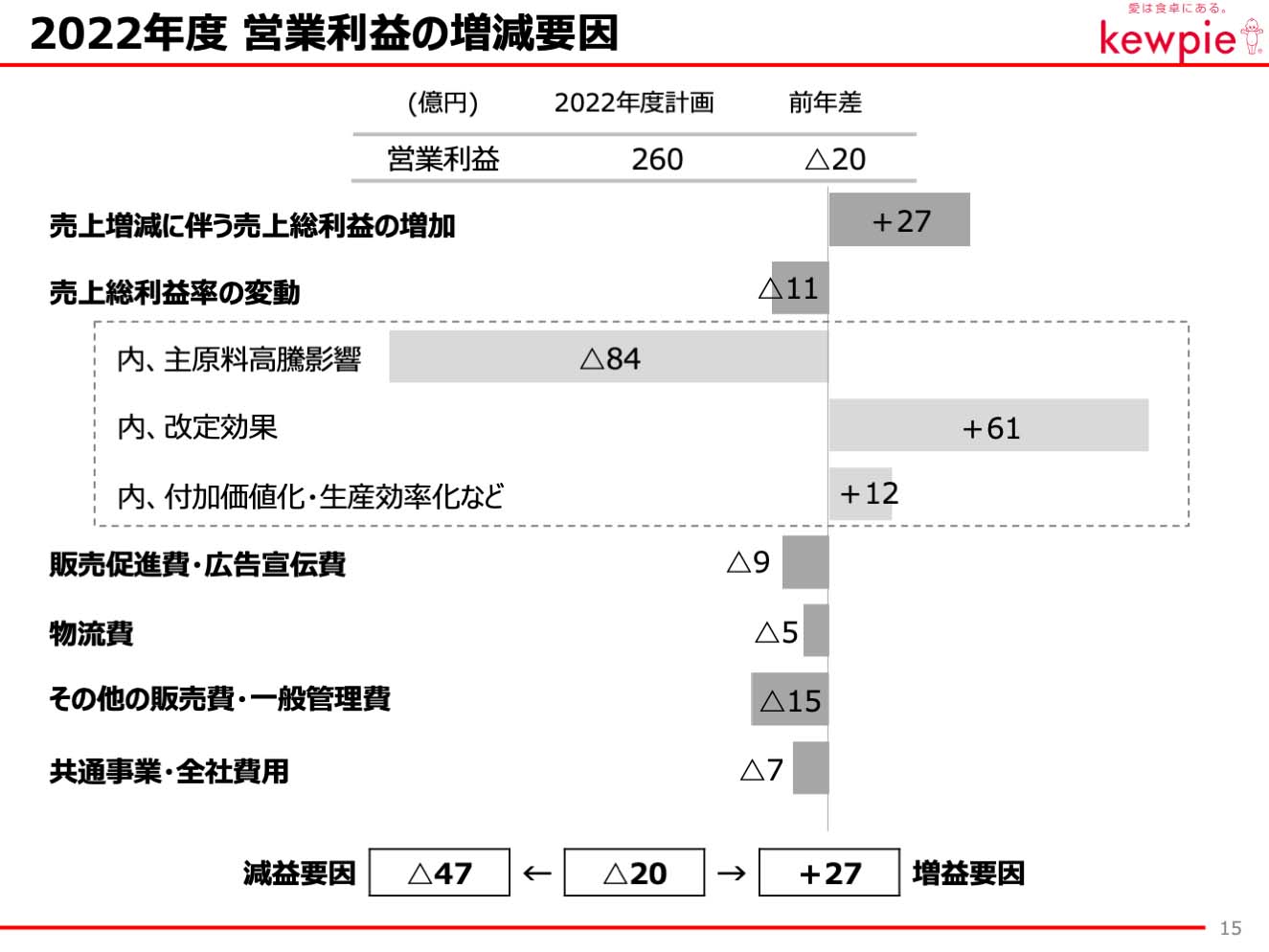
2022年度の営業利益の増減要因について。
売上増減に伴う売上総利益は、27億円の増加を計画しています。
海外での売上成長と、国内では業務用市場がコロナから緩やかな回復があると想定しています。
一方、国内市販用は、3月に実施する価格改定により、需要の影響を受けることを想定しています。売上総利益率の変動は、価格改定効果と、付加価値商品の拡大・生産の効率化の合計で73億円の改善を予定していますが、主原料の高騰影響による減益要因が84億円と見込まれることから、11億円の減益を計画しています。
販売促進費・広告宣伝費は、海外での広告費の増加などにより9億円、その他の販売費・一般管理費では基幹システムの導入に伴う経費の増加などを見込んでいます。
-
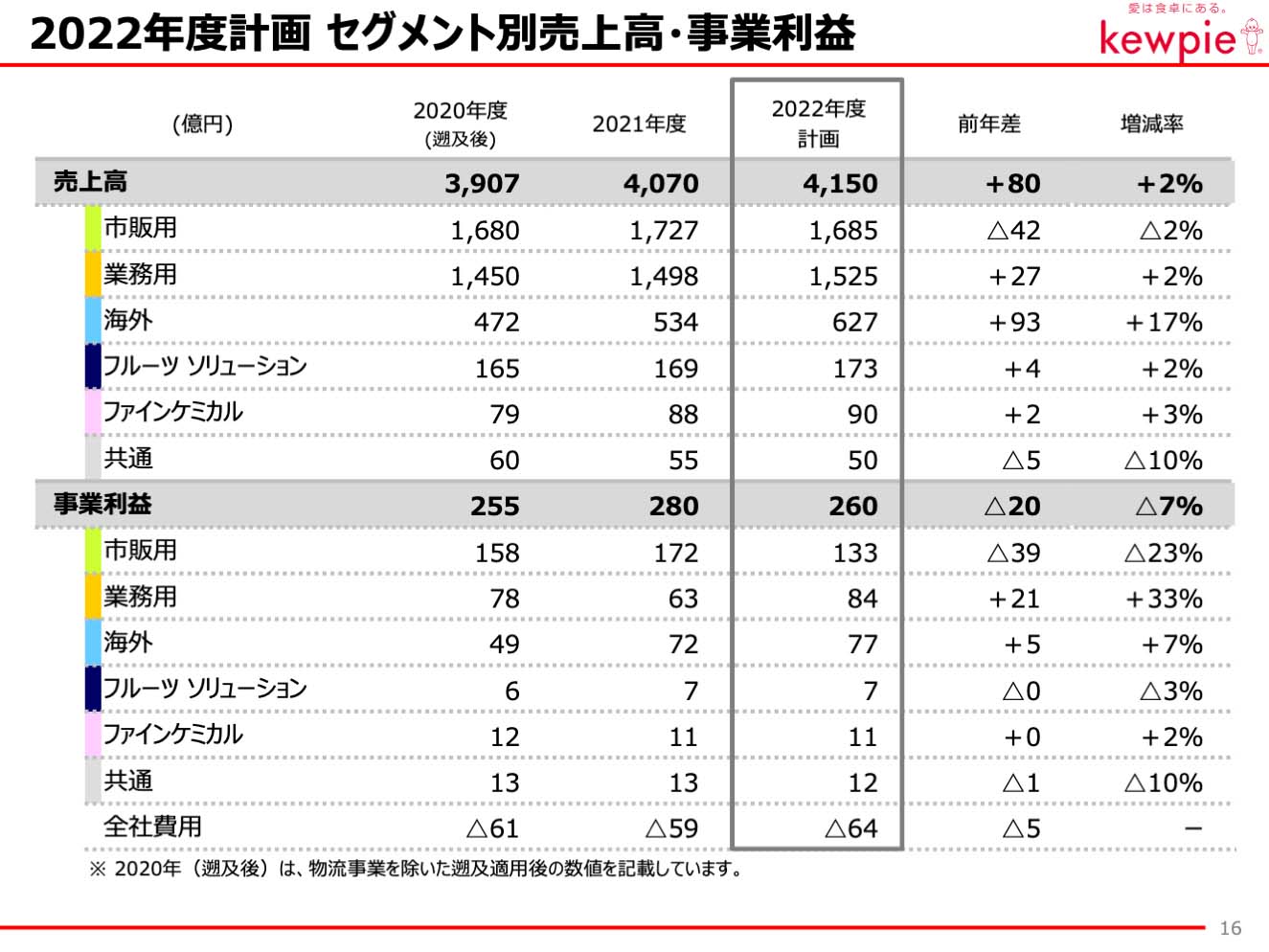
セグメント別の計画について。
まず市販用ですが、減収減益の計画となっています。売上高は、3月からの値上げによる需要の減少を想定しています。
利益については主原料高騰影響と、価格改定後の一時的な需要減少により、39億円の減益を計画しています。業務用では、値上げによる需要の減少はあるものの、外食需要のゆるやかな回復を想定し、増収増益を計画しています。
海外では、中国・東南アジアに加え、北米での安定した成長を継続させ、増収増益を見込んでいます。
-
中期経営計画の進捗状況について。
ちょうど1年前、当社はそれまでの中期経営計画を2年でやめ、あらたな計画を策定し、推進することを皆さまにお伝えいたしました。
お客様の買い物行動の多様化や食習慣の変化に、商品ではなく市場を軸として対応し、新型コロナウイルス感染症拡大の環境にも適応していくために、中期経営計画のテーマを「持続的成長を実現する体質への転換」として、お客様・社会・従業員としっかり向き合っていくことを決めました。
そして2021年度上期ではコロナからの回復が見えない中、内食需要の増加や販管費の抑制などで業績に回復の兆しが見えてきましたが、その後、かつてないほどの主原料高騰の影響を受けることから、昨年7月の決算説明会では短期的な対応を行ったうえで主原料高騰のリスクに対して、中長期に対応をしていくことをお伝えしました。
-
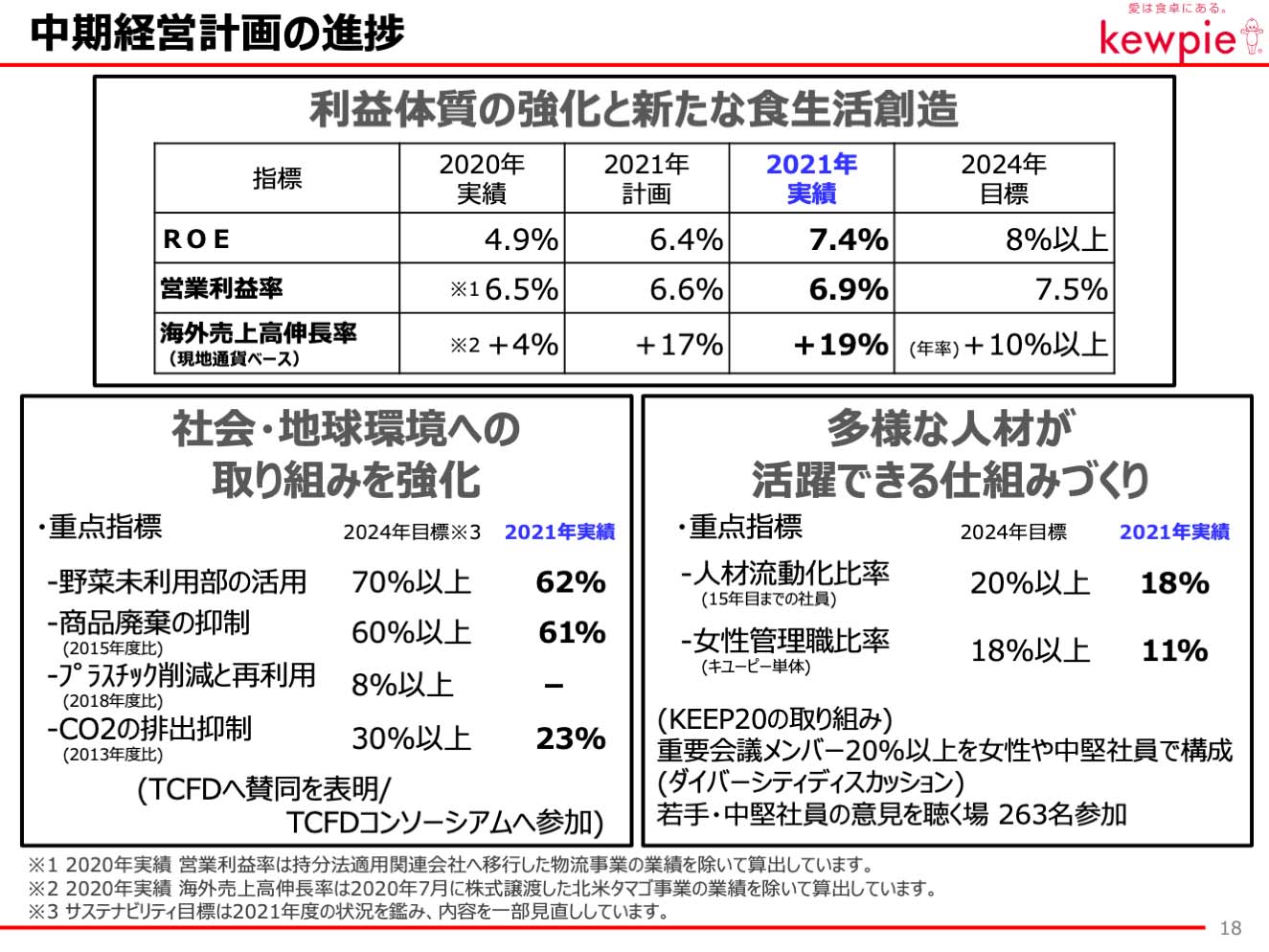
中期経営計画の1年目の結果について。
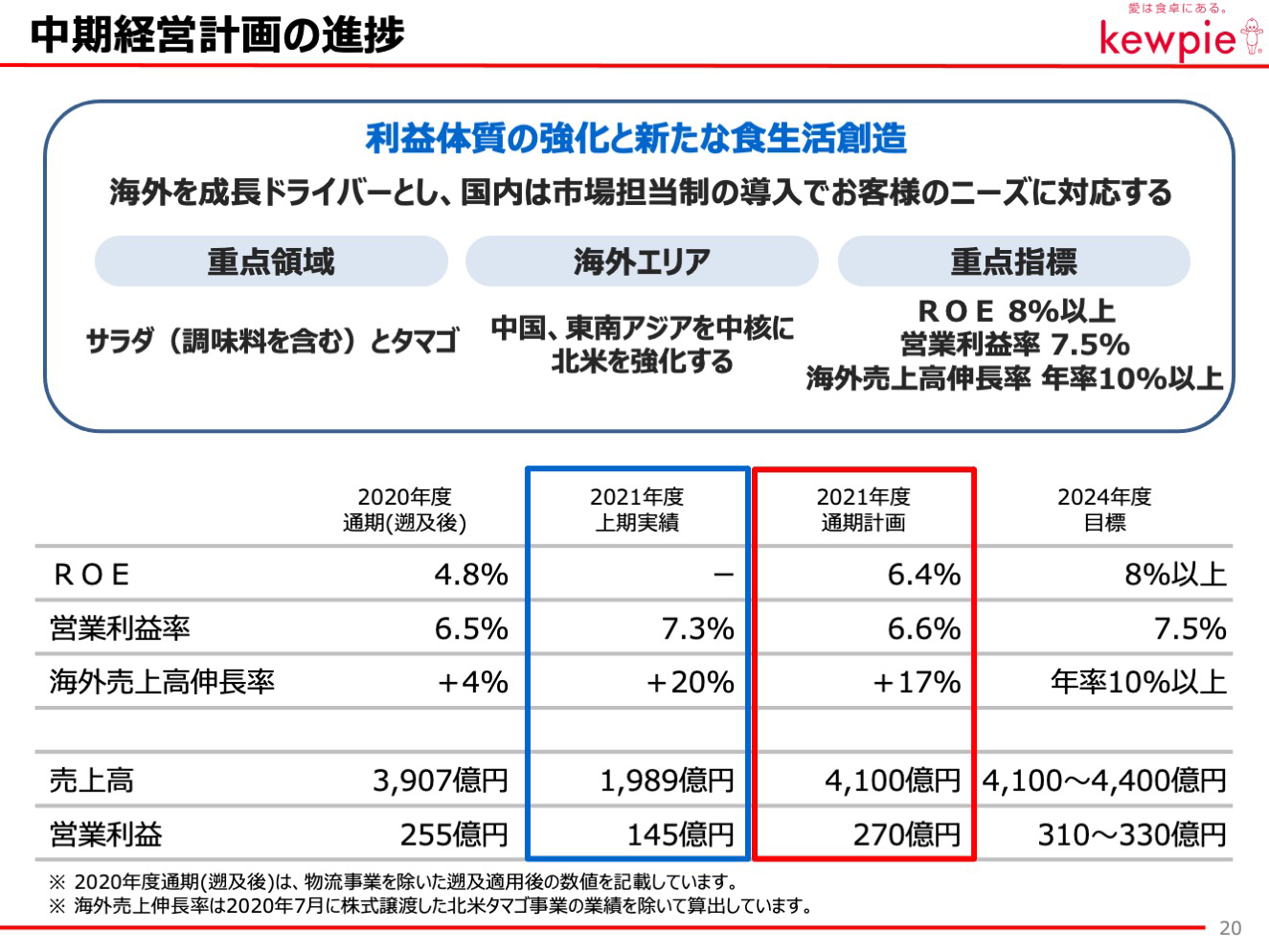
「利益体質の強化とあらたな食生活創造」の経営指標に掲げた、ROE、営業利益率、海外売上高伸長率では、前年のコロナ影響を受けた業績から回復し、おおむね計画以上の結果となりました。
ROEについては当期純利益の回復に加え、100億円規模の自己株式を取得したことから、2024年度の目標である8%に向けて順調に推移しています。
営業利益率については海外成長や市販用での利益改善が貢献しましたが、この後ご説明する主原料高騰の影響により2022年度は大変厳しい状況になる見通しです。
海外売上高伸長率についてはコロナからの回復と成長ドライバーとしての安定的な売上拡大により順調に推移しています。社会・地球環境への取り組み強化についても初年度で当初の2024年度目標を上回る成果となっており、あらためて目標値を見直しました。また、昨年10月に当社はTCFDの提言に賛同を表明し、TCFDコンソーシアムに参画することにしました。
多様な人材が活躍できる仕組みづくりでは、人材流動化として従業員の多様なスキルを活かす場を提供し、また、入社15年目までの社員については新しいスキルを習得できる取り組みも推進してきました。社内でKEEP20と呼んでいるプロジェクトでは、経営会議、利益管理委員会、市場統括会議など重要会議のメンバーの20%以上を女性や中堅社員が参画し、議論の活性化を進めました。
-
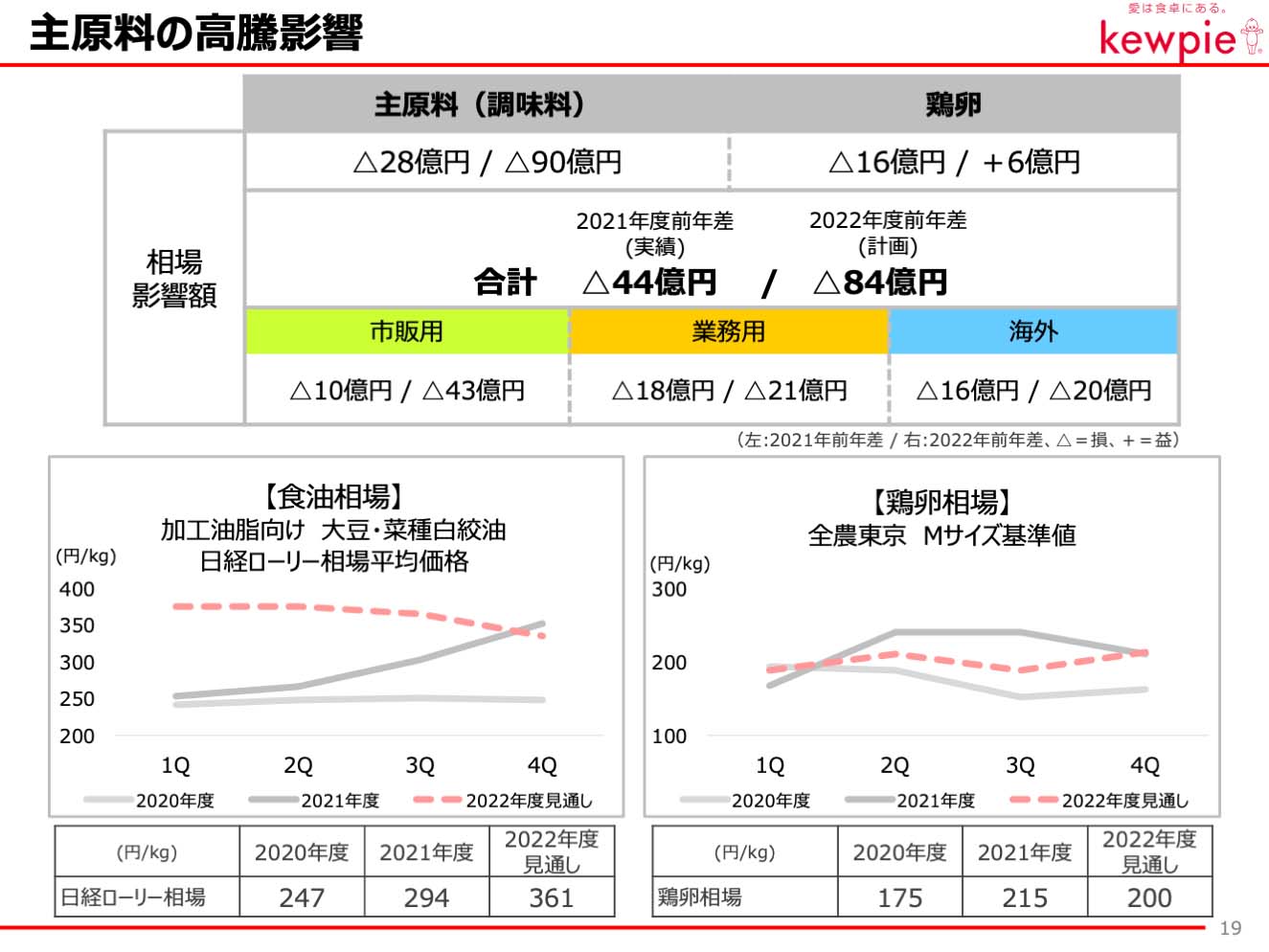
主原料高騰について。
食油相場は2019年まで200円前半で推移していましたが、昨年上期に200円後半、8月から350円まで一気に上昇しました。
また、鶏卵相場も鶏インフルエンザの影響から需給バランスが崩れたことから高騰し、大きなインパクトを受けました。
2021年度は55億円の主原料高騰影響があることを見込んでいましたが、鶏卵相場は当初の見込みよりも若干落ち着いたことから44億円となりました。しかしながら、2022年度は本格的に食油の影響を受けるため、84億円の逆風になると見込んでいます。 -
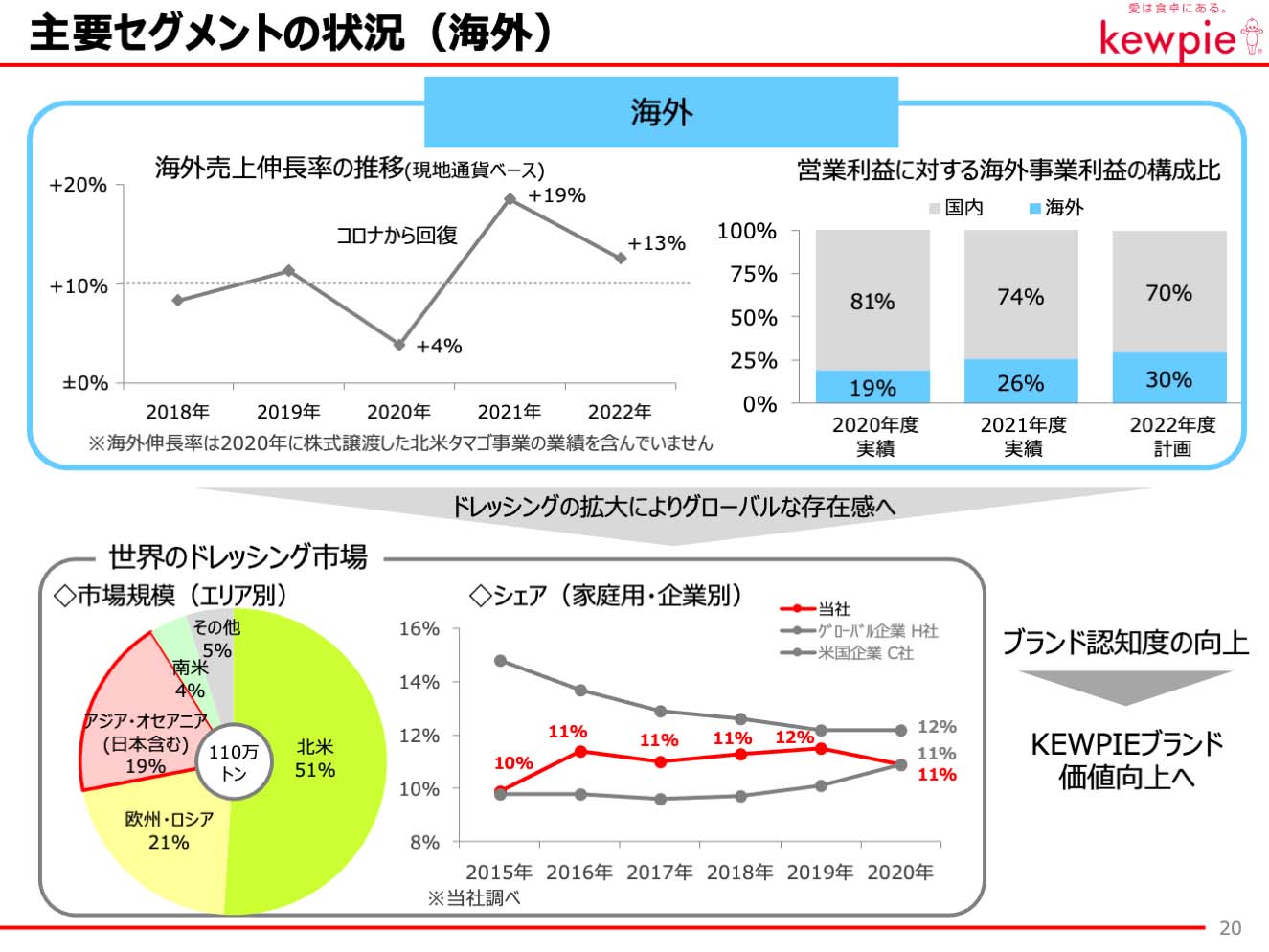
この様な環境の中、海外については2020年度にコロナによるロックダウンの影響を受け、伸長率が一時鈍化しましたが、2021年度はその反動もあり、大きく伸ばすことができました。
2022年度についても2桁成長を維持し、引き続きキユーピーブランドの浸透を進めていきます。
また、2022年度の海外の事業利益は77億円を計画していますが、これは当社グループ全体の3割にあたり、利益貢献度という意味でもグループ全体をけん引する存在感になってきています。2030年には売上構成比で4割、利益構成比で5割を目標に、資源配分もしっかり行っていきます。
現在、当社はメーカー別でドレッシングは世界3位というポジションにいますが、シェアの大部分がアジア・オセアニアであることから、北米、欧州市場ではまだまだ伸びる余地があるものと考えています。深煎りごまドレッシングを国内外で広げ、美味しさやその価値を認めてもらうための様々な提案をしていきます。 -
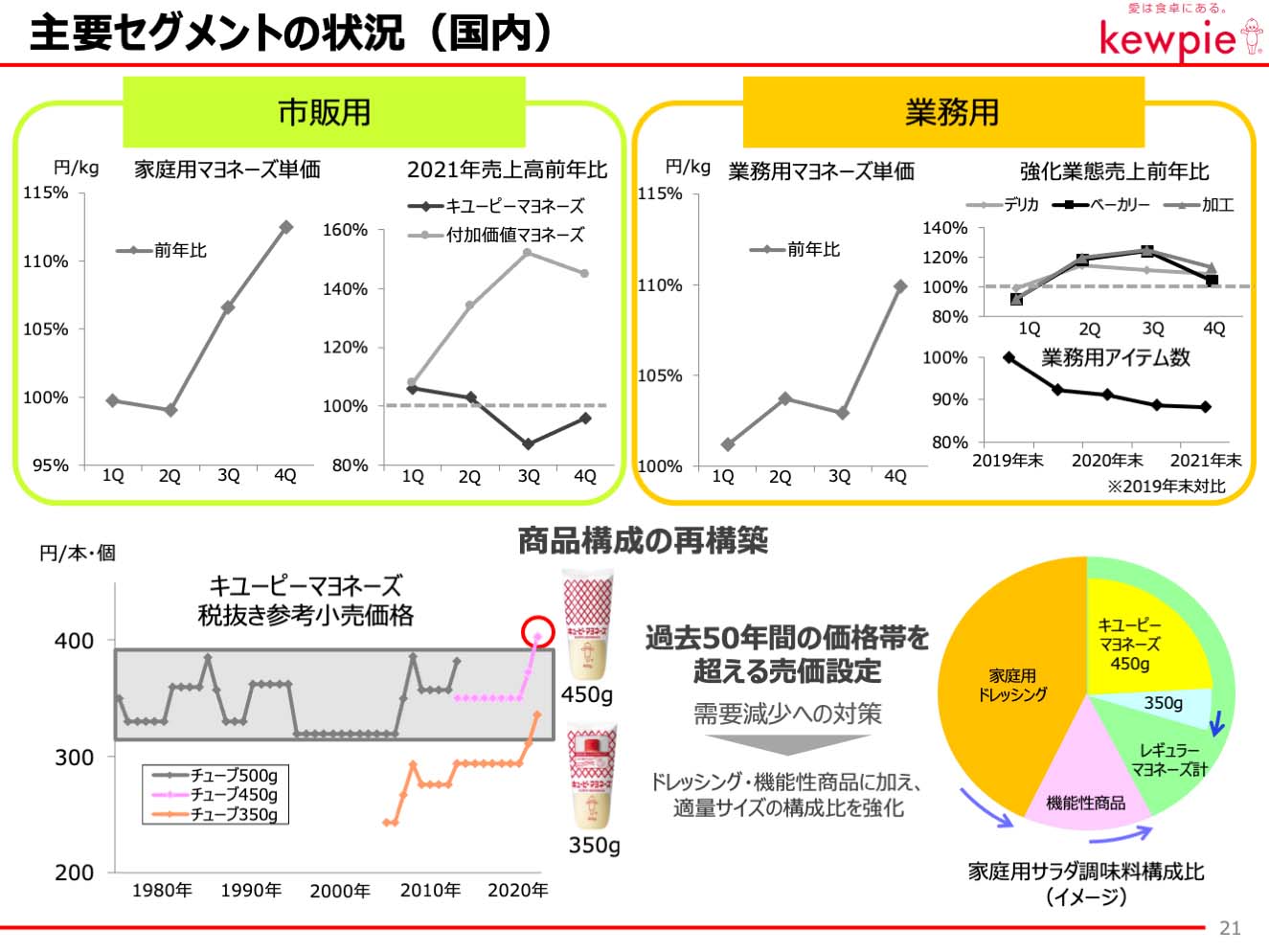
国内では市販用・業務用ともに昨年7月に実施した値上げによる単価上昇が第4四半期から顕著に出てきています。需要については市販用で第3四半期に減少がみられましたが、第4四半期に入ってからは徐々に回復しています。
また、昨年7月にお伝えした付加価値品の取り組みとして機能性マヨネーズの強化については、まだ規模は大きくありませんが、価格改定後でもしっかり伸長しています。業務用ではより一層アイテムの精査を進め、デリカ・ベーカリー・冷食加工などの強化すべき業態に集中する体制作りに取り組んでいます。昨年12月にリリースしました3月からの値上げについて、これまでとの違いは過去50年間の価格帯から逸脱し、今までにないマヨネーズの価格設定でお客様のご理解をいただかなくてはならないということです。
そのため、ある程度の需要の減少を想定していますが、まずはしっかりと商品の価値をご理解いただく努力をしたうえで、商品構成の再構築を進めてまいります。これまでにもお伝えしたドレッシング・機能性マヨネーズへのシフトに加え、容量毎のマヨネーズの価値も見直していきたいと考えています。
マヨネーズ350gは2005年から発売しており、単身世帯・核家族化による一世帯当たりの人数が減少することを想定し、マヨネーズを最後まで美味しく召し上がっていただけるサイズとして開発しました。2020年度の国勢調査では2005年と比較し、人口は150万人減少している中、世帯数は600万世帯増えており、特に単身世帯が著しく増加しています。適量サイズの価値を認めていただき、値上げ後も手に取っていただきやすい350gのシフトも含めて、対応していきます。
-
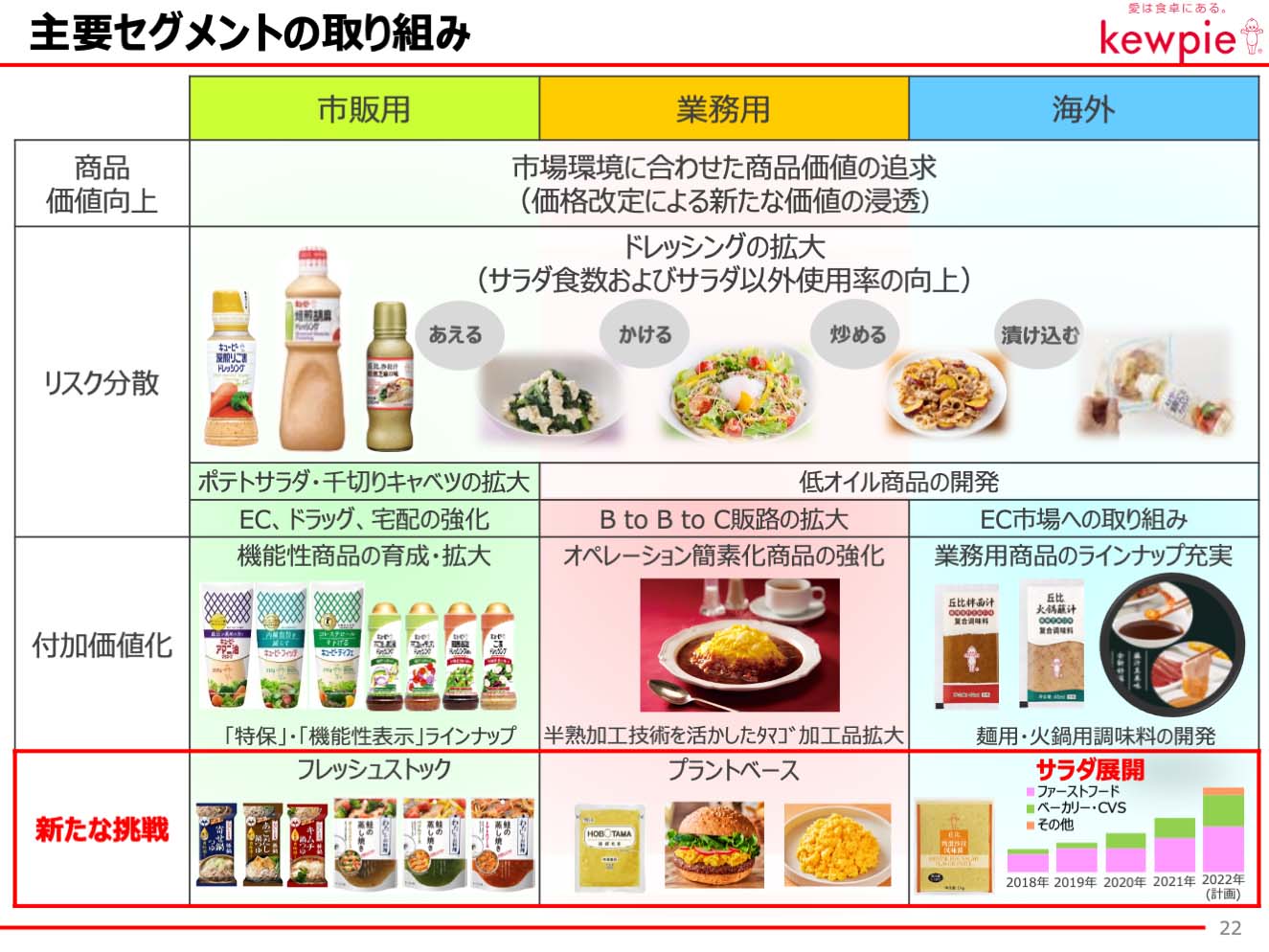
各セグメントの取り組みについては、これまでご説明したものも含めて4つの戦略を描いて進めています。「新たな挑戦」では以前にお伝えしたフレッシュストック事業やプラントベース商品の他に、海外でのサラダ商品の育成を進めています。
-
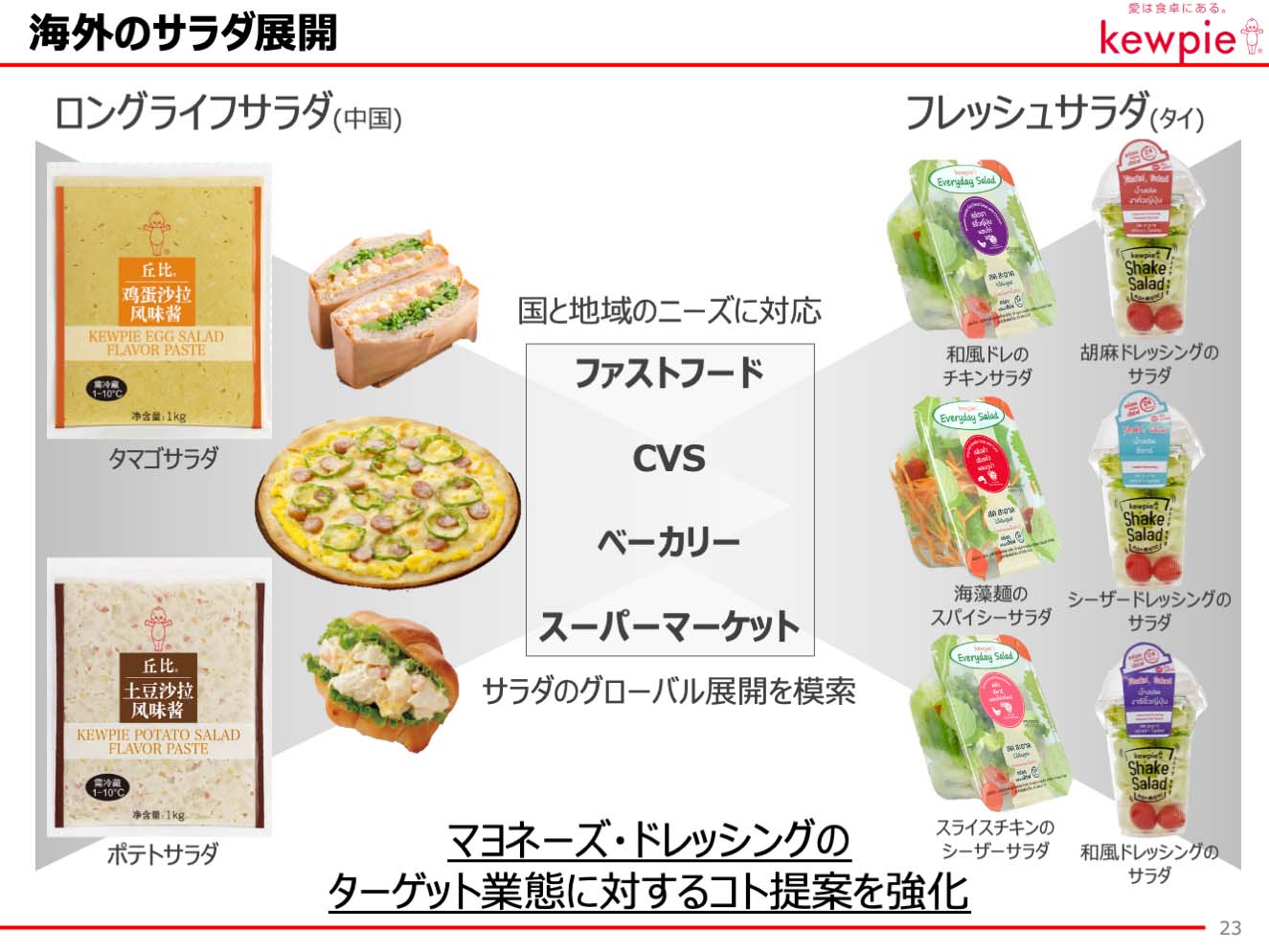
中国ではコロナ収束後の急激な外食市場の回復において、人手不足により店内オペレーションの簡素化が求められています。当社が提供するロングライフのタマゴサラダやポテトサラダへのニーズが急激に高まっており、主力の調味料と合わせてこのカテゴリーを強化していきます。マヨネーズやドレッシングにおけるターゲット業態に対して、当社が得意とするサラダ提案を一緒に行うことで、お客様のニーズにお応えし、価値を認めていただけるものと考えています。サラダ事業のグローバル展開は、その国、その地域のサプライチェーンをしっかり構築する必要があるため、簡単ではありませんが、当社が培ってきた技術と経験でお客様に貢献できるところから水平展開を進めていきたいと考えています。
-
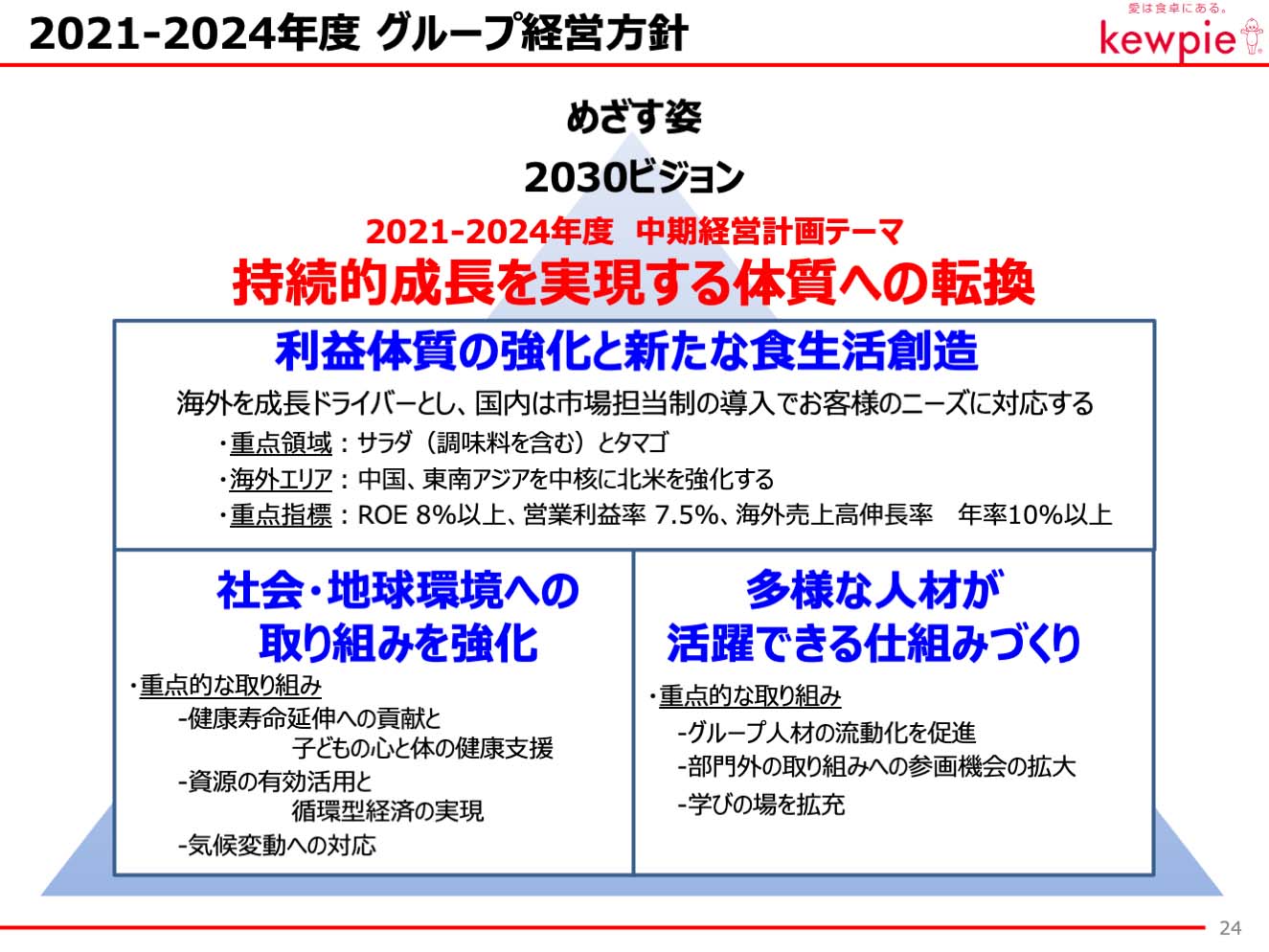
2022年度は主原料高騰の影響を大きく受ける為、減益の計画としています。2年で約128億円の逆風ということになりますが、これまでの取り組みの成果やこれからの対策により、早い段階でしっかりと利益を出せる体質に転換できるのものと考えています。
環境にもよりますが、今回の価格改定をしっかり進めることができれば、2023年には営業利益300億円、さらには中期経営計画の目標達成の道筋が見えてくるものと考えています。
Q&A (Japanese only)
-
The volume of goods decreased when we raised prices in July 2021. While it has been gradually recovering in the fourth quarter of 2021, based on past experience, we anticipate that it will take six months to a year for the new prices to take hold and for demand to return to normal. We suspect that the recovery in volume after the July 2021 price increase was faster than in the past due to lingering demand from people staying at home because of the coronavirus, but we anticipate that the second price increase scheduled for March 2022 will be implemented before demand recovers after the first increase, resulting in a slower recovery in demand.
-
For 2023, we anticipate a stabilization of edible oil prices, resulting in a profit of 3 billion yen. We also expect a 1 billion yen increase in egg prices due to the recovery from avian influenza and another 1 billion yen due to the resurgence of COVID-19. Negative factors include a decrease of 1.5 billion yen due to increased selling, general and administrative expenses, and a decrease of 700 million yen due to increased costs for overseas growth.
-
The surge in edible oil prices is due to the high cost of rapeseed in Canada, and we believe it's unlikely to continue for two consecutive years. Even considering the price increases due to biofuels, we anticipate the recovery described above.
-
We are shifting our focus to salad dressings in the medium to long term. We aim to increase our market share from 42% to 50%, and we believe that expanding our salad dressing business, including Fresh Stock ™, will help mitigate rising raw material costs. While this may be difficult in the short term, we plan to achieve our goals by creating untapped sales channels such as e-commerce.
-
We are working to transform our business into one capable of sustainable growth. Currently, due to the combined effects of COVID-19 and rising raw material costs, we have projected a decrease in profits for fiscal year 2022. However, we will pursue improved profitability towards 2024. We view the surge in key raw material prices as an opportunity to strengthen our business structure, and we will diversify our risk against fluctuations in key raw material prices. We are also optimizing our investments in preparation for 2025 and beyond. Furthermore, while our 2022 plan includes increased costs, we will consider changing direction to generate profits depending on the situation.
-
We anticipate the business negotiations will be challenging. Regarding price increases for our customers, we are basing them on the Nikkei Tanker price for condiments oil, and covering other costs through our own efforts. We want to continue conveying the wonderful qualities of mayonnaise as an essential part of daily life.
-
Our regular mayonnaise remains a strong seller, and the challenge lies in how to launch new product lines. As our next medium-term plan coincides with the 100th anniversary of our mayonnaise launch, we are considering the future of mayonnaise for the next 100 years. Regarding added value, we feel we need to be more creative in how we communicate this to our customers. We will be focusing on health benefits with functional mayonnaise and dressings.
-
In particular, we anticipate a significant decline in mayonnaise sales, leading to a shift from 450g to 350g sizes. Even selling the same number of bottles, smaller sizes take longer to recover, so we plan to compensate for this by expanding the uses of dressings, increasing the production of value-added mayonnaise, and developing other fresh stock and functional dressings. Furthermore, we anticipate a decrease in demand as we recover from the pandemic, so we have set our plans somewhat conservatively.
-
We launched Freshstock ™, and with each company taking on additional responsibilities, we have spent the past year establishing a solid sales system. Freshstock ™ is currently on a scale of 2.4 billion yen in fiscal year 2021, but we aim to generate sales through new channels such as e-commerce, drugstores, and home delivery.
-
In anticipation of a drop in demand following the price revision in March 2022, we anticipate a volume decrease of around 10-15% for mayonnaise and around 10-15% for salad dressings.
-
Regarding the 22% increase in the FY2022 plan (Net sales), the plan calls for a 14% increase on a local currency basis. Growth in FY2021 was driven by a recovery in food service, which had been impacted by the COVID-19 pandemic in FY2020.In fiscal year 2022, we plan to focus on foodservice by proposing local menu items and promoting products such as LL salads to bakeries. For the home market, since these products are still relatively niche, we intend to actively implement sales promotions. Additionally, given the vibrant e-commerce market in China, we plan to strengthen our use of digital channels.
Regarding the risk of lockdowns, while there are risks associated not only with the movement of people but also with the movement of materials and other supplies, we plan to respond to these risks effectively. -
While Q4 2021 saw a downtrend, we believe that the strengths and weaknesses of different business sectors are becoming more apparent in China. Until now, our main focus has been on proposals to full-service Chinese restaurants, but we plan to expand into bakeries, convenience stores, and other retailers. Because we have gained support for our delicious taste and quality, we want to strengthen our food service business, primarily using functional mayonnaise and large-size salads as our strengths. We have also revised our prices for food service products since January 2022. These price revisions are set at a level that does not reduce the volume of products sold.
-
For food service, no change in volume was observed during the first revision in July 2021. For the second revision, we do not anticipate a decrease in volume, and we intend to proceed while maintaining volume to prevent brand switching. Regarding the impact of COVID-19, we are not forecasting it for Omicron shares, but we are planning a 2% recovery in the first half and a 3% recovery in the second half.
-
Regarding our plans, we have made conservative estimates retail market. We believe that if demand after the price revision improves somewhat more than expected, we could exceed our targets. We also believe there is some room for cost control. Downside risks include the possibility that the price revision may not be as favorable as expected. Furthermore, since we have not factored in the current Omicron stock boom in our domestic plans, there is a possibility of a downward revision depending on the situation. The same risks from the impact of COVID-19 apply overseas. Operating income plan of 26 billion yen for fiscal year 2022 is conservative, so please consider it as an absolute value.
-
By shifting from a product-based approach to a market-based system, we feel that each company within the group can now operate more flexibly within a single market.
-
Our company is supported by strong brands and products. We recognize that our products are familiar and commoditized.
I intend to continue improving with confidence. Furthermore, while our existing business has a strong foundation, the world is constantly changing. I want to leverage my lack of sales experience as a strength, offering fresh perspectives to generate revenue and contributing to decision-making from a third-party viewpoint.
I currently work at Kewpie Egg Corporation, a business heavily impacted by both the supply chain and the effects of the COVID-19 pandemic. While the egg business has historically relied on scale expansion for profit generation, this assumption is no longer viable given the projected population decline. I want to leverage my experience working under these challenging circumstances to overcome these obstacles.
2Q Financial Results Briefing
July 7, 2021 (first half of the fiscal year ending November 2021)
-

2021年度上期 決算説明資料
-
-
2021年度上期の概要について。
-
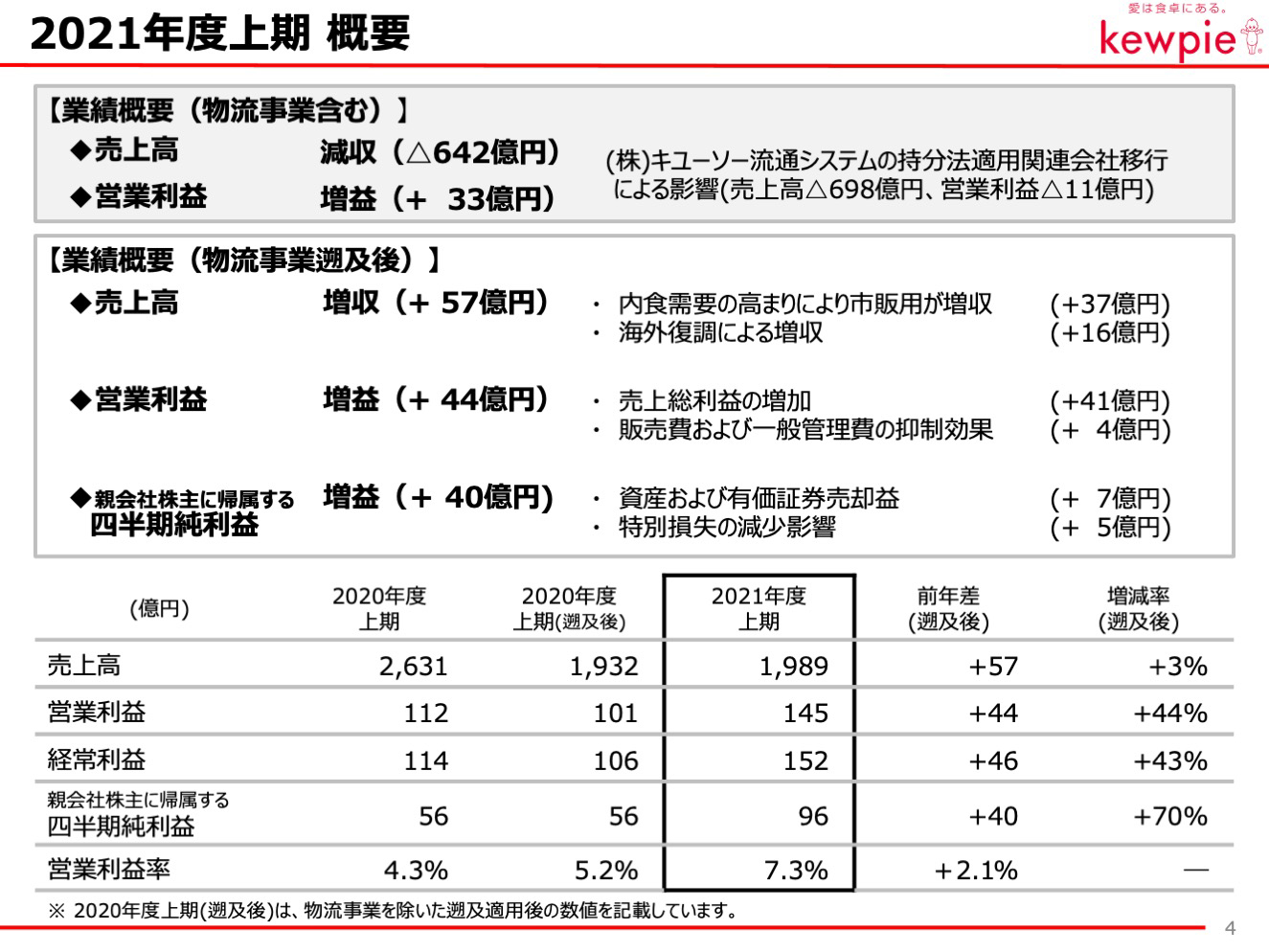
本年1月に、連結子会社であったキユーソー流通システムの株式を一部売却し、持分法適用関連会社へ移行したことにより、売上高については、前年に対して642億円の減収となりました。
営業利益では、物流事業の影響は11億円の減益要因となりましたが、その影響を含めて、前年に対して33億円の増益となりました。2021年度上期については、物流事業を除いた遡及適用後の数値を使用しています。
まず売上高は、前年に対して57億円増収の1,989億円となりました。
国内では引き続き内食需要の高まりにより、市販用の販売が伸長したことや、海外では新型コロナウイルス感染症から回復基調にあったことなどにより増収となりました。営業利益については、売上増加や販売費および一般管理費の抑制に努めたことなどにより、前年に対して44億円増益の145億円となりました。
親会社株主に帰属する四半期純利益は、資産および有価証券の売却益などにより、前年に対して40億円増益の96億円となりました。
-
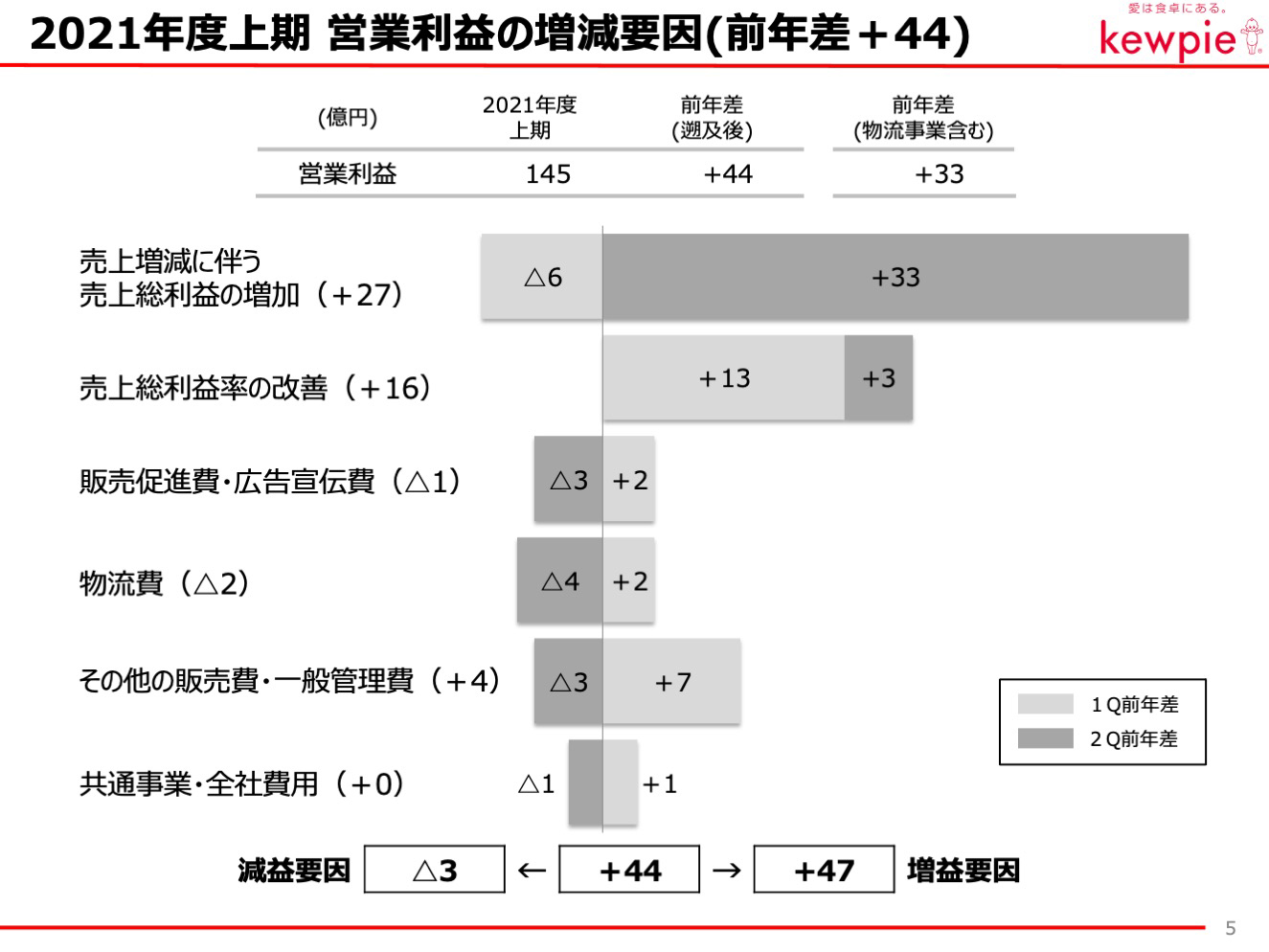
次に営業利益の増減要因について。
2021年度第2四半期に、新型コロナウイルスによる影響が一巡し、第1四半期と第2四半期で、増減要因が変化しています。売上増減に伴う売上総利益の変動については、第1四半期は、緊急事態宣言の再発出による業務用商品の需要低迷が影響し、6億円の減益となりましたが、第2四半期では市販用や海外が伸長したことから33億円の増益となり、上期合計では27億円の増益となりました。
売上総利益率の改善については、生産性の向上や、付加価値品の伸長などにより16億円の増益となりました。
販売促進費、広告宣伝費、物流費、一般管理費などについては、コロナ感染拡大以降、コストコントロールの強化に努め、第1四半期では、12億円の増益効果となったものの、一巡した第2四半期では、11億円の減益要因となり、上期合計では1億円の増益となりました。
-
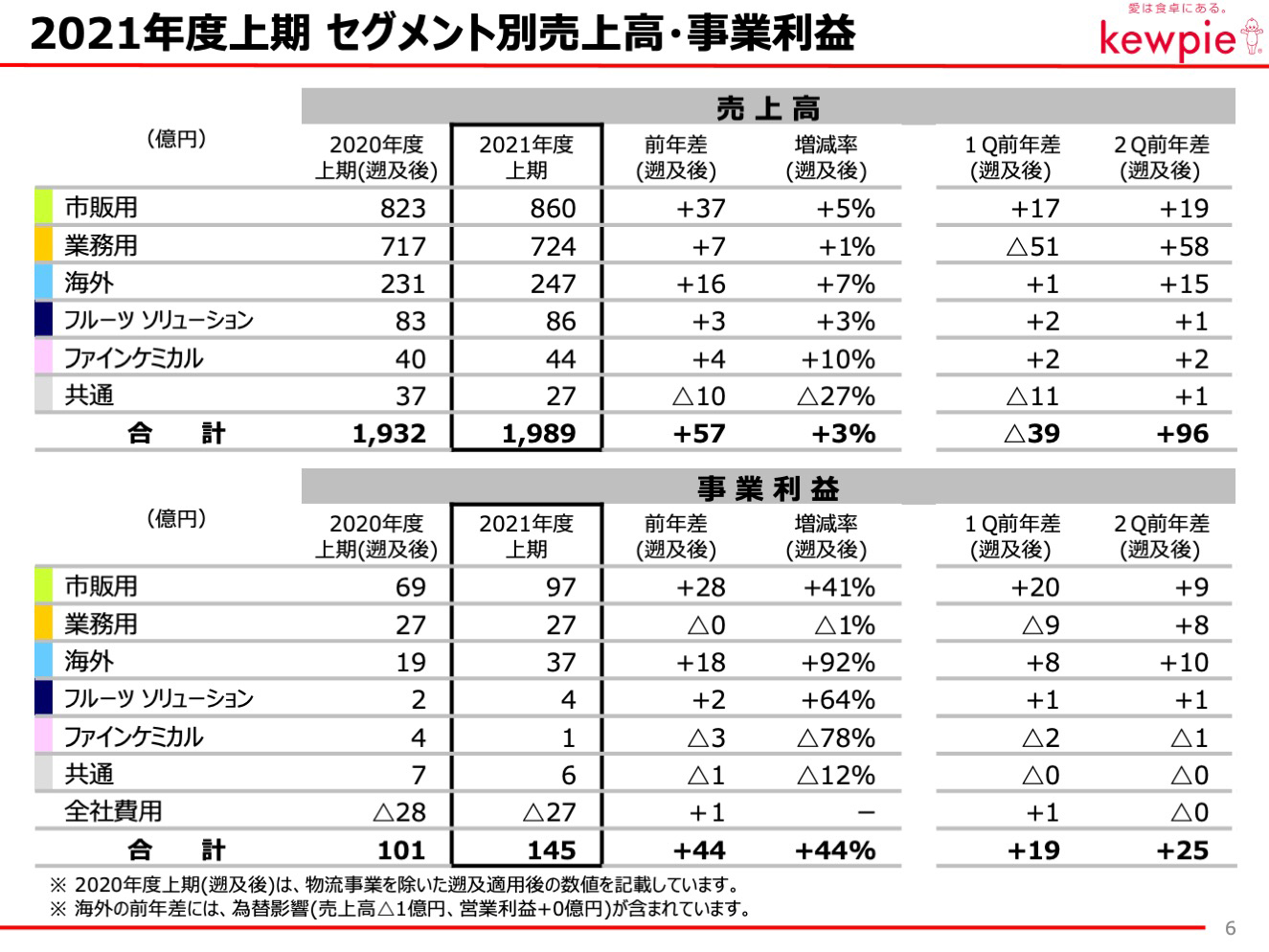
次に、セグメント別の売上高・事業利益について。
セグメント別では売上・利益ともに、市販用と海外がけん引しました。業務用については、コロナによる需要の低迷が続いておりますが、第2四半期は増収増益に転じております。
フルーツソリューションは、家庭用商品が堅調に推移し増収増益となりました。
また、ファインケミカルは通販ビジネスが伸長し、増収となったものの、広告宣伝費の増加により減益となりました。 -
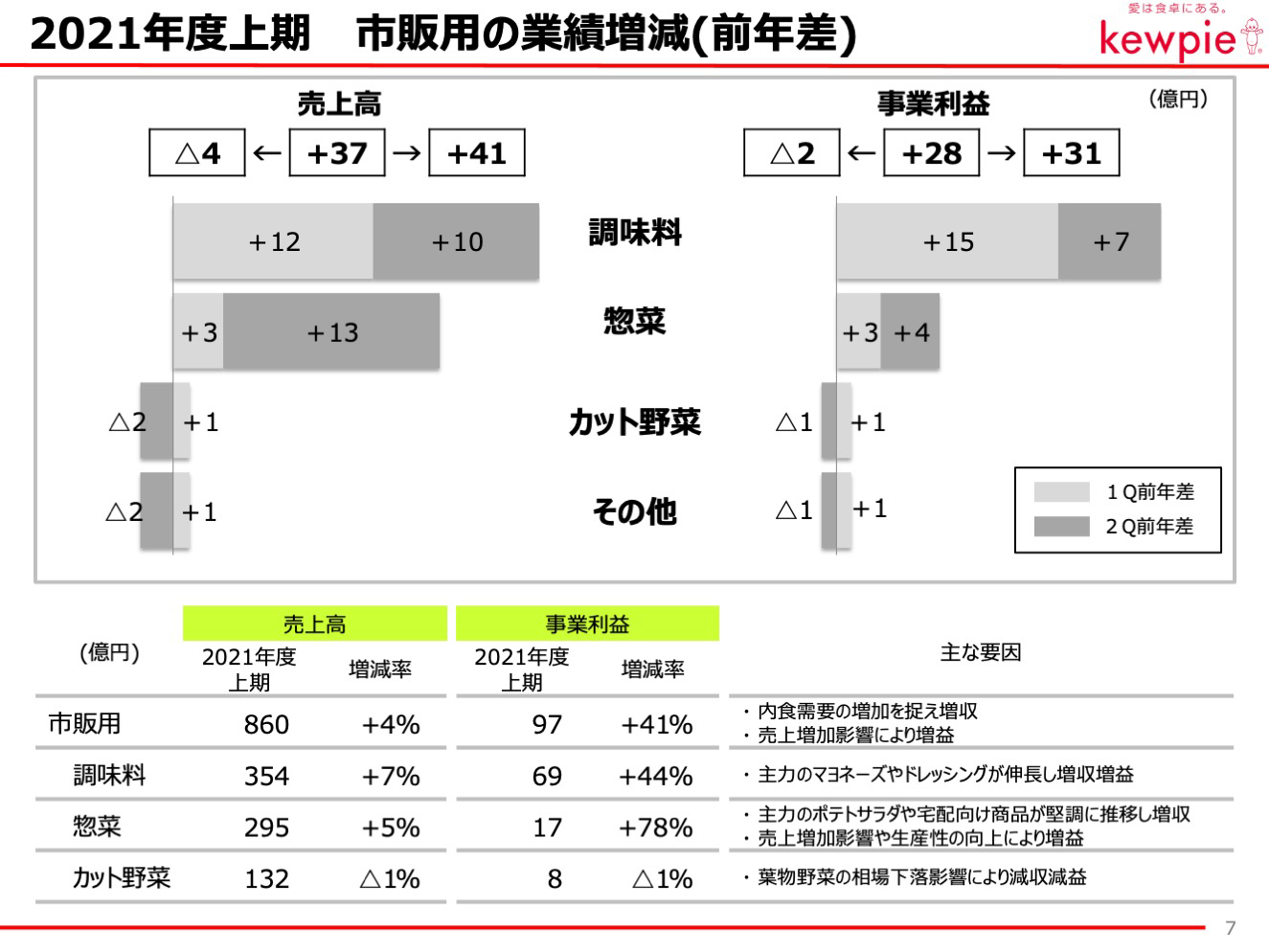
主要セグメントの売上高・事業利益の状況について。
市販用は、第2四半期では昨年に比べ内食需要が落ち着きをみせておりますが、概ね堅調に推移し、増収増益となりました。
調味料はマヨネーズやドレッシングの伸長が貢献して増収増益、惣菜は、主力のポテトサラダ、宅配向け商品が堅調に推移したことや、生産性の向上に努めたことなどにより、増収増益となりました。
カット野菜は、「葉物野菜相場」が軟調に推移していることが影響し、減収減益となっています。 -
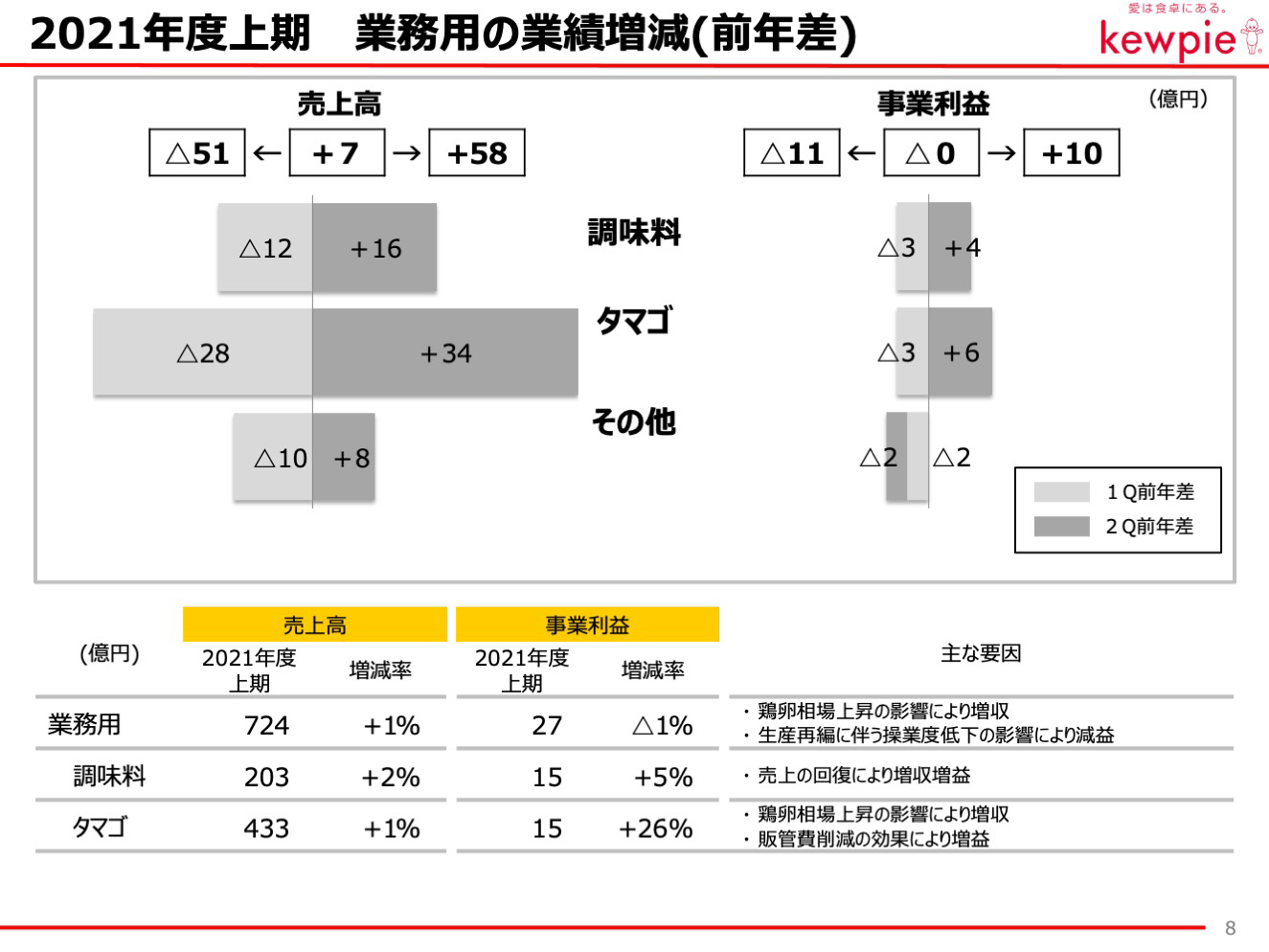
業務用については、第2四半期でコロナ影響が一巡したことから、第1四半期とは大きく異なる状況となっています。
調味料は、第1四半期の減収を補う売上の回復により、増収増益となりました。
タマゴは、鶏卵相場上昇の影響により増収、利益については販管費の抑制に努めたことにより増益となりました。
-
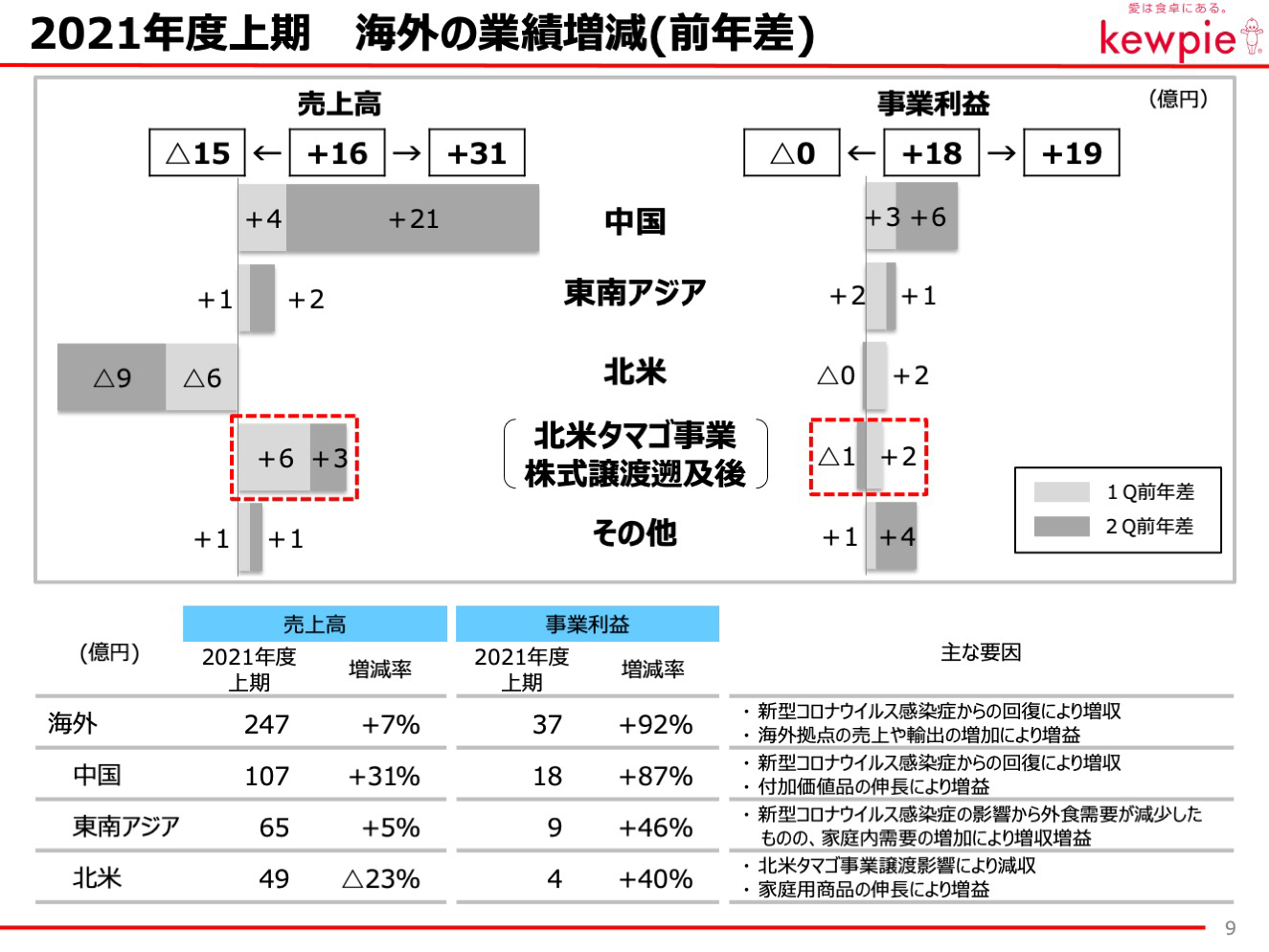
海外は、中国を中心にコロナからの回復がみられ、増収増益となりました。
また、現地通貨ベースでの海外売上高伸長率は120%となりました。エリア別では、中国は外食需要の回復に伴い業務用商品の売上が増加し、増収となりました。利益は売上増加とドレッシングの伸長などにより増益となりました。
東南アジアは、コロナ影響は国ごとに違いはありますが、内食需要の増加により家庭用商品が好調に推移していることから、増収増益となりました。
北米では、2020年7月に株式譲渡したタマゴ会社の影響があり、売上高は減収となりましたが、調味料だけでみると、ブランド品の売上が堅調に推移したことや、生産の効率化により増収増益となっています。
-
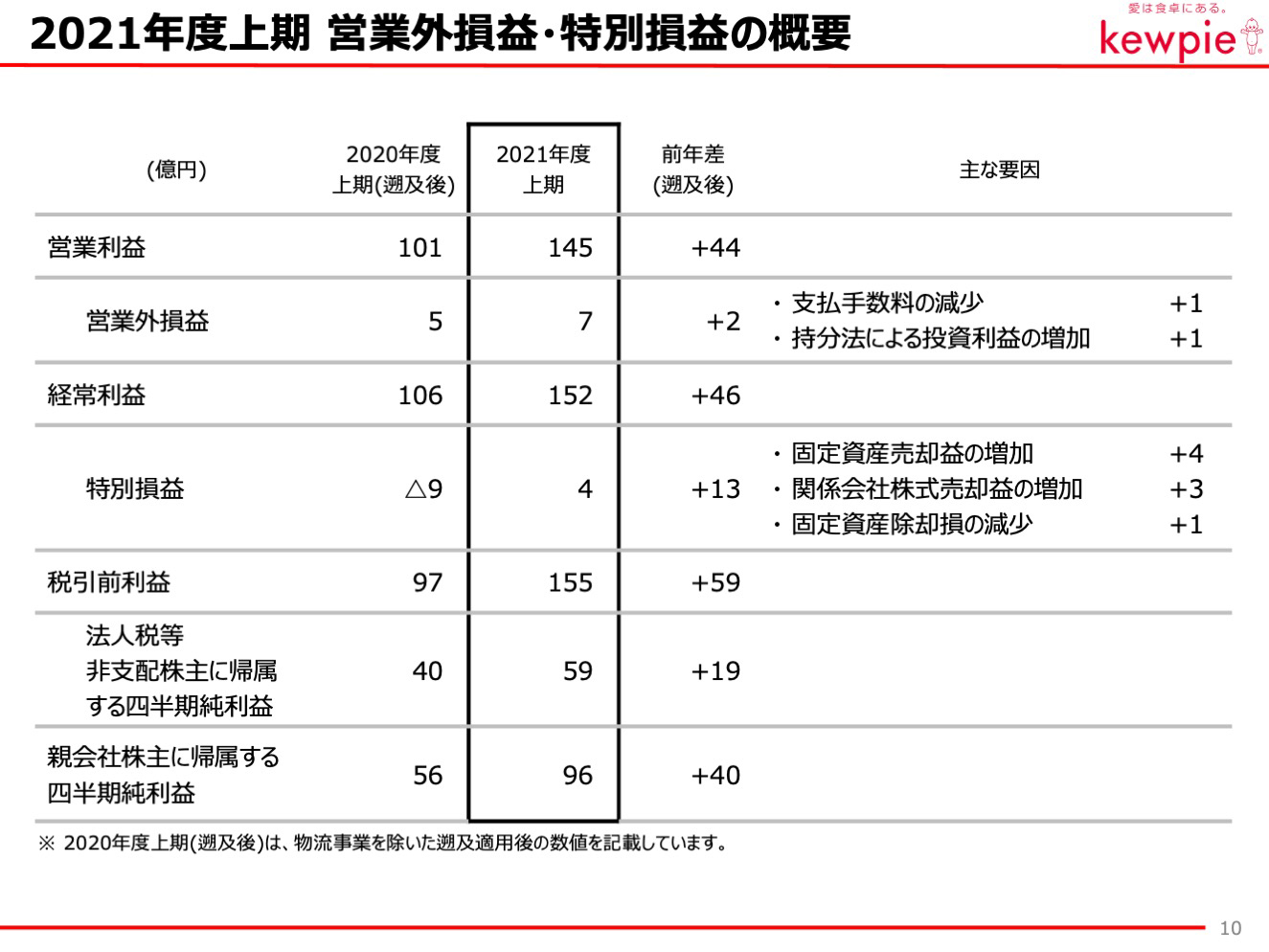
次に営業外損益、特別損益の概要について。
営業外損益は、前年に発生した一時的費用の減少や、持分法による投資利益の増加により、2億円増加しました。
特別損益は、生産再編に伴う固定資産や、関係会社株式の売却益などにより13億円増加しました。 -
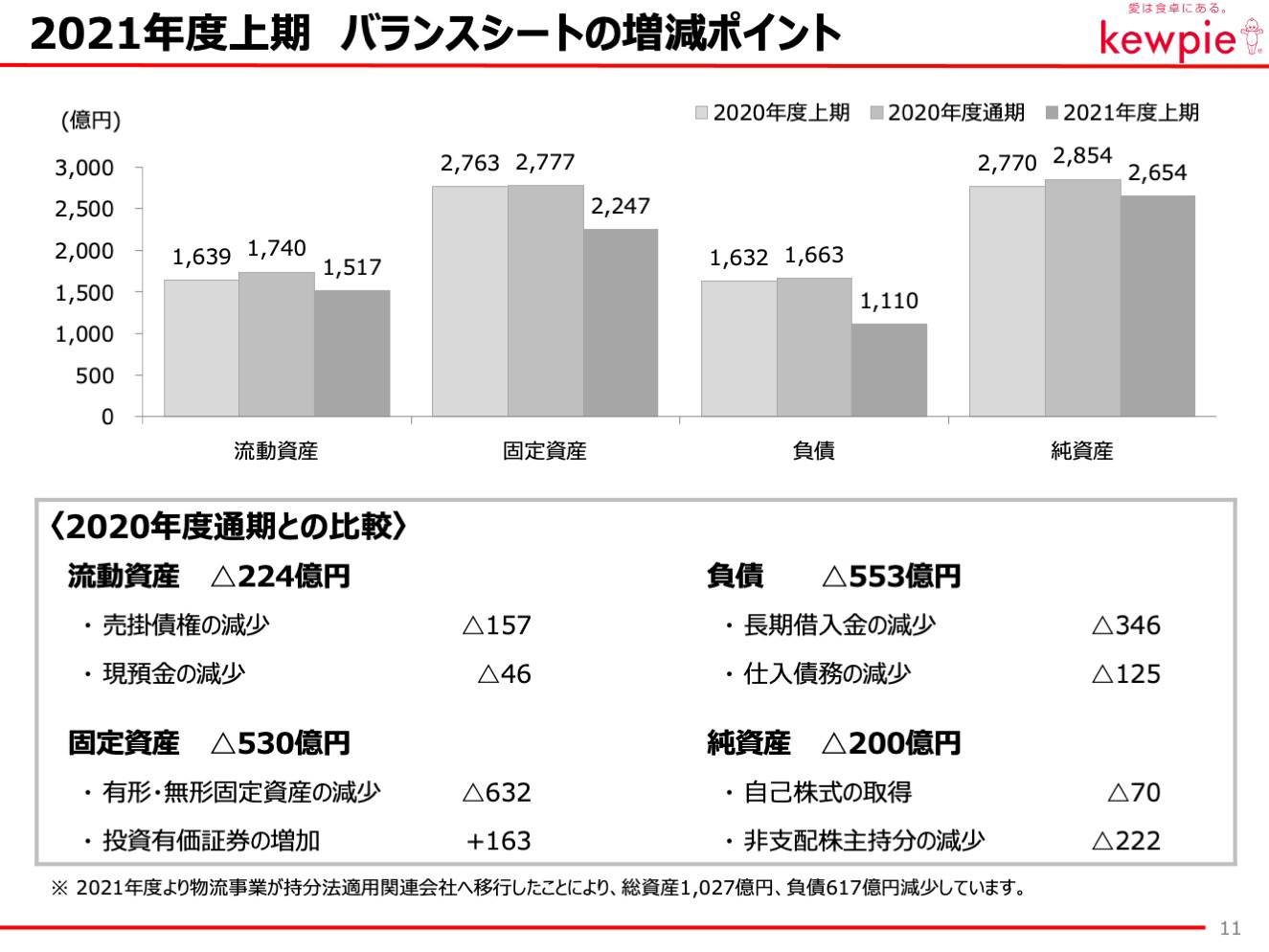
次にバランスシートですが、物流事業が持分法適用関連会社に移行したことにより、総資産で1,027億円、負債で617億円減少しています。
また、純資産については、1月より実施している自己株式の取得が70億円影響しております。 -
2021年度計画と主原料相場への対応について。
第2四半期業績についてはおおむね堅調に推移しました。 -
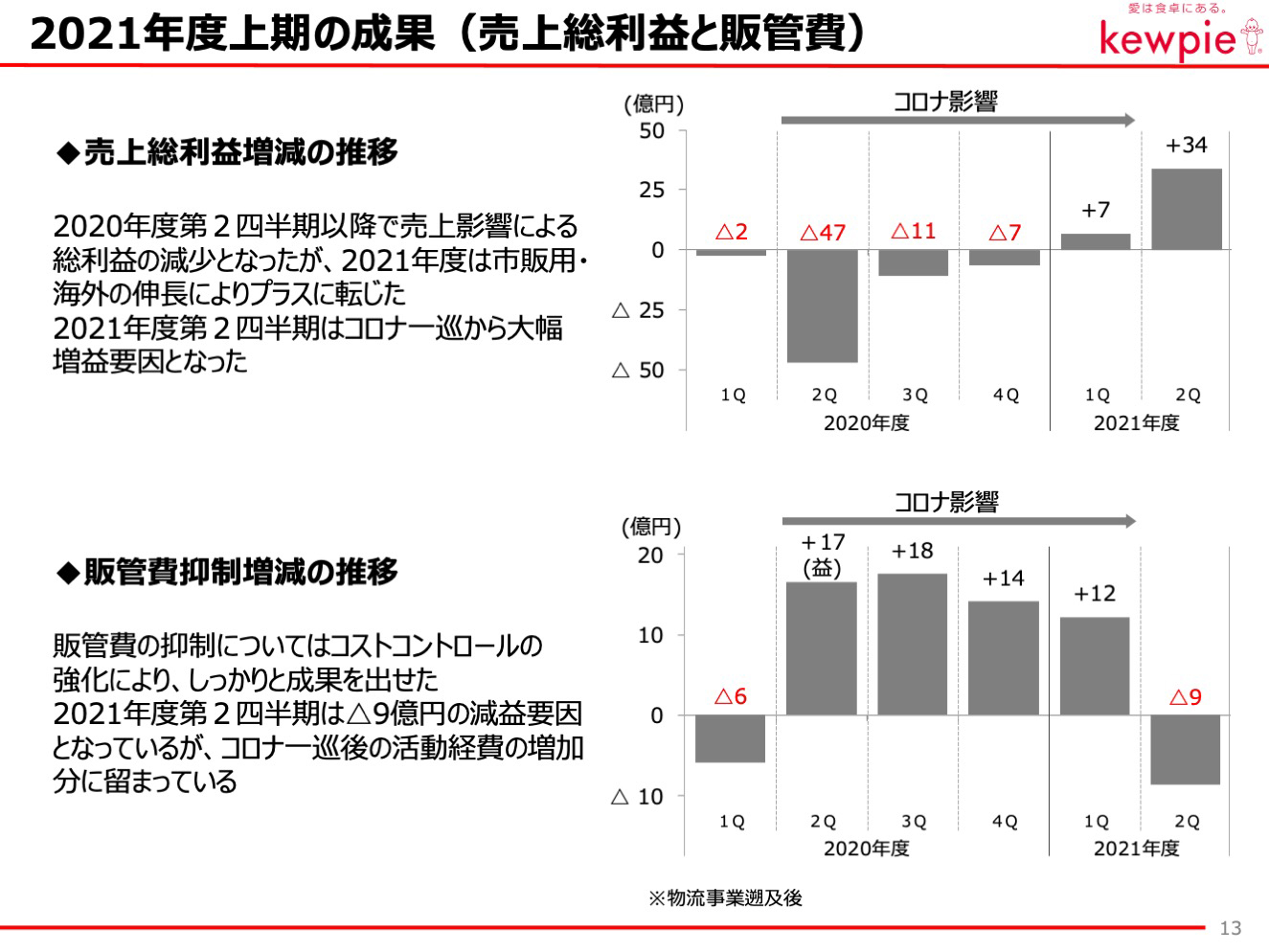
当社グループは昨年、新型コロナウイルス感染症拡大の影響を受け、大幅な減益となりました。ちょうど1年前「コストコントロールの強化」と「売上総利益率の改善」に取り組むことをお伝えしました。
現在もコロナ影響は続いており、売上総利益については、昨年第2四半期のマイナス分を取り戻すまでの回復に至っておりませんが、市販用・海外の伸長によりプラスに転じることができました。販売促進費・一般管理費の抑制ではグループ一丸となってコスト意識を高め、昨年の第2四半期から今年の第1四半期までの1年間で累計61億円のコスト削減を実施しました。コロナが一巡した第2四半期の3月~5月では経済活動の再開に伴い、物流費などのコストは増加傾向となっておりますが、一定程度の抑制を継続できているものと考えております。
-
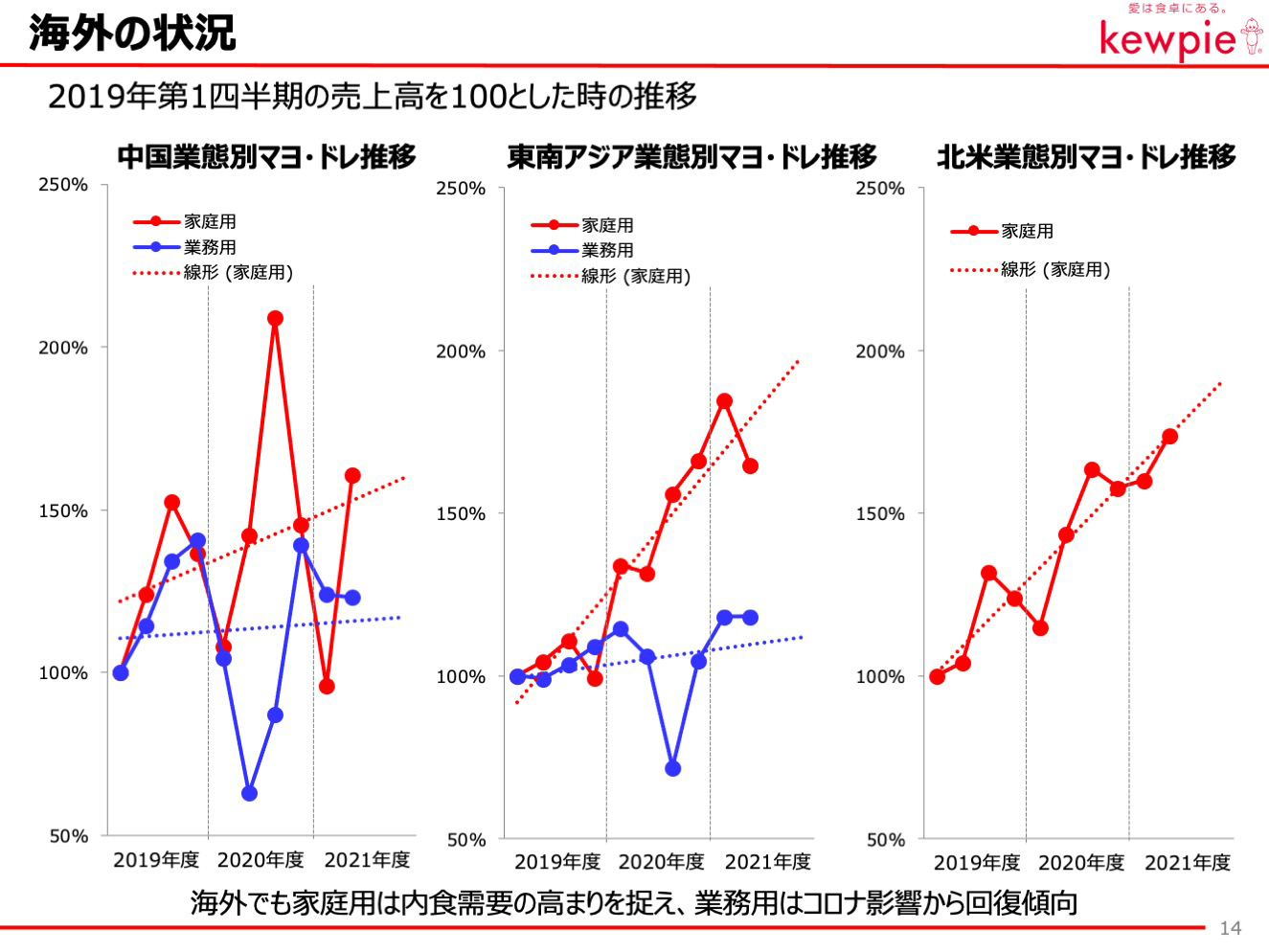
2019年第1四半期の売上を100とした時の海外各エリアの伸長率の推移です。
内食需要の高まりをとらえ、家庭用商品が大きくけん引しております。
また、業務用商品においても、昨年のコロナによる需要減少を受けた後から回復していることがご覧いただけると思います。
特に北米エリアでは深煎りごまドレッシングなどのブランド品の好調に加え、家庭用のOEM商品も堅調に推移しており大幅な増収となっております。 -
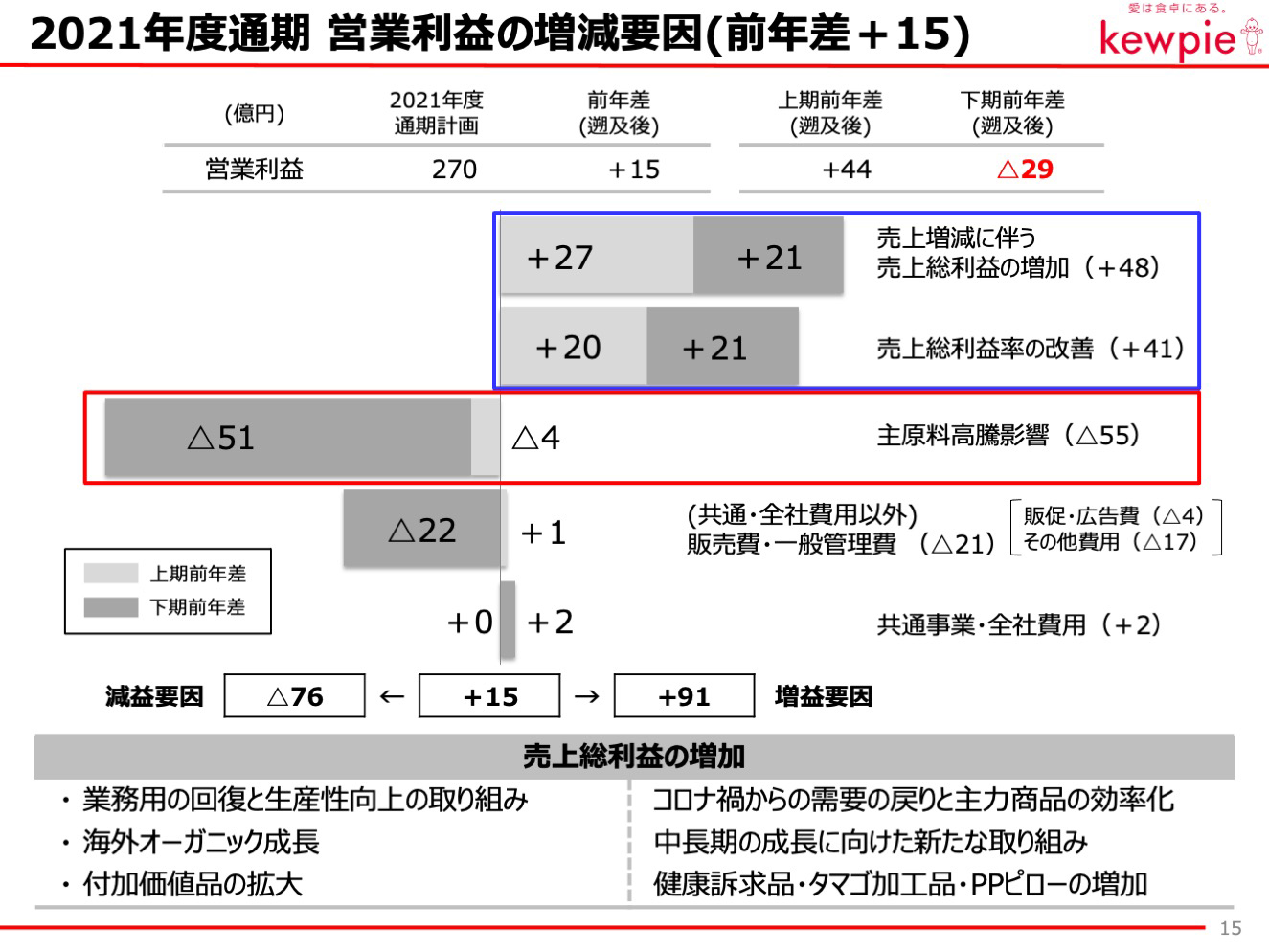
このような状況から下期においても売上総利益の向上と販売費・一般管理費の効率的な配分を徹底し、利益にこだわってまいりますが、マヨネーズの主原料となる食油と鶏卵の相場が高騰しており、業績に大きな影響を及ぼす見込みとなっております。
すでに4月26日にリリースしている通り、主力のキユーピーマヨネーズ450gについては22円、キユーピーハーフ400gについては11円の値上げを実施しております。7月1日から改定させていただいており、今の所お客様からご理解をいただけております。 -
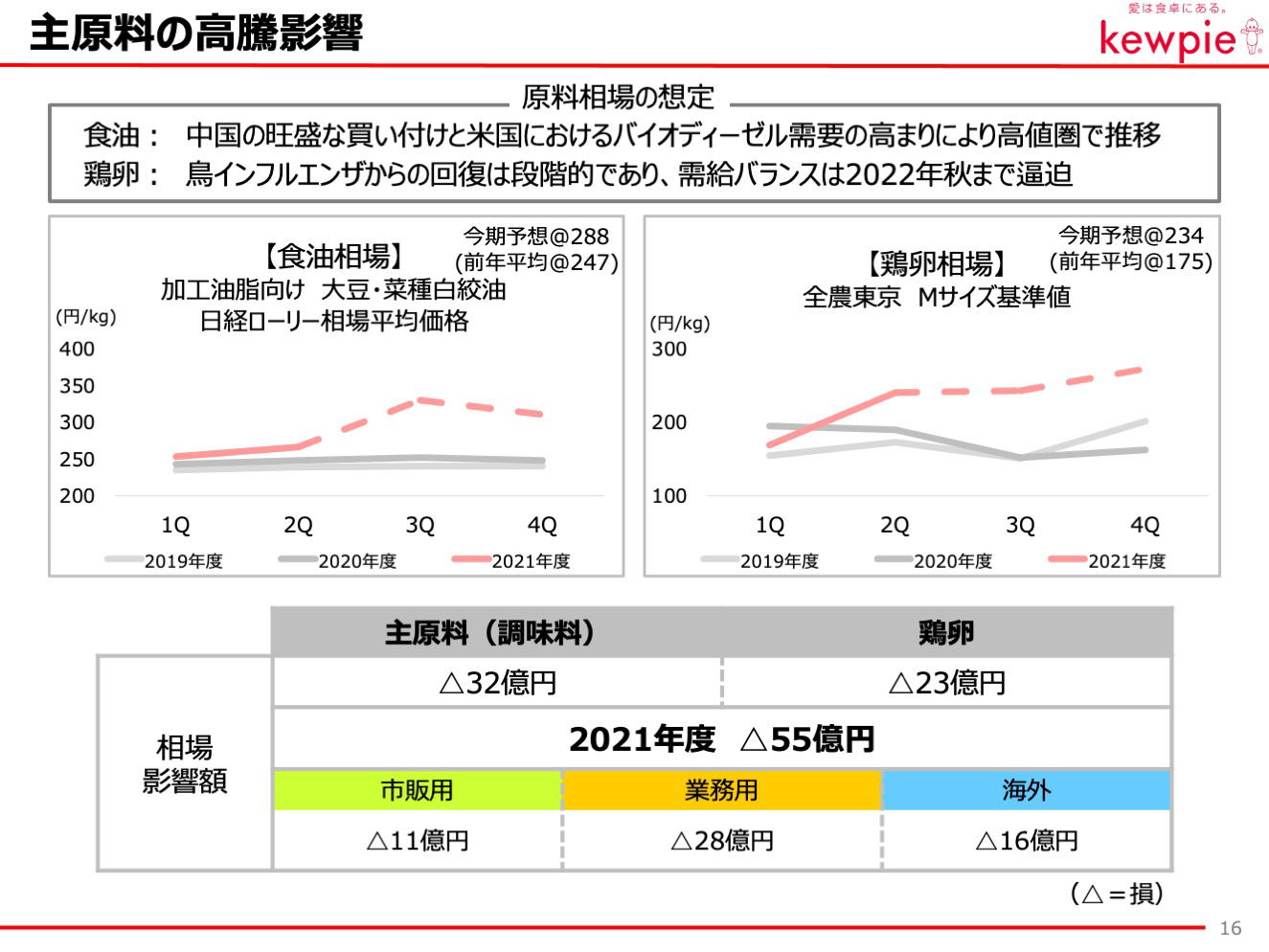
主原料の高騰については鶏卵相場の影響とあわせて55億円のコスト増加を見込んでおります。
世界的な油糧種子の指標となるシカゴ大豆相場は、中国の旺盛な買い付けや米国におけるバイオディーゼル需要の高まりから高値圏で推移しております。
一時的な調整局面で下がることはあっても長期トレンドとしては高値安定が継続するものと考えております。
また、日本における食油価格の指標となる日経ローリー相場は、先ほどの原料相場の状況から、製油メーカー各社が4月からキロあたり20円、6月から30円、8月から50円の値上げを表明しており、海外相場と同様に高値で推移するものと考えております。鶏卵相場については昨年11月から今年3月にかけて、香川県や千葉県などで鶏インフルエンザが相次ぎ、過去最高の殺処分数により、生産量が5%以上落ち込んだことから需給がひっ迫し、相場が急騰いたしました。
今後、採卵用の羽数は段階的に増加する見込みですが、来年秋まで需給バランスはひっ迫するものと想定しております。今年の影響額は先ほど申し上げた通り、55億円程度を見込んでおりますが、来年もこの影響が同程度もしくはそれ以上続くものと考えております。
-
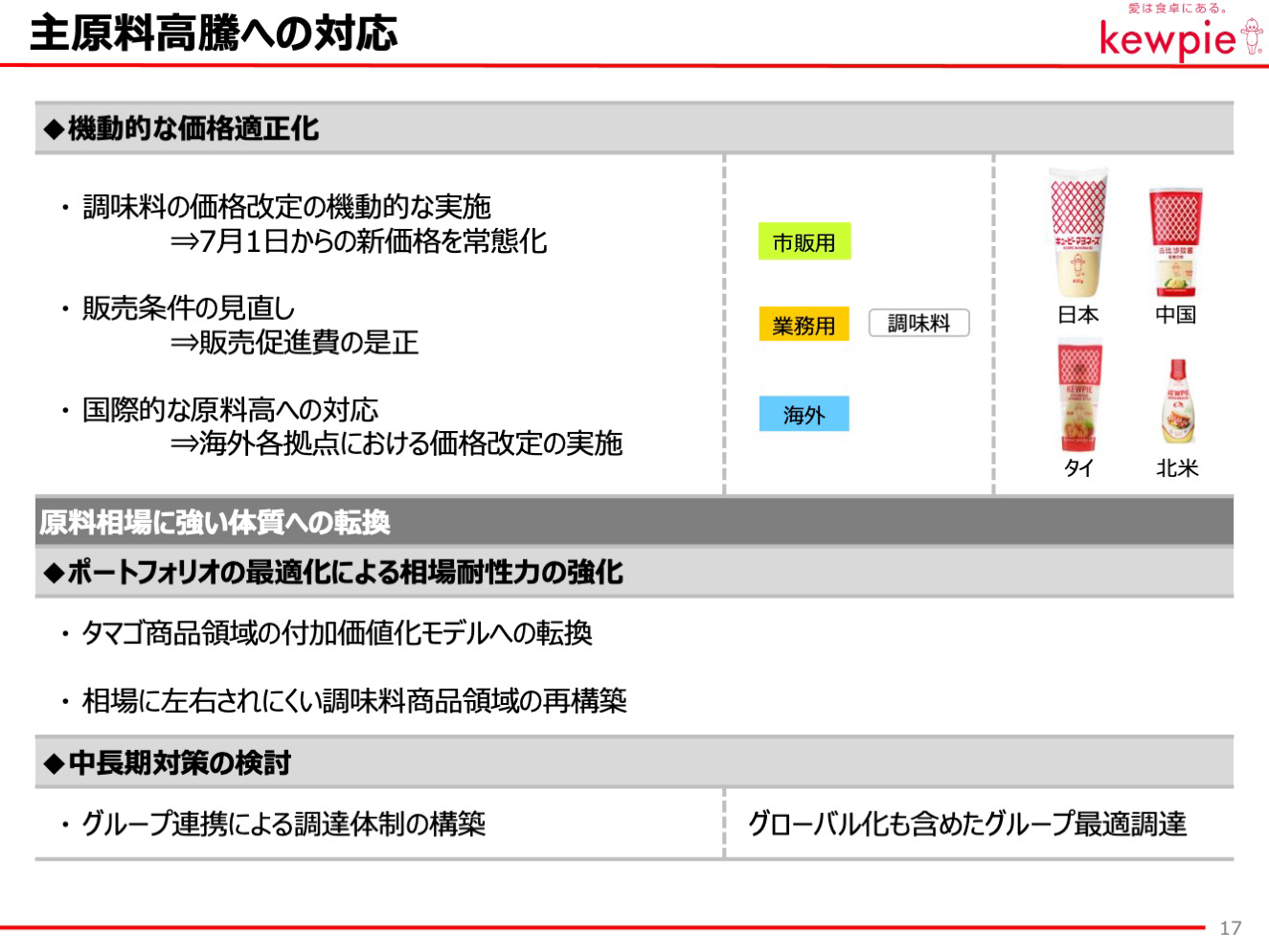
このような状況の中、当社グループとしましては短期的な対応を行ったうえで、主原料高騰リスクに対し、持続的な成長への転換を見据え、中長期的にしっかり向き合っていきたいと考えております。
まずは7月1日からのマヨネーズの価格改定について、新しい価格の浸透を着実に進めてまいります。
今回は改定条件に食油の高騰影響のみを反映しておりますが、鶏卵相場の影響も大きいことから販売条件の見直しなど、総括的な販売促進費の使い方にもメスを入れていきたいと考えております。
また国際的な原料高は海外グループ各社にも影響を与えており、日本よりも早めに業績にあらわれてくる見込みです。すでに中国・タイ・北米などでもお客様に価格改定の商談を進めている状況です。
業務用がメインとなるタマゴ商品ではコロナ影響が残るなか、需要の大幅な回復を見込めない状況もあり、鶏卵相場の高騰は業績に大きく影響します。
これまでも付加価値品へのシフトを進めておりましたが、今回の環境変化から改めて事業の脆弱性が浮き彫りになりました。
タマゴ商品はこれまでのボリュームを追う事業モデルから付加価値にこだわる事業モデルへの転換が必要だと考えています。まずは現在の鶏卵相場の上昇に応じた価格改定を進め、その先の収益構造の転換をめざしたいと考えています。 -
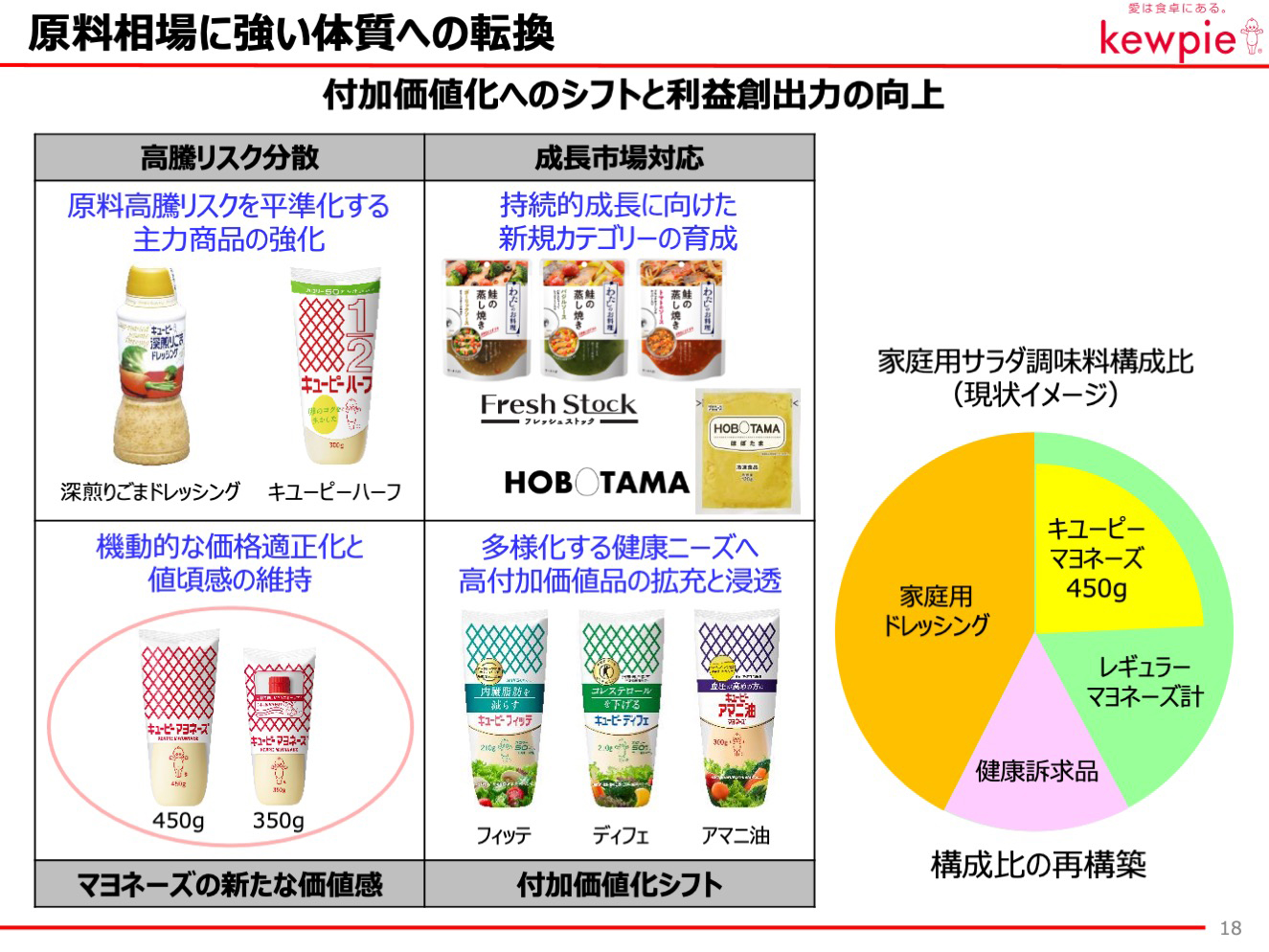
次に、主力商品であるキユーピーマヨネーズは食油・卵黄ともにリッチな商品であり、それがお客様からご支持いただいている要因のひとつですが、原価における主原料比率が高く、また450gを中心としたマヨネーズの構成比は当社家庭用サラダ調味料の約3分の1を占めている状況です。
これに対して「価値観」「リスク分散」「付加価値化」「成長市場」の4つの観点から売上構成のリバランスが必要だと考えております。
「価値観」については新しい価格の浸透において値頃感とのタイムラグを短縮させ、万能調味料としての価値と価格を追求していきます。2025年にはマヨネーズ発売100周年を迎えることから、それまでにバックキャストで主原料の高騰対応を築き、マヨネーズの価値向上を描いていきたいと考えています。
「リスク分散」については、キユーピーマヨネーズよりもキユーピーハーフ、キユーピーハーフよりも深煎りごまドレッシングと高騰影響は薄まってまいりますので、原料高騰の際の収益性にこだわり、これらの構成比の割合について流動性を持たせたいと考えております。
さらに成長市場に向けてフレッシュストック商品やHOBOTAMA(ほぼたま)といったような食油も鶏卵もほとんど使用しない新規カテゴリーの育成もこれまで以上に重要な取り組みになります。
また、価格改定によりキユーピーマヨネーズと健康訴求品との価格差が縮まり、相対的に「付加価値品」へのシフトが起こることも想定しております。
特にコロナ禍では健康に気を遣われるお客様の関心が日頃の食事に集まることも考えられます。
健康意識は個々の多様化されたニーズもあるため、ある程度のバラエティを備えておく必要があります。
環境変化に伴う需要のシフトに加え、当社が意思を持って構成比を付加価値品へシフトすることで、トータルとして原料相場への耐性を高めていけると考えております。 -
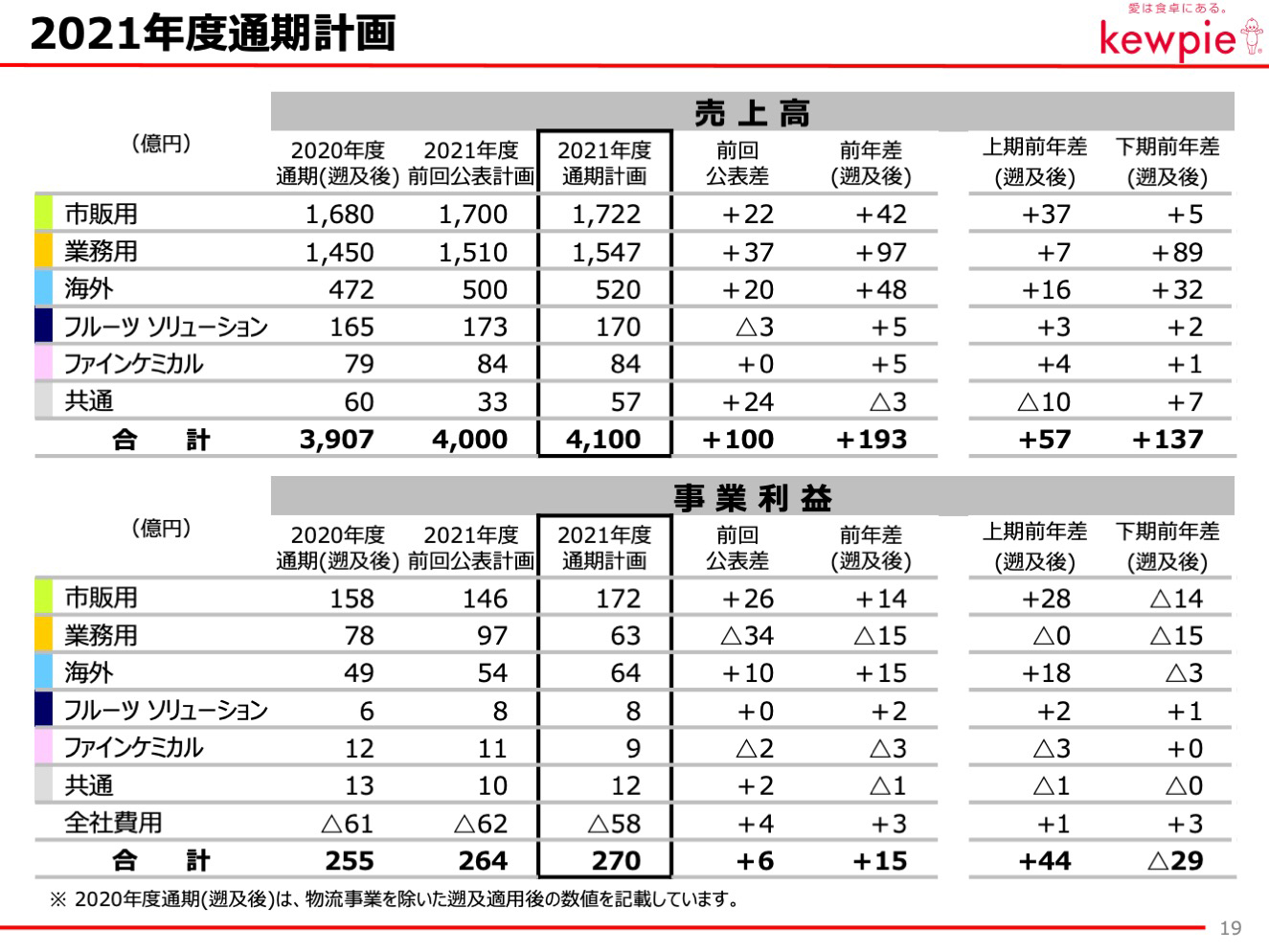
この様な状況を踏まえ、通期の見通しについては、年初に公表した業績予想から売上高100億円の増収、営業利益6億円の増益として修正計画をリリースしました。
しかしながら、下期の営業利益は、前年に対して減益の見通しとなっております。
価格改定や収益効率の強化・付加価値化へのシフトなどを行ない、タイムラグは発生するかもしれませんが、来期以降も続くと見込まれる主原料高騰に対してしっかりと向き合っていきたいと考えています。 -
最後になりますが、昨年のコロナ影響に続き、今年は主原料の高騰影響もあり、皆さまにはご心配をおかけしていることと思います。
当社グループにおいては、販路の多様さや主力商品のユニークさ、として捉えているものが急激な環境変化によって大きく業績に影響を受けることから、これらのリスクに対して先ほども申し上げた様な取り組みを進めてまいります。
昨年はコロナのマイナス影響に対して販管費の削減で立ち向かい、今年は主原料高騰に対して海外伸長や付加価値化の取り組みによる売上総利益の改善で対応することになります。
大きな逆風ではありますが、これを乗り越えることで、中期経営計画でかかげている「転換」につなげ、持続的な成長を実現する体質をめざしてまいります。
Q&A (Japanese only)
-
Of the ¥5.5 billion loss due to soaring raw material prices, ¥2.3 billion is due to the impact of the egg market, and we are proceeding with revisions to our egg products. We expect the revised prices to be around ¥400 million higher this term, and we will work to recover that amount next term.
The 3.2 billion yen decrease is due to condiments, but this includes overseas markets. Price revisions will be implemented in China and Thailand from August, and in North America from July. Since the fiscal year ends in October-September overseas, the effect of the revisions in fiscal year 2021 will be limited.
Domestically, we secure our supply of edible oil in advance, so we are not affected simultaneously by changes in tanker truck prices. Furthermore, instead of passing on the increased cost of egg yolks due to high egg prices, we will improve our situation by shifting to value-added products, improving productivity, and curbing overall sales promotion expenses. We aim not only to cope with the current surge in main raw material prices, but also to transform our business into one that is more resilient to changes in main raw material prices from a medium- to long-term perspective. -
The 1.4 billion yen increase in the price revision includes price increases for egg products and imported condiments, so it is not assumed that it will absorb all of the costs. We will continue to explore all possible means to address the impact of price increases beyond our release, including those for non-edible oil products.
-
Regarding domestic markets, we would like to request revisions in accordance with fluctuations in the prices of key raw materials, taking into account the economic situation at the time. For any costs that cannot be absorbed by revisions alone, we will address this by expanding value-added products, improving the return on investment through more efficient marketing activities, and promoting the development of essential goods.
Overseas, we will implement price revisions in each country, mainly for mayonnaise and salad dressings. The effects of these price revisions are expected to become apparent from fiscal year 2022 onwards. In China, we will implement price increases for household use starting in August. The food service market is growing rapidly, and if other companies enter business types or areas where we are not yet well-established, it may take considerable effort and time to regain market share. Therefore, rather than revising prices, we plan to absorb the impact of rising raw material costs through increased sales. -
While Japan's population is declining due to a low birthrate and aging population, it is increasing globally, and we believe that the supply and demand for grains are tightening year by year. We also believe that the shift in consumption from grains to livestock due to economic growth in emerging countries is influencing the rise in raw material prices. Recently, there has been a surge in the use of clean energy in order to realize a sustainable society, but there are also situations where food for humans and livestock is being used for energy, such as with corn bioethanol and soybean biodiesel, and we believe this situation will continue for some time.
-
We are currently reviewing our plans for fiscal year 2022, so we cannot provide details at this time. However, we are operating under the assumption that headwinds in the market for key raw materials will continue. It will also be necessary to change our product mix, such as developing products that are less susceptible to these effects. Furthermore, we believe that shifting towards health-focused products such as Fitte and Diffe is a way to adapt to the changing environment brought about by the COVID-19 pandemic.
-
Regarding China, we have been deploying personnel since the fall of 2020. Development personnel have been deployed to our headquarters in China (Kyuby), and sales personnel have been deployed to our strategic area, South China. In addition, we plan to implement some digital infrastructure development in fiscal year 2021, although it will not be on a large scale.
We've had a dedicated person in charge of e-commerce for the past three years, and while it's still not a large part of our overall sales, it's growing at a rate of +28%. In marketing, we're integrating real-world and digital approaches, strengthening our activities from being primarily in-store to developing cooking recipe apps and streaming menu videos. -
Regarding price revisions for household goods, our competitors do not appear to be taking any action at the moment. On the other hand, some competitors regularly raise and lower their prices. In the case of our products, we anticipate that the impact of a decrease in sales volume will not be as significant as in Japan, due to our high market share and the large amount of consumption by affluent consumers.
In food service, there is a lot of competition, and prices seem to be low. However, we believe the market is in a growth phase, and rather than spending time and effort on price revisions, we plan to increase sales by proactively targeting industries and areas where we are not yet strong, thereby absorbing the impact of rising raw material costs. -
Regarding food service, we anticipate continued recovery from the impact of COVID-19. While large-scale restaurants continue to face difficulties, industrial catering, convenience stores, and fast food businesses are gradually seeing the results of their previous efforts.
Regarding the household market, we are pleased with the growth in our Deep-Roasted Sesame Dressing and expect it to remain strong in the second half of the year. -
Excluding the sale of the egg business in the previous fiscal year, Net sales in North America grew by 130% year-on-year in local currency terms.
While our business has primarily focused on brands for our valued customers, in recent years, our KEWPIE brand mayonnaise and Deep-Roasted Sesame Dressing have seen significant growth. These products are highly regarded in e-commerce and other sectors. Furthermore, in food service, we are seeing an increase in adoption by local restaurants other than Japanese restaurants, as well as by delivery services. -
In the first half of the year, while we had anticipated a challenging Net sales outlook due to the waning impact of COVID-19, the continued expansion of demand for home-cooked meals has contributed to our success. Furthermore, the all-purpose condiments of mayonnaise and the general-purpose nature of salad condiments have also helped capture the demand from people staying at home. delicatessen foods companies such as Deria Foods Co., Ltd. are performing well thanks to their advertising and promotional efforts.
-
Fresh Stock ™ officially launched in April 2021 and is currently progressing according to plan. We are expanding our product lineup in the meat and fresh fish sections, areas where we had not been able to adequately focus before. In addition, our boiled egg product line has grown significantly recently, and we have also established a production system. We believe these efforts will lead to increased sales in fiscal year 2022.
-
Previously, we had stated that we would be shifting our product focus from raw materials to processed goods. However, in our 2021-2024 medium-term management plan, our organizational structure has shifted from a business-centric approach to a market-centric approach, and we will be pursuing a business strategy that is more market-oriented.
Specifically, we will promote the introduction of processed foods to manufacturers of frozen foods and other processed foods, as well as to delicatessen businesses, thereby increasing the product mix of value-added items. -
Previously, each company was responsible for specific business areas and made proposals to their respective sales floors. However, because business areas took priority, coordination was weak. By shifting to a market-based system, this issue has been resolved, and we intend to continue moving forward with a sense of urgency from 2022 onward.
Year-End Financial Results Briefing
January 8, 2021 (Fiscal year ending November 2020)
Materials
[Divided version]
-
2020年度 決算説明資料
-
-
2020年度の概要について。
-
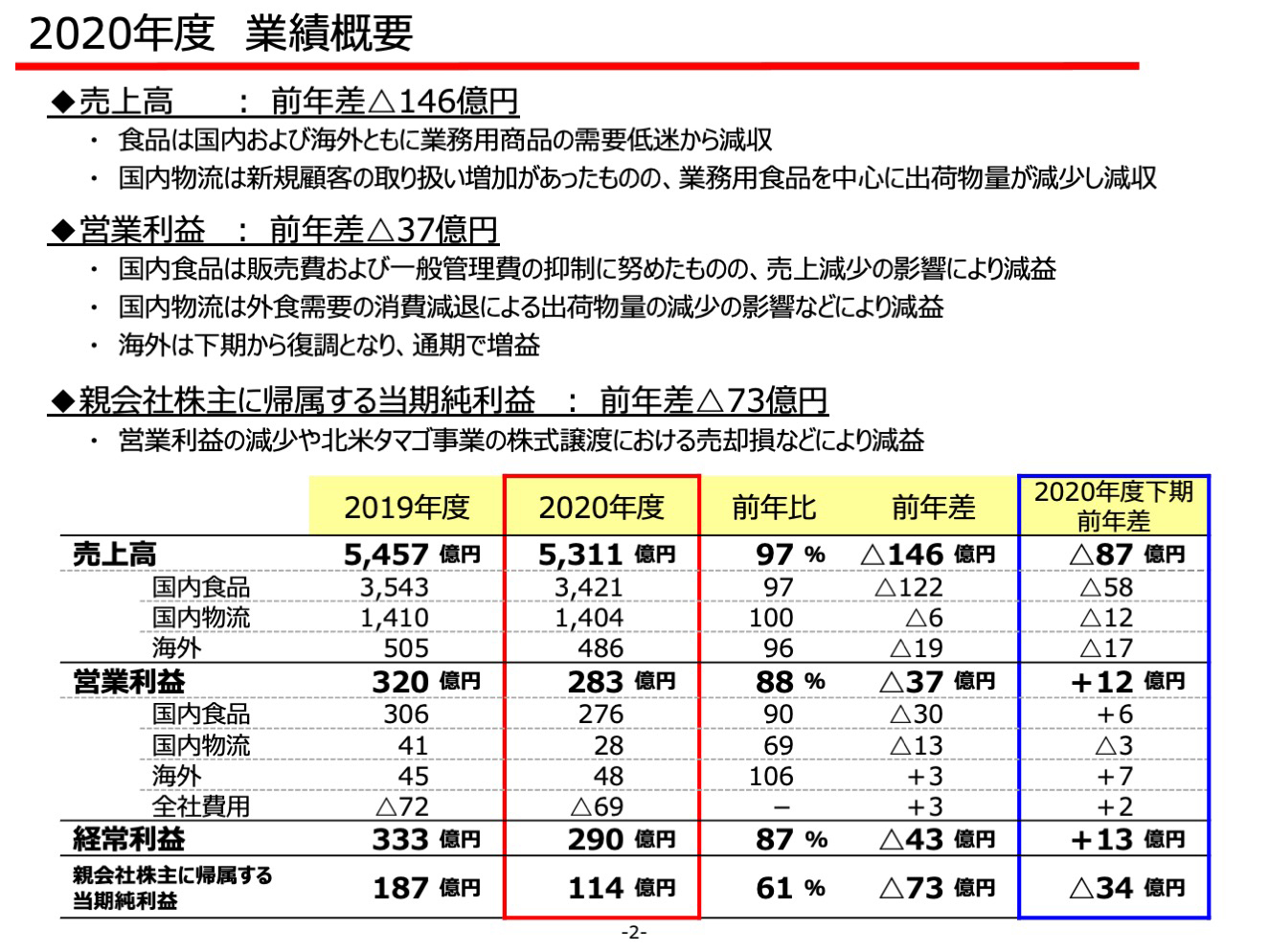
まず売上高は、前年に対して146億円の減収の5,311億円となりました。国内、海外ともに新型コロナウイルス感染症による、業務用商品の需要低迷が影響しました。物流事業においても、新規顧客の増加があったものの、業務用食品の出荷数量減少が影響しました。
営業利益は、下期は販売費および一般管理費の抑制に努めたことなどにより12億円の増益となりましたが、新型コロナの影響を大きく受けた上期の業績をカバーすることができず、通期では37億円減益の283億円となりました。
なお、海外は、下期は新型コロナの影響から復調し、通期で増益となりました。親会社株主に帰属する当期純利益は、営業利益の減少によるものと、2020年7月に実施した北米タマゴ事業の株式譲渡による売却損などにより、前年に対して73億円減益の114億円となりました。
-
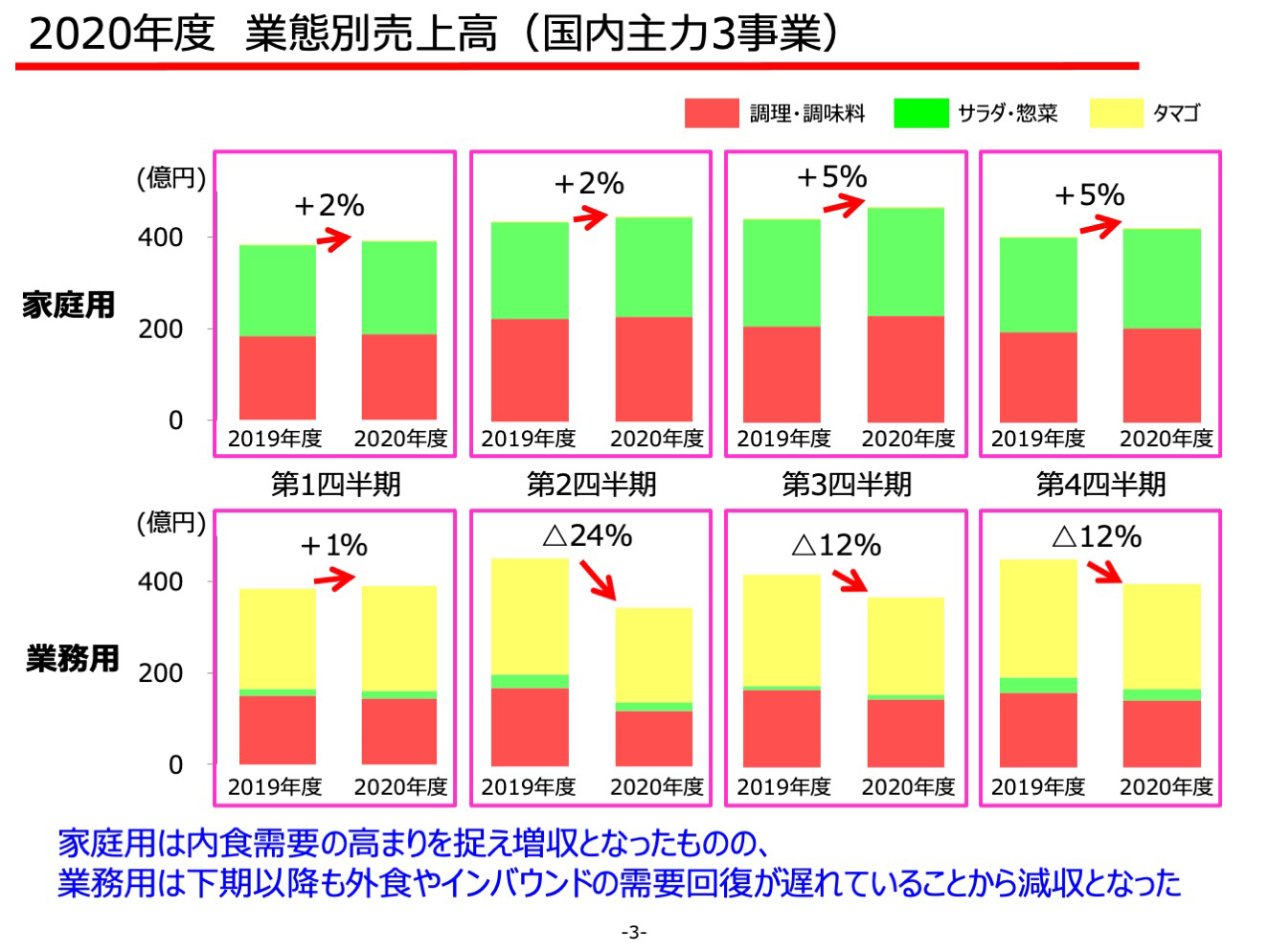
次に国内主力3事業の業態別の売上高について。
家庭用は、内食需要の高まりを捉え、マヨネーズやパスタソースが堅調に推移し、下期においては前年対比で5%の増収となりました。
一方、業務用は、緊急事態宣言の影響を大きく受けた第2四半期に比べて、下期は回復傾向となったものの、外食需要の低迷の影響が継続しました。 -
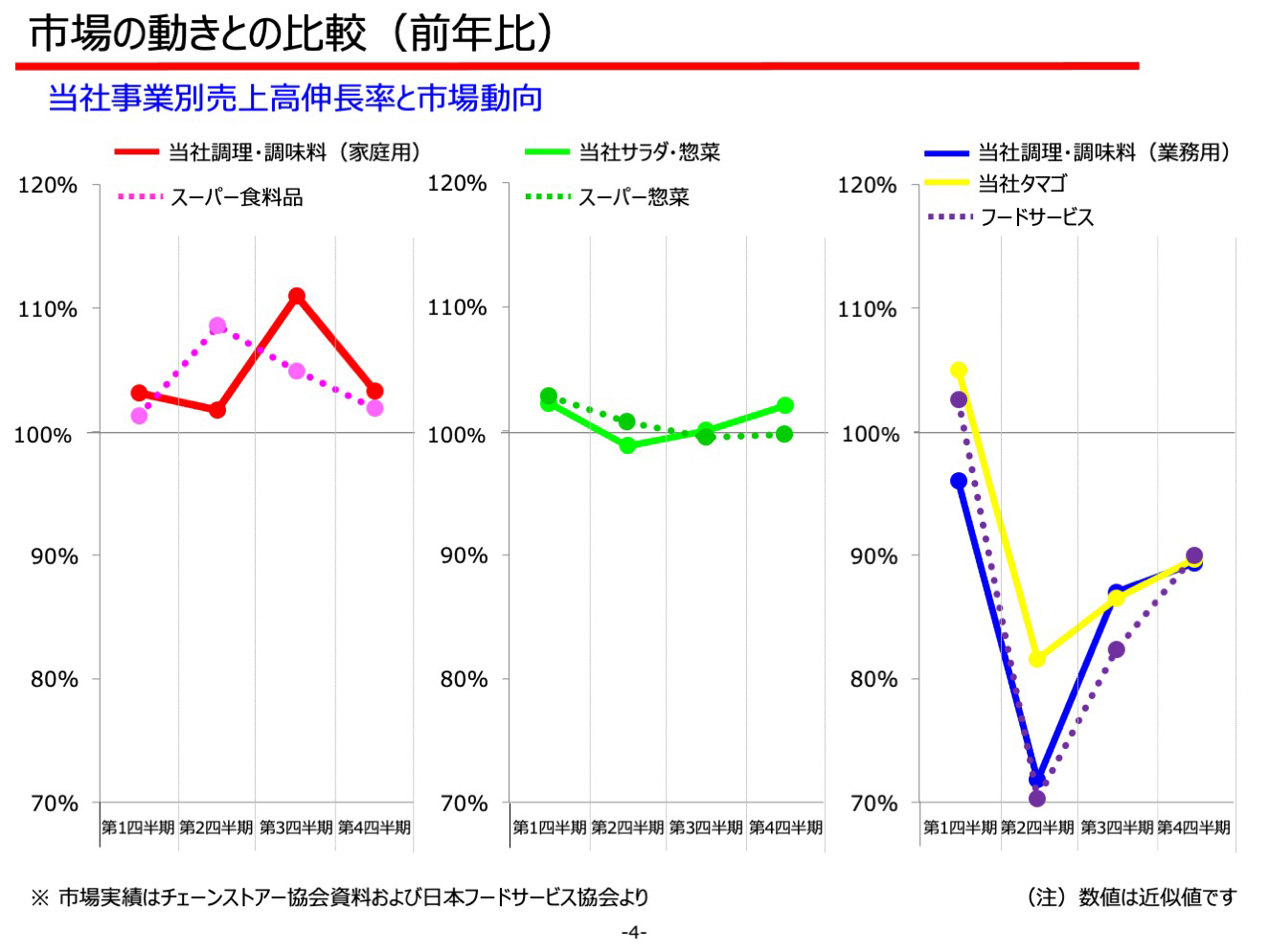
国内主力3事業の売上高伸長率と市場の動向について。
家庭用の調理・調味料商品は、下期は市場の推移以上に伸長しました。
サラダ・惣菜は、スーパーへの買い物頻度が減少したことにより、消費期限が短い商品が、やや敬遠されましたが、日持ちを延長したカット野菜などがストック商品として捉えられたことにより、市場の動向を上回る状況となりました。
業務用の調理・調味料、タマゴは、外食市場がゆるやかに回復する中で、ほぼ市場に追従した売上となりました。
-
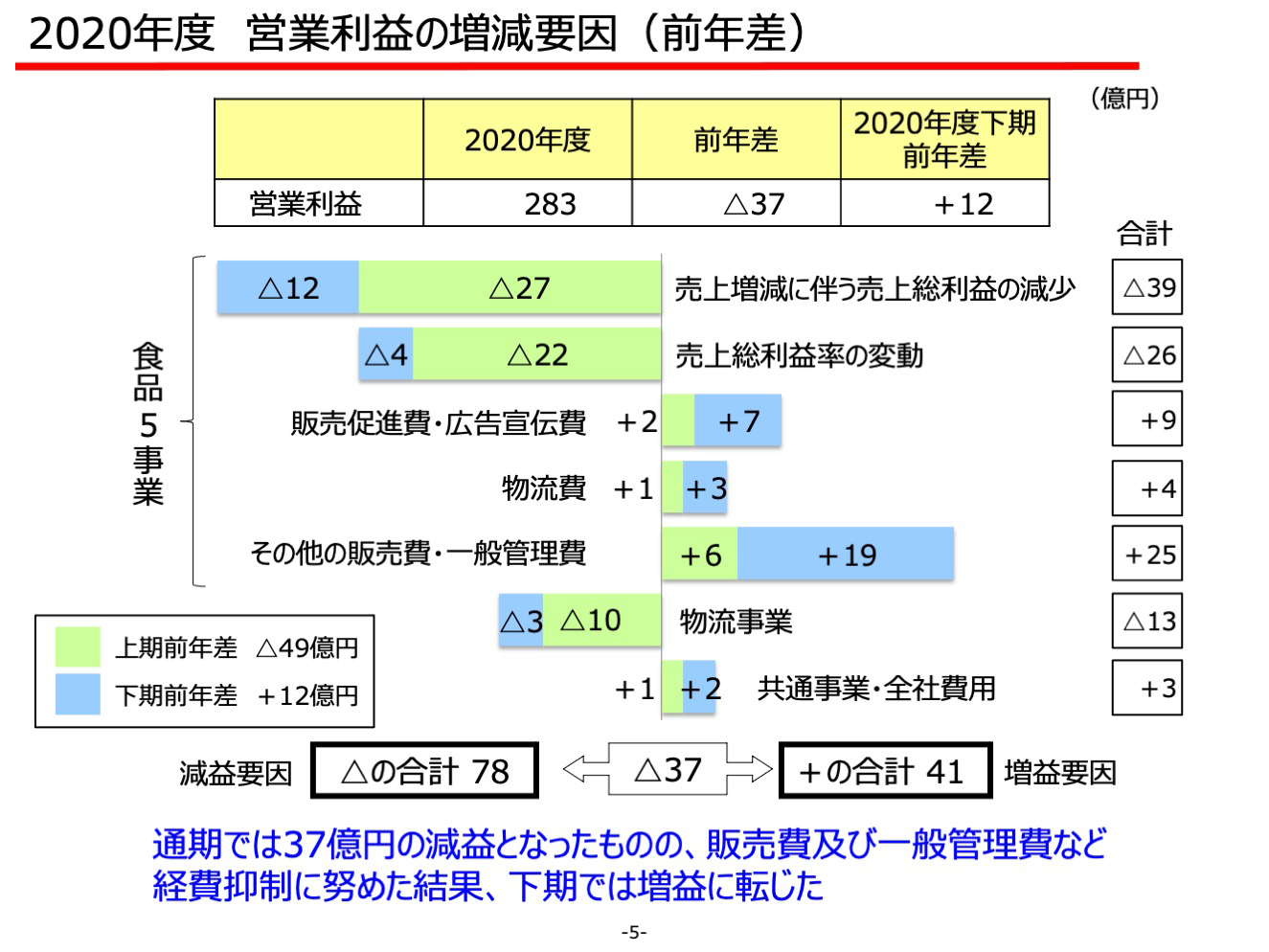
営業利益の増減要因について。
売上増減に伴う売上総利益は、特に上期に大きな影響を受け、通期で39億円の減少となりました。
売上総利益率の変動に伴う利益は、通期で26億円の減少となりますが、下期は付加価値品の需要の戻りや、主原料の上昇影響が和らいだこともあり、減益幅を抑えることができました。販売促進費・広告宣伝費は販売環境の変化に合わせて見直し、より効果的な投下を意識したことで、通期で9億円の抑制となりました。
その他の販売費・一般管理費では出張費や渡航費の削減などを中心に抑制に取り組み、25億円の増益要因となります。
以上の結果、上期では大きく減益となったものの、下期では12億円の増益となりました。 -
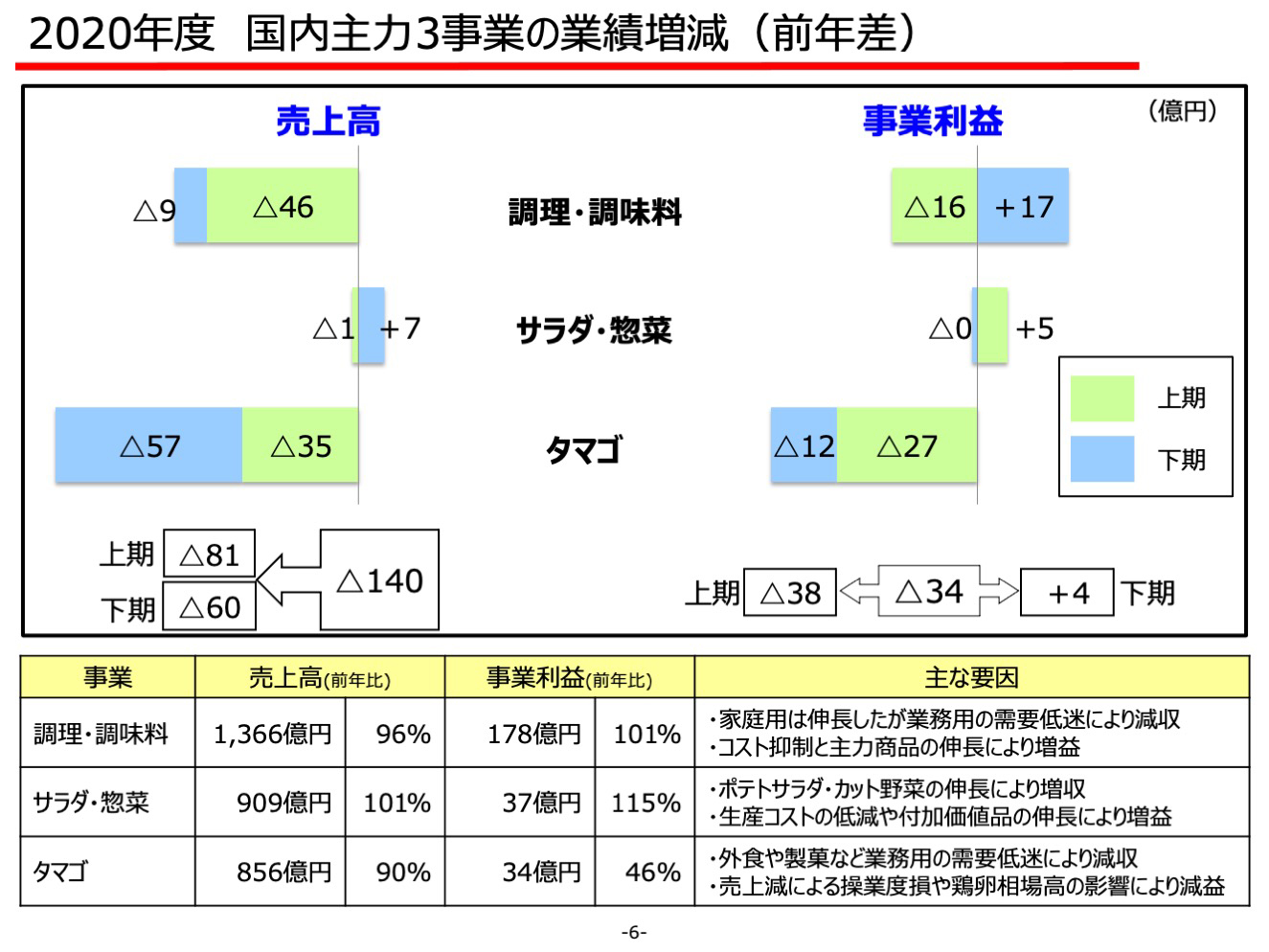
国内主力3事業の売上高、事業利益の増減について。
調理・調味料事業は、通期で減収となったものの、営業利益では、コスト抑制と主力商品の伸長により増益となりました。
サラダ・惣菜事業は、主力のポテトサラダの伸長や、日持ちを延長したカット野菜が、巣ごもり需要においてご好評いただき、増収増益となりました。
タマゴ事業は、ほぼ業務用商品で構成されていることから、外食やお菓子メーカー向けの需要減少を受け、減収となりました。
利益についても、売上の減少影響に加え、工場の固定費を吸収することができず、大幅な減益となりました。しかし、下期については一部の卵加工品において、前年以上の需要回復が見られたことや、鶏卵相場が安定して推移したことから、減益幅は上期に対して抑えることができました。 -
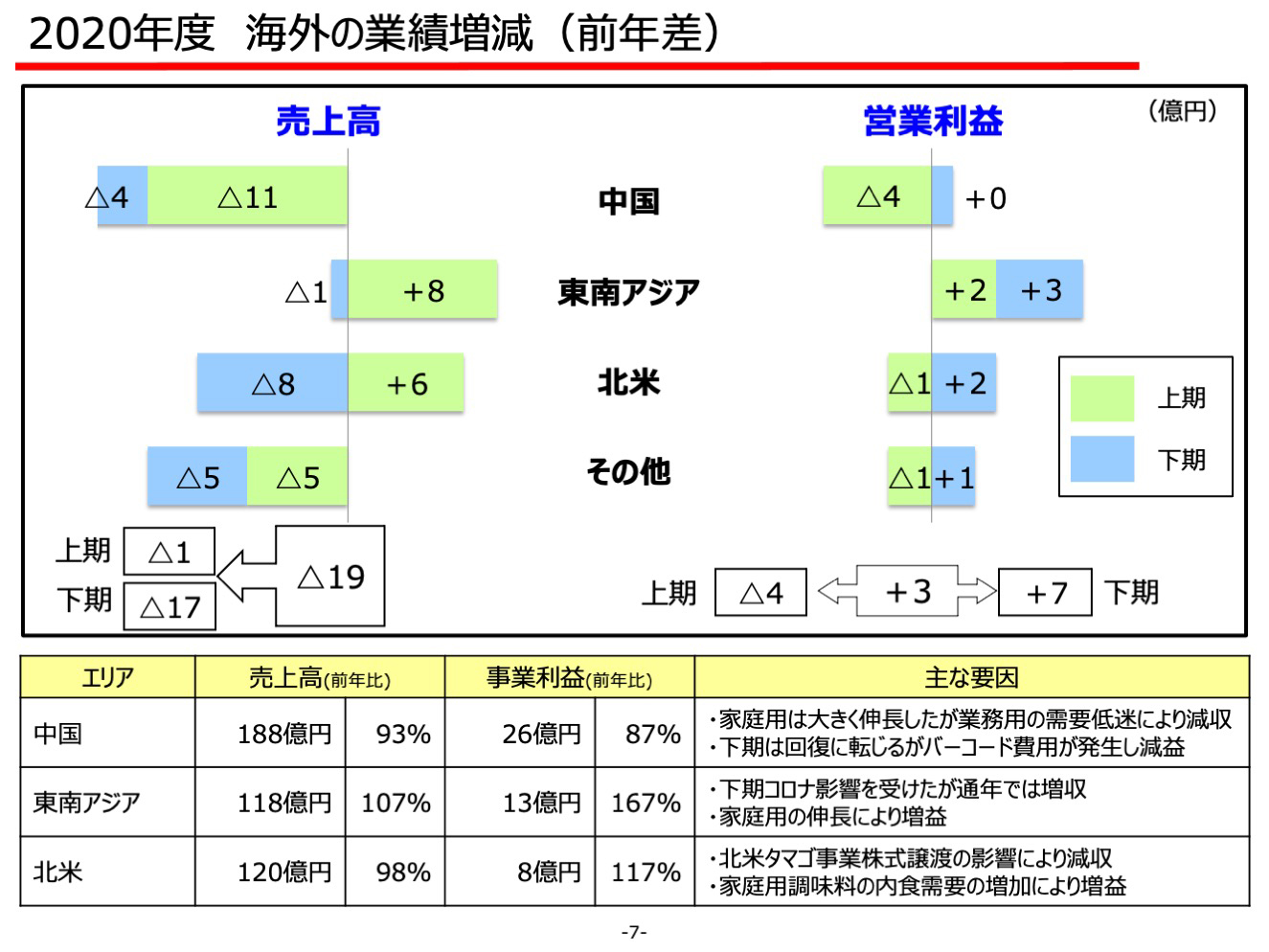
海外の売上高、営業利益の増減について。
海外全体では第2四半期から中国で、第3四半期から東南アジアで新型コロナウイルスの影響を受け、売上高は通期で減収となりましたが、営業利益については第4四半期で大きく回復したことから、通期でも増益に転じました。
中国では、業務用の需要低迷が続き減収となりました。営業利益は、下期に家庭用の好調が継続したことや、業務用に回復がみられたことから増益に転じましたが、政策的に行ったバーコードの統一費用が発生したこともあり、通期では減益となりました。
東南アジアについては、下期にコロナ影響による売上の減少がみられましたが、通期では家庭用の伸長により、増収増益となりました。
北米では、2020年7月に実施したタマゴ事業会社の株式譲渡により減収となりましたが、調味料においては家庭用の需要増加で、売上高は前年に対して121%の増収、営業利益は160%の増益となりました。 -
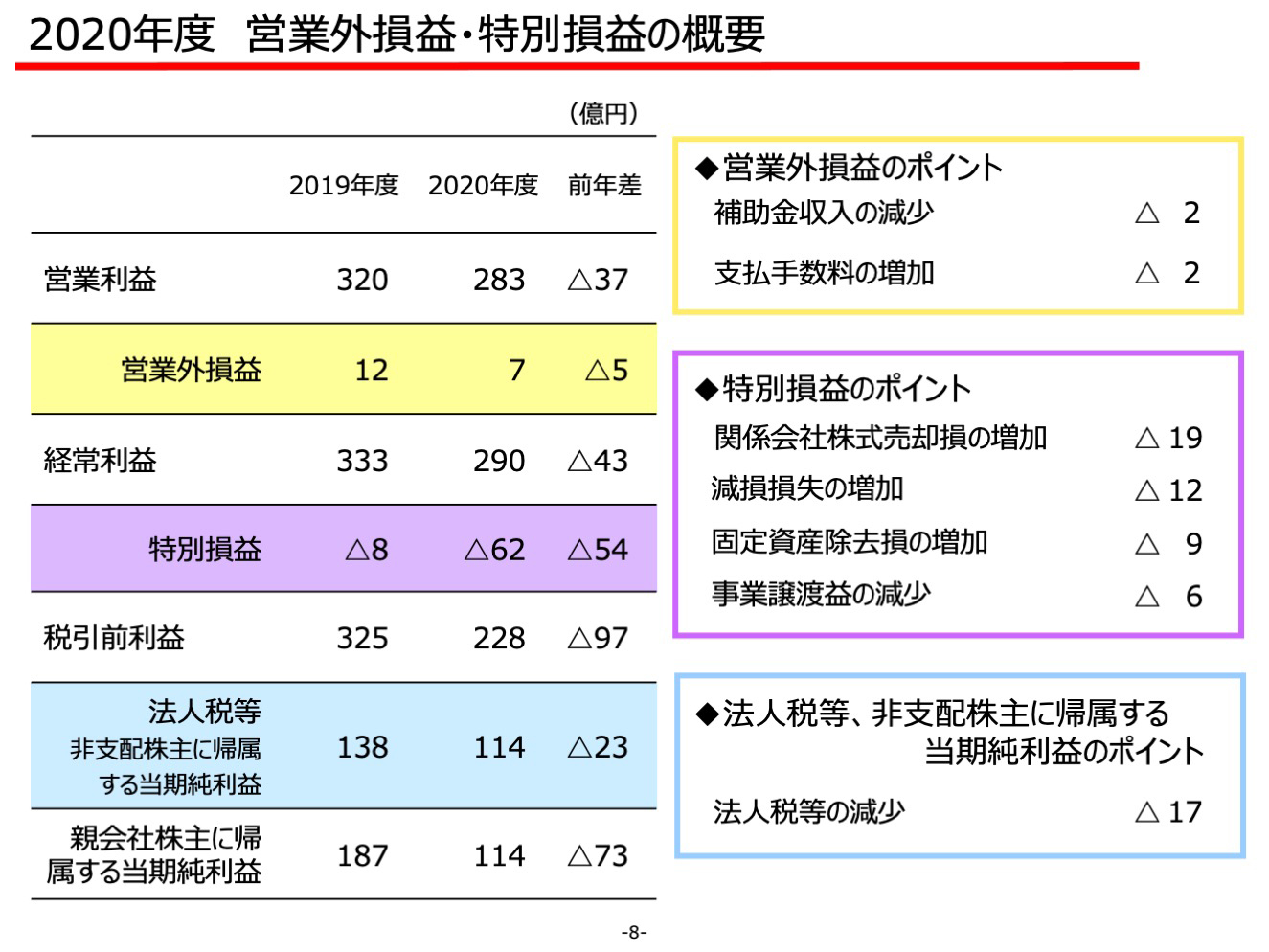
特別損益は、北米タマゴ事業会社の株式売却損が19億円、減損損失の増加12億円などがあり、前年に対して54億円の減少となりました。
-
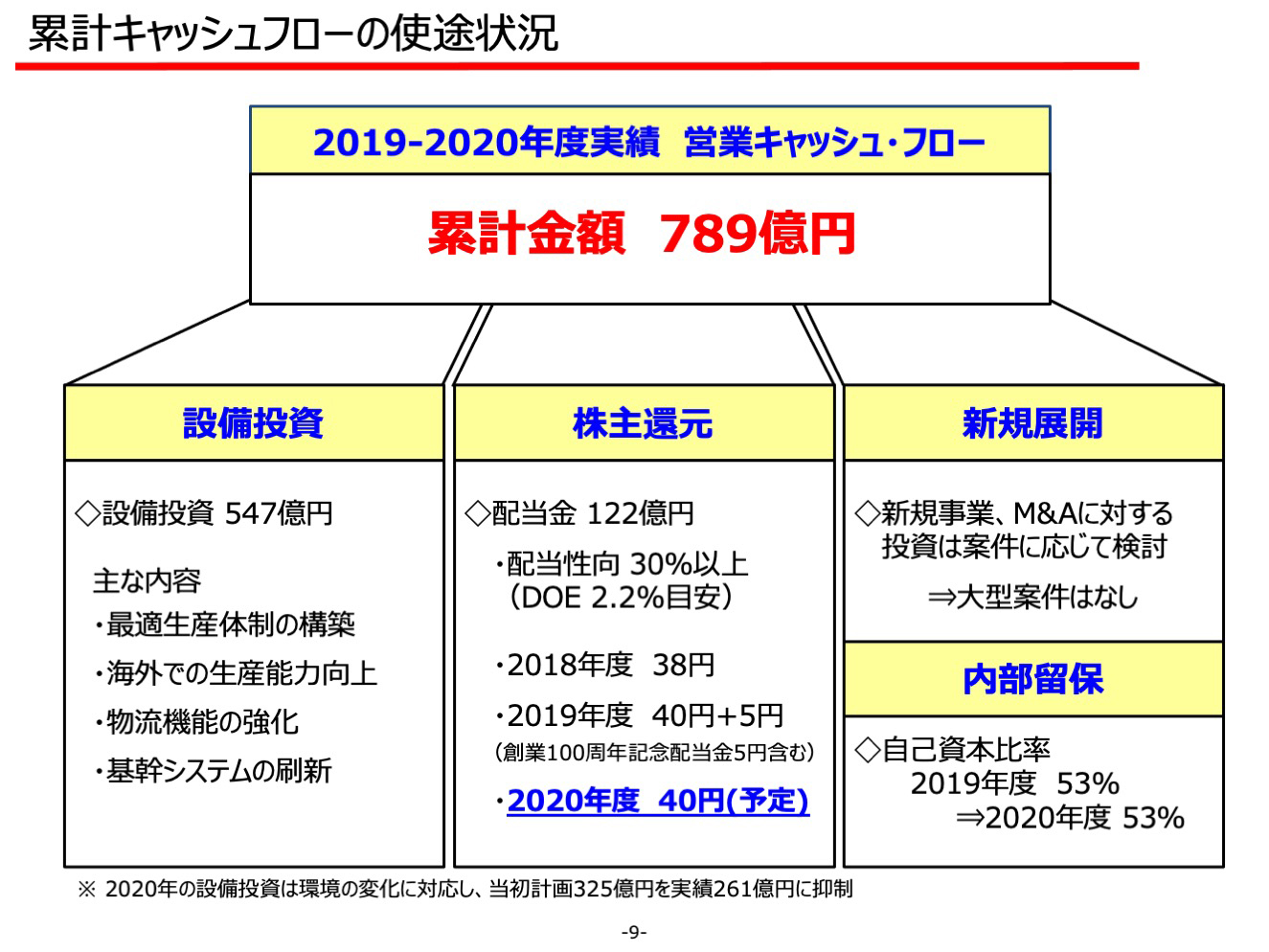
営業キャッシュ・フローですが、2019年からの2年間で累計789億円となりました。
そのうち、設備投資については547億円を、タマゴ事業の関西地区生産再編や、中国4か所目の工場である広州工場、基幹システムの刷新などに投じています。なお、2020年度の年間配当金につきましては40円を予定しています。
-
新型コロナウイルス感染症がいまだ猛威をふるう中、医療従事者、自治体関係者をはじめ、製造・流通・販売など現場で活動を続けている皆さまに、深く感謝申し上げます。
キユーピーグループが事業を継続出来ているのも、多くの方の御尽力があってのことと考えており、関係者の皆様に感謝を申し上げたいと思います。2021年から2024年度の新しい中期経営計画と2021年度計画について、まず最初に、今までの中期経営計画を2年で終える決断をし、今年度から4年間の新たな中期経営計画をスタートすることにした経緯をお伝えします。
-
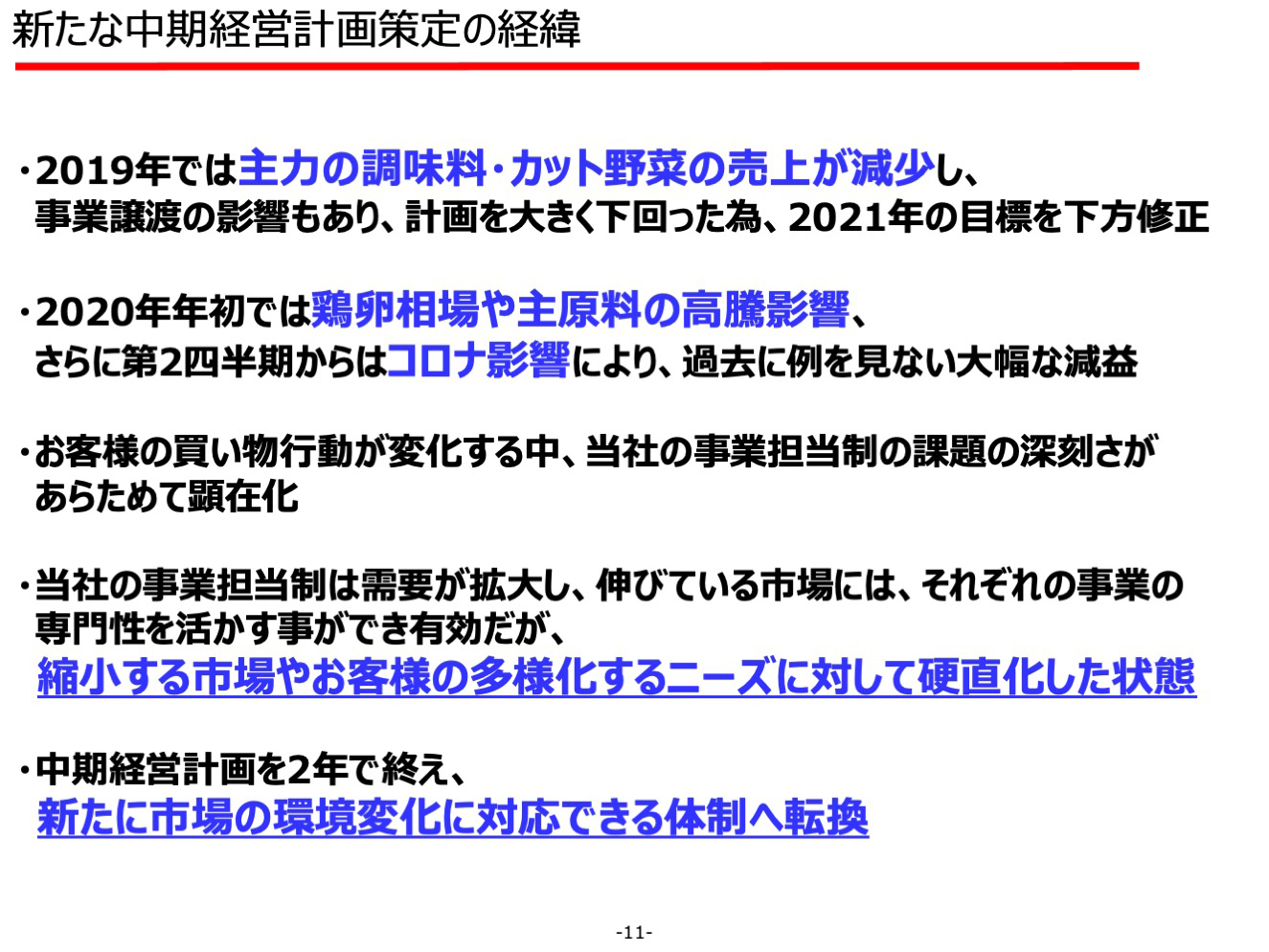
前中計では初年度となる2019年に国内の主力商品である調味料とカット野菜の売上が減少し、また2018年に行った事業譲渡の影響もあったことから、売上高・営業利益ともに厳しい結果となりました。
2年目となる2020年は第1四半期における鶏卵相場の高騰影響に加え、新型コロナウイルス感染症拡大の影響により3月から5月の第2四半期で過去に例を見ない大幅な減益となりました。
時短などのお客様の買い物行動の変化は緊急事態宣言以降、その動きが加速され、それによって当社の事業担当制の課題の深刻さがあらためて顕在化しました。
当社の組織は、具体的には商品軸で営業も生産も開発も、これに紐づく体制を取っています。販売体制でいえば、たとえば1つの量販店に対し、事業ごとにそれぞれが得意とするカテゴリーでアプローチしています。そのため、現行の事業担当制は、伸びている市場の中で、商品軸で専門性を高め、お客様のニーズに対応するには有効な体制であるものの、縮小する市場や多様化するお客様のニーズや購買行動にはフレキシブルな対応ができず、また提案の幅も広がりません。
これは当社が市場やお客様のニーズに対して硬直化した状態であったと言えます。
そこで、その対応には、大きな組織改革が必要だと考え、これまでの中期経営計画を2年で終え、新たな戦略と組織でこの環境変化に対応していく決断をしました。 -
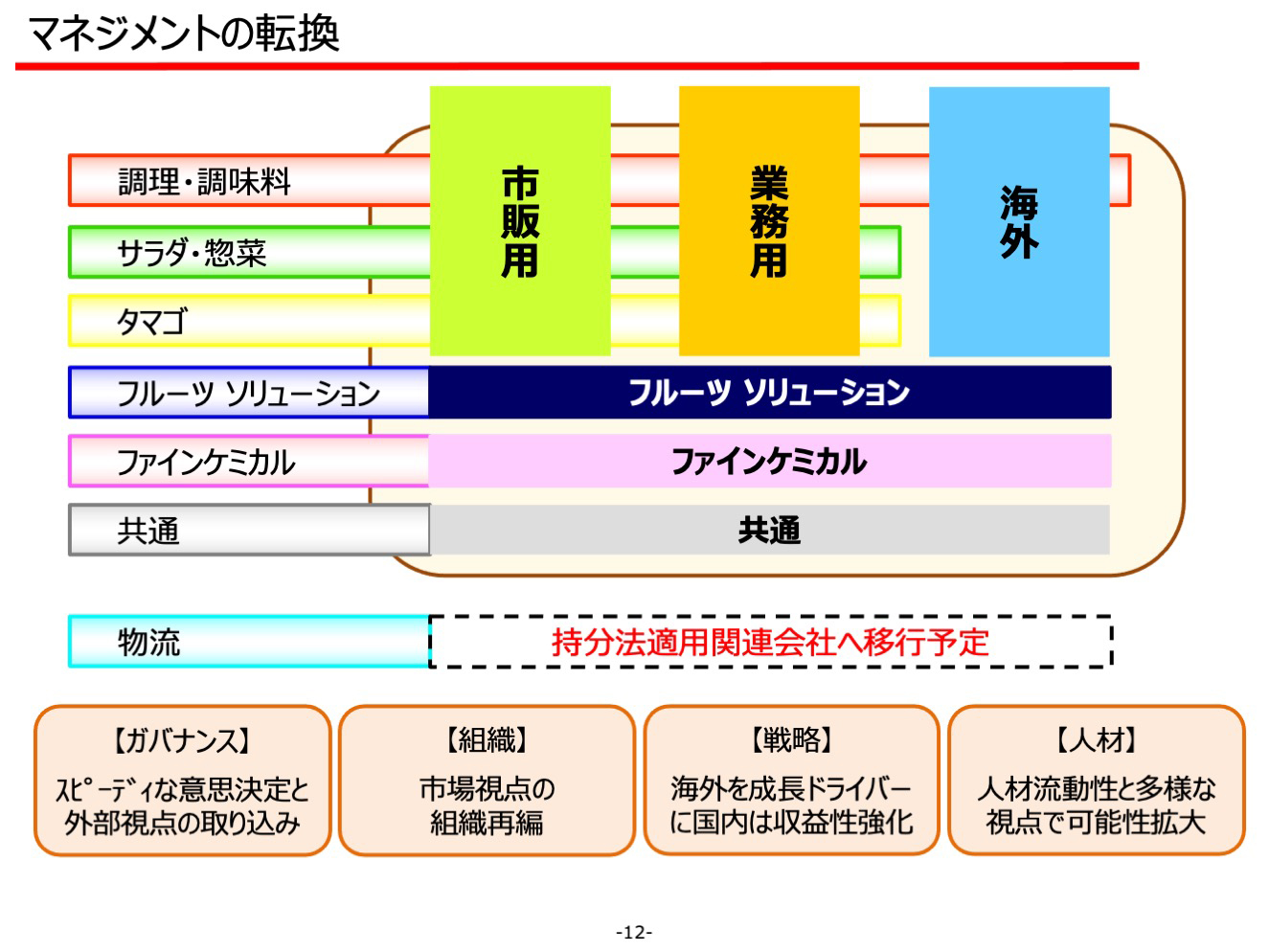
新たな中期経営計画ではお客様や市場の多様化に対応するため、これまでの事業担当制から市場担当制へ移行します。
当社では市場担当制をフレキシブルな対応が取れる組織と定義し、内食・中食・外食へ展開力のある当社の潜在的な力を改めて活かし、サラダとタマゴの可能性を広げていきます。また、1月7日リリースのとおり、物流事業の株式会社キユーソー流通システムを連結子会社から持分法適用関連会社へ移行する予定です。
近年、物流業界においても取り巻く環境が激しく変化し、お互いの将来の在り方を改めて考えた結果、キユーソー流通システムの経営の独立性を高めることが、さらなる成長戦略の実現につながると両者合意の上で判断しました。
食品事業にとって、物流機能は極めて重要であることから、引き続きキユーソー流通システムとは強固なパートナーシップを維持してまいりますが、当社は国内・海外の食品事業に経営資源を集中し、課題であった収益性と資本効率性の改善を図っていきます。さらに組織体制だけではなく、経営体制においても改革を行う決断をしました。取締役の社内構成をスリム化し、社外取締役を増員します。スリム化により事業戦略を迅速に決断し、社外取締役増員により外部視点を取り込み、実効性を評価する力を高めていきます。経営の監督・管理と業務の執行を分離する意味でも、今回のマネジメントシステムの変更は、組織改革と両輪で必要なことだと考えました。
-
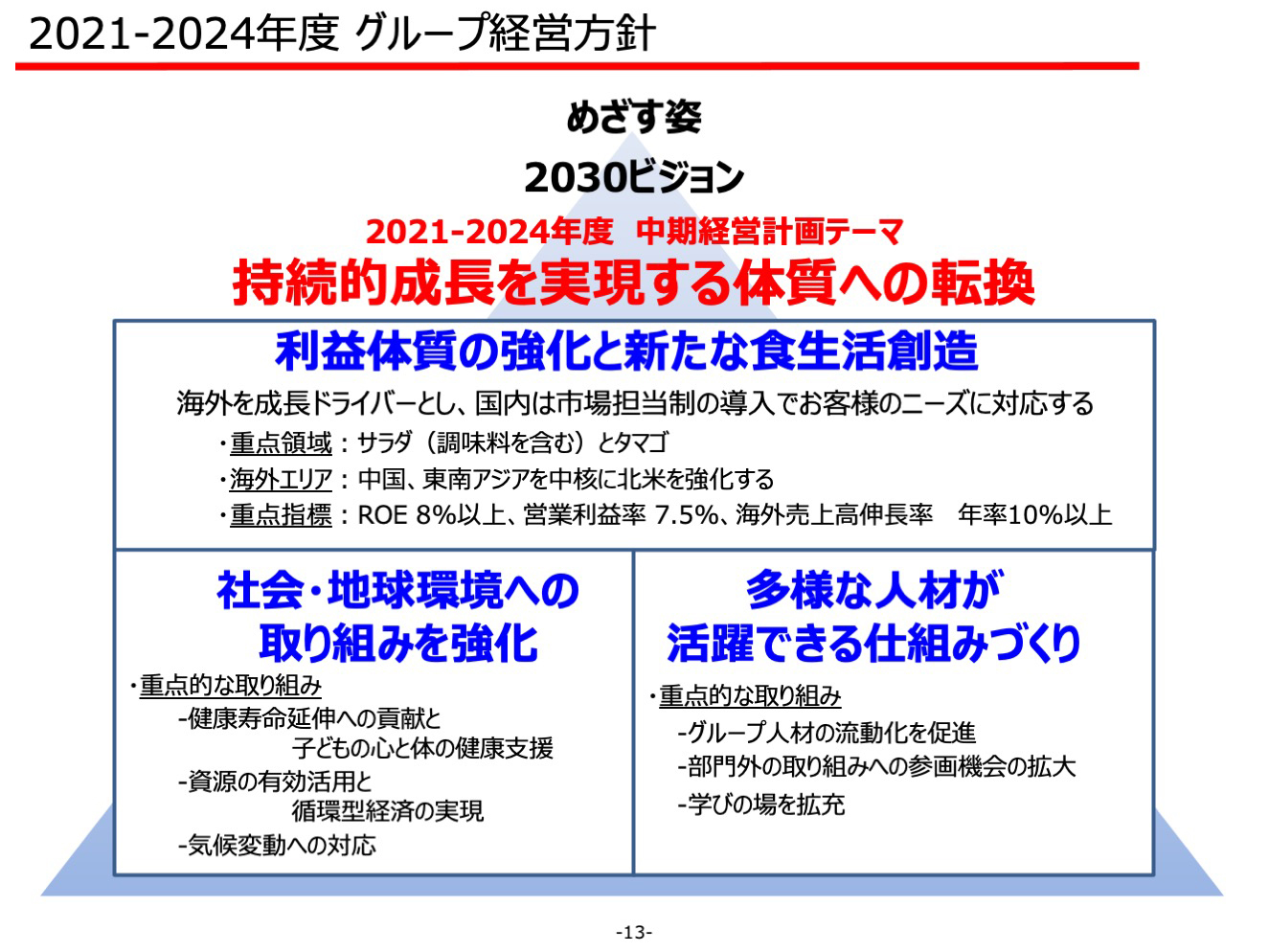
以上を踏まえ、2021-2024年度中期経営計画では、持続的成長を実現する体質への転換をテーマに「利益体質の強化と新たな食生活創造の取り組み」、「社会・地球環境への取り組み」、「人材の多様性を活かす取り組み」の3つの視点から経営方針を定めました。体質の転換には時間を要するため、これまで3年間としていた中計経営計画の期間に1年を加え、4年間を対象とすることとしました。
-
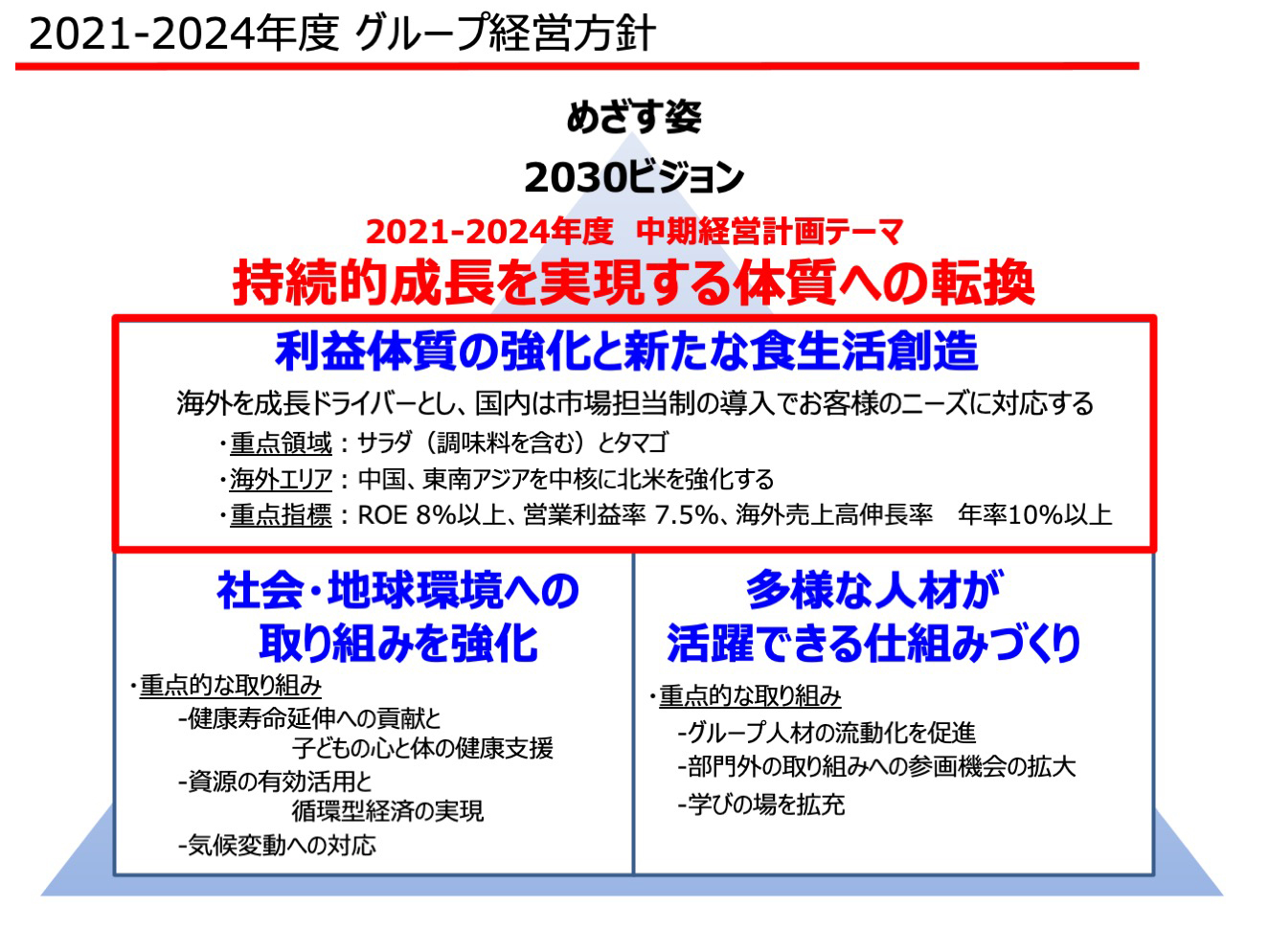
「利益体質の強化と新たな食生活創造」の取り組みでは、海外を成長ドライバーとして展開の拡大を進めていきます。国内では市場担当制の導入により、商品視点から市場を軸としたお客様視点に転換することで、お客様の食生活におけるお悩みの解決や新たな食シーンの創造につながるような商品やサービスをスピーディに提案していきます。
-
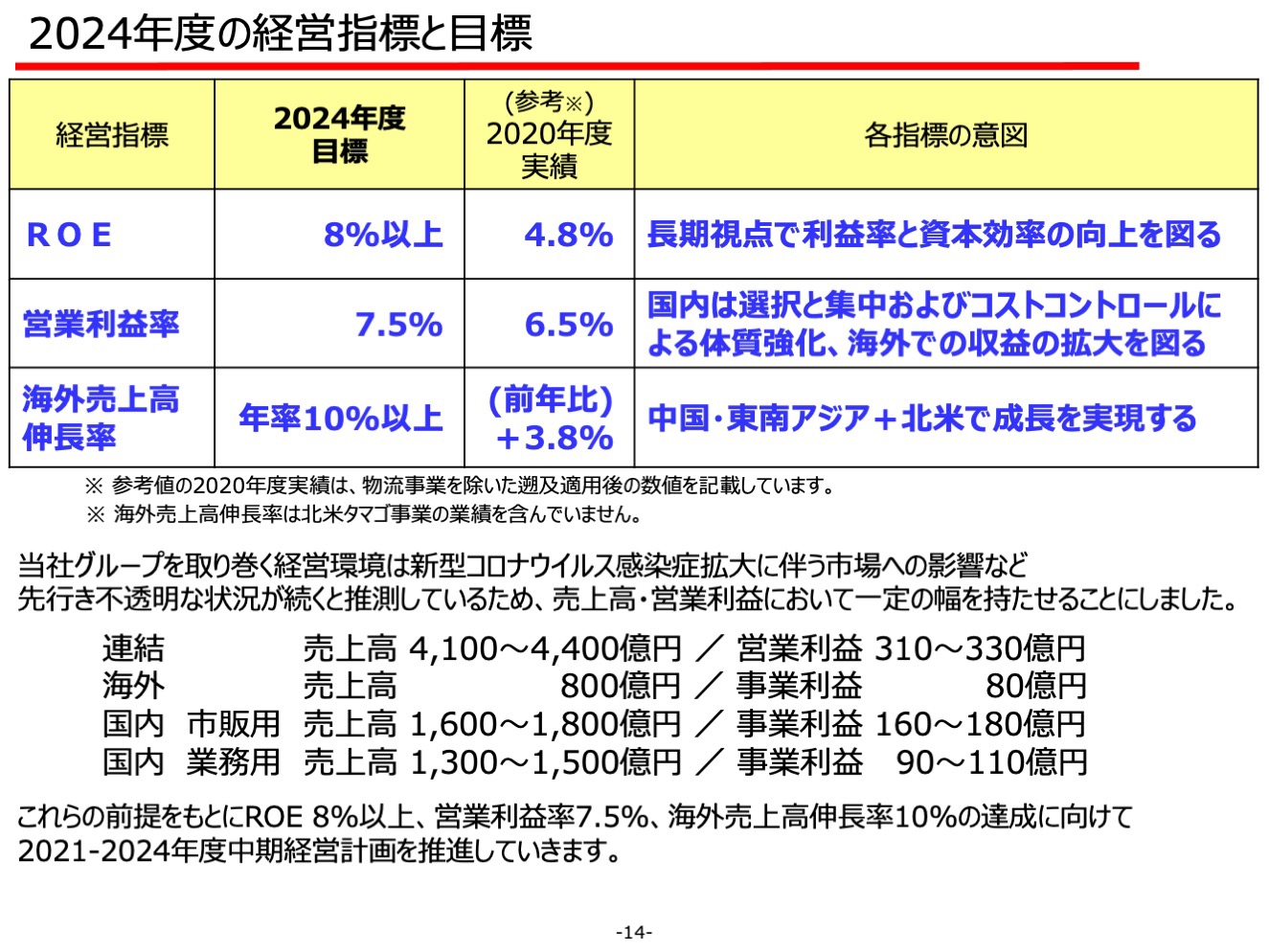
経営指標につきましては、「ROE」、「営業利益率」、「海外売上高伸長率」の3つとしており、それぞれの指標の達成にこだわっていきます。
ROE8%の実現に向けて、長期視点で利益体質の強化を図るため、国内では重点領域を定め、海外では中国・東南アジアを中心に展開を進めるとともに、北米を強化することで持続的な成長を実現します。
また、資金需要の変動に応じて株主還元も検討を行うことで、ROE8%の実現に向けて事業収益性の向上と資本効率性の向上の両輪で推進していきます。なお今回の中期経営計画の策定では、新型コロナウイルス感染症の影響など予測が難しいリスクが存在しており、先行きが不透明な状況が続くと推測しています。
そのため、現時点において2024年度の連結業績予想を合理的に算出することが困難な状況であることから、売上と営業利益においては、一定の幅を持たせることにしています。 -
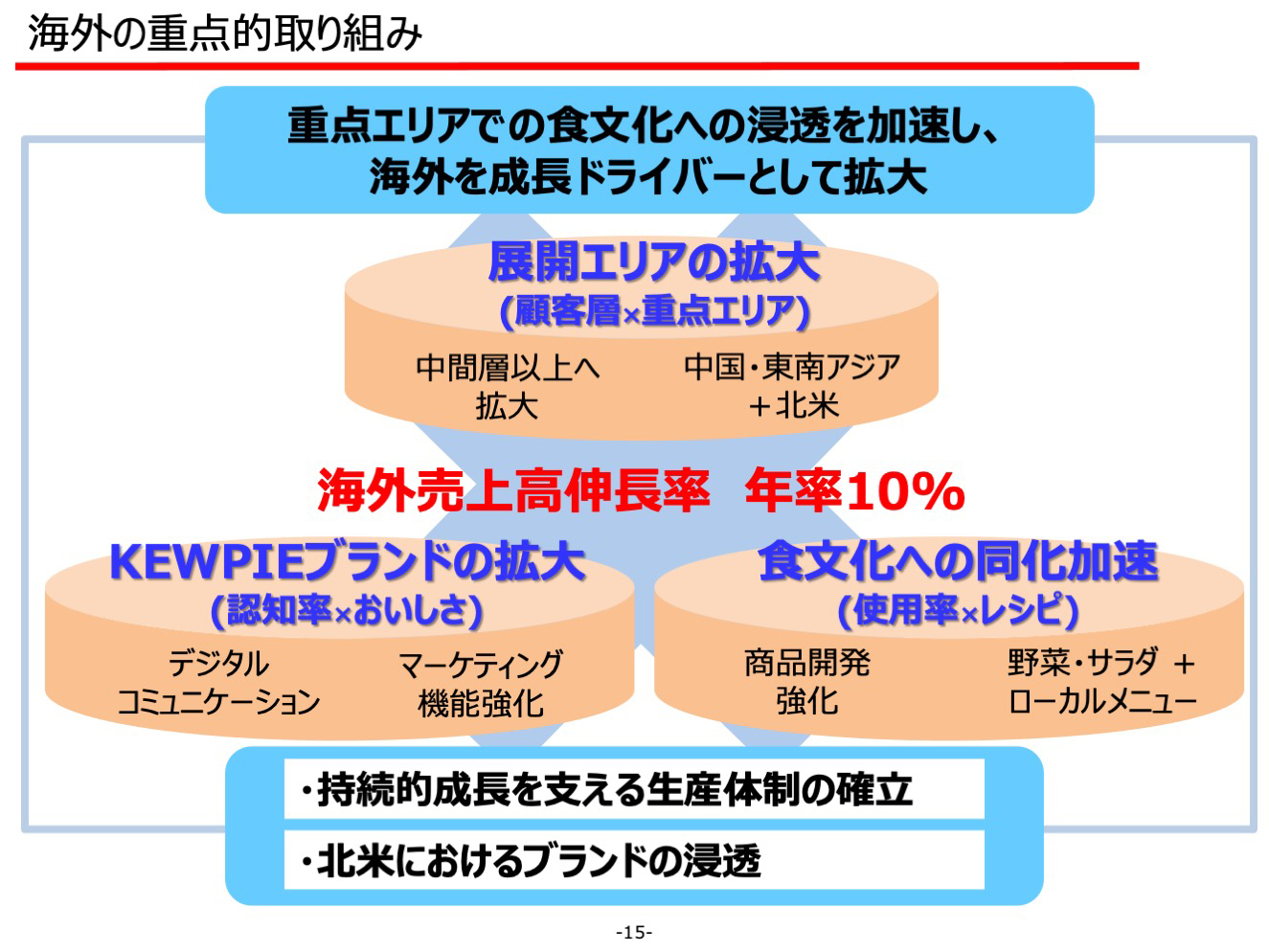
海外は、当社のこれまでの顧客層である富裕層から中間層へ開拓を進めるため、商品アイテム・エリア・機能など重点領域を定め、ブランド認知率と商品使用率の向上に取り組んでいきます。中国・東南アジアを中心に人材・商品開発・マーケティング・ガバナンスなど経営資源を集中的に投下し、売上高伸長率は年率10%以上を目標とし、持続的な成長をめざします。
海外での成長に伴い、増産投資などの対応が必要になりますが、エリアごとに最適な供給体制を整え、安定的なサプライチェーンを構築していきます。 -
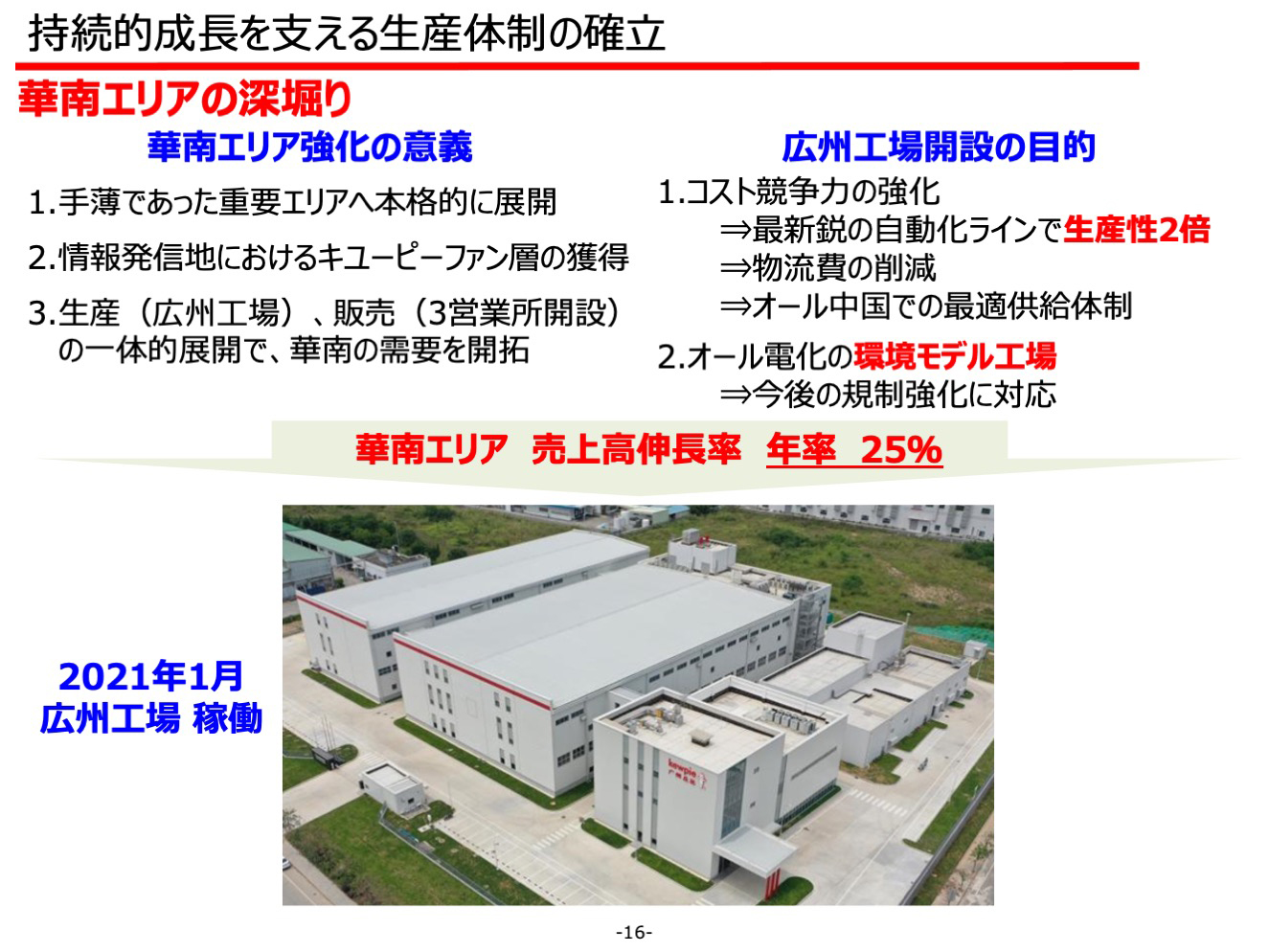
中国では2021年1月から4つ目となる広州工場が稼働を開始します。広州工場がある華南エリアは、深センなどを擁す大経済圏であり、重要エリアへ本格的に展開することになります。中国のシリコンバレーとも呼ばれる情報発信地においてブランド展開を進め、ファン層の拡大に努めていきます。
また、生産・販売が一体となって展開し、家庭用だけでなく業務用においても華南エリアの需要を開拓していきます。
広州工場には最新鋭の自動化ラインを導入し、生産性を2倍としたことで中国全体の安定供給に寄与し、またコスト競争力を強化します。
海外全体では持続的な2桁成長をめざしますが、華南エリアは重点地域と位置づけ、年率25%の成長を目標に取り組んでいきます。 -
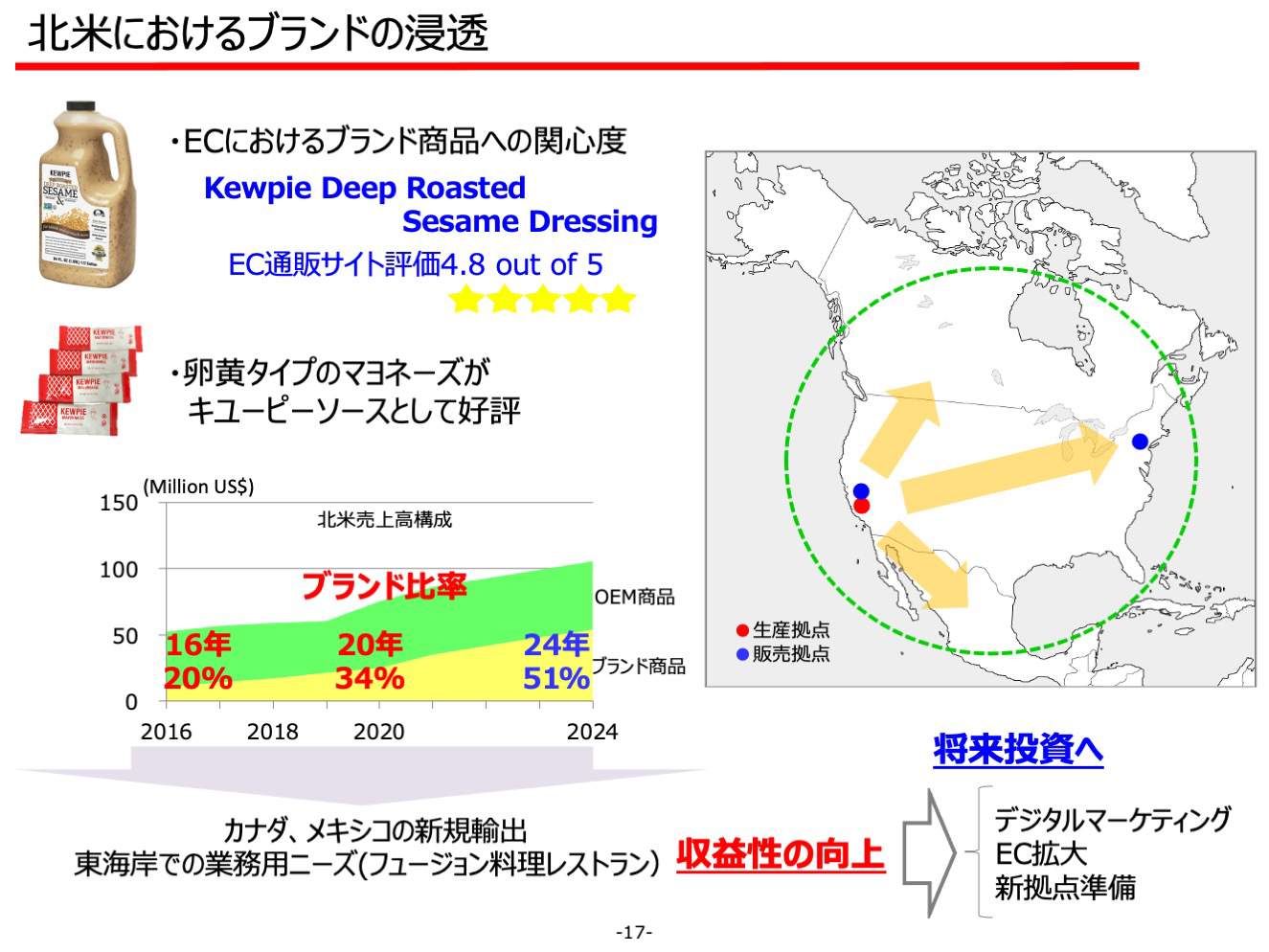
北米はまだ規模は大きくないものの、新たな動きが出てきています。
2010年に米国のECサイトアマゾンドットコムで日本製のキユーピー マヨネーズが人気ランキングNo1となり、以後も高評価をいただいており、さらに最近では当社北米の拠点であるQ&Bが生産する深煎りごまドレッシングもご好評いただいています。
これらの影響により、コストコなどホールセール向けの出荷が伸びており、カナダ・メキシコなど近隣国への輸出も開始しています。
また、東海岸でもニーズが高まってきており、将来の新規販売拠点や増産投資を検討しており、キユーピーブランドを浸透させ、次の成長の軸に育てていきたいと考えています。 -
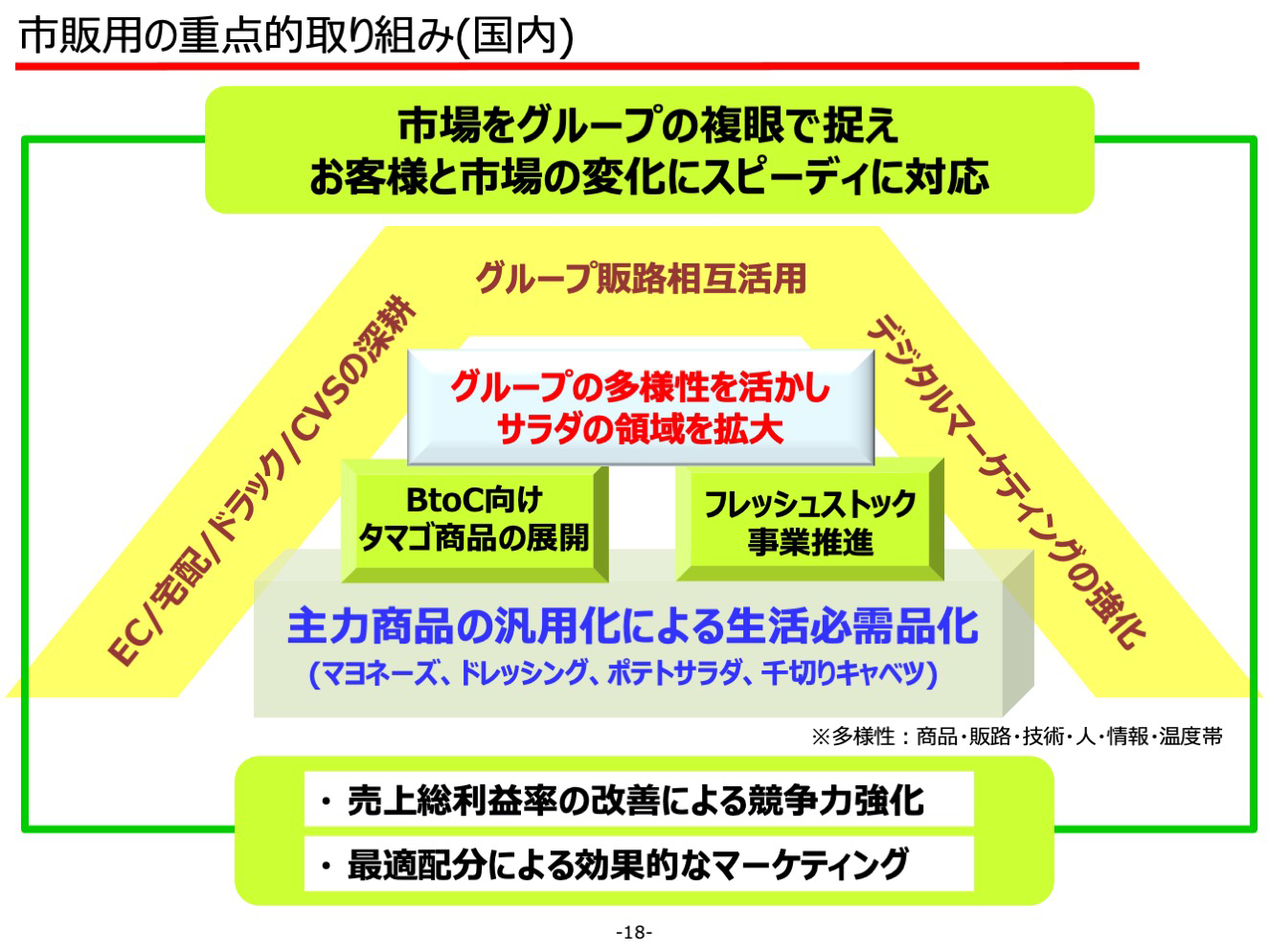
国内市販用の重点取り組みについて、お客様や市場の多様化するニーズにしっかり対応し、サラダの領域を拡大してまいります。
まずは当社の主力商品であるマヨネーズ、ドレッシング、ポテトサラダ、千切りキャベツなど生活に欠かせない商品を展開させ、安定的な収益を確保した上で、お客様になくてはならない新たな商品やサービスを提供してまいります。すでにフレッシュストック事業ではお客様へ食べ方や調理場面など新たな食シーンを提案していますが、この基本構想は市販用全体で進めていく取り組みと考えています。
さらに、業務用で培ったおいしさと技術の掛け合わせを、家庭でのタマゴ需要の拡大に展開させていきます。卵の栄養機能を広め、当社ならではの家庭用タマゴ商品を強化し、調味料・サラダに続く第3の市販用の柱に育成していきます。
また、縮小する国内需要の中でも成長が見込まれるドラッグストアや業務用向けスーパーなど未開拓販路を開拓することに加え、デジタルマーケティングを強化することで、D2C市場へのアプローチを進めていきます。
これらの取り組みを個社で推進するのではなく、グループが一体となって動くことで、主力製品の強化による収益性の向上や重複する機能を集約することで経営資源の有効活用も推進していきます。 -
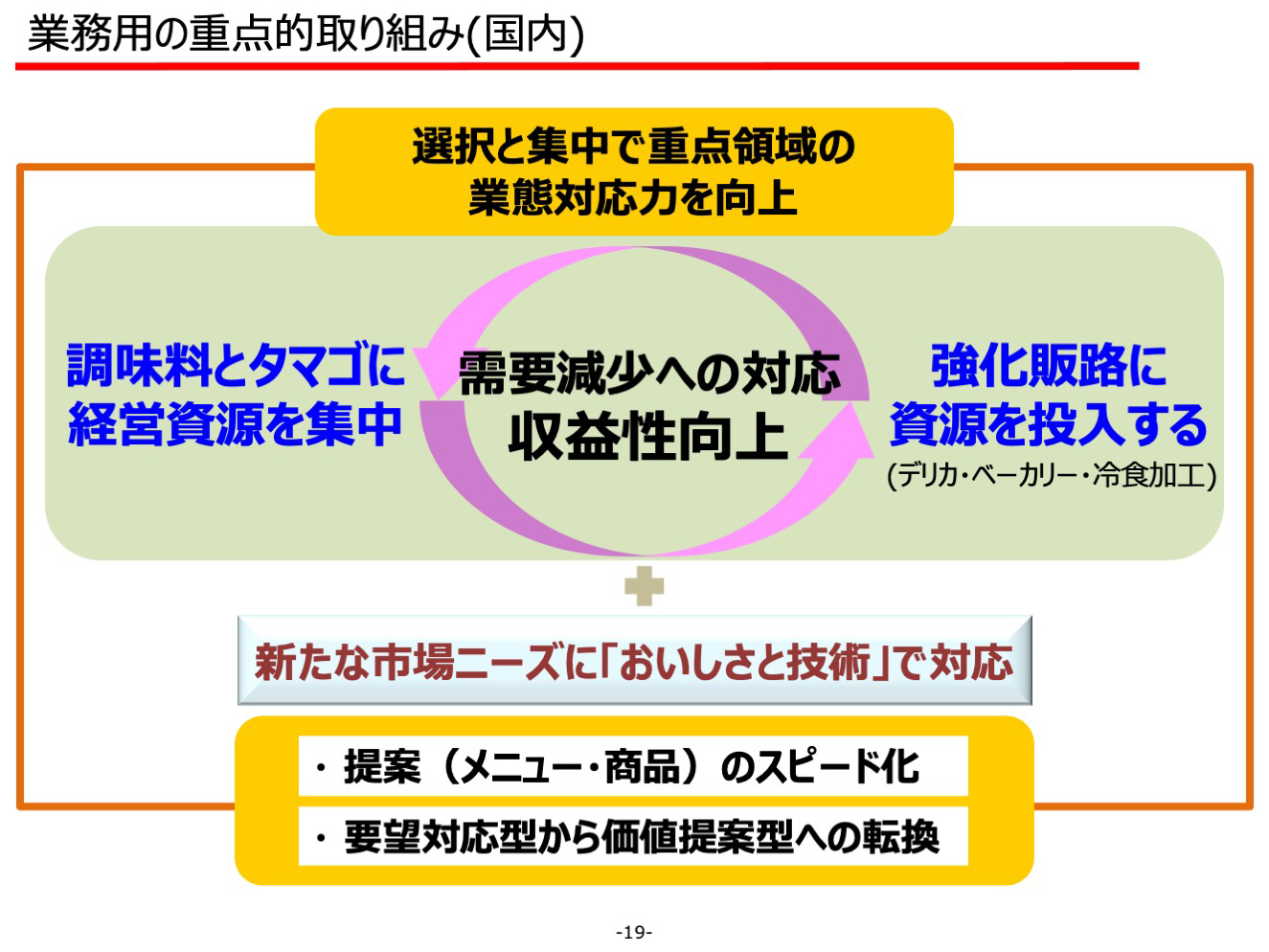
業務用市場では新型コロナウイルスの影響により消滅してしまった需要減少に対する取り組みが重点テーマとなります。
業務用市場においても、まずはグループが一体となって商品展開領域の適正化を図り、分散している機能や潜在価値を集約することで効率性を改善します。デリカ、ベーカリー、冷食加工業態などの強化する販路においては商品開発・品質管理体制を含めた経営資源の集中を行い、業態別対応チームでは、よりお客様のニーズにスピーディに対応できる提案をおこなっていきます。
また業務用市場ではお客様のニーズも多様化しており、技術を要する対応が求められてきております。一例では、フードテックの取り組みとして植物性素材を使用したタマゴ加工品の開発を進めています。鶏卵を使用しないノンエッグ加工商品は環境配慮など、お客様の新しい価値観に対応した商品となります。現在詳しくはお伝えできませんが、これまで培ったタマゴ加工技術を応用し、タマゴの魅力を知るキユーピーだからこその、おいしいノンエッグ加工商品を今年から展開できるよう準備を進めています。 -
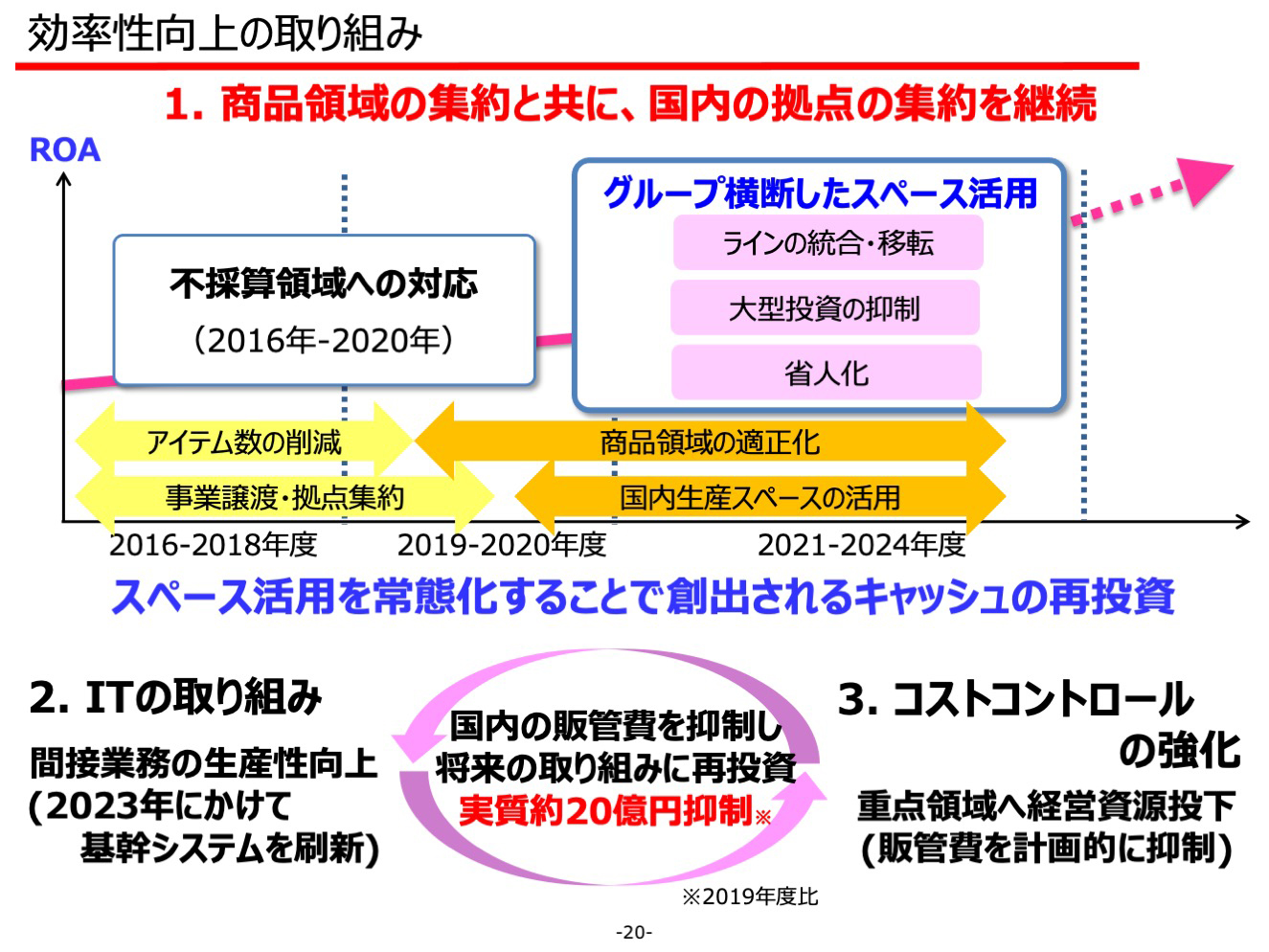
効率性向上の取り組みについて、商品領域の集約と共に、これまでも進めてきた生産の適正な再編を継続していきます。
今までの考え方は不採算領域の対応を中心に、収益性の低いものからアイテム・カテゴリー・事業を見直してきました。
この取り組みを進める中でも、少しずつグループを横断したスペース活用を広めてきましたが、これからはより進んだ形でこの流れを加速させていきます。事業の工場ではなく、市場に対応する工場という考えでスペースの有効活用を進めていきます。
スペース活用を常態化することで創出されるキャッシュと合わせ、現在すすめている基幹システムの刷新による間接業務の生産性向上や、さらにはコストコントロールの強化によって得られるメリットを将来の成長投資に向けた原資という考え方で捻出していきます。 -
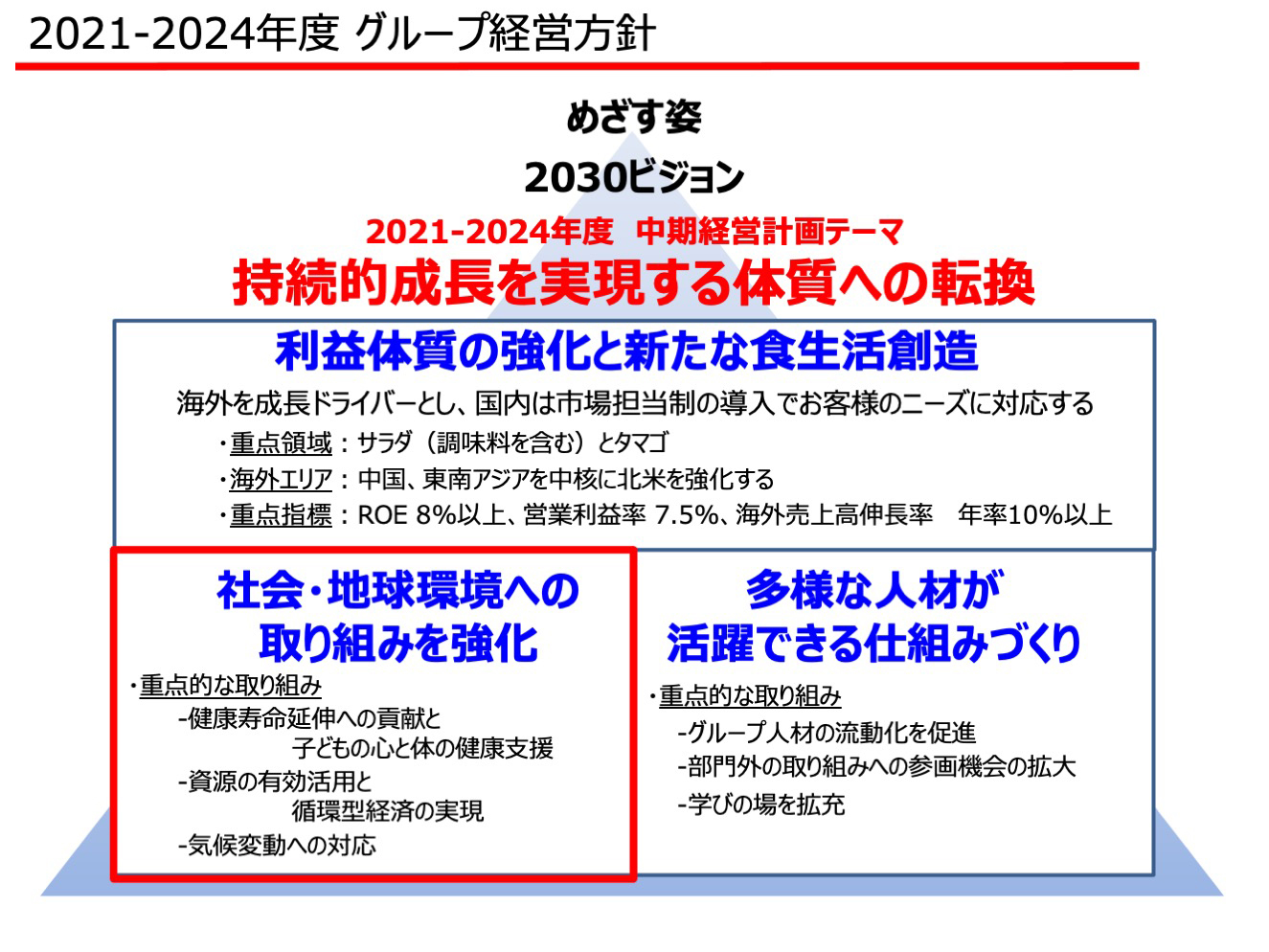
社会・地球環境の取り組みでは、持続可能な開発目標(SDGs)と連動した重点課題を進めていきます。
当社グループでは、自然の恵みに感謝し、限りある資源を大切にするという想いで、環境活動に長年取り組んできました。地球規模での問題に対して企業の責任に向き合い、事業活動を通じて従業員一人ひとりが日々の企業活動と紐づけて行動、実感できる取り組みを強化することで、ブランド価値の向上につとめています。 -
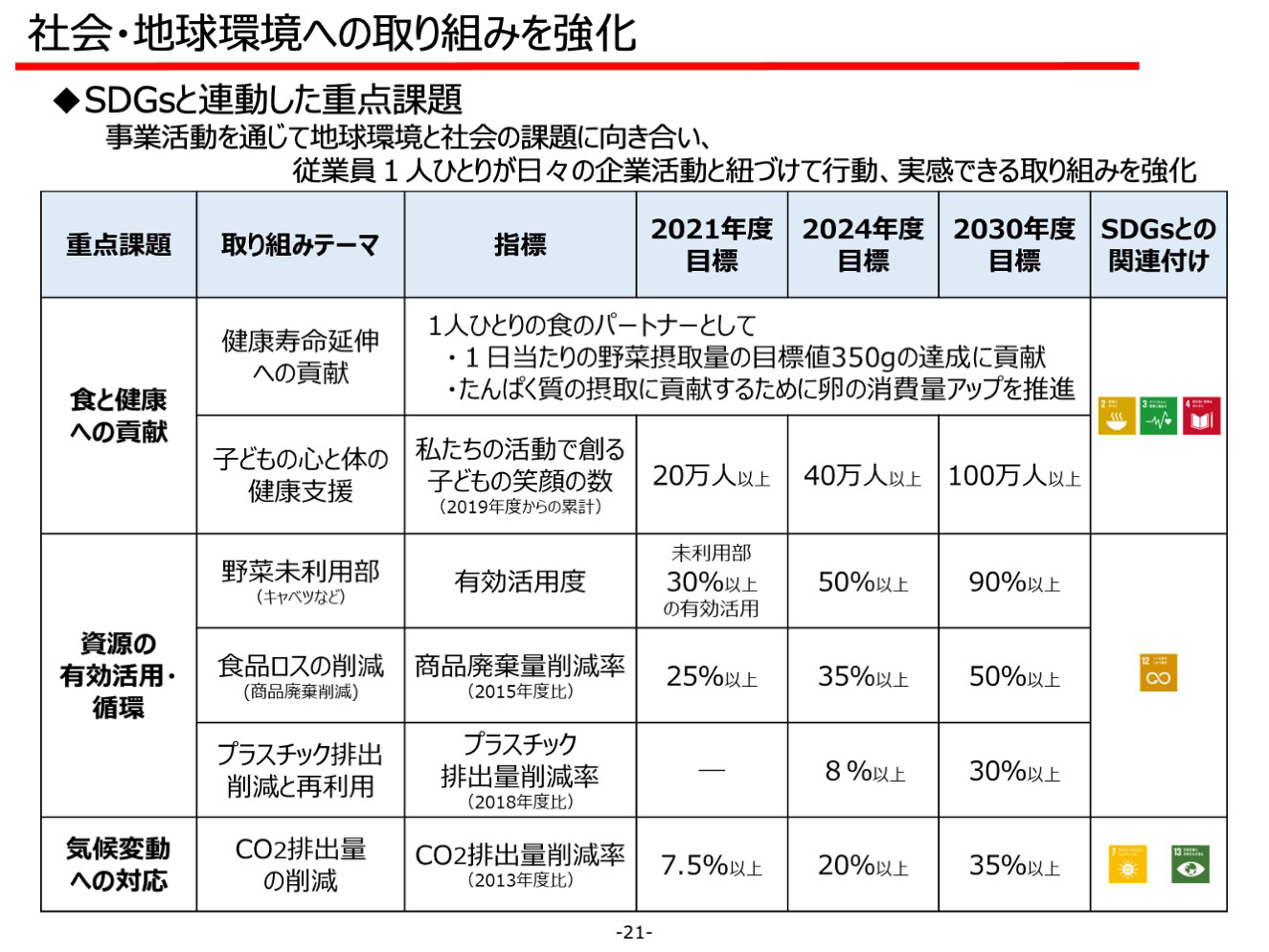
食と健康への貢献では、健康寿命延伸への貢献と子どもの心と体の健康支援に取り組んでいきます。
2019年は工場見学で10万人以上の来場者をお迎えしていましたが、現在のコロナ禍では見学を中止しており、替わりにリモートによるオンライン見学会を実施しています。社会の状況に合わせた食育やさまざまな食体験を提供することで、子どもの笑顔があふれる社会の実現に貢献していきます。
資源の有効活用・循環では、国内一の使用量となっているタマゴに続き、当社グループのサラダクラブが使用しているキャベツについても2021年度には未利用部の100%の活用をめざしています。
また、プラスチックの軽量化、代替素材の研究などプラスチック削減に取り組んでいきます。 -
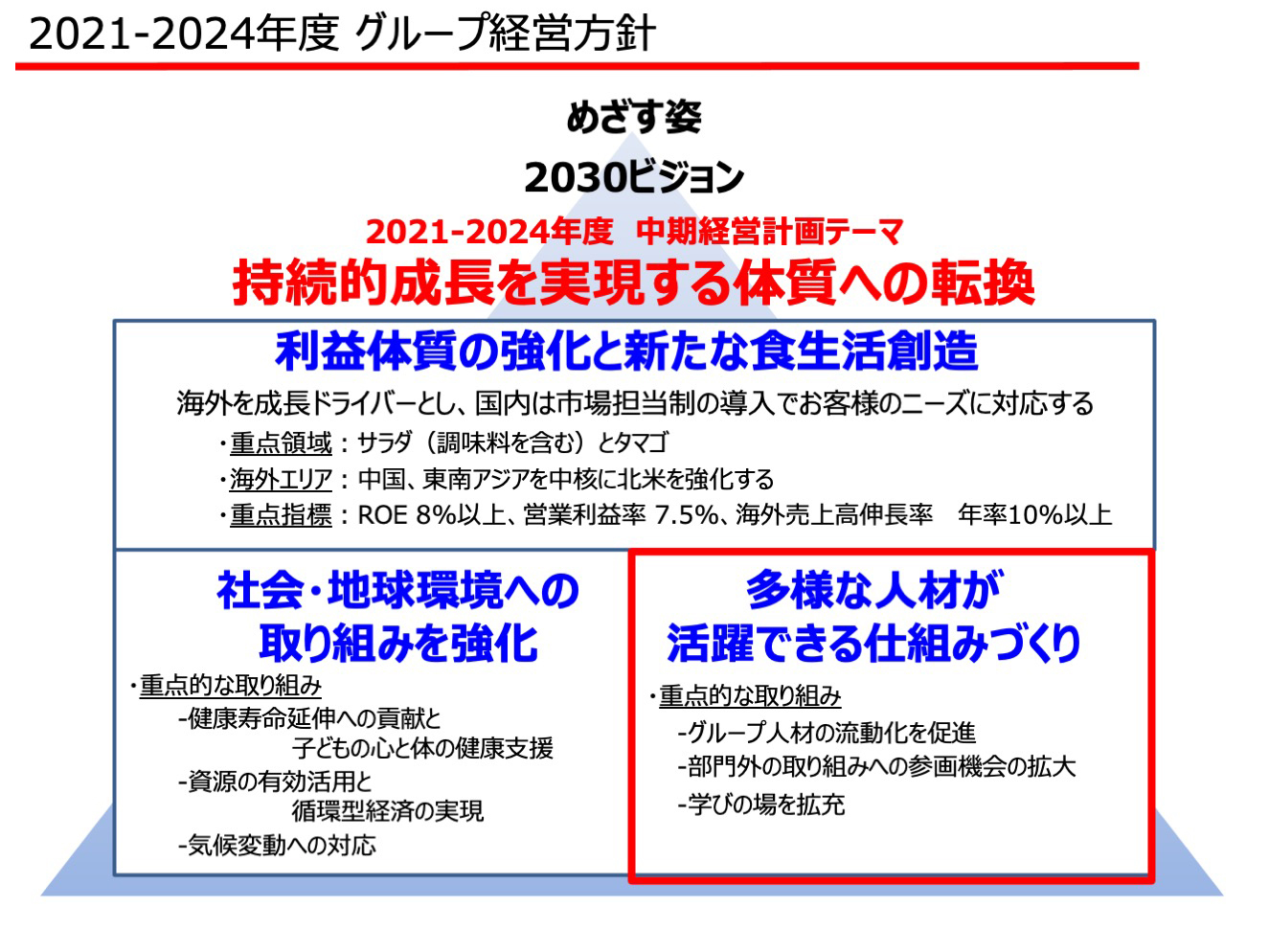
持続的成長を実現する人材を育成していくために、多様な人材が活躍できる仕組みづくりを実施していきます。
-
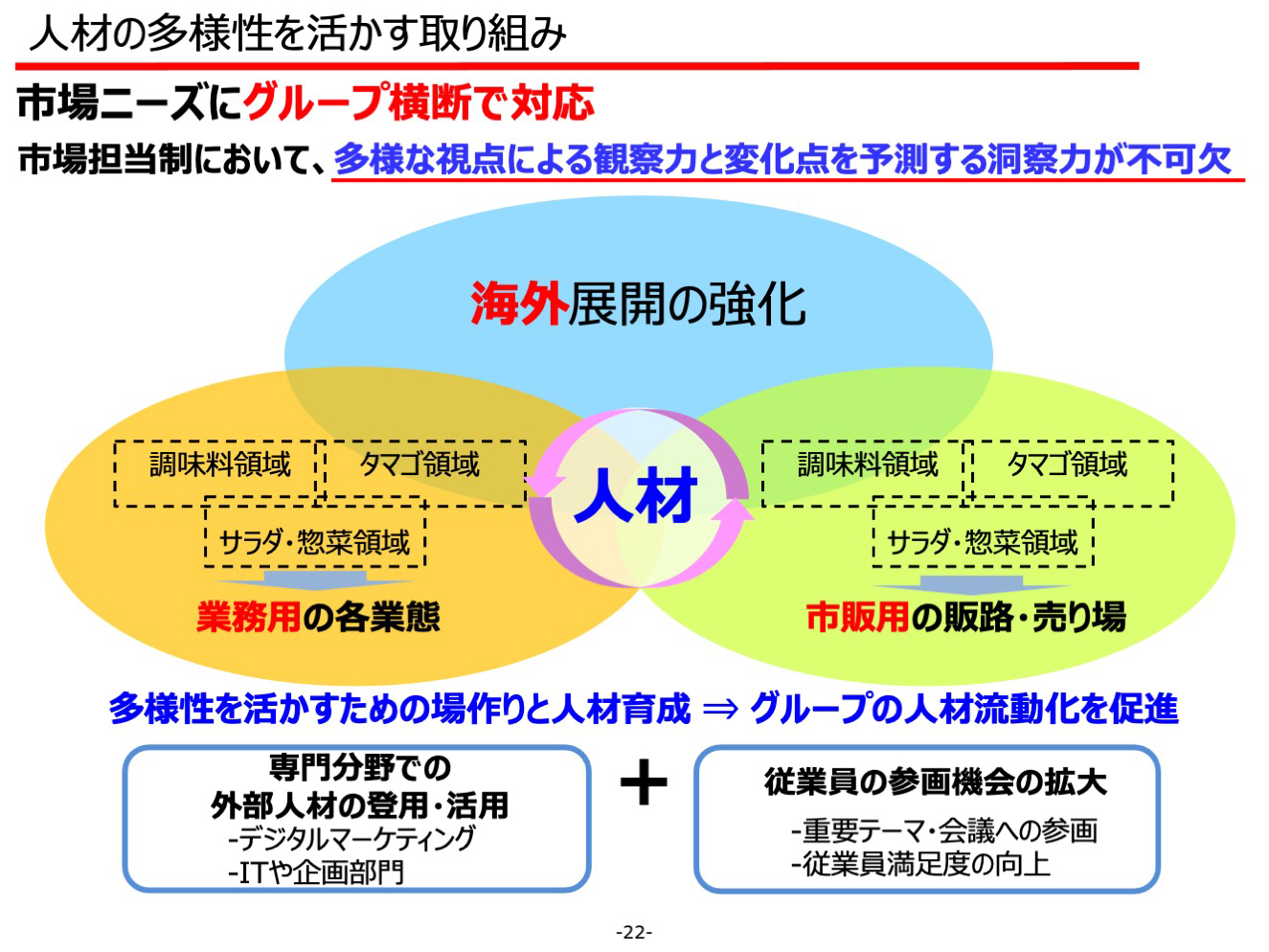
これからの海外展開および市場担当制への移行においては、多様な視点で物事や現象を捉え、それをチャンスに変えることが必要となります。市場で起こる変化点を俯瞰して捉えるためには、市場に精通し、複数の経験やスキルをもった人材の育成が重要です。人材流動性の促進を強化することで、多様なスキルを持つ人材の育成を進めていきます。
また、他部門とのプロジェクトや会議への積極的な参画、社内やグループ内へのインターンシップなどを通じて、多様性を認め合い、関わり合いを持つことができる風土を醸成していきます。
新たな取り組みとして、オンラインでビジネスに必要なカテゴリーを学ぶことのできるプログラムなども導入しました。学びの場を提供していくことで、一人ひとりが新たな経験や知識を習得し、能力を発揮できる環境を構築していきます。
また、ITなどの専門性の高い分野においては、外部人材の登用や活用を推進します。 -
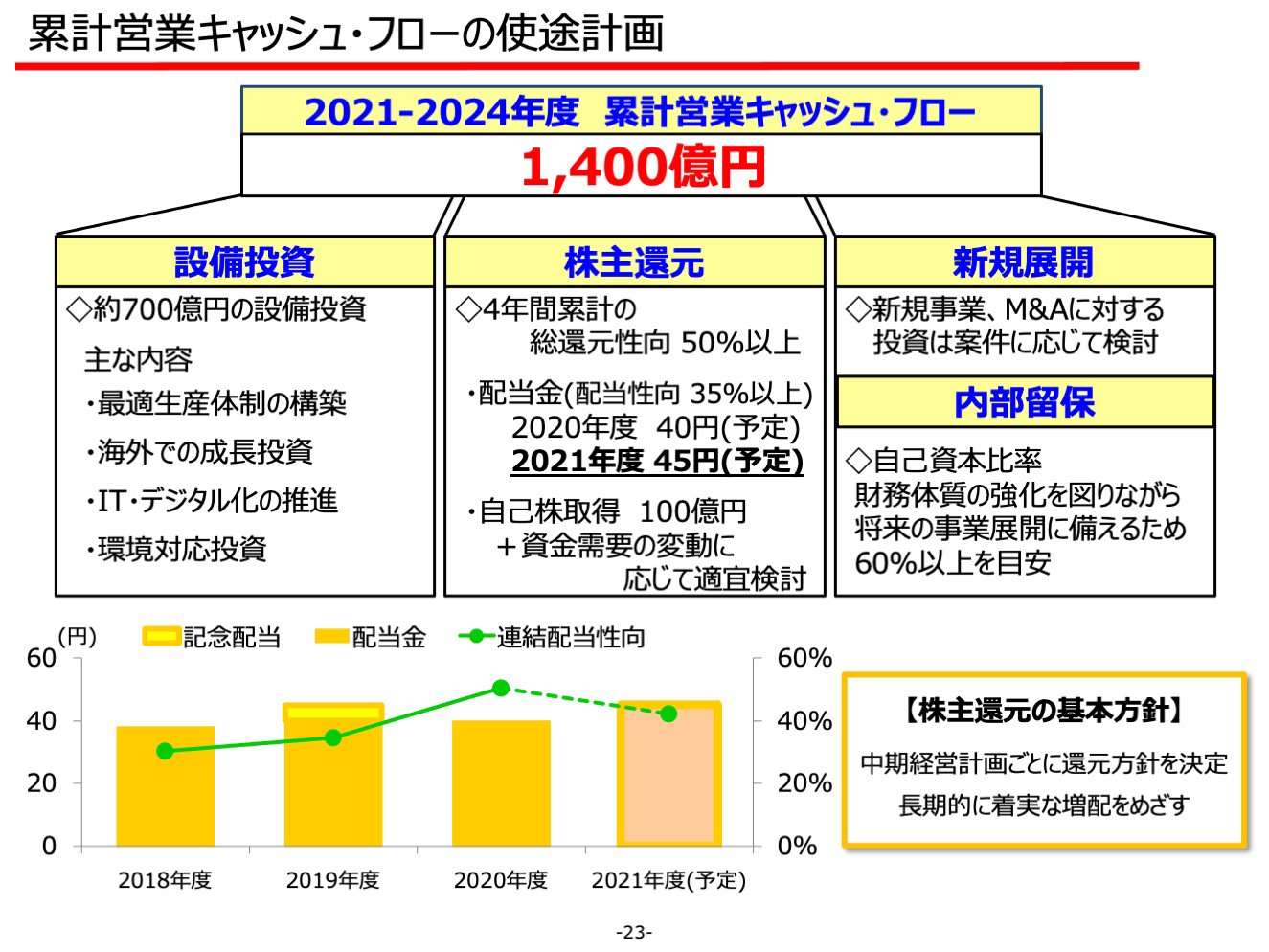
「持続的成長を実現する体質への転換」の取り組みを実施することで、2024年までの4年間の累計営業キャッシュ・フローは1,400億円を計画しています。
今回の中期経営計画では、このうち半分となる約700億円について国内・海外含めた設備投資に配分します。内部留保ついては財務体質の強化を図りながら将来の成長に備えるため、自己資本比率60%以上を目安とします。
当社の株主還元の基本方針は、配当金を最優先とし、中期経営計画ごとに還元方針を決定しています。本中期経営計画では、配当金45円以上を基準として、4年間累計の総還元性向50%以上を目標にしています。 -
2021年度 計画について。
-
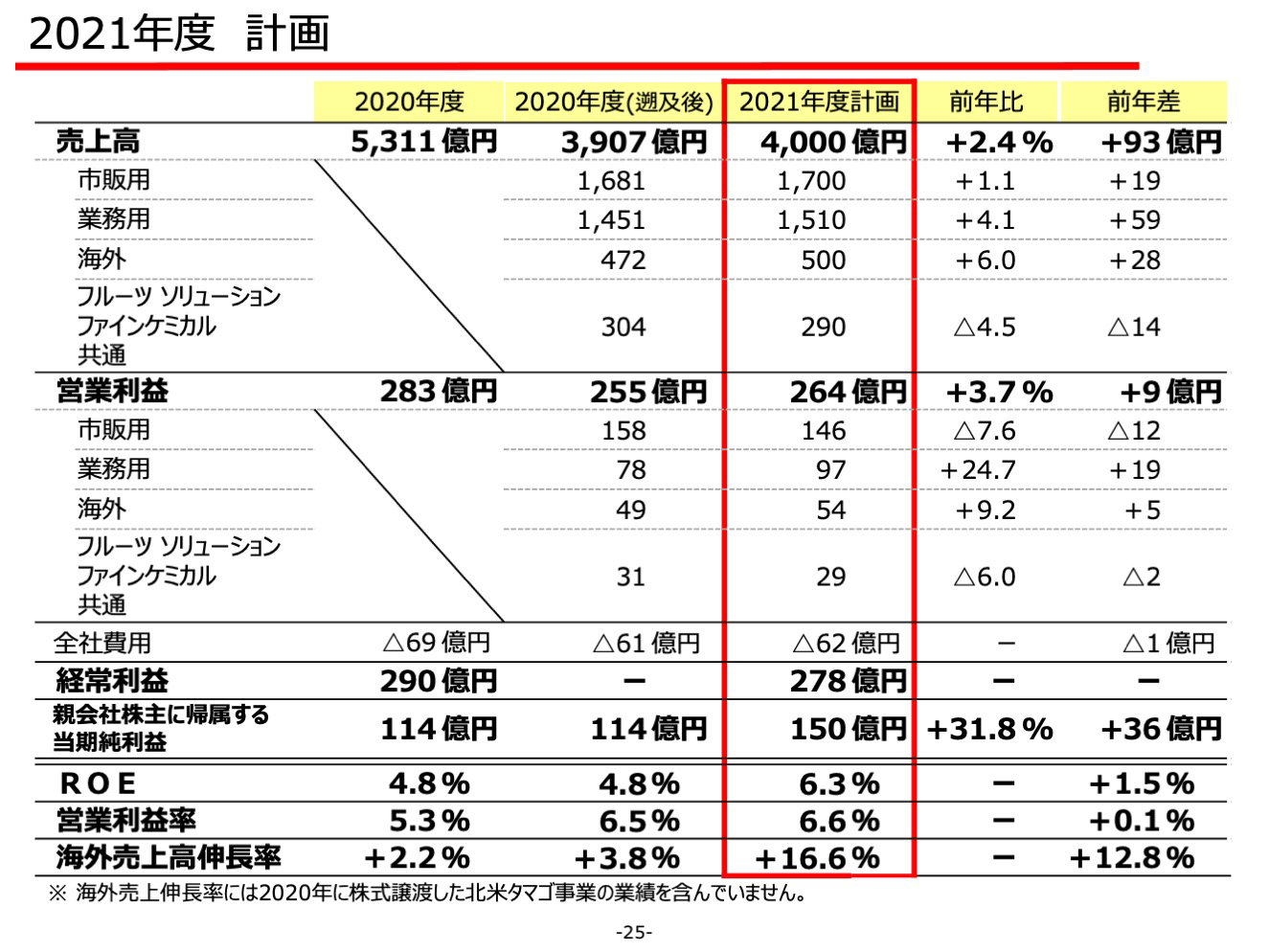
2021年度より、物流事業が連結対象外となり、またセグメントを変更しています。
2020年度実績について物流事業を除いた遡及後の数値を記載しており、前年比、前年差については2020年度の遡及後の実績と比較しています。売上高は、前年に対して93億円増収の4,000億円、営業利益は前年に対して9億円増益の264億円、親会社株主に帰属する当期純利益は、前年に対して36億円増益の150億円を計画しています。
経営指標のROEは6.3%、営業利益率は6.6%、海外売上高伸長率は2020年に株式譲渡した北米のタマゴ事業を除いた数値で、16.6%と2桁成長を計画しています。 -
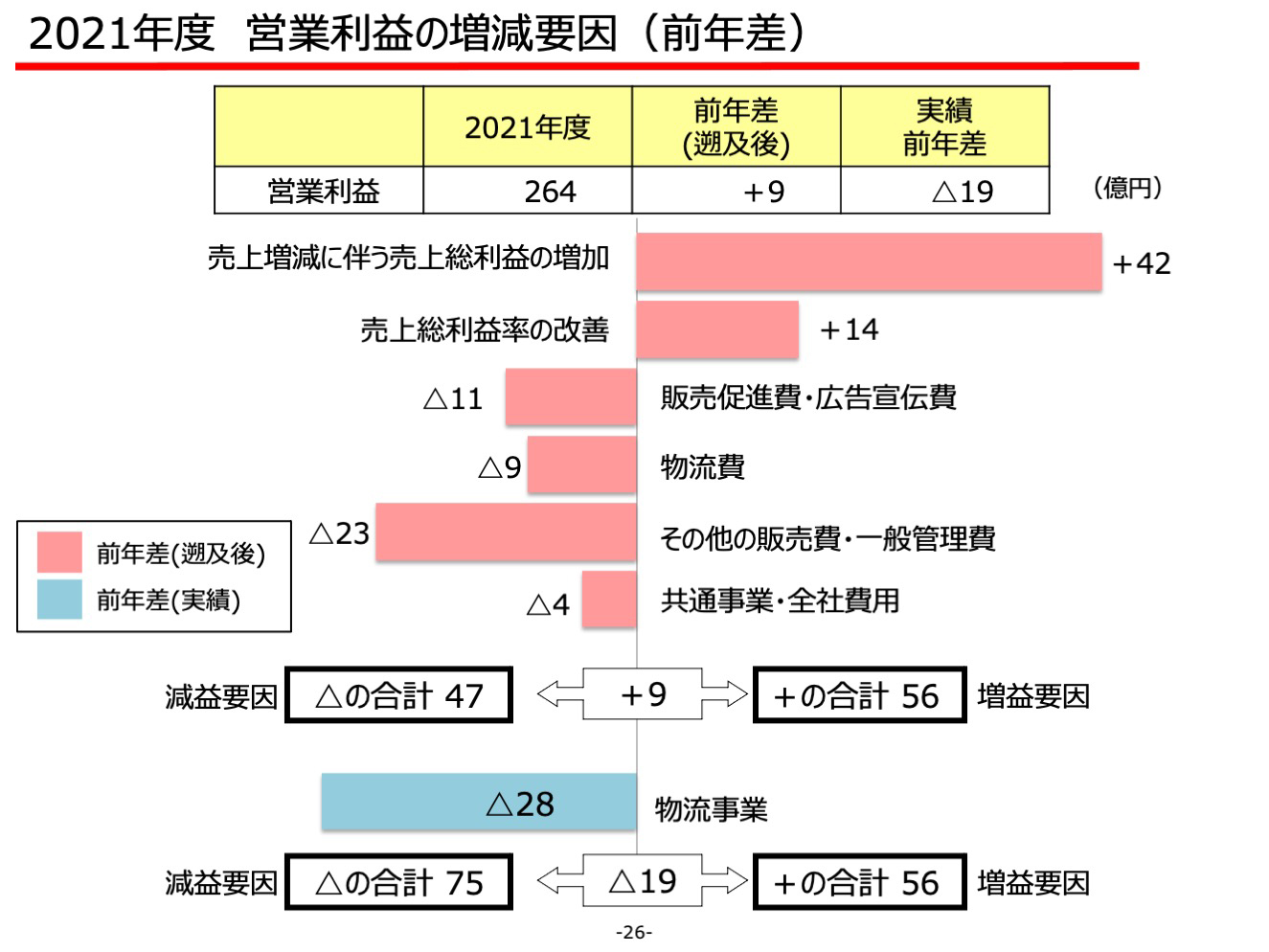
2021年度の営業利益の増減要因について。
売上増減に伴う売上総利益の増加では、コロナからの売上回復により、42億円増益となり、売上総利益率の改善については、主原料の高騰影響による減益要因を19億円と見込んでいますが、付加価値品が伸長することで14億円の増益を計画しています。
その他販売費・一般管理費では、経済活動の再開に伴う諸費用の増加により23億円の減少を見込んでいます。 -
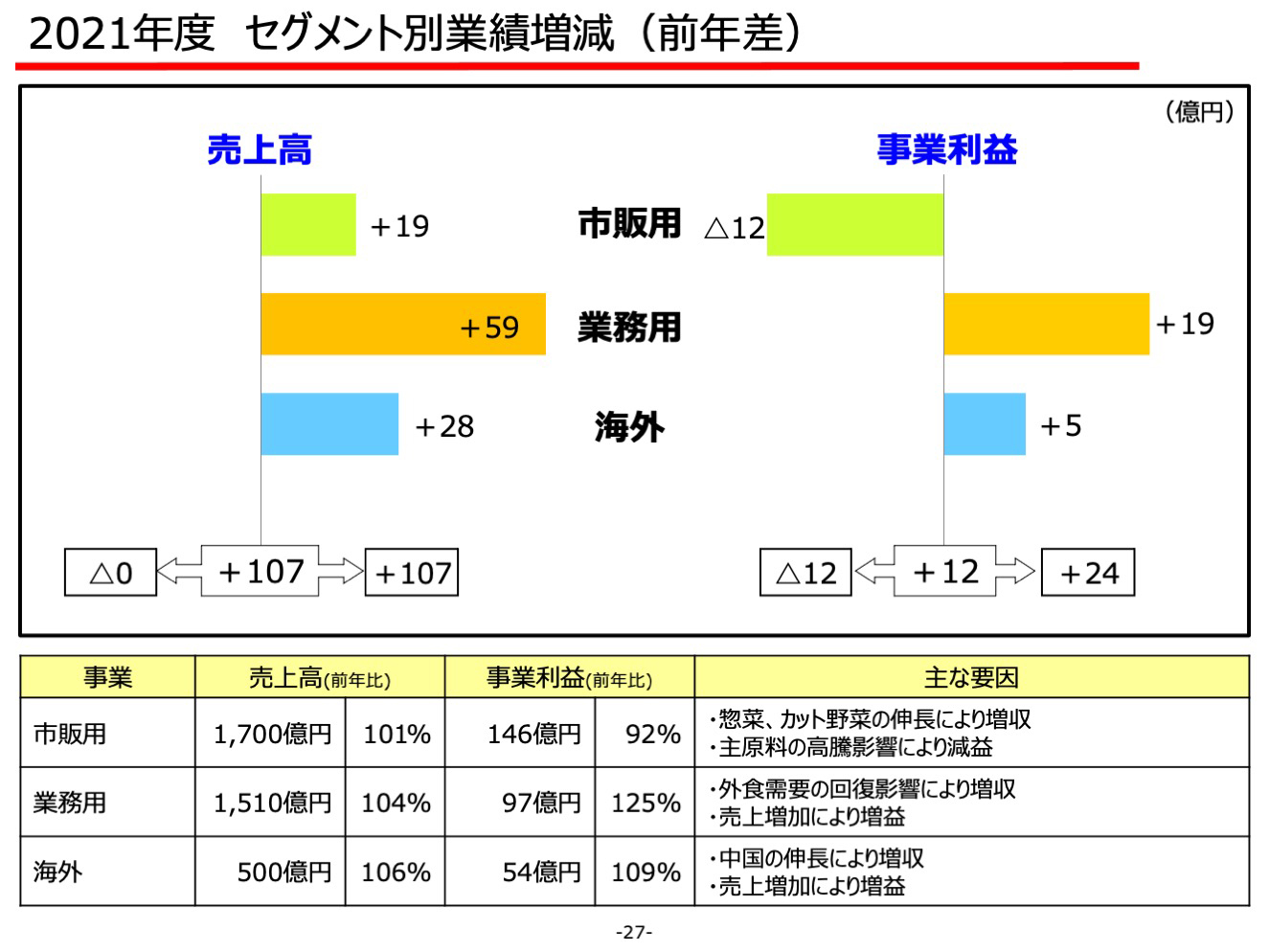
まず市販用は、増収減益の計画です。売上高は、惣菜やカット野菜の伸長により増収となりますが、営業利益は主原料の高騰影響などにより減益となります。
次に業務用では、外食需要の回復により増収増益の計画です。
海外では、中国の新型コロナウイルス感染症からの回復により増収増益を計画しています。 -
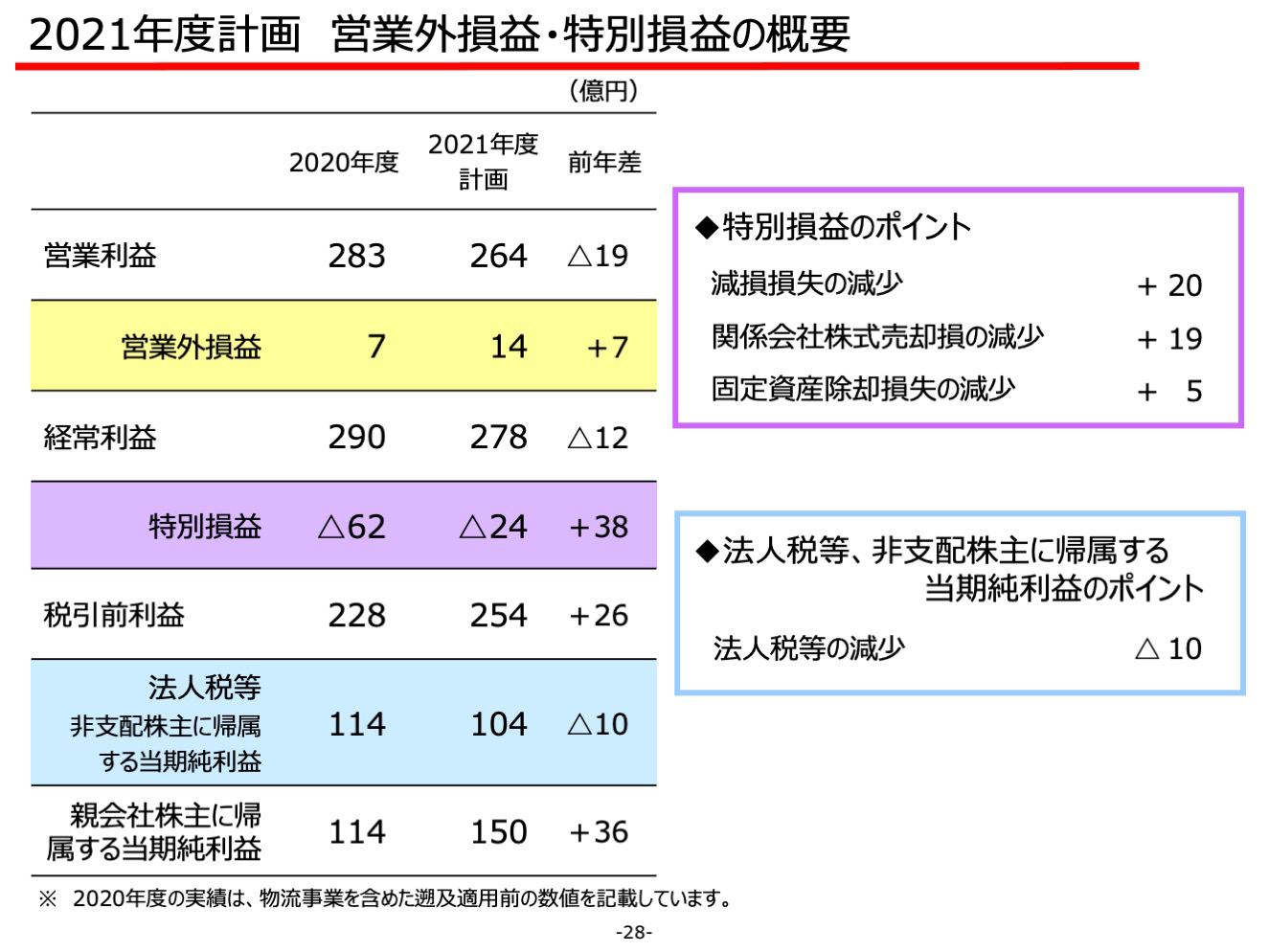
2021年度営業外損益、特別損益の概要について。
2020年度実績は物流事業を含めた遡及適用前の数値を記載しています。
特別損益は減損損失や関係会社の株式売却損が前年に対して38億円減少、法人税では前年に対して10億円減少することから、親会社株主に帰属する当期純利益は前年に対して36億円増加の150億円を計画しています。 -

キユーピーは2019年におかげさまで創業100周年を迎えることができました。2020年度は創業101周年ということで、次の100年に向けスタートをしましたが、世界的な新型コロナウイルス感染症拡大により、私たちの生活はもちろん、当社グループの業績にも大きな影響を及ぼしました。
新たな中期経営計画を推進していくことで、2030ビジョンのめざす姿で掲げている世界の食と健康に貢献するグループに向けて、持続的成長を実現する体質を創り上げていきます。
Q&A (Japanese only)
-
Since around 2019, we had been considering our business model because we felt that our traditional business unit system was insufficient to respond quickly to the diversification of our customers and changes in the market in recent years. It was during this time that the COVID-19 pandemic spread, and the challenges facing our group became apparent.
The COVID-19 pandemic has reinforced our understanding of the importance of profitability, efficiency, quality, and the breadth of our operations. Ultimately, in June 2020, we determined that we needed to urgently revise our medium-term management plan. -
We have been considering our future direction for some time now. We have determined that it is important to increase management independence and accelerate the speed of decision-making in order to support the growth strategy of K.R.S. Corporation Co., Ltd. We will continue to maintain a strong partnership with K.R.S. Corporation Ltd., and we will focus on the food business, prioritizing profitability and efficiency.
-
Our group's vision for around 2030 is to "contribute to global food culture with great taste, empathy, and uniqueness, centered around salads and eggs." Currently, our salad offerings are primarily fresh vegetable salads, but we aim to expand our menu to include more delicious and abundant vegetable options. We plan to first establish these offerings within Japan, and then propose Japanese-style vegetable-focused menus to other countries where we operate.
While our egg business, both domestically and internationally, is primarily focused on food service, we aim to strengthen food service and establish egg products as essential household items. By processing and delivering eggs, we aim to make the world of eggs more accessible to households and establish egg products as a household necessity, following in the footsteps of mayonnaise and salad dressings. -
Our medium-term management plan through 2024 focuses on strengthening our foundation and implementing transformations, so profit growth is not our top priority. From fiscal year 2025 onwards, we intend to pursue profit growth more proactively than we do now. Rather than seeking significant profit growth domestically, we believe that overseas markets, which are our growth drivers, will be the main focus.
-
Under the previous business-unit system, we honed our respective areas of expertise on a product-by-product basis. food service In the market, condiments has focused on the food and beverage sector, restaurants and CVS (convenience stores), while our egg division has sold to the confectionery, baking, deli, and frozen food processing industries. By transitioning to a market-based system, we believe we can integrate these sales channels and, while leveraging the strengths of each business, food service expand broadly into the market.
In addition, our portion-sized hard-boiled eggs, which we have been test-marketing since last year, have been well received. We are moving forward with preparations for a nationwide rollout and are also considering investments in this area. -
Since 2013, we have been making proactive investments, including reorganizing our domestic production facilities and addressing aging equipment, but we have largely completed major investments. Due to uncertainty regarding domestic demand, we plan to temporarily curb domestic capital investment from 2021 to 2024, and then make strategic choices and focus our efforts after carefully assessing market trends. Until now, our business and production plants have been inextricably linked, but going forward, we will work to optimize production management across the entire domestic market.
Regarding overseas operations, major investments were completed by 2020. We anticipate needing to further strengthen our overseas production system from 2025 onwards, and we intend to use these next four years to build up our strength and secure investment capacity. -
There are no special factors. Our policy is to keep capital investment to a minimum over the next four years. We will continue to make necessary investments for safety and relocation, but we will curb investments for increasing production, as these have already been completed.
In our previous medium-term management plan, we initially stated that our investment amount would be 100 billion yen, but in 2019, that was reduced to 85 billion yen, and we have continued to restrain our investments since then. We are not pursuing a strategy of scaling back; rather, since we have completed our large-scale investments, we want to temporarily restrain them for the sake of the future. -
The lower limit of 130 billion yen Net sales is based on the worst-case scenario of a complete market stagnation due to COVID-19, while the upper limit of 150 billion yen assumes a gradual recovery and a new business strategy. Rather than waiting for the market environment to recover, we aim for recovery by implementing new measures.
-
We are planning to Net sales of 35 billion yen in China in fiscal year 2024, and we will be implementing four initiatives to achieve this.
① Area expansion: We want to invest resources in areas with large populations.
② Strengthening Mayonnaise and Deep-Roasted Sesame Dressing: Deep-Roasted Sesame Dressing has been well-received during the COVID-19 pandemic. In China, it is more versatile and well-known than mayonnaise. Currently, Net sales ratio of mayonnaise to dressing is 62:38, but we plan to increase the sales of dressing to 55:45 by fiscal year 2024.
③ Strengthening localization: We will promote initiatives to ensure that our products become an integral part of home food culture.
④ Strengthening digital marketing: We are advancing digital marketing, including understanding how customers use our products. -
Regarding personnel, we will deploy individuals skilled in expanding sales channels and marketing. We will also invest in technical personnel (production, quality, and development) who can implement the latest technologies in our factories, and we will promote horizontal deployment across our four factories in China. At the same time, we will promote training for local staff.
In addition, we have been promoting digital marketing since fiscal year 2020, and we will be investing in information to strengthen marketing focused on usage and potential consumption rather than just selling. -
The COVID-19 pandemic created a significant gap between home-cooked meals and restaurants. While household demand grew compared to fiscal year 2019 due to increased demand, food service, particularly the food and beverage industry, continued to face challenging conditions, although a recovery trend was observed towards the second half of the year. Given the declaration of a state of emergency from January 2021, we anticipate that the food and beverage industry will continue to face difficult conditions. However, by transitioning to a market-based system, we aim to contribute beyond the market size by thoroughly addressing the needs of industries other than food and beverage. For household use, we anticipate continued growth in domestic demand. We will establish a foundation by developing all-purpose condiments and promote versatility by proposing menus that encourage the consumption of vegetables in a delicious and abundant way.
We anticipate that it will take about two to three years to recover to pre-COVID levels, given the continued uncertainty. However, we aim for recovery by maintaining domestic demand for household use and by adapting to different business models through a shift to a market-based sales system for food service. -
It is difficult to fully incorporate the impact of COVID-19, so the planned figures have a certain degree of flexibility. For the first quarter of fiscal year 2021, we expect a 10-20% decrease to compare with the situation in fiscal year 2020 without the impact of COVID-19. For the second quarter, we anticipate a positive year-on-year increase due to the significant impact of COVID-19 in fiscal year 2020, and for the third and fourth quarters, we expect a gradual recovery following the trend of the second half of fiscal year 2020.
The 4% Net sales is broken down as follows: condiments +2% and eggs +5%. The difference in growth rates between condiments and eggs reflects differences in their main business models and customer recovery rates. -
We anticipate that low prices will be the highest since 2013. While our group's self-help efforts are insufficient, we will consider price revisions, but we intend to make careful decisions regarding the timing, scope of products, and what customers will find to be reasonable prices in light of the COVID-19 pandemic.
-
If we determine that strengthening our core business structure is difficult through self-help efforts, and given the rising costs of personnel and logistics, we will consider all factors as options.
-
In China, the food service was affected mainly by COVID-19 in Q2, and although food service mayonnaise and dressing did not fully recover in Q3, they almost recovered in Q4. Overall, large banquet restaurants continued to see customers not returning, but we have adapted to medium-sized restaurants, food service, CVS (convenience stores), and BtoBtoC by changing sales channels.
For the first half of fiscal 2021, we expect the recovery of large banquet restaurants to remain challenging, but we aim to increase profits by 5%~15%. In the second half of the year, as COVID-19 settles down, we expect the food service to recover by nearly 20%~30%, with plans to grow by 22% for the full year. -
The improvement in profit margins is due to the recovery of food service. The plan incorporates the impact of increased raw material costs. As stated in the Q&A above, we anticipate that the recovery of large banquet restaurants and other commercial establishments will take time in the first half of fiscal year 2021, and food service will remain in a difficult situation. However, we expect that the COVID-19 situation will subside in the second half of the year, and food service will recover. This recovery in food service is planned to contribute to the improvement in profit margins.
2Q Financial Results Briefing
July 3, 2020 (first half of the fiscal year ending November 2020)
-

-
-

2020年上期概要について。
-
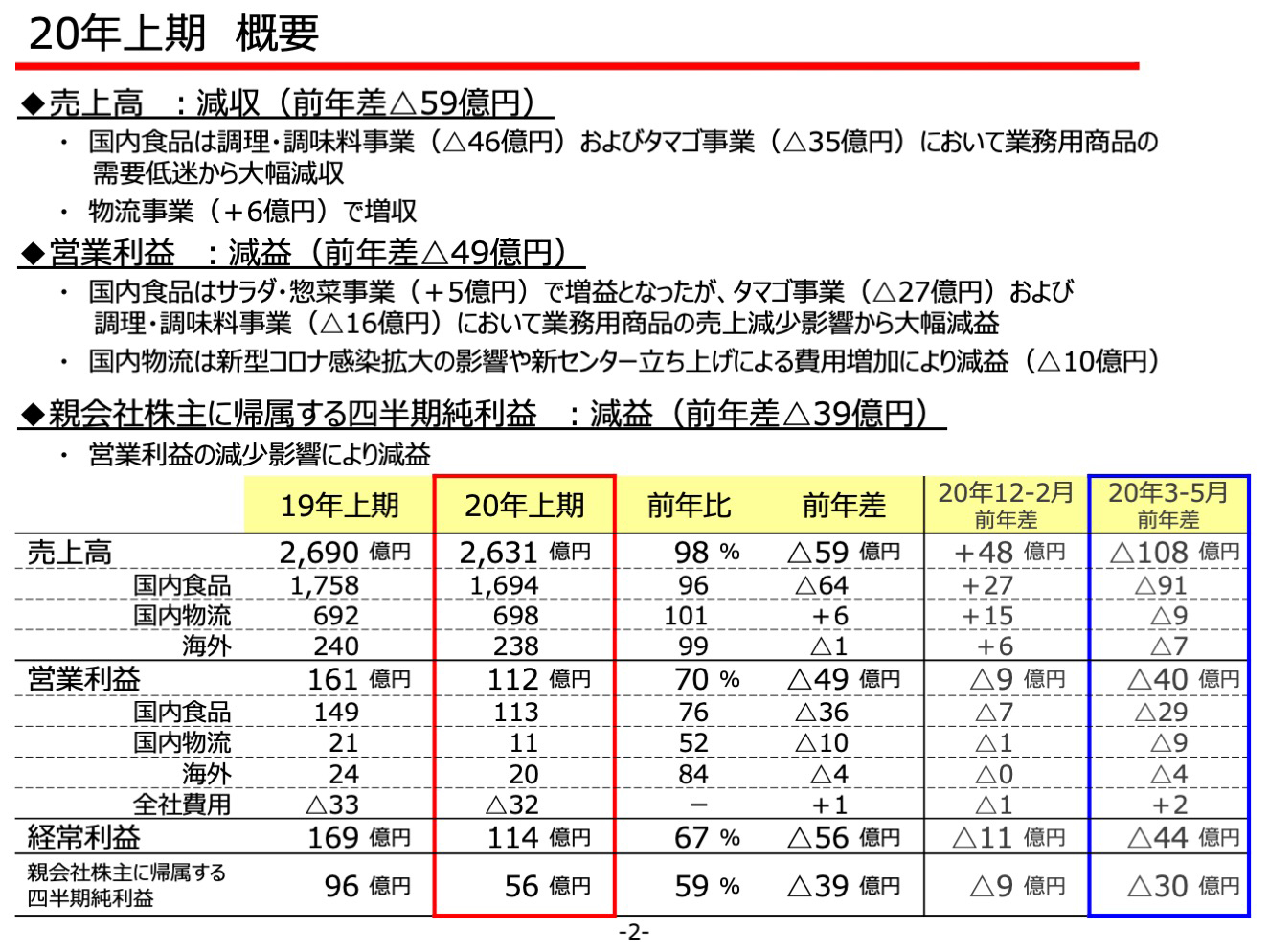
売上高は、前年に対して59億円の減収となる2,631億円となりました。物流事業において6億円の増収となったものの、国内の調理・調味料事業で46億円の減収、タマゴ事業で35億円の減収となり業務用商品の需要低迷から非常に厳しい結果となりました。
営業利益は前年に対して49億円減益の112億円となりました。サラダ・惣菜事業は5億円の増益となりましたが、タマゴ事業および調理・調味料事業において、業務用商品の売上減少により大幅な減益となりました。
また、国内の物流事業においても新型コロナウイルスの影響から出荷物流が減少したことや新センター立ち上げによる費用増加により10億円の減益となりました。親会社株主に帰属する四半期純利益は、営業利益の減少によるもので、前年に対して39億円の減益となりました。
今回の業績は3月から5月の影響を大きく受けており、表の青枠で3か月間の業績を示しています。ちょうど新型コロナウイルスの影響を受けた期間となります。
-
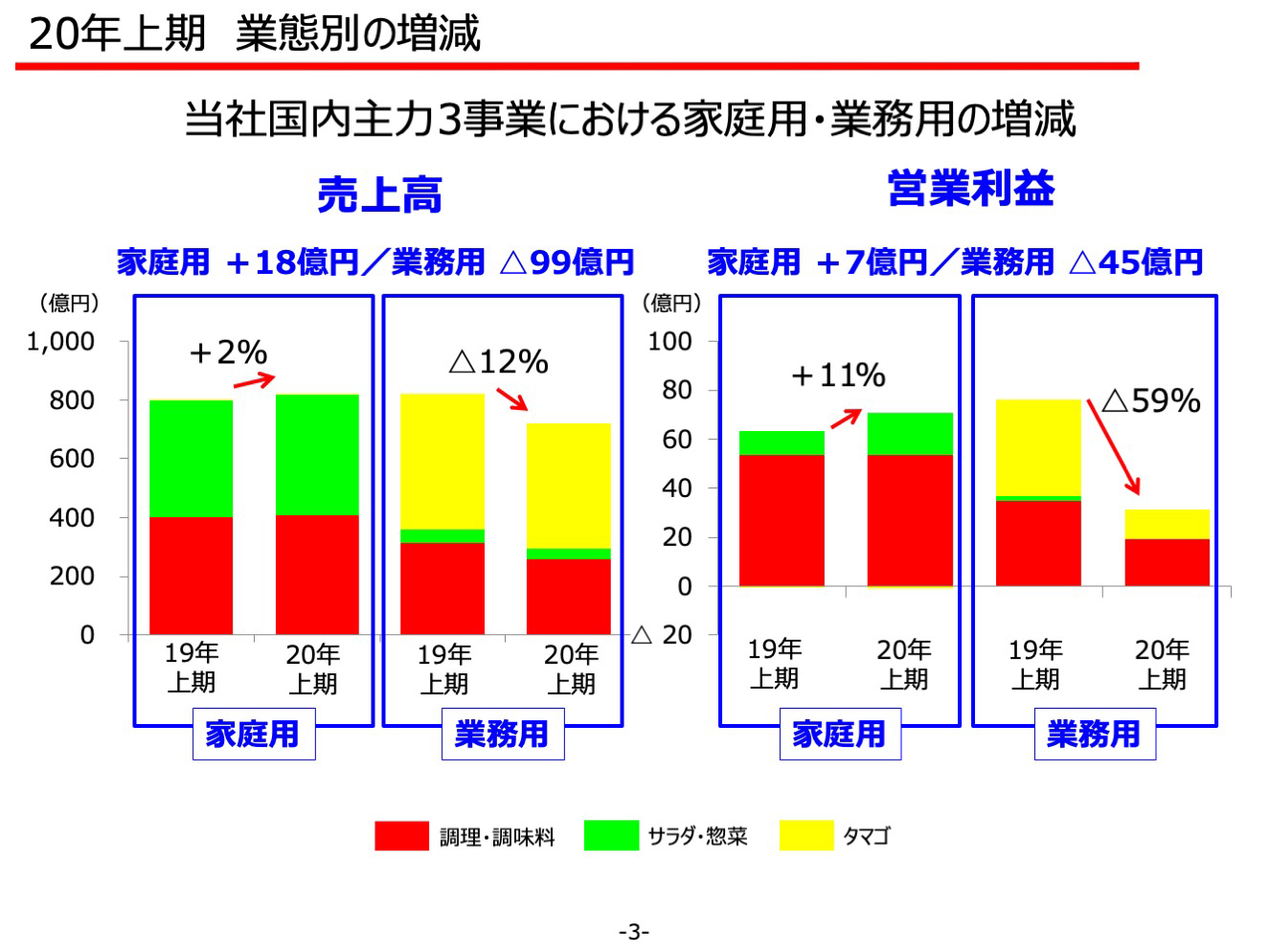
当社の国内主力3事業の売上高、営業利益を家庭用と業務用にわけて示しています。外出自粛などの影響で、業態別に差が生じました。
家庭用は主に調理・調味料、サラダ・惣菜となりますが、巣ごもり需要による影響から売上で2%増加し、利益では11%の増益効果がありました。業務用は主に調理・調味料とタマゴとなりますが、売上で12%減少、利益では59%の減益要因となりました。 -
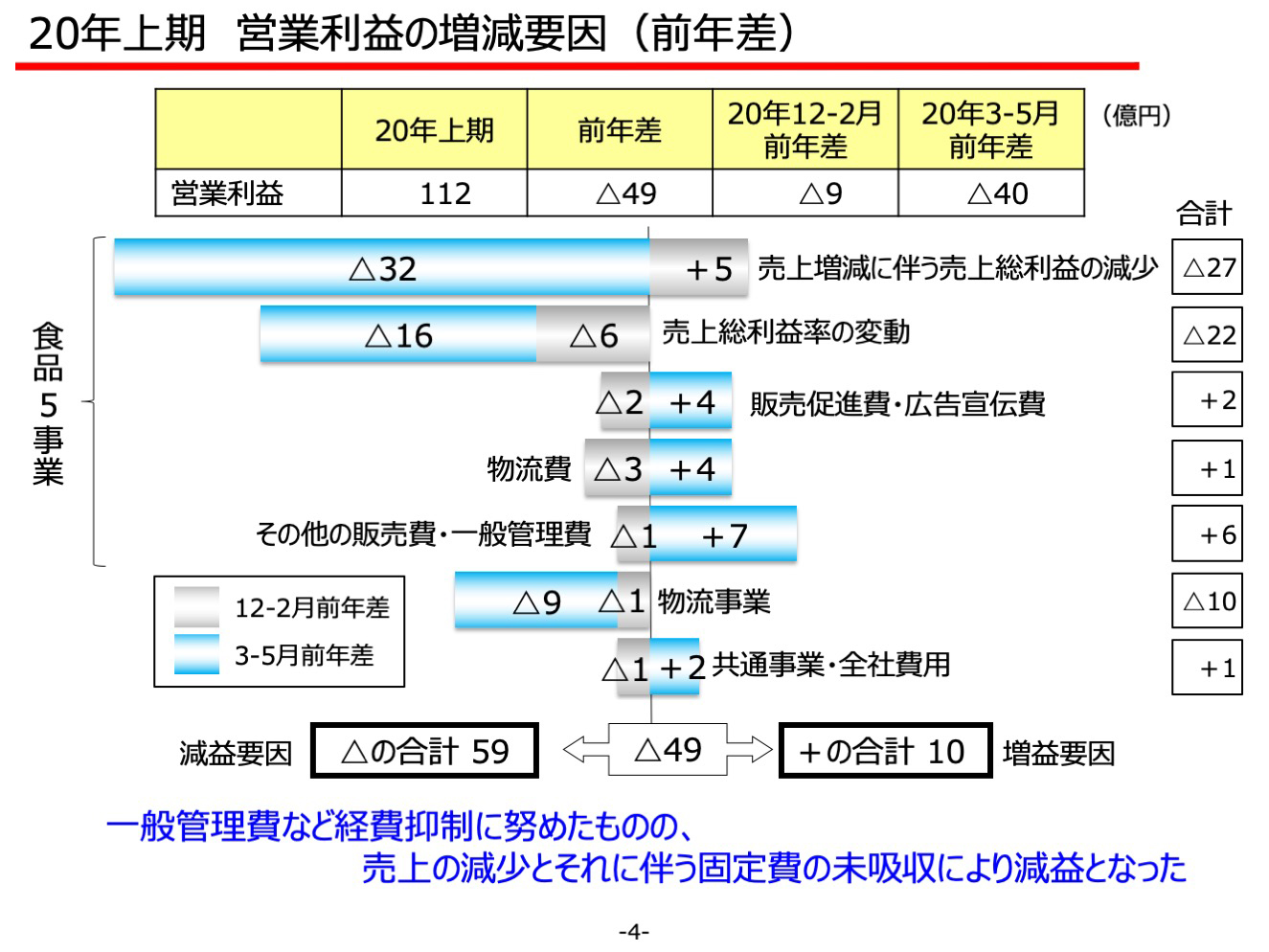
営業利益の増減要因について。
今回第2四半期で大きな変動があったため、第1四半期と第2四半期に分けて増減要因をグラフで示しました。
売上増減に伴う売上総利益の減少により27億円減益となり、そのうち第2四半期で32億円減益となりました。新型コロナウイルスの影響により業務用商品の需要低迷が減益の要因です。
売上総利益率の変動においては、主原料コストの増加や、工場の操業度低下などにより22億円減少しました。
販売促進費、広告宣伝費、一般管理費などで経費の抑制に努めましたが、全体では49億円の減益となりました。 -
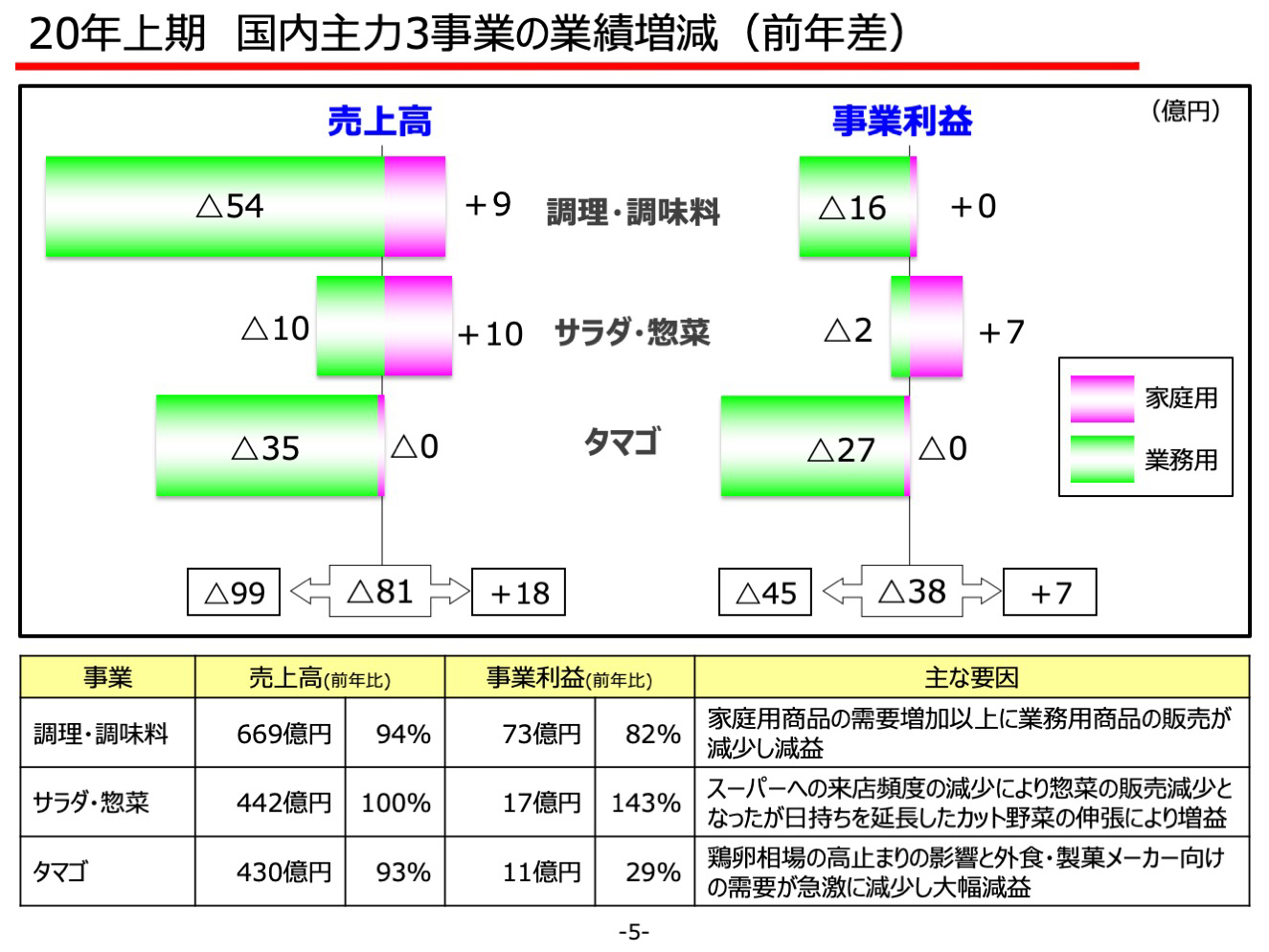
国内主力3事業の売上高、事業利益の増減について。
調理・調味料事業では、家庭用商品の需要増加以上に業務用商品の販売が減少したため、減収減益となりました。サラダ・惣菜事業では、業務用商品で販売の減少が10億円ほどみられましたが、カット野菜や惣菜において10億円販売が増加し、売上は前年並みとなりました。利益については、日持ちを延長したカット野菜が伸張したことなどから増益となりました。
タマゴ事業は、ほぼ業務用商品の取扱いであることから、外食、製菓メーカー向けの需要が急激に減少したことにより減収となりました。利益についても、売上減少に伴う固定費未吸収に加え、鶏卵相場の高止まりによる影響を受け、大幅な減益となりました。
-
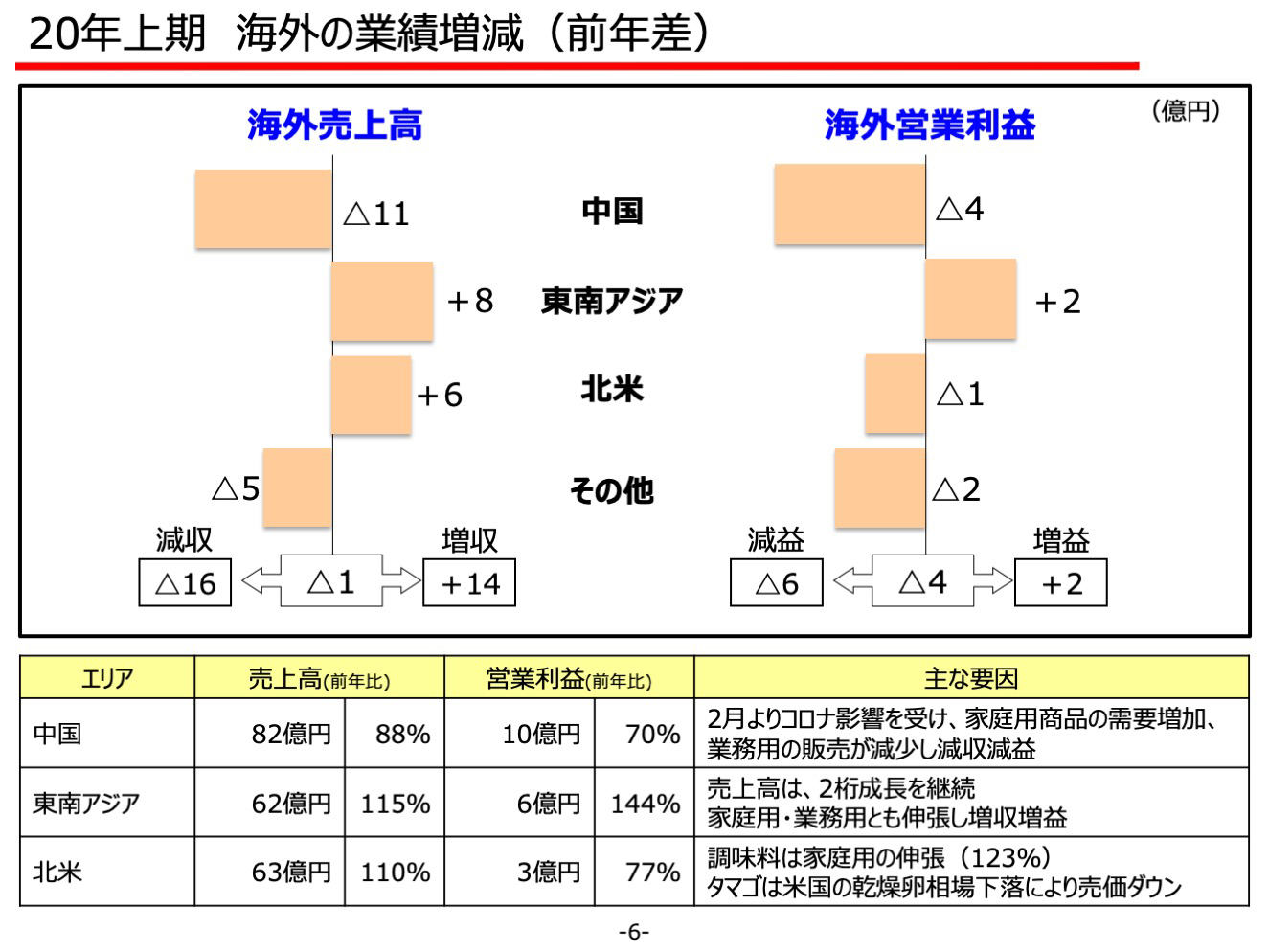
海外の売上高、営業利益の増減について。
中国では、1月下旬のロックダウン以降、外食レストランなどが休業した影響により業務用商品の販売が減少し減収減益となりました。東南アジアについては、上期では新型コロナの影響はそれほど受けておらず引き続き2桁成長を続けており営業利益も増益となりました。
-
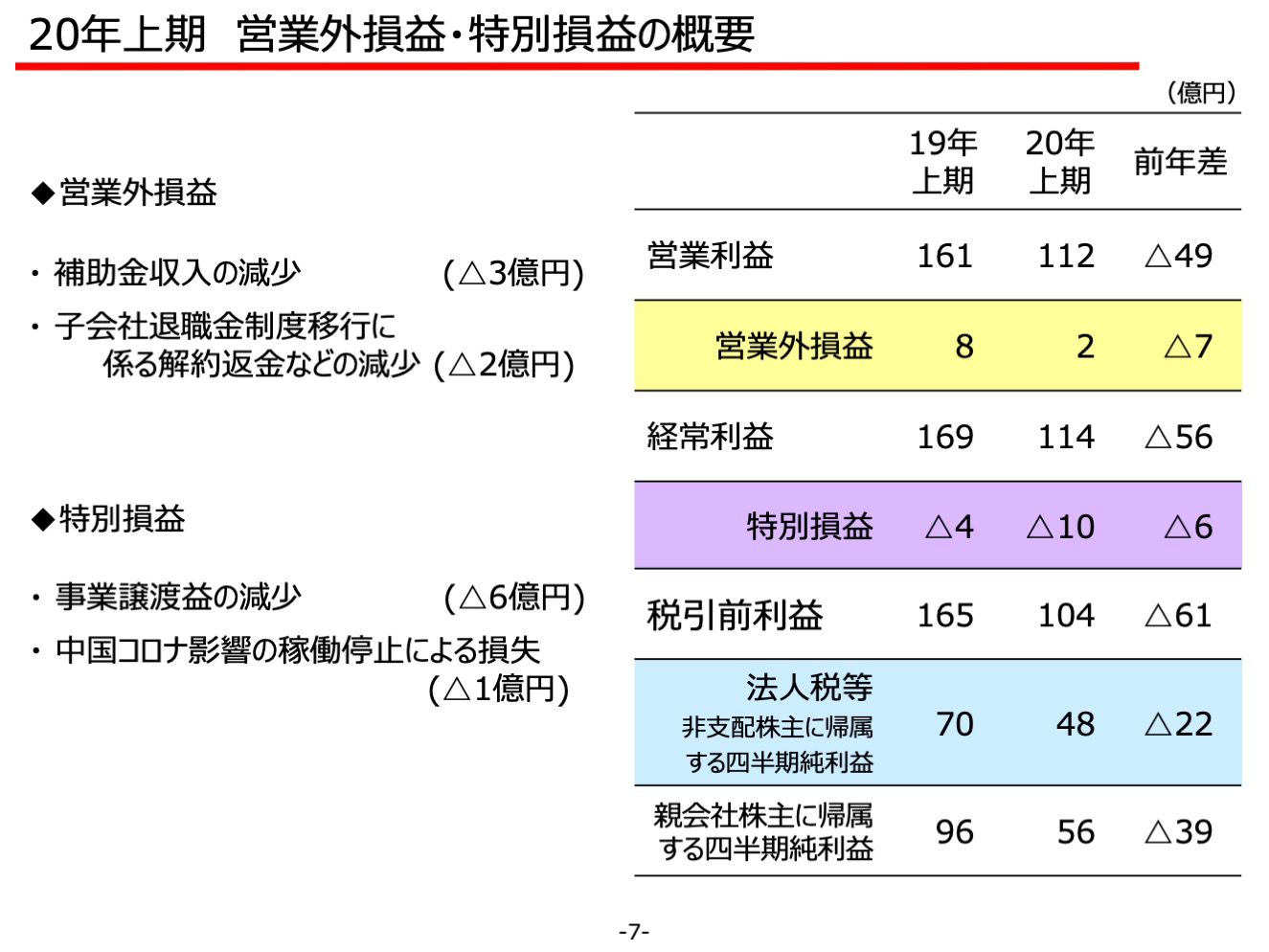
営業外損益、特別損益の概要について。
営業外損益は補助金収入の減少により3億円減少、特別損益は事業譲渡益の減少により6億円減少しました。
-
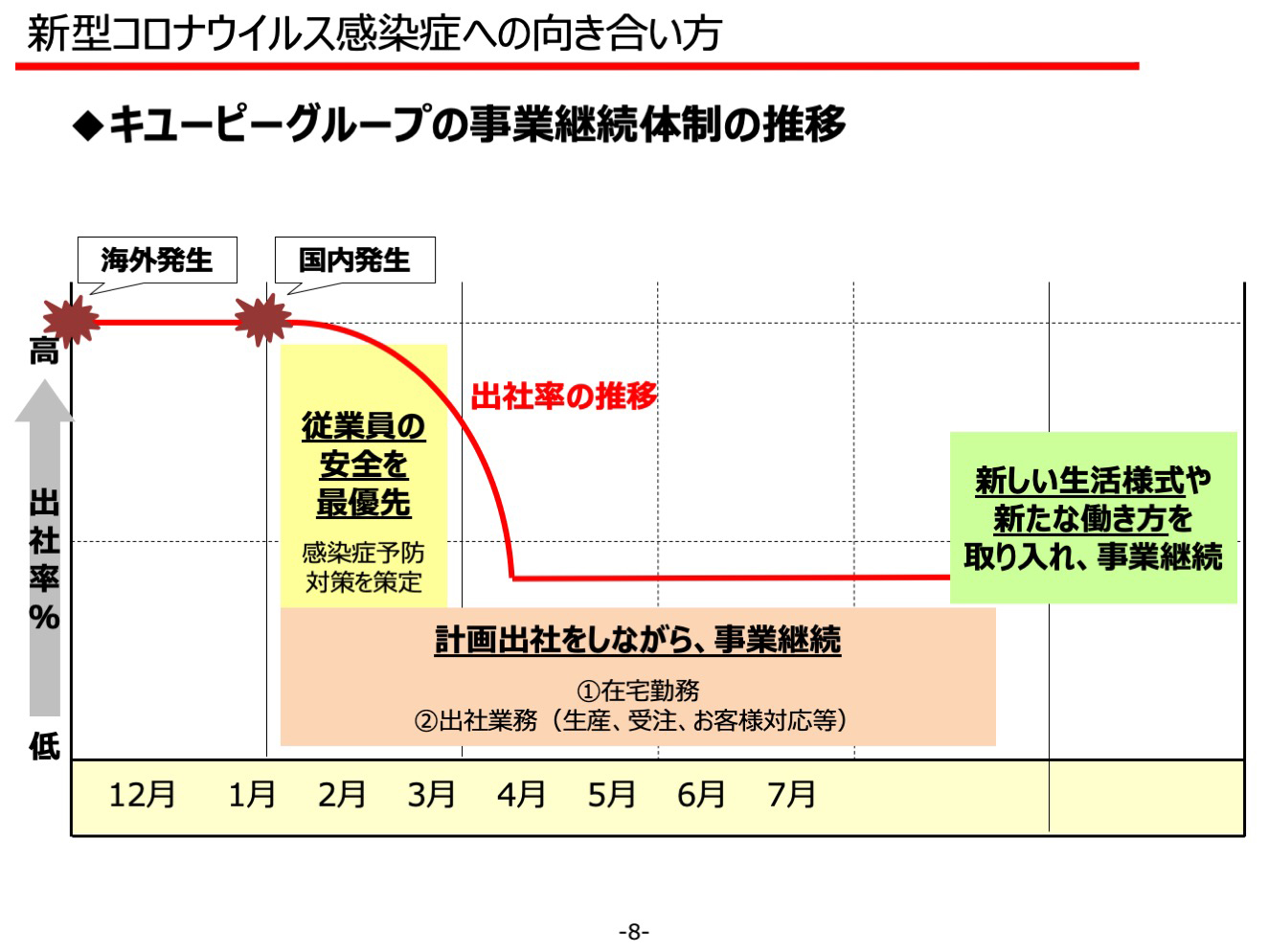
新型コロナウイルスへの当社の向き合い方について。
当社グループの感染防止対策については、まずは、グループ従業員の安全を最優先とし、その上で、段階ごとに工夫を重ねながら、事業を継続してきました。 -
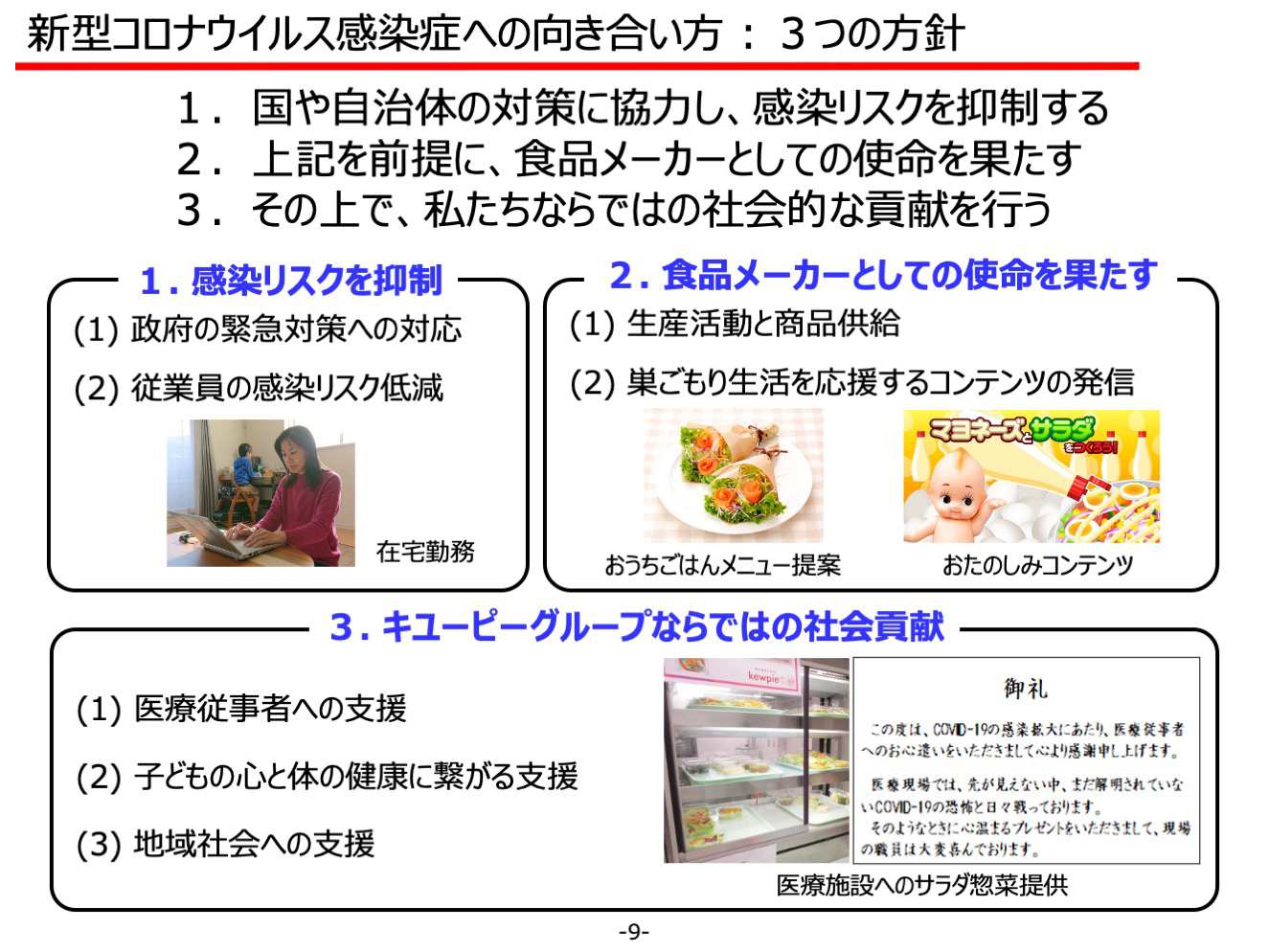
具体的には、3つの方針をもとに対応をしており、1つ目の「感染リスクの抑制」については、徹底した感染予防対策をとった上で段階的に経済活動を再開してきました。
2つ目は、生活に不可欠な「食」の分野を担う者としての使命を果たす、ということです。生活必需品である食品を安全・安心に供給し続けることに努めてきました。あわせて外出自粛や巣ごもり生活を応援するための料理レシピなどのコンテンツを発信してきました。
3つ目として、当社グループらしい社会貢献を実施しています。
医療従事者への支援、子どもの心と体の健康に繋がる支援などの、食を通じた社会貢献活動なども行っています。今後もこのコロナの経験をいかして、働き方や業務のあり方を見直しいきます。
-
2020年度通期見通しについて。
-
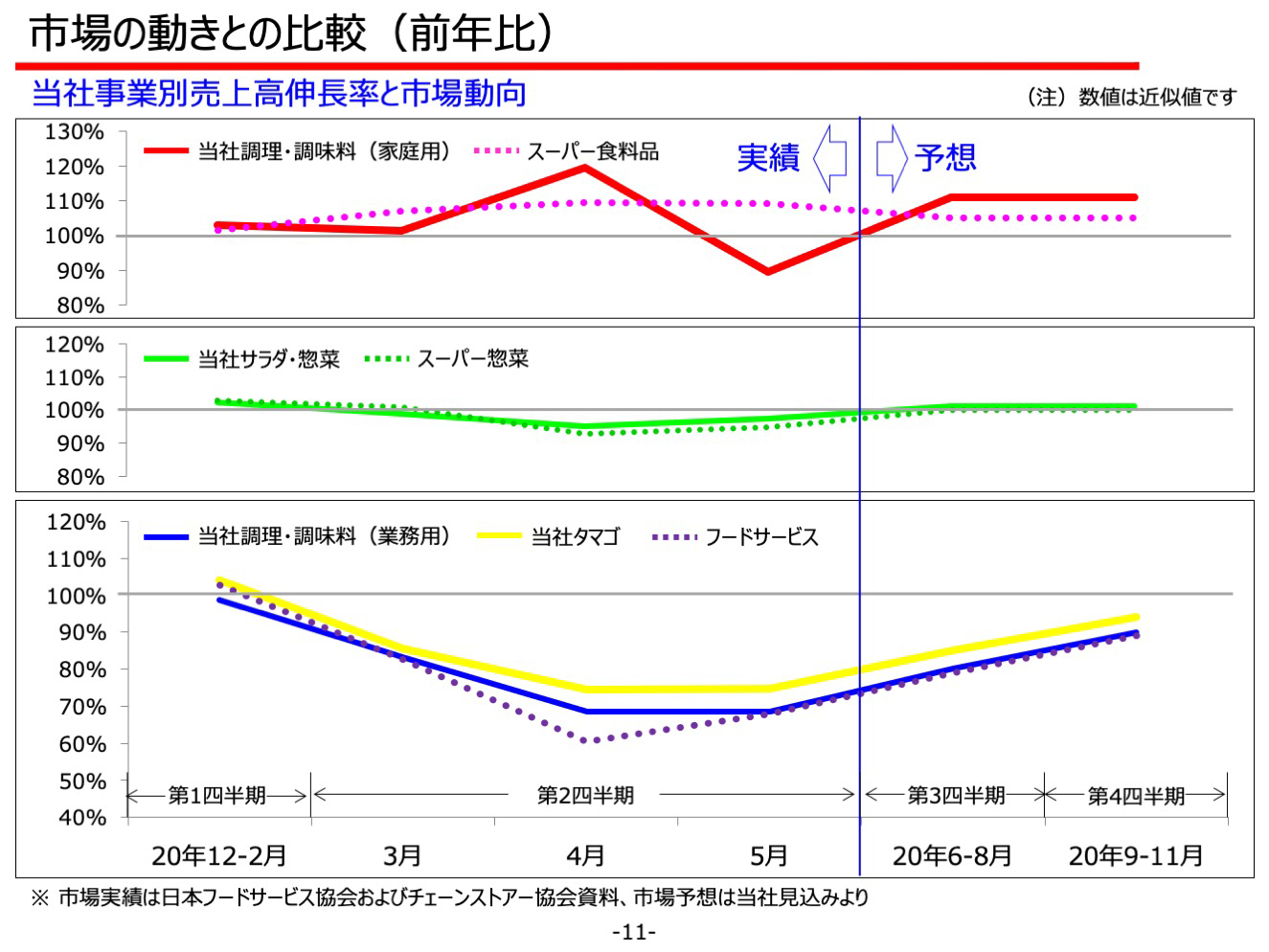
当社国内主力3事業の伸長率と市場の動向を比較したグラフを示しています。
3月に東京都の外出自粛要請に続き、4月に緊急事態宣言が発令されると、家庭用の調理・調味料商品は買いだめの需要がみられ約20%の増加となりました。5月は4月の買いだめによる反動により前年より減少しましたが、今後も前年を上回る見込みです。
サラダ・惣菜は、スーパーへの買い物頻度が減少したことにより賞味期限の短い商品がやや敬遠され、前年を下回る結果となりましたが今後は徐々に回復すると考えています。
業務用の調理・調味料、タマゴは4月からは30%から35%の減少となっています。新型コロナの収束時期はいまだ不透明ではありますが、今後は緩やかに経済活動が再開され、時間をかけて消費が回復していくと見込んでいます。
-
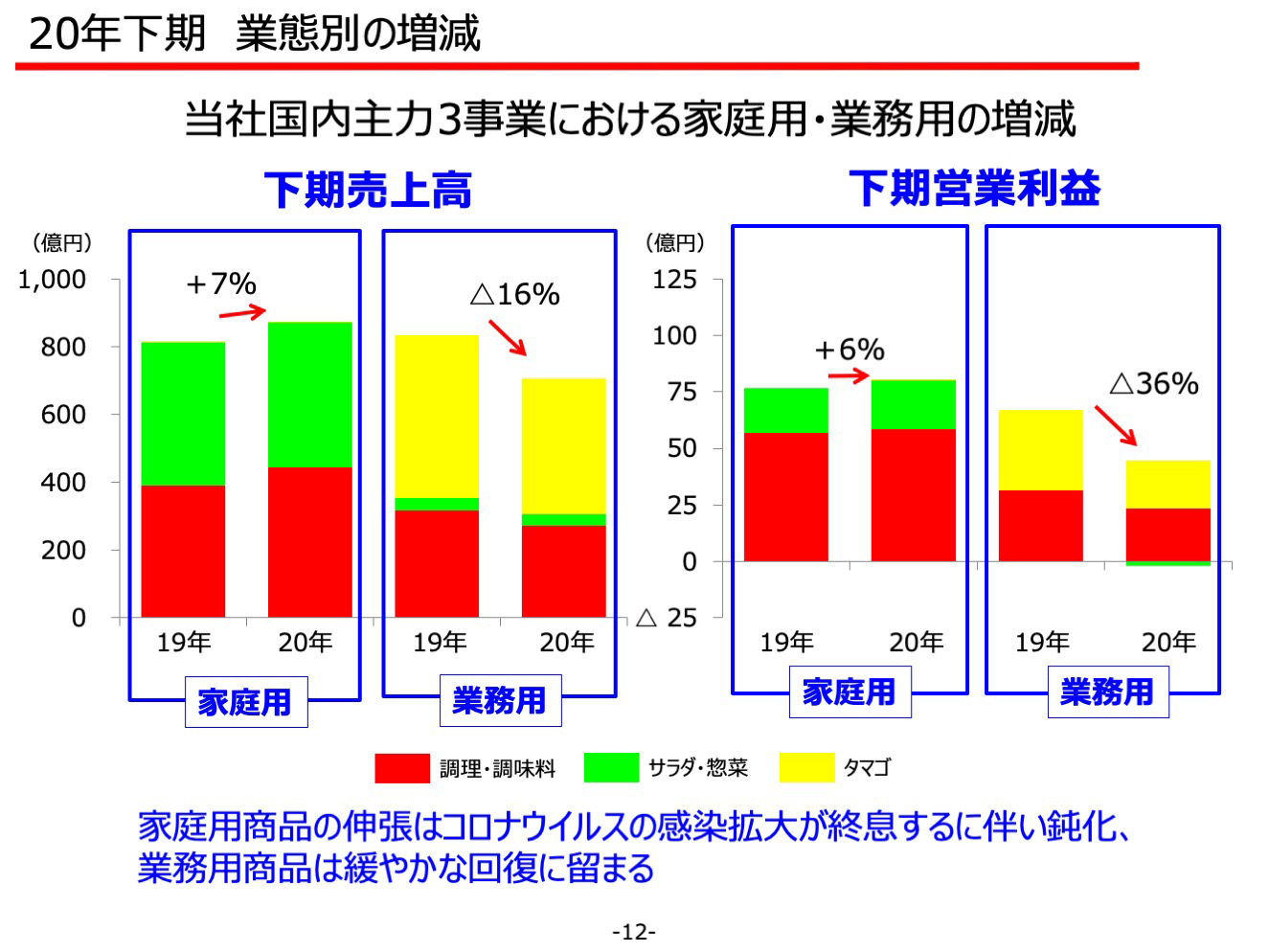
当社国内主力3事業における下期の見通しについて。
下期の売上見通しは、家庭用においては7%増加で引き続き堅調となる見込みですが、業務用は回復に時間を要することから約16%の減少を見込んでいます。このような状況から、2020年11月期の通期計画を修正しています。
-
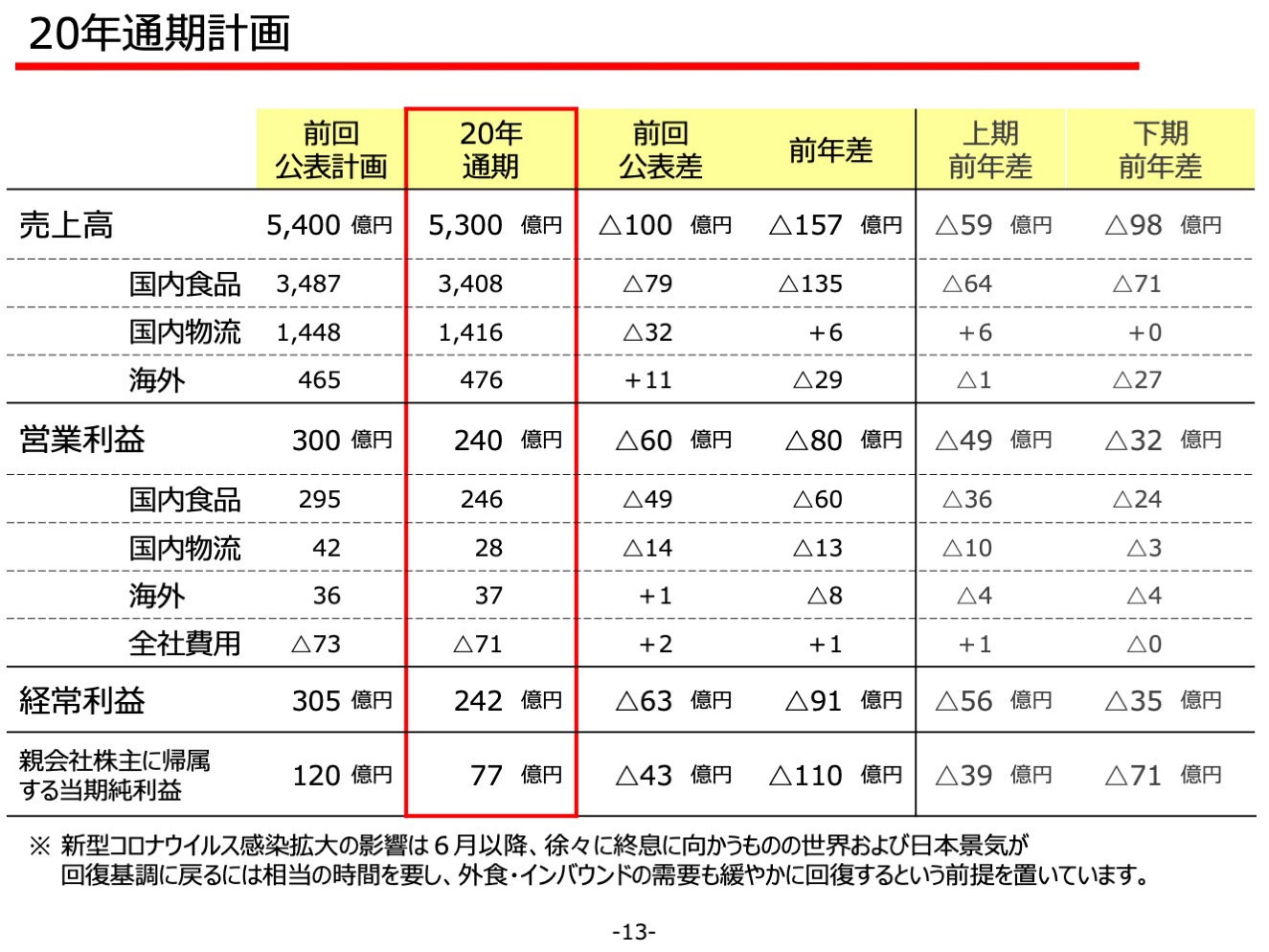
2020年11月期の売上高は5,300億円、営業利益は240億円、経常利益は242億円、親会社株主に帰属する当期純利益は77億円と計画します。
下期についても新型コロナウイルスの影響は受けると見込んでいますが、上期に比べ緩和されていくものと想定しています。
現時点で可能な範囲で、新型コロナウイルスによる当社グループへの影響額を算出したところ、年間で売上約250億円の減少、利益約70億円の減少を見込んでいます。
なお、この見通しは、新型コロナウイルスによる大規模な第2波の影響は織り込んでいませんが、引き続き今後の動向を注視していきます。 -
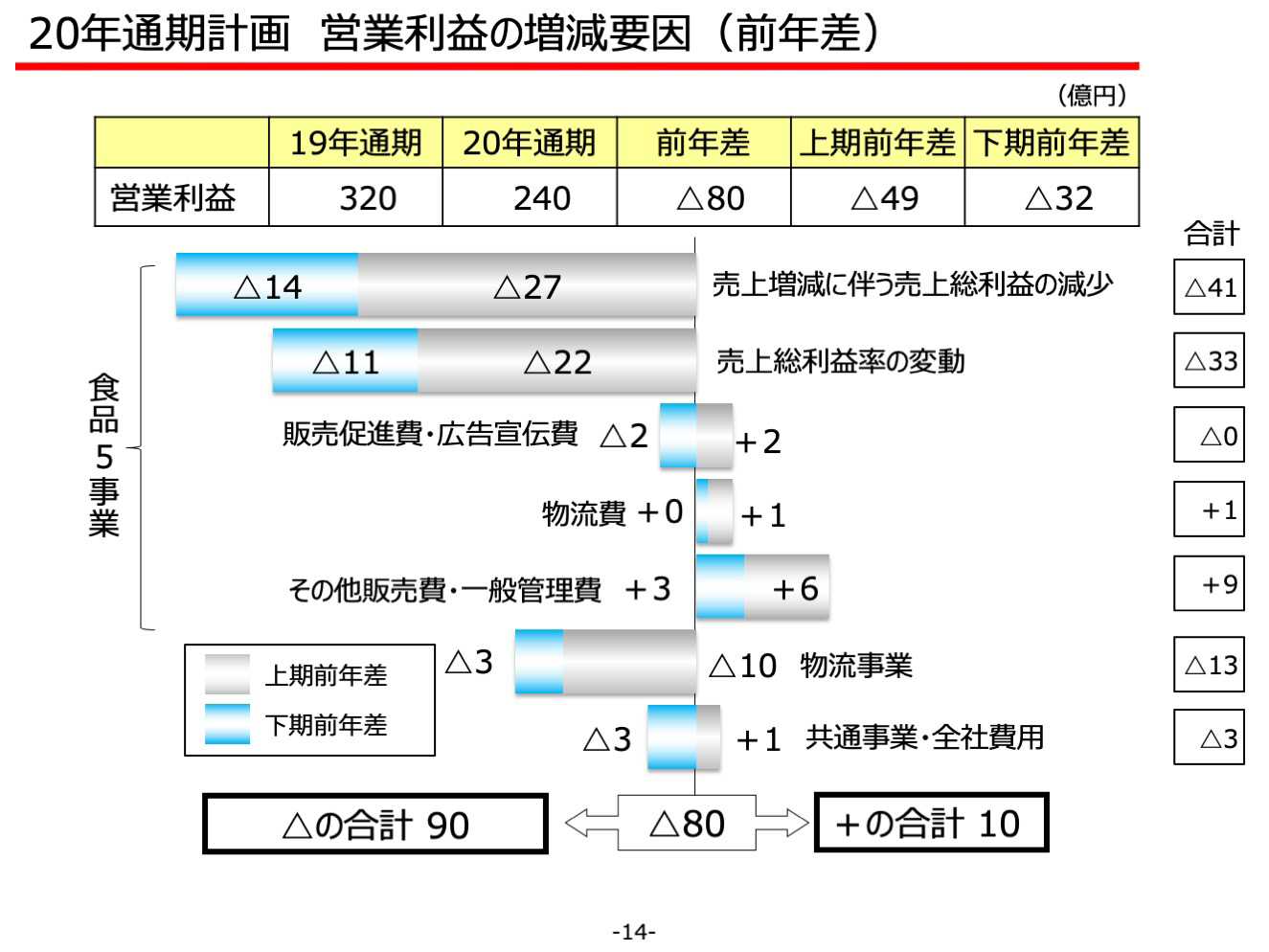
営業利益の通期の増減について。
売上増減に伴う売上総利益の減少は、上期の27億円減少に加え、下期でも14億円減少となり、年間で41億円の減益要因となります。売上総利益率の変動は年間で33億円の減少を見込んでおり、要因として工場操業度低下による影響で14億円、鶏卵相場高の影響で12億円、サラダ調味料の主原料コストの増加で9億円です。
販売促進費や広告宣伝費は中国でのバーコード費用が5億円発生しますが、総額では抑制に努めます。
-
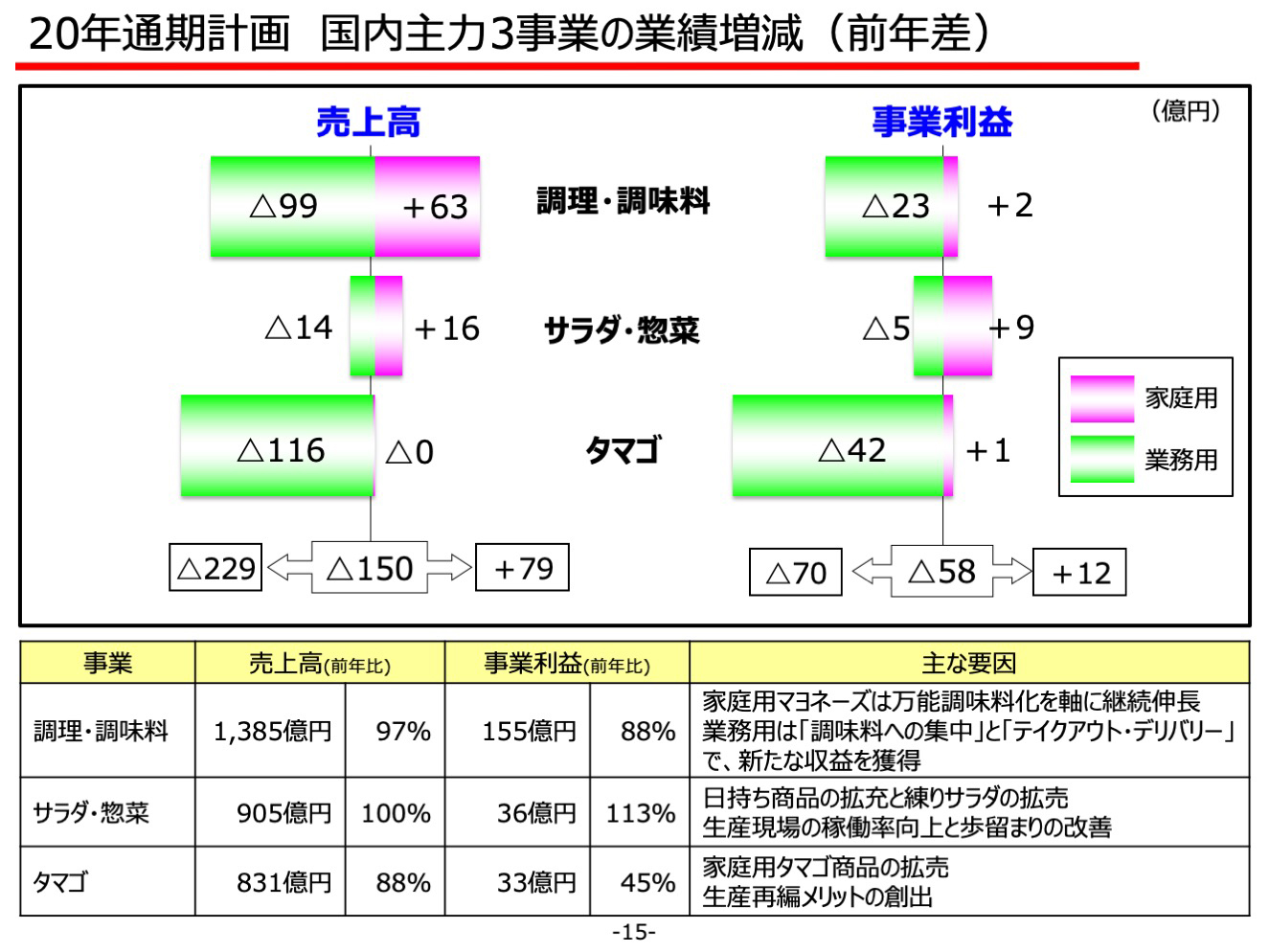
国内主力3事業の売上高・事業利益の増減について。
調理・調味料事業は家庭用商品において63億円増加しますが、主原料のコスト増による影響もあり、利益は若干の増益となる見込みです。業務用商品は99億の減収、23億円の減益となり、調理・調味料事業全体では減収減益となります。サラダ・惣菜事業は、カット野菜が好調なことから増収増益を見込んでいます。
タマゴ事業は、需要の回復に時間がかかるため減収減益を見込んでいます。
-
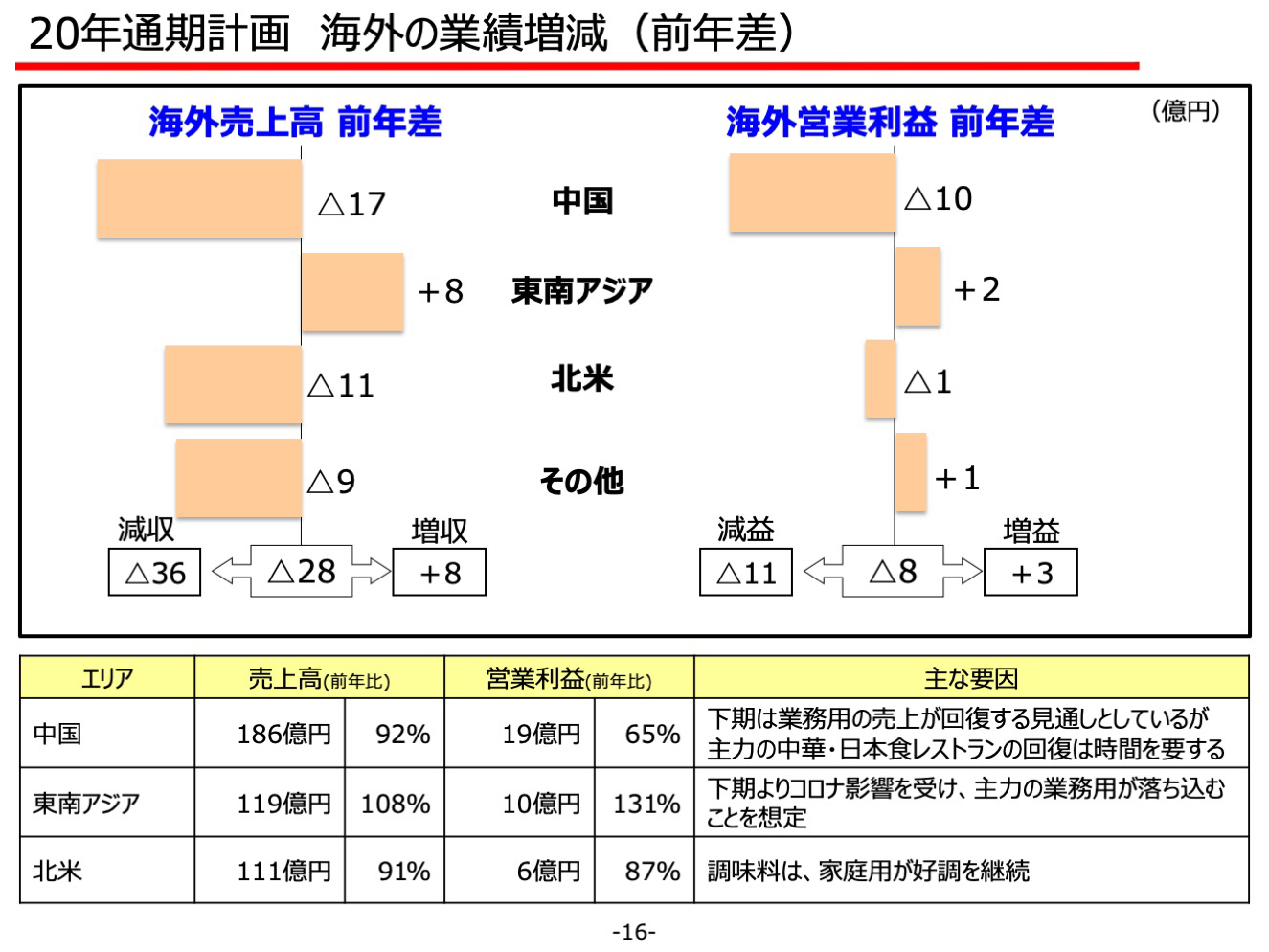
海外の売上高・営業利益の増減について。
中国は緩やかに業務用商品が回復する見込みですが、主力の日本食レストランの回復に時間を要し減収減益となります。東南アジアは、新型コロナによる影響は比較的少なく増収増益を見込んでいますが、売上については2桁成長には届かない見込みです。
-
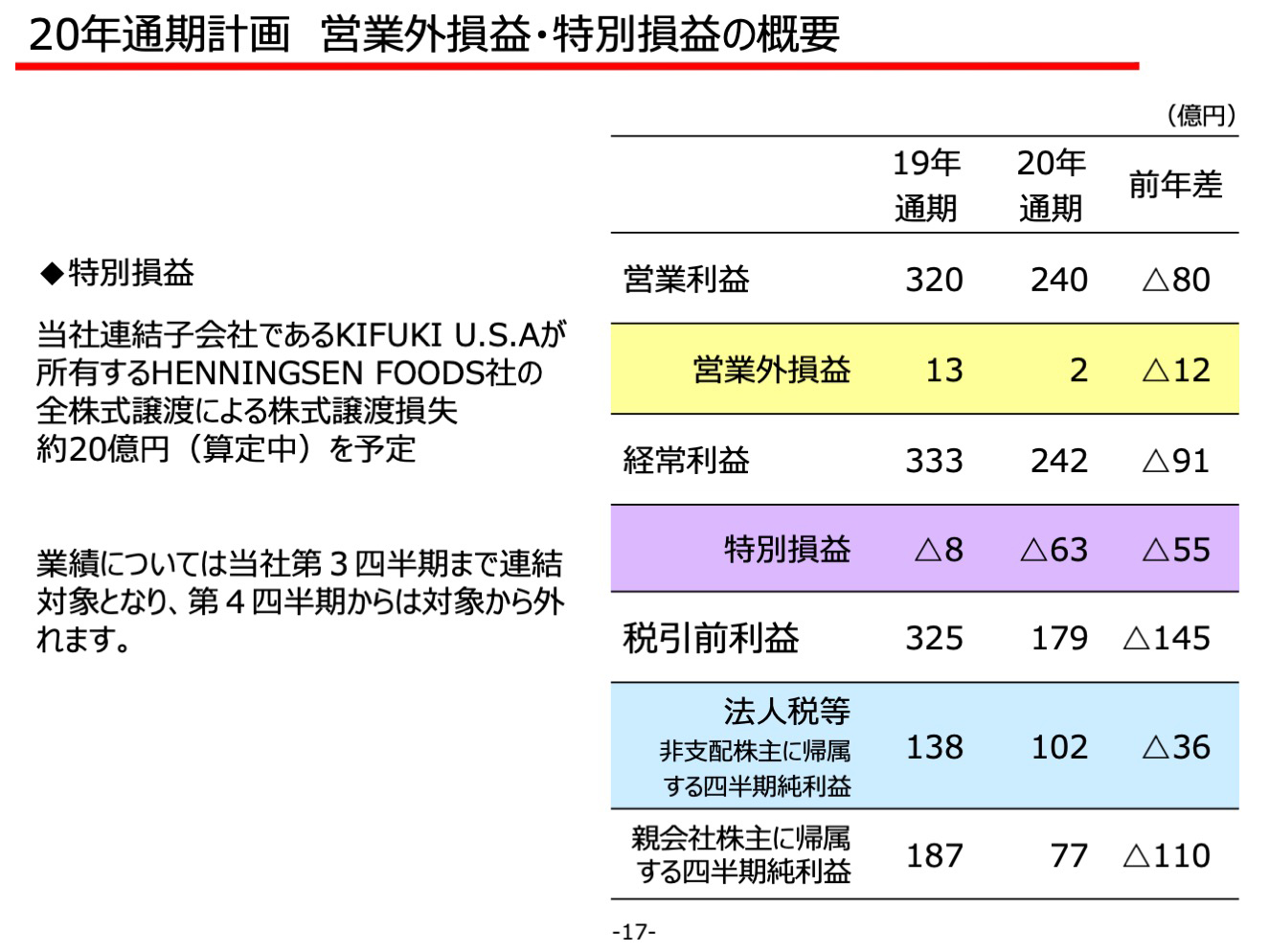
営業外損益・特別損益の概要について。
当社連結子会社であり、北米でタマゴ事業を展開しているHENNINGSEN FOODS, INC.の全株式譲渡を完了しました。
HENNINGSEN FOODS, INC.へは1990年より北米での安定的な原料供給を目的に経営に参画してきました。
近年では、米国での乾燥卵相場の変動が不安定要因になっていたことから、米国内外に強固なネットワークや事業基盤を有するMichael Foods of Delaware, Inc.のもとで、ビジネスを強化することがHENNINGSEN FOODS, INC.の持続的成長と企業価値の向上に資すると判断し、全株式を譲渡することとなりました。
譲渡に伴う株式譲渡損失として約20億円を計上する予定です。 -
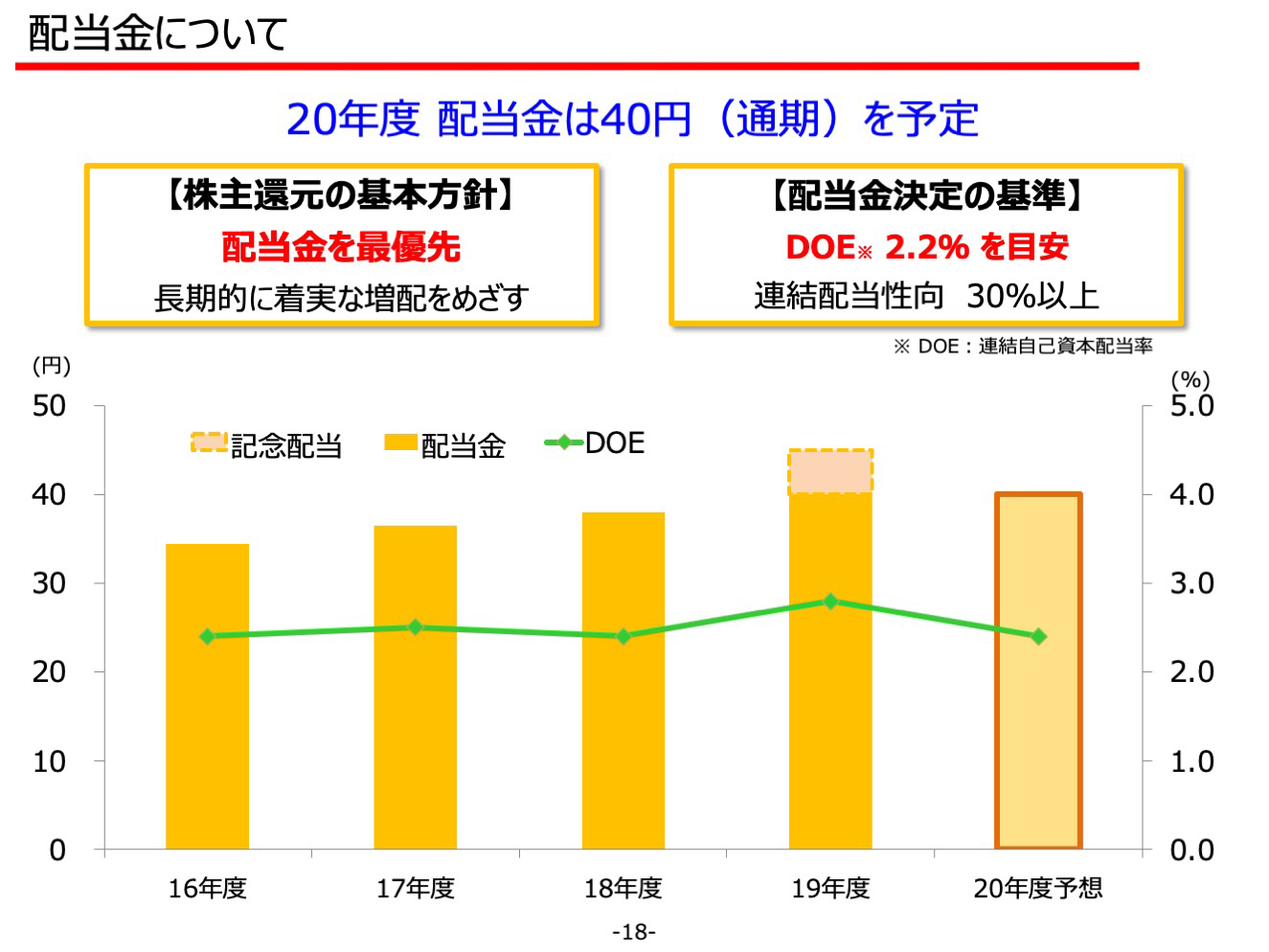
配当金について。
2020年度の配当金については、当社基本方針に従い、今期通年で40円を予定しています。 -

新型コロナウイルス感染拡大の中、命を守るために従事していただいている、医療従事者、自治体関係者をはじめ、ライフラインとして感染リスクがある中、毎日生活必需品の供給に携わっていただいている、製造・流通・販売など現場で活動を続けている皆さまに、心より感謝申し上げます。キユーピーグループが事業継続出来ているのも、多くの方の御尽力があってのことと考えており、感謝の気持ちを大切にしながら、食を通じて社会に貢献したいという想いで、事業活動を進めていきます。
-
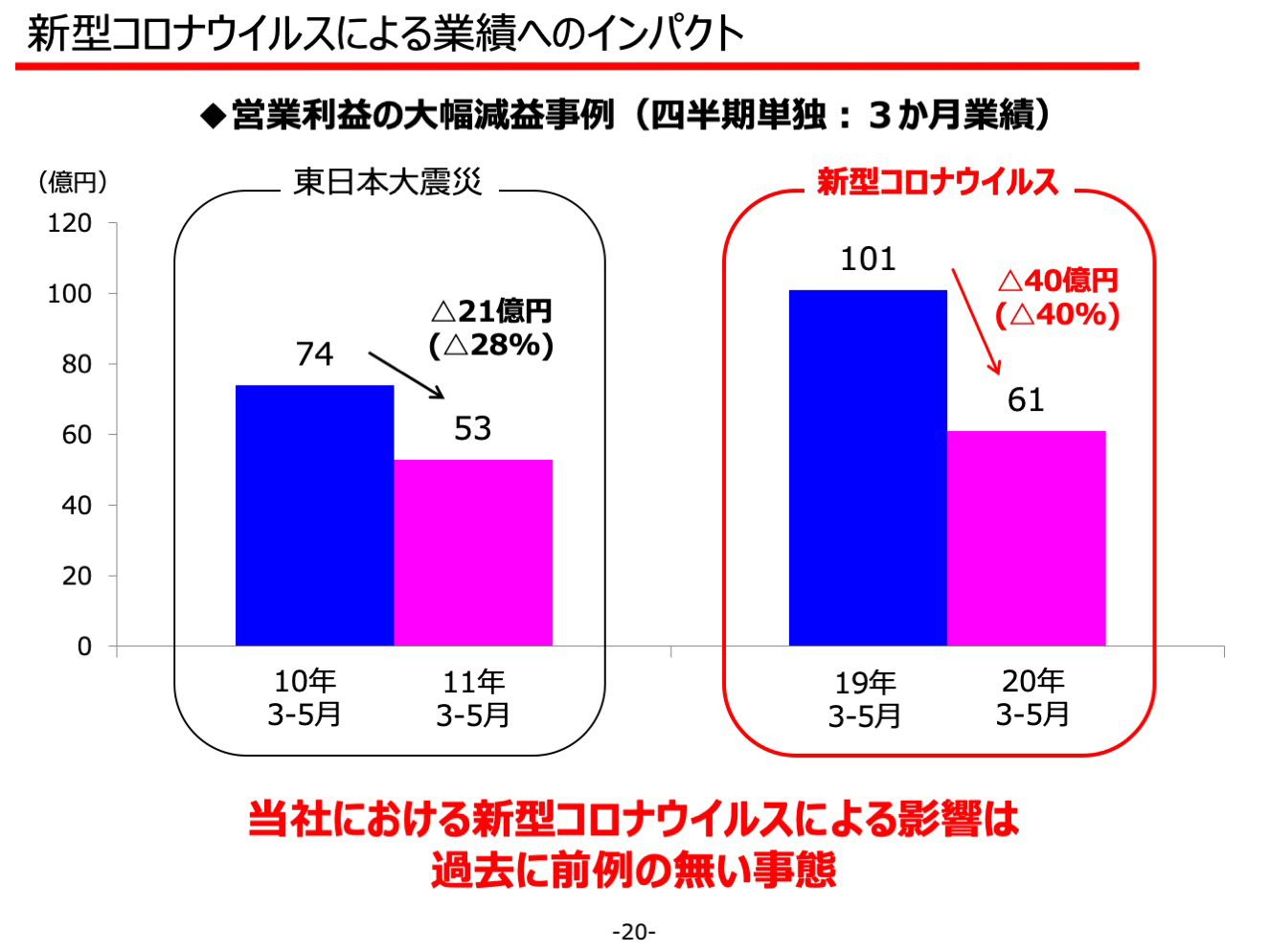
今回の業績は当社にとって大変厳しいものであり、深刻な事態だと捉えています。
2011年東日本大震災の時も大きな影響を受けましたが、今回の新型コロナウイルス感染拡大影響は過去最大のインパクトとなっています。特に3月から5月の3か月間の業績については、前年に対して営業利益が40%も減少するほどの大幅減益となりました。
-
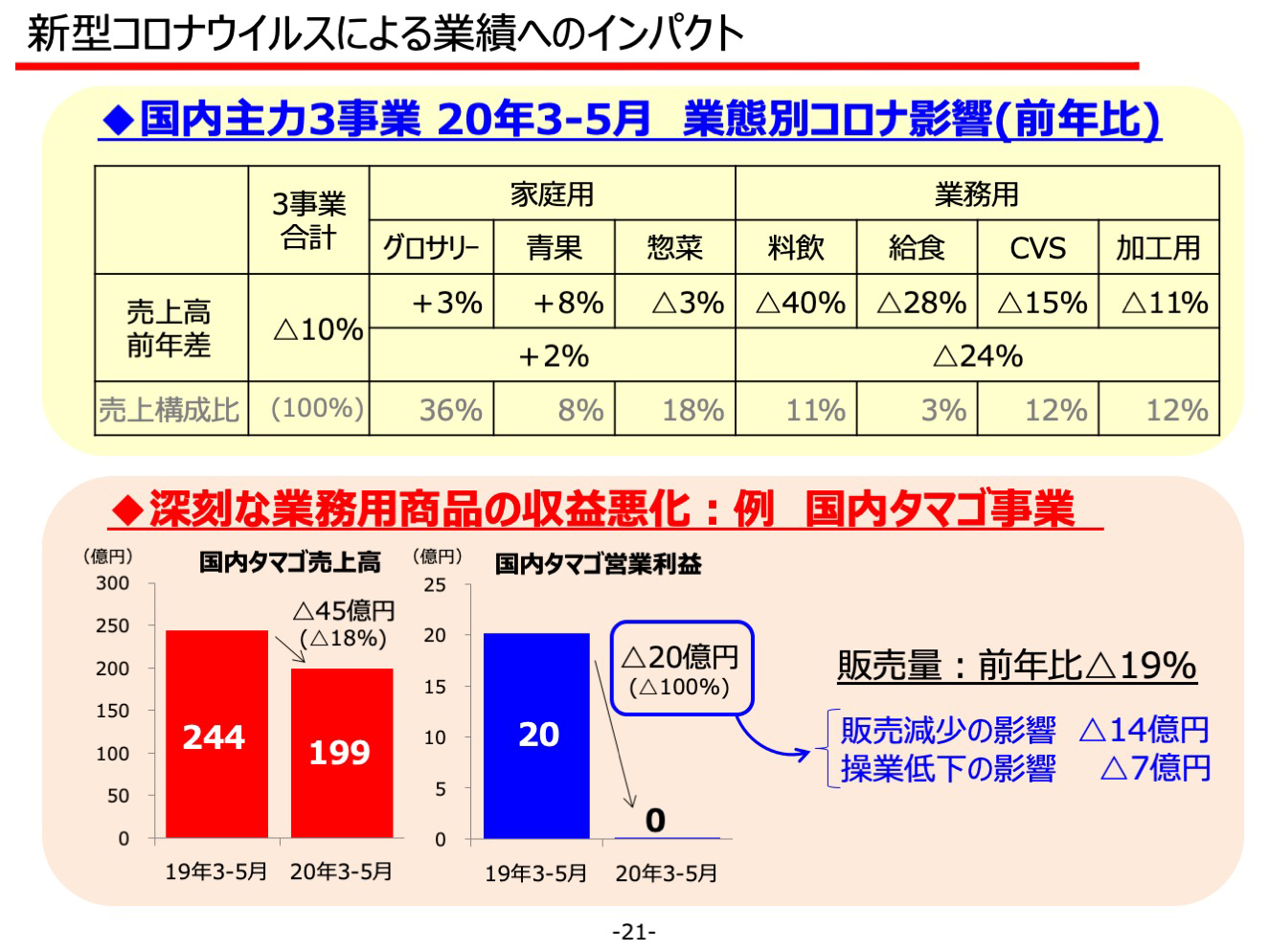
この3か月間での業務用商品の売上は料飲向けが40%減少し、給食においても30%弱の減少となります。
かたや家庭用商品についてはマヨネーズやパスタソース、青果売場で展開しているカット野菜など、巣ごもり需要もあり伸張しましたが、業務用の需要減少をカバーする伸びには至っていません。
当社において業務用比率が高いタマゴ事業では、売上の減少は20%弱程度でしたが、営業利益では収益性が大幅に低下しました。
これはコロナ影響での販売減少とそれに伴う工場稼働のダウンで、固定費が吸収しきれなかったことが大きな要因です。こういった状況は、タマゴ事業だけではなく、業務用商品を製造・販売するグループ各社でも同様に起きており、グループ全体で大きな影響を受けています。
この様な環境の中で、まずは従業員の安全を確保し、お客様へ安全、安心な商品の安定供給を継続することを最優先としたうえで、当社にできることを1つひとつ実施してまいりました。
外出制限や営業自粛要請の影響による需要の減少は我々だけで回復させることは難しいですが、販売の減少に伴う費用の抑制など、意思を持って対応できる所には手をうってきました。 -
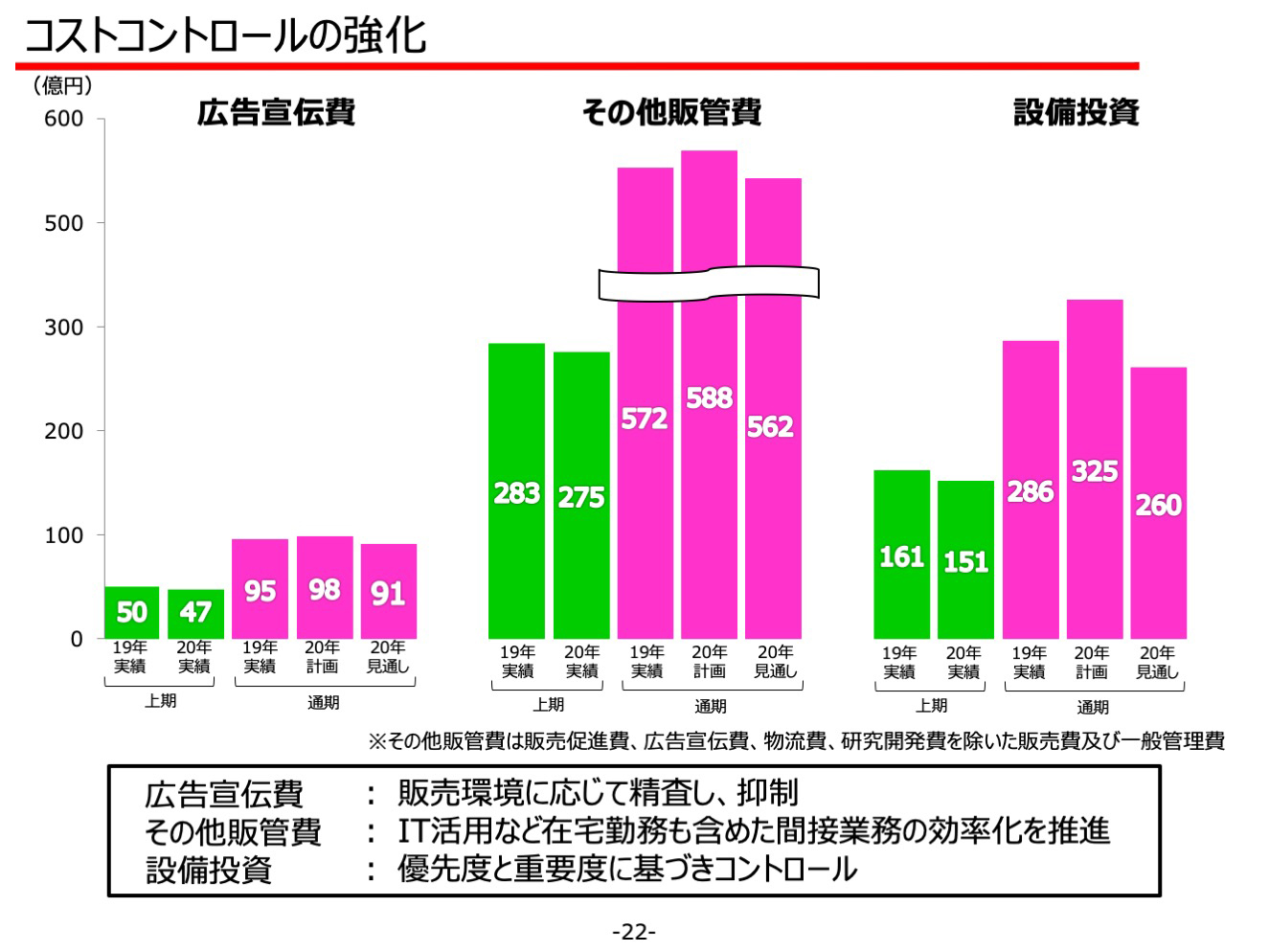
コストコントロールの強化について。
広告宣伝費では上期で3億円の抑制をしていますが、下期については販売環境を勘案しながら集中すべき所には効率的に投下していこうと考えています。
その他販管費では、在宅勤務や遠方とのウェブ会議などコロナ収束後も働き方の標準が変わっていく中で、ITを活用し間接業務の効率化を推進することで、出張費や国外渡航費の抑制を進めます。
投資については不要不急の項目を精査し、優先度と重要度で実施項目を選択していきます。
引き続き継続的な取り組みを進め、コスト抑制に努めていきます。 -
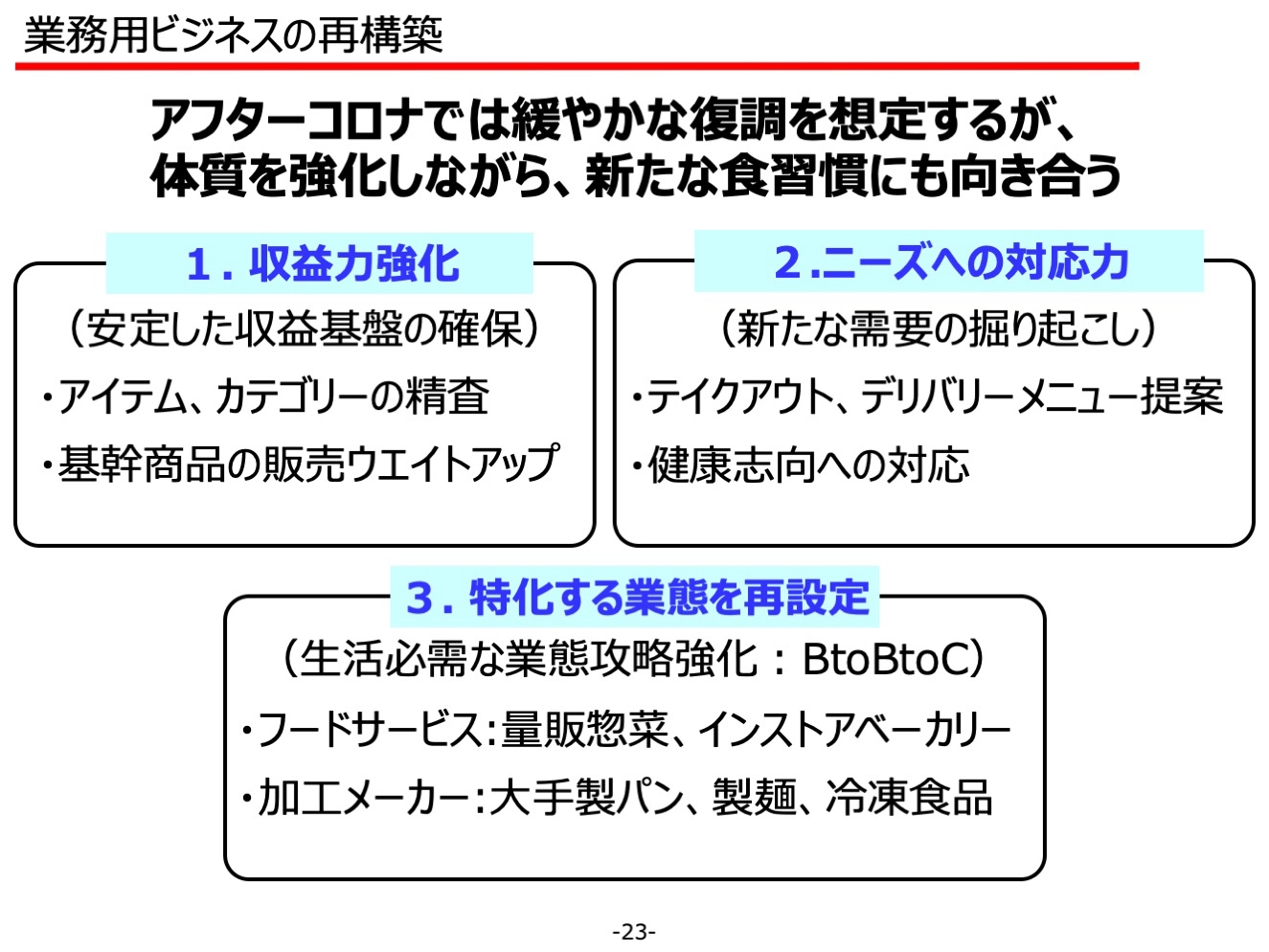
コストコントロールと同時に手を打たなくてはならないのが、業務用ビジネスの再構築です。
業務用市場は、今後緩やかな復調となることを想定していますが、元のボリュームに戻るかどうかは不透明な状況です。
当社においては、この機会を体質強化のターニングポイントと捉え、まずは踏み込んだ低収益商品の精査で収益基盤を固めていきます。
次に、内食・中食・外食の境界線が低くなることにより生まれる新市場への商品、技術提案、コロナ禍により存在感が増したテイクアウトやデリバリーなどのメニュー提案、免疫力アップで注目されるようになった健康志向などへの対応を促進することにより、新たな需要を掘り起こしていきます。
次に、生活必需品を取り扱っている大手製パンメーカーなどの業態への戦略を明確にすることで、効率的な営業スタイルを見出していきたいと考えています。このような取り組みを実施しても、コロナ前の市場に戻ることが難しいと判断したため、さらに家庭用ビジネスの盤石化を進めていきます。
-
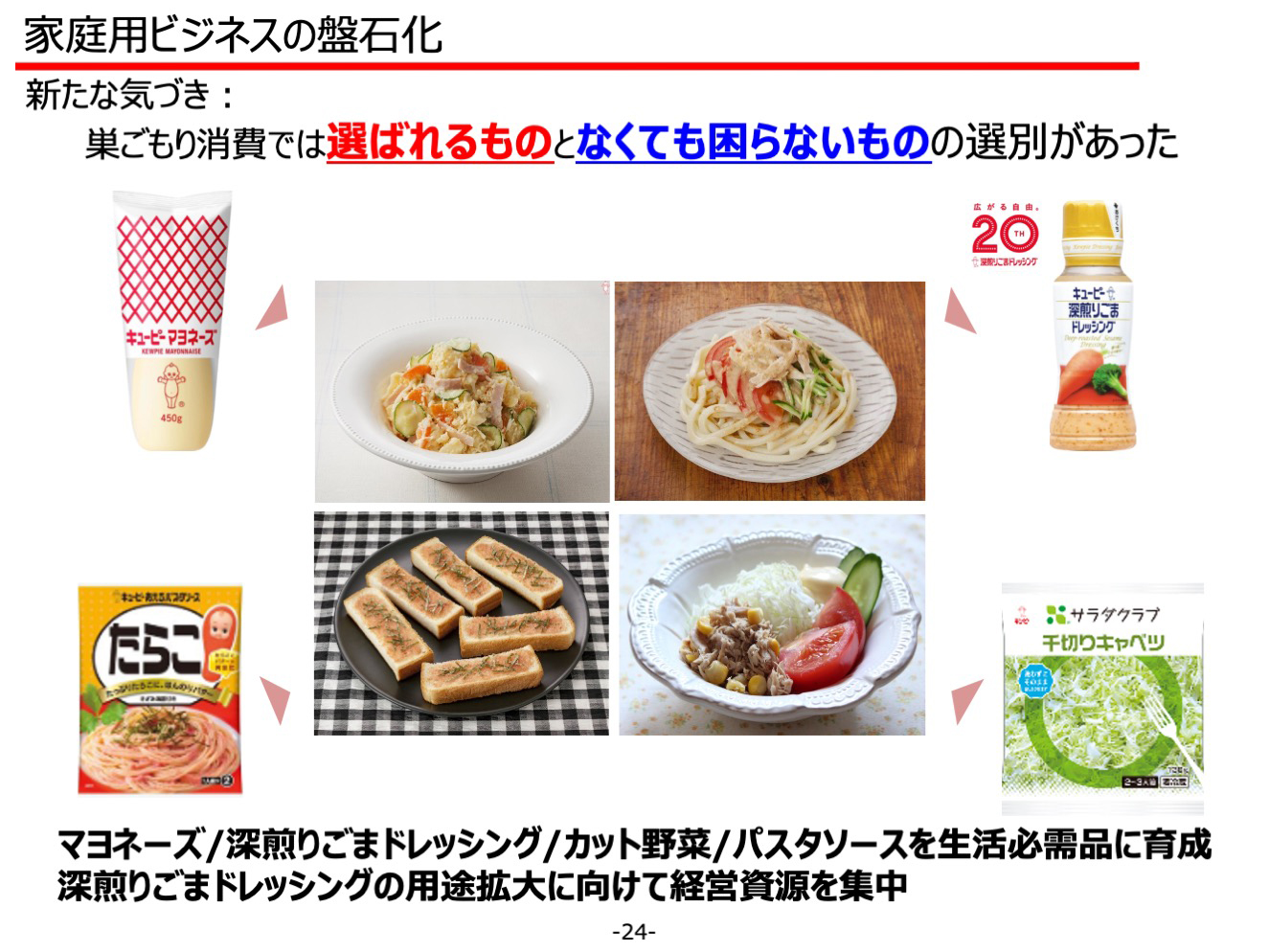
家庭用ビジネスについてはコロナ影響を経て、新たな気づきがありました。巣ごもり消費では、「選ばれるもの」と「なくても困らないもの」の選別をお客様がしていた、ということです。
当社マヨネーズについては、まさに万能調味料としてお客様に選ばれ、安定的な需要が今も続いています。
カット野菜やあえるパスタソースも好調を維持しており、お客様に良さを認知いただいているものと考えています。
ドレッシングについては、外出制限や営業時間短縮要請の直後は一時的に需要が増加したものの、その後鈍化しました。
このことから家庭用において、生活必需品と認識をしていただく様な商品の育成が大切だと捉えています。
まずは深煎りごまドレッシングの用途拡大に向けた取り組みを実施し、生活必需品の領域に育成を進めていきます。 -
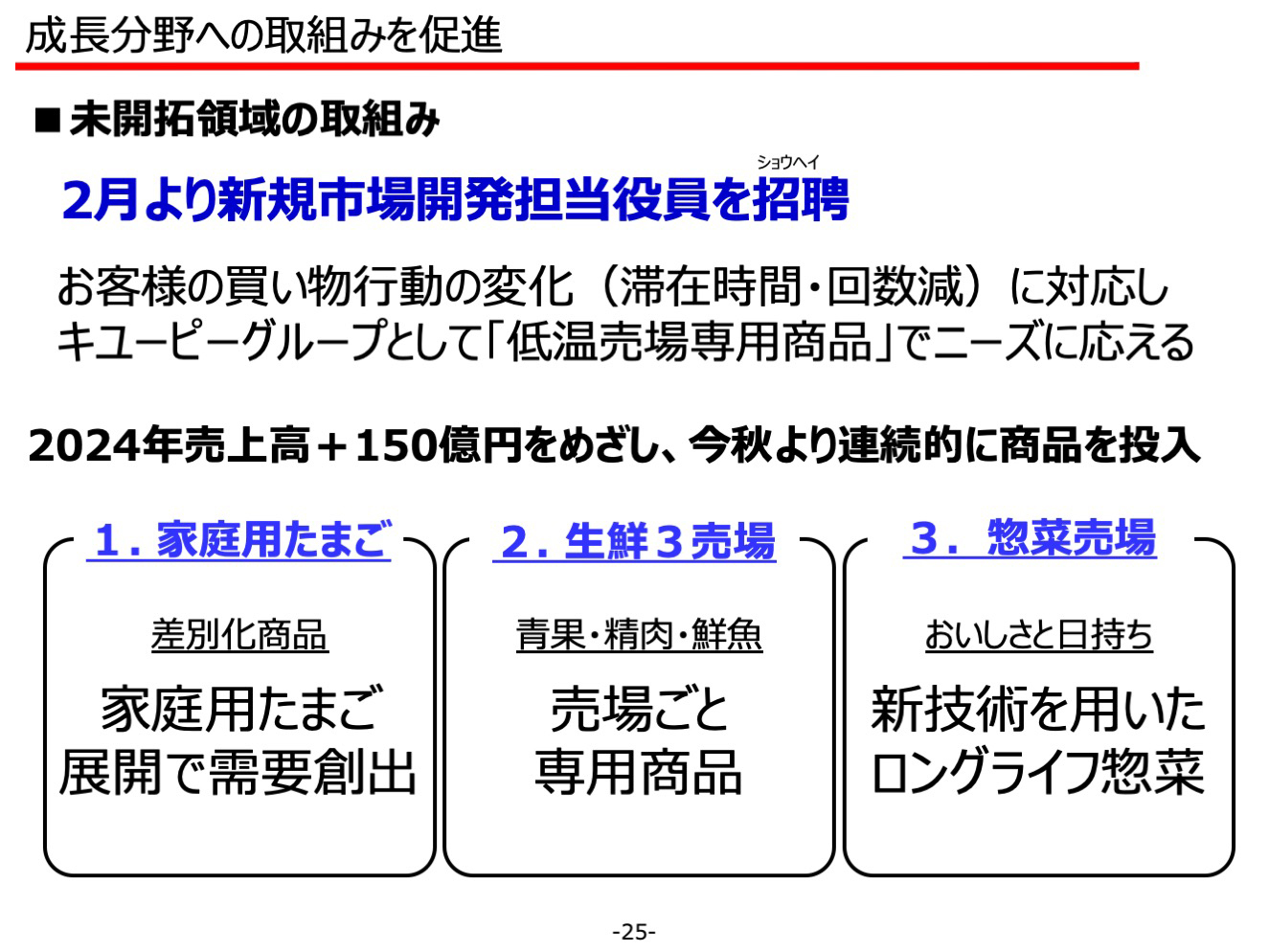
またグロサリーだけでなく、週に1回だけのストック型ショッピングへとお客様の買い物行動が変化することから、今後は生鮮周り、惣菜売場においても消費期限延長のニーズが高まり、当社の技術を発揮できる場面が増えるものと考えています。
具体的には、家庭用たまごの商品開発を進めることで需要を創出し、生鮮売場では専用商品を展開し、消費期限延長の技術を用いたロングライフ惣菜の開発を進めていきます。
その役割を担ってもらうため、2月には新規市場開発担当役員を招聘したこともあり、新たな市場への取組みで2024年には売上150億円を創出する動きを進めていきます。 -

当社は昨年おかげさまで創業100周年を迎えることができました。お客様への感謝などさまざまな活動を進めるとともに、創業の想いをグループ一同で振り返りました。このコロナ禍の中で創始者の志である「日本人の体格向上のため、美味にして栄養に富むマヨネーズを生活必需品となるまで、広く普及させたい」との想いの大切さを改めて認識するに至りました。
厳しい業績の中でもマヨネーズなど生活必需品と認識されている商品は安定的な出荷となりました。特に健康を意識したキユーピーハーフが伸張しました。
食に携わるものとして、当社の原点ともいえる、生活必需品をお届けすること、そして健康へ向き合うことを大切にしながら、次の100年も成長していけるよう、進めていきます。最後になりますが、
今回の業績および今期見通しにおいては、過去に例のない大変厳しい状況であり、現在掲げている中期経営計画の進捗とは乖離しています。この危機を乗り越え、次のステップへ向かう為当社では現在新たな中期経営計画の策定に取り掛かっています。
まだ、詳しくは申し上げられませんが、次の1年を待たず、新たな戦略のもと組織の最適化を行い早期の業績回復と次の成長に向けた動きを取っていきます。
Q&A (Japanese only)
-
Our business model has so far involved offering a wide range of products for home-cooked meals, ready-made foods, and restaurants. The COVID-19 pandemic has brought about new changes in ready-made foods and restaurants sectors, such as takeout and delivery. We are already offering takeout and delivery menu suggestions for food services on our website. Looking ahead, we anticipate expansion in ready-made foods and home-cooked meals cooking, particularly in products like meal kits. We will expand into new areas, such as food service sauces, primarily through our group company, Deria Foods Co., Ltd., which manufactures and sells prepared delicatessen foods.
-
While food service market is expected to see a gradual recovery, the food and beverage industry (hotels, restaurants, cafeterias), which includes our customers, continues to face challenging conditions.
In this context, the growing delivery market demands reduced cooking and preparation time, and we aim to maintain profitability by offering added value through products such as our generously portioned sauces. Furthermore, assuming that the proportion of remote work will increase in the future, we will enhance profitability with kit products and products with extended shelf life.
Furthermore, we will review our low-profit products and focus on increasing profits. -
Sales of salad dressings were initially weaker due to temporary demand resulting from increased consumption at home, which led to measures such as refraining from special sales, suspending sales, and allocating shipments to avoid temporary shortages. Currently, however, sales are showing signs of recovery as restrictions on special sales have been lifted.
-
In the second half of the year, profit growth will be influenced by the recovery of food service sales, key raw material costs, and the product mix. While the overall market is expected to recover gradually in the second half, we anticipate that the recovery of the food and beverage sector in food service-business sector will take time. Therefore, we believe it is important to utilize new sales channels to compensate for the weakness in food service with household products. Regarding key raw material costs, the high prices of edible oil and eggs have continued since the first half of the year and are expected to be affected by market fluctuations in the second half as well. In terms of the product mix, while low-priced products grew in the first half, we will focus on increasing the sales of value-added products in the second half.
-
I believe one reason for the growth of mayonnaise is its low price per unit volume. Low-priced salad dressings are also selling well, and we will control our sales promotion expenses and revise our pricing to a more appropriate level in the future.
-
We are working on digitalization in areas such as overseas operations, advertising, and mail order sales, and are promoting information sharing.
Our e-commerce ratio is still relatively low, but it nearly doubled during the COVID-19 pandemic. Products adapted for e-commerce, such as Yasashii Kondate series of meals for the elderly and ingredients for Salad Club, Inc. line, have contributed significantly, resulting in annual sales of 1 billion yen. We see e-commerce as a department that we will strengthen going forward, and we will invest resources such as personnel and expertise into it. -
There are two methods for purchasing eggs as raw materials: regular purchases of a fixed quantity and spot purchases. Until now, we had not changed the quantity of raw materials purchased through our regular purchases, but due to the impact of the COVID-19 pandemic, we adjusted our operations by reducing the volume of these regular purchases. This, in turn, had an impact on the poultry industry.
While demand in the foodservice and institutional food sectors has declined by 30–40% due to the COVID-19 pandemic (food service), the processed foods sector has remained flat compared to the previous year. We believe this will enable us to shift toward more profitable processed products. Even if demand in the foodservice sector does not recover in the future, we will continue to secure profits through the processed foods sector. -
The impact on egg prices for the year is projected to be 1.2 billion yen. In the first half of the year, the first quarter was up 41 yen year-on-year and the second quarter was up 17 yen year-on-year. Currently, while supermarket demand has increased significantly, food service has decreased, and prices have fallen by 5 yen, so the second half is expected to be about the same as last year.
Regarding price revisions, we have implemented price adjustments for boiled eggs and PP pillows, and we are factoring in an estimated annual effect of 500 million yen from these price revisions. -
Across China, the market has recovered to around 95% of the previous year's levels, with April at 50% and May at 70%. However, there is a significant difference between consumer and food service. Consumer sales grew by 140-150% from April to June, while food service vary depending on the type of business. In the food and beverage sector, demand for banquets at Chinese restaurants has not yet recovered to around 80-100%, while bakeries, convenience stores, and global fast food chains have recovered to 100-110%. As our company has a high proportion of sales in the food and beverage sector, our overall food service have been at 30% in April, 70% in May, and 90-100% in June.
Furthermore, there will be no major strategic changes due to the impact of the COVID-19 pandemic. Our strategy in China is customer creation, and we estimate that while approximately 90% of people across China are aware of mayonnaise, only about 16% actually use it (according to our research). We will continue to strengthen our brand power. We will also expand sales of tube-type mayonnaise and develop our e-commerce operations. For the restaurant sector, which has been struggling, we will steadily work on developing menus that reflect the changes in demand caused by the pandemic. -
In the first half of the year, we changed the packaging design and standardized the product barcodes for our household mayonnaise. The packaging design was changed from vertical stripes to a mesh pattern similar to that used in Japan. Furthermore, by standardizing the product barcodes throughout China, we were able to ensure mutual supply of products across the country in times of emergency, and expand sales to large-scale retailers beyond local areas.
-
We anticipate that some investment will be required in fiscal years 2023-2024 due to a review of items and categories, and the resulting changes in production bases and production lines.
-
In fiscal year 2020, we implemented emergency measures to curb investment due to the impact of the COVID-19 pandemic, but we intend to continue strengthening our control over capital investment in fiscal year 2021 and beyond. Specifically, investment in efficiency systems, including IT, will account for a large portion of capital investment from fiscal year 2021 onwards.
-
One of the challenges we faced during the COVID-19 pandemic was that we didn't have a system in place to allow a large number of people to work from home. In preparation for the Tokyo Olympics, we had been working to implement multi-location solutions at nearby workplaces, but our teleworking system was still lacking. Currently, we have a system in place that allows more than 2,000 people to work from home, and we plan to continue this even after the COVID-19 pandemic subsides.
Furthermore, our group's IT systems were a patchwork of various systems built up over many years, but three years ago we launched a new project to make them seamless. From a DX (Digital Transformation) perspective, we aim to centralize the management of scattered purchasing and customer information to facilitate market analysis. -
Regarding cost control, we would like to implement some additional measures, but we recognize that significant changes are difficult because we have already imposed considerable restrictions. We will keep costs linked to sales to a certain extent and raise awareness of cost control in each company and department, but we do not anticipate any major fluctuations.
In the second half of the fiscal year, sales promotion expenses are planned to increase, with a decrease in domestic spending but an increase in overseas spending. -
We had been working to integrate our business units under a business unit management system, but each business had its own sales channels, and development was not going well. We needed a marketer who could comprehensively control everything, and Fujiwara, who was appointed as Senior Executive Officer in charge of New Market Development, has a track record of growing Frugra from 3 billion yen to 30 billion yen in his previous position at Calbee, Inc.
-
We are currently considering the matter and cannot disclose details at this time. We anticipate that food service market, including inbound tourism, will take time to recover. Domestically, we need to strengthen the consumer market, and we will accelerate the implementation of a new system, expanded sales channels, and product selection process that goes beyond simply continuing the status quo.
Year-End Financial Results Briefing
January 10, 2020 (term ending November 2019)
-
19.11期 決算説明会
国内での持続的成長と海外での成長加速を実現する
1st Stage 報告 -

2019年度11月期の業績について
-
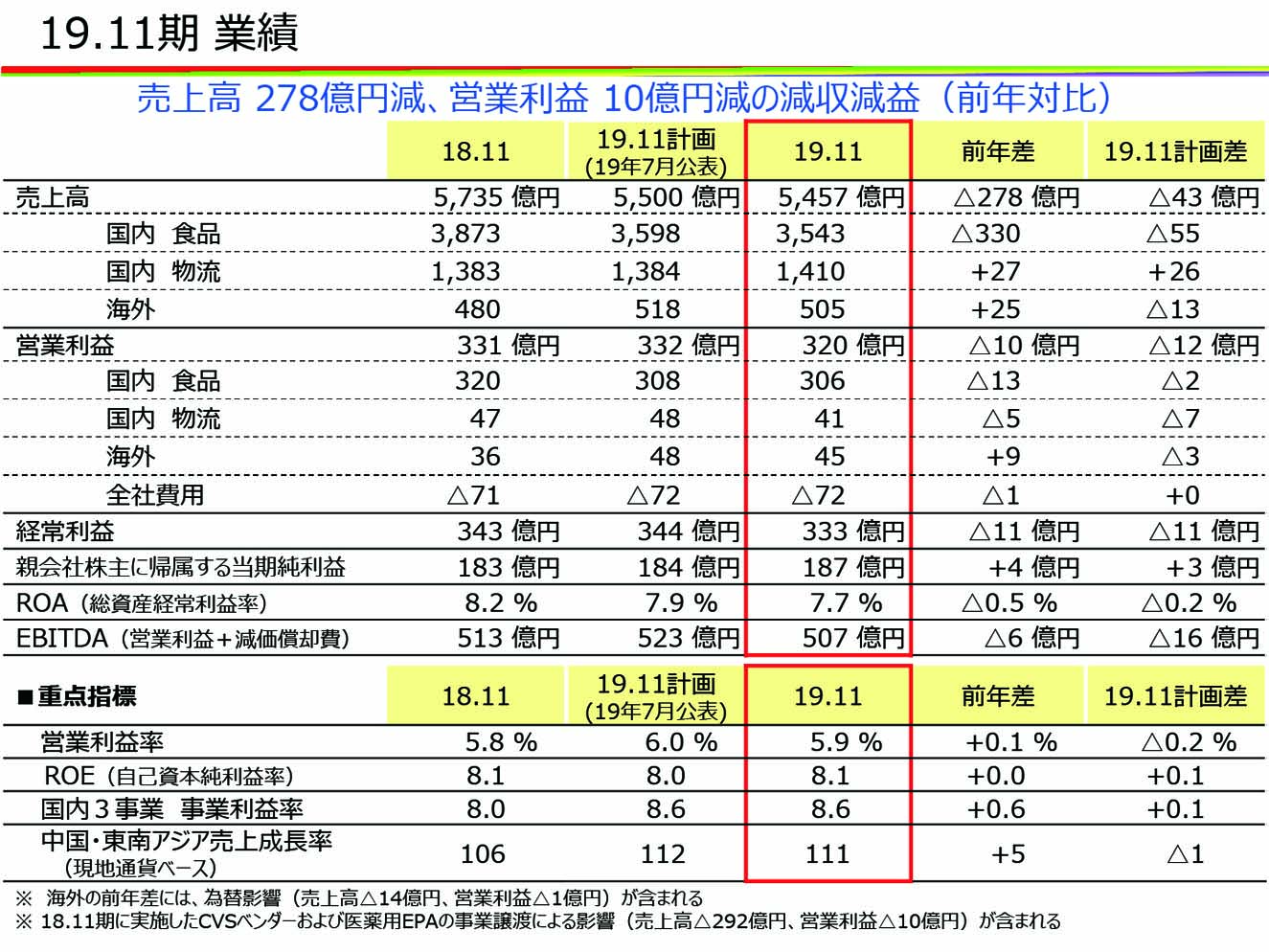
今回から売上高と営業利益の大分類を国内食品・国内物流・海外の3つに分けて掲載しています。
まず売上高は、5,457億円、前年に対して278億円の減収となりました。18年度に実施した事業譲渡のマイナス影響292億円を加味すると、全体の実質前年差は微増収ですが、国内食品事業は実質でも厳しい結果となりました。営業利益は前年に対して10億円減少の320億円。海外の利益は増加しましたが、国内は食品・物流ともに減益となりました。
なお、国内食品には前年実施した事業譲渡影響がマイナス10億円含まれています。 -
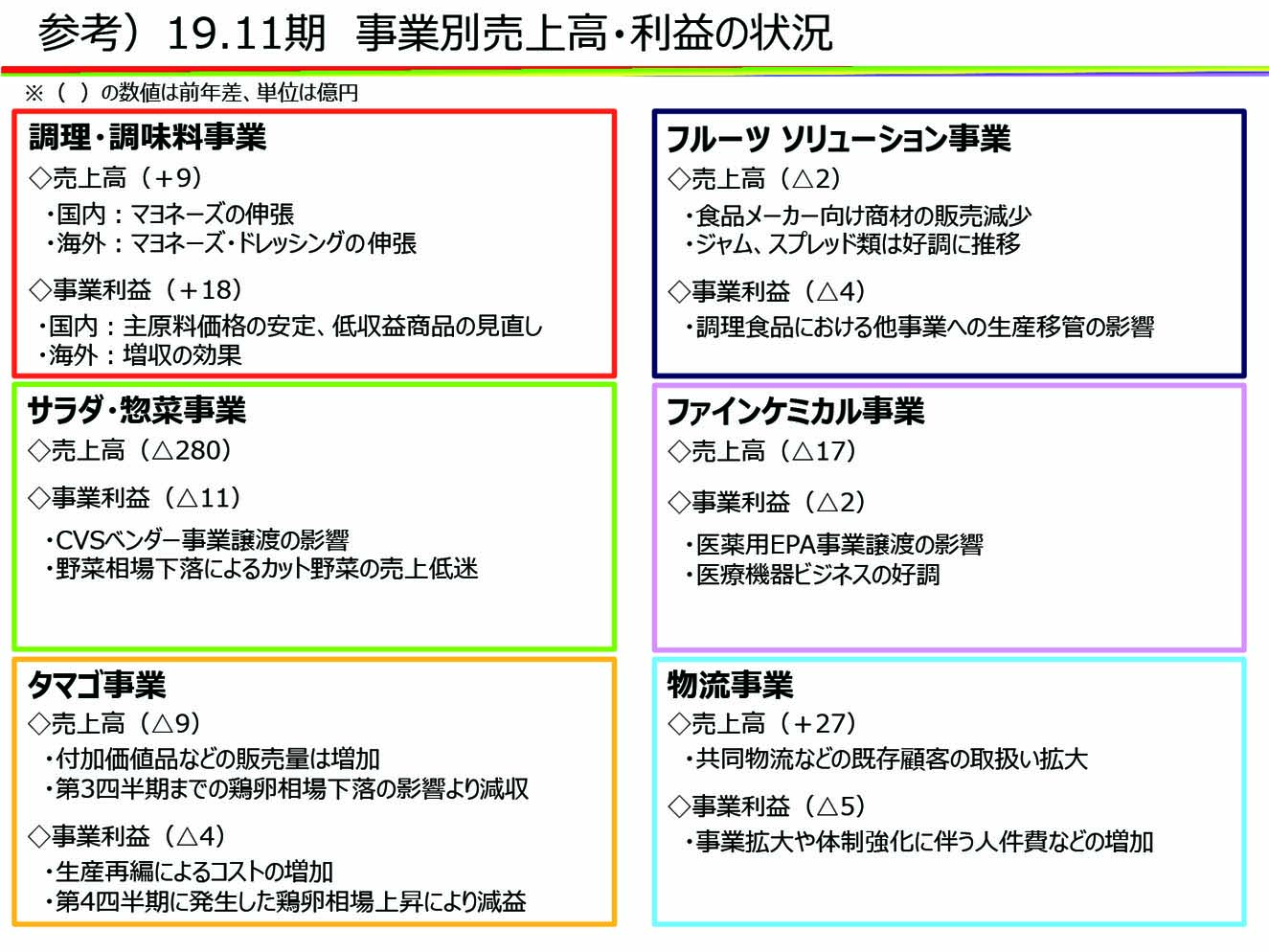
事業別の売上・利益の概要を申し上げると、
調理・調味料事業は海外が伸長し、国内のマヨネーズの売上も19億円増加したものの、国内のドレッシングの売上は11億円減少しました。
サラダ・惣菜事業は、CVSベンダー事業譲渡の影響以外では特にカット野菜の売上が18億円減少していることが利益に影響しています。
タマゴ事業の利益は生産再編に関わる一過性のコスト増と、夏から秋にかけての自然災害の影響で第4四半期の鶏卵相場が急上昇したことが影響しました。
物流事業は、売上は増加しましたが、全体的な人件費増に加え新規設備の稼働経費が負担となり減益となりました。
-
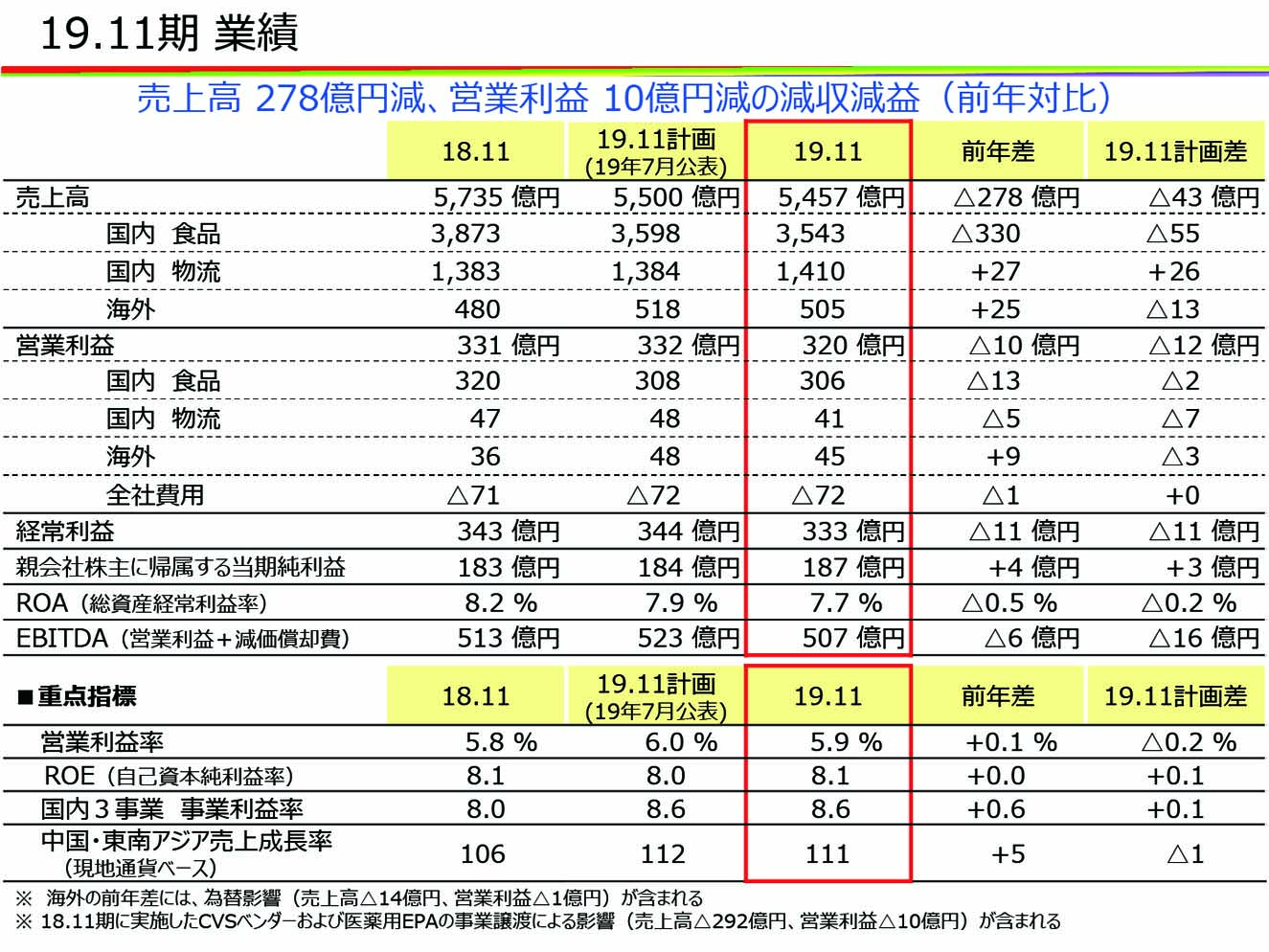
重点指標のうち、国内3事業の利益率は達成しましたが、売上と利益の拡大については課題を残しています。
中国・東南アジアでの現地通貨ベースの成長率は計画には若干及びませんでしたが二桁の成長となりました。
-
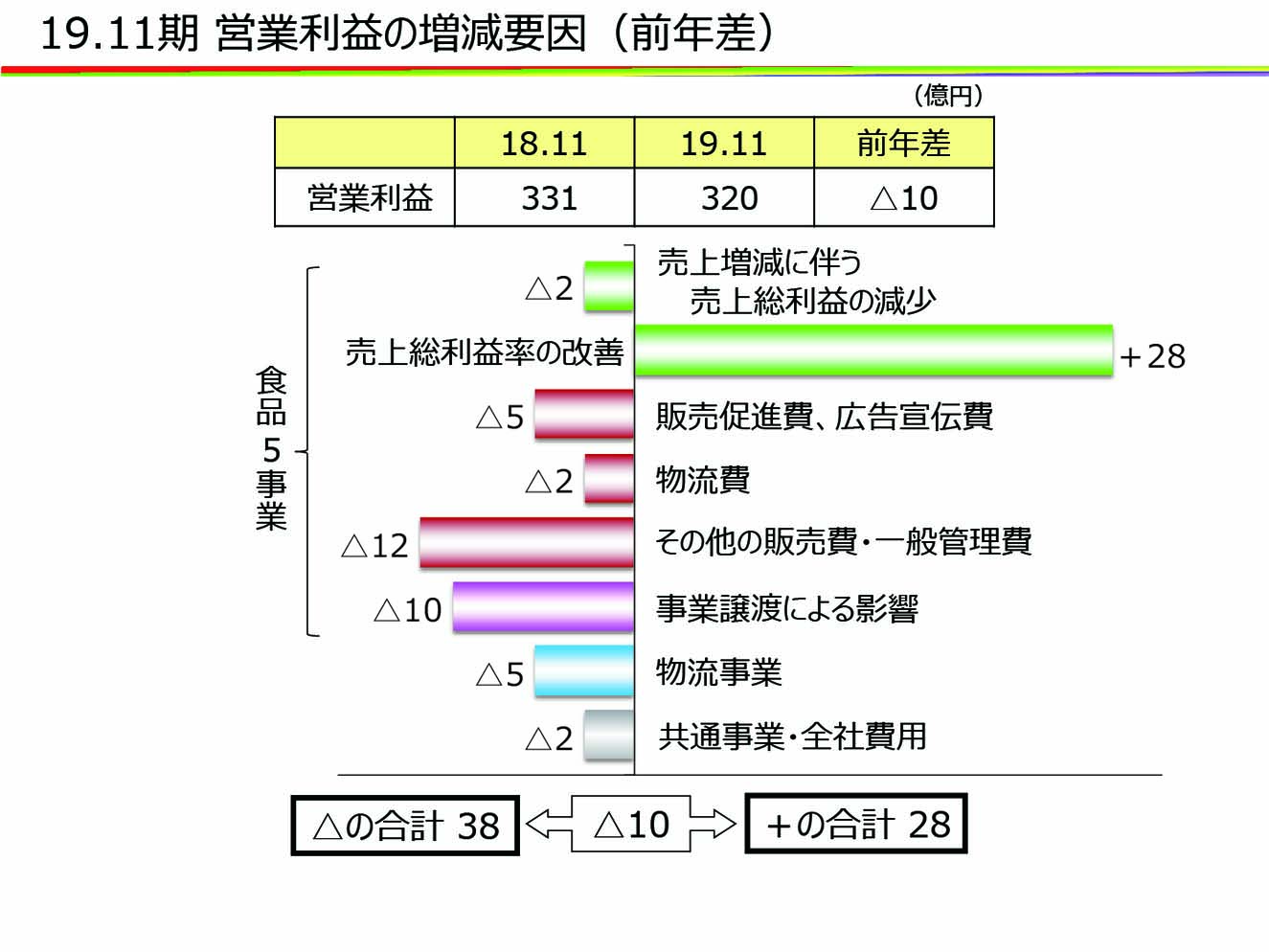
営業利益10億円減の要因です。
-
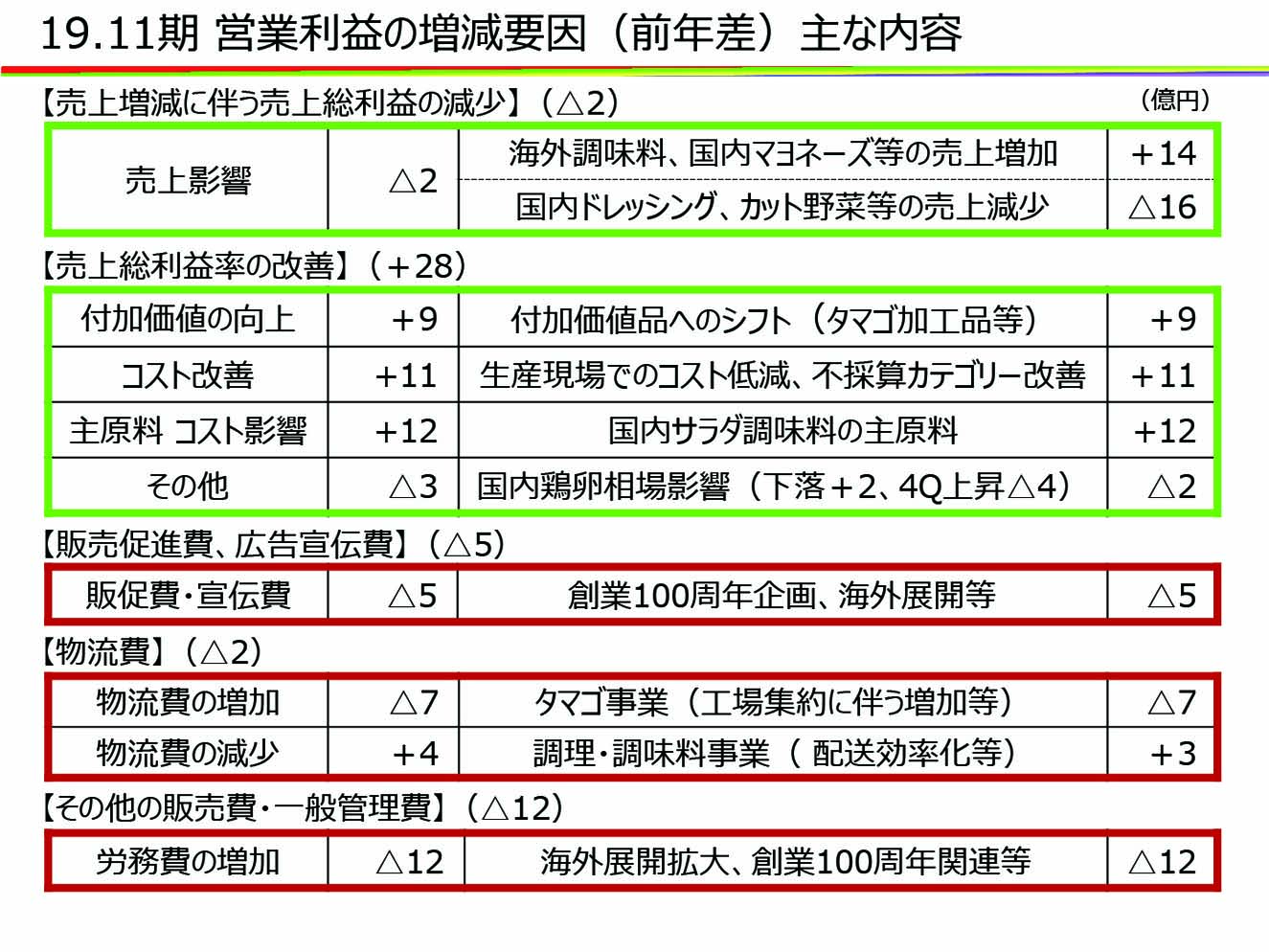
売上増減に伴う売上総利益は2億円の減少となりました。
特に国内のドレッシング、カット野菜の減少が影響しています。
19年7月に公表した計画では、この項目で18億円の増益効果を予定していましたので大きな乖離となりました。売上総利益率の改善は28億円の効果です。
主原料コスト減少によるプラス影響が想定より拡大しました。販売促進費や物流費、一般管理費などについては概ね想定内の着地となりました。
なお、2019年度の一過性の費用である創業100周年の費用は総額で15億円。
主な内訳は販売促進・広告宣伝費で7億円、販売費・一般管理費で6億円となりました。 -
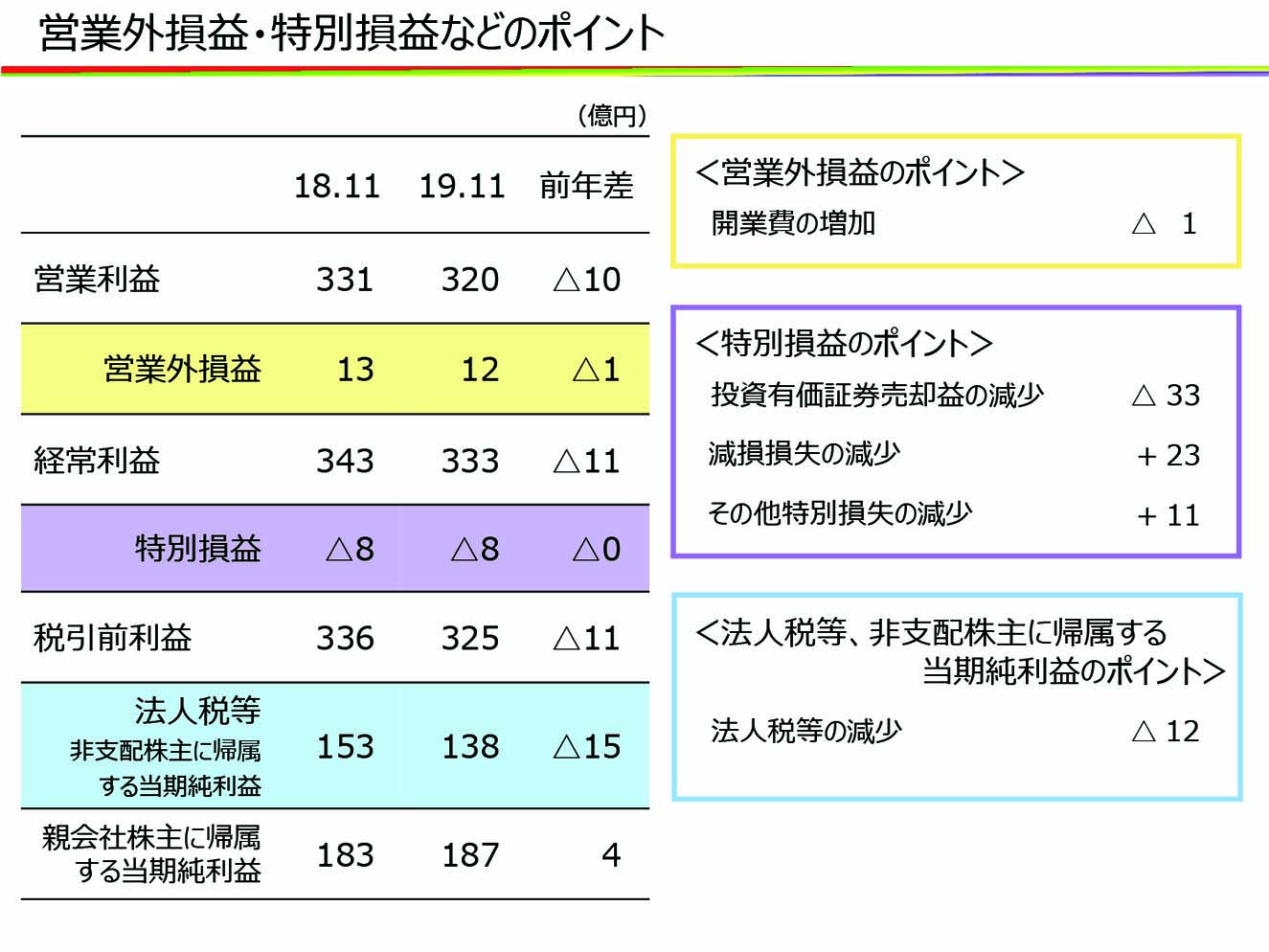
経常利益は前年に対して11億円減少の333億円、当期純利益は前年の減損損失による法人税の減少により4億円増の187億円となりました。
2019年度の設備投資は、計画では414億円でしたが、業績の状況を考慮して抑制に努め、286億円の実績となりました。
2020年は325億円を計画しています。 -
21年11月期業績目標の修正と当初目標との乖離要因を踏まえた今後の重点施策について。
19年度は、海外はほぼ計画どおりに進めることができましたが、国内については事業譲渡の影響や創業100周年に伴う費用を考慮したとしても、努力不足の結果となったことを重く受け止めています。
ドレッシングやカット野菜などの需要喚起によるトップラインの回復が当社の当面の課題となりますが、それを踏まえたうえで、中期経営計画の業績目標を変更します。
現在進めている3事業の取り組みについては、サラダクラブが得意とする青果売場用の調味料商品の販売やデリア食品が得意とする惣菜売場におけるタマゴ加工品の展開など少しずつ成果を出しつつありますが、全体的な動きとしては育成に時間がかかるため、20年・21年度においては、将来の継続的な成長に向けた体制を立て直す期間にしたいと考えています。
-
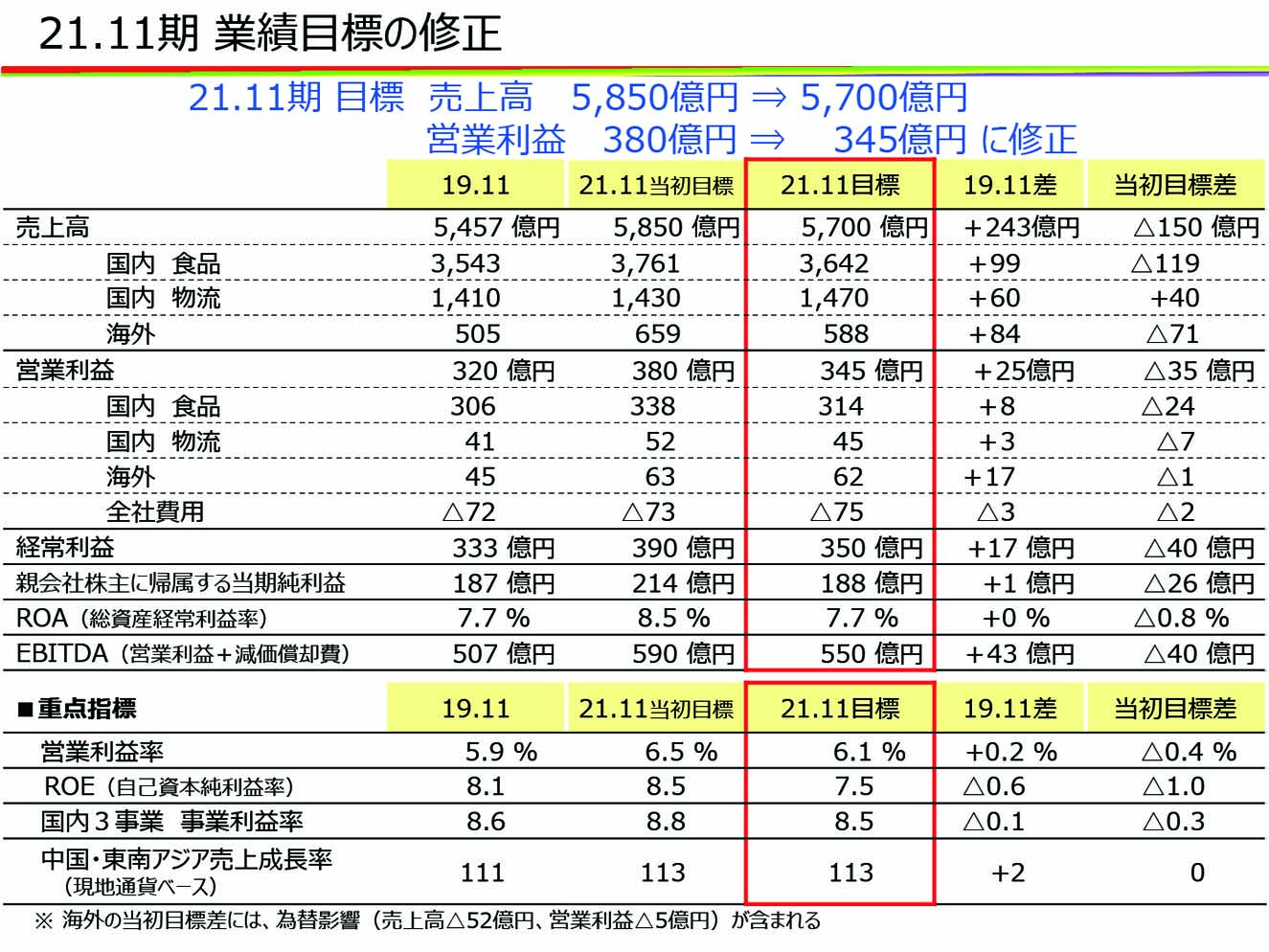
21年度11月期の売上高は、当初目標の5,850億円から150億円減となる5,700億円、営業利益は、380億円から35億円減となる345億円に修正します。
売上高について、国内食品は当初目標の3,761億円から119億円減の3,642億円に修正します。
主力3事業では75億円減を計画しています。海外では20年・21年の2年間で84億円の増収を見込んでいますが、当初目標との差は、為替影響の52億円を含め、71億円減となります。
次に営業利益について、国内食品は当初目標との差は24億円減となる314億円に修正します。
このうち、17億円が主力の3事業であり、ドレッシングやカット野菜などの売上の伸び悩みによる減少によるものです。物流事業では2年間で3億円の増益を見込んでいますが、当初目標からは7億円減となる45億円に修正します。
荷主からの少量多品種・多頻度化の対応要求や人手不足の長期化など、当初の想定よりも厳しい環境になっており、料金の適正化やコスト改善は進めていきますが、収益の安定には時間がかかるものと見込んでいます。
海外については、19年差で17億円増となる62億円に修正します。
当初目標との差は1億円減ですが、為替の影響が5億円減となり、実質では4億円増となります。経常利益については、当初目標との差が40億円減となる350億円に修正します。
親会社株主に帰属する当期純利益については、当初目標の214億円から26億円減となる188億円に修正します。
そのため、ROEにつきましては、当初目標8.5%から1.0%減となる7.5%を予定しています。 -
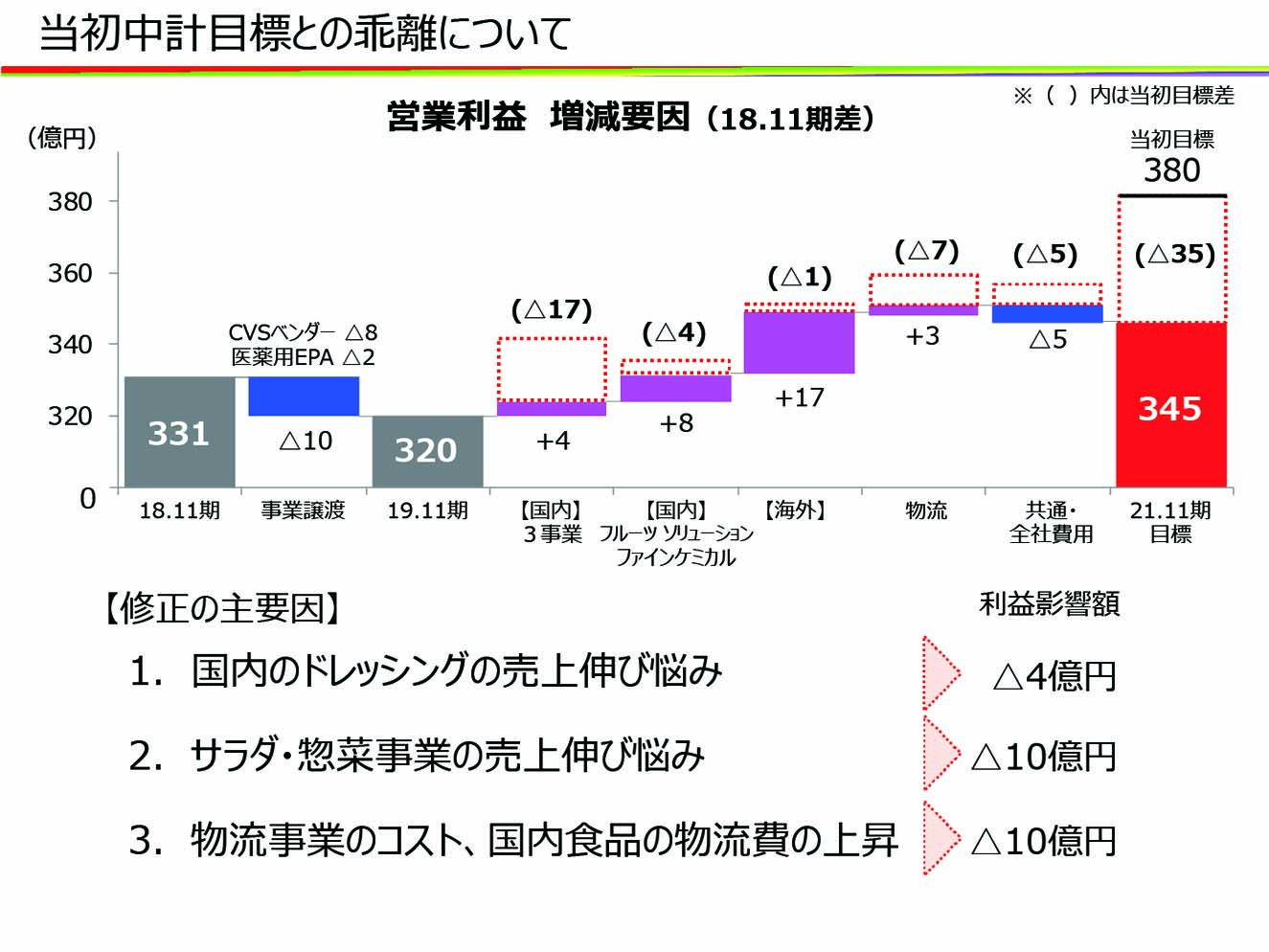
今回、中期経営計画の遅れとなった要因は主に3つです。
1つはドレッシングの環境変化への対応が遅れていることです。
18年度の容量変更により値頃感を失ってしまったことやオイルの健康感が見直され、ノンオイルドレッシングの需要が減ってしまったことなど、様々な要因がありますが、それらを踏まえたうえで全体的な戦略の方向性を示せなかったことに反省があります。2つめはサラダ・惣菜事業における売上の伸び悩みとして、カット野菜における野菜相場の変動への対応の遅れによるものです。
3つめは、物流事業および食品事業における物流費において、当初の想定よりも厳しい環境になっていることによるものです。
これら3つの主要因について見通しの甘さがあったことを認めたうえで、あらためて当面の重要課題として取り組んでいきますが、直近としての成果は限定的であることから、20年・21年は足場固めと転換の期間とし、22年度以降の持続的成長につなげていきます。
なお、物流にかかるコストの上昇については、社会的な環境から根本的な改善はすぐには難しい状況であるととらえており、コスト抑制は進めながら現状より極力負担とならない施策を継続的に進めていきます。
-
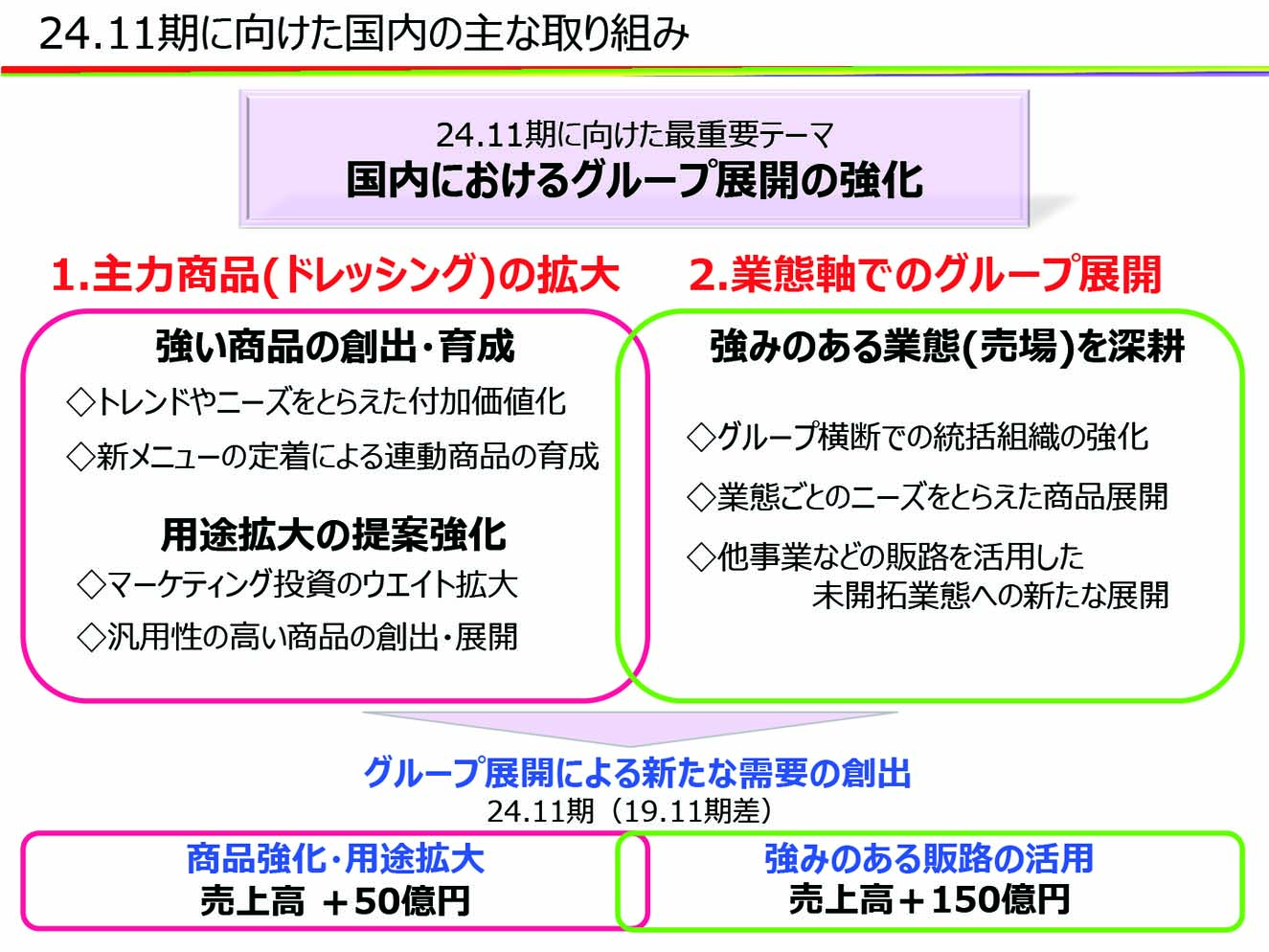
ドレッシングについて、まずは既存カテゴリーでの取り組みとして商品戦略と販売戦略の2つを進めていきます。
商品戦略ではお客様のオイルの質への拘りから嗜好性の変化をとらえるなど、ニーズやトレンドをとらえた商品開発の強化を行います。
昨年8月に発売した、オリーブ油を使用したオリーブオイル&オニオンドレッシングは、オイルの健康感からお客様の支持をいただき、年間4億円の売上見込みです。
今後ともオイルの質を含め、嗜好性の変化をとらえた商品開発を充実していきます。
販売戦略においては、現在苦戦している外食・料飲に対してドレッシングを軸に、サラダとタマゴを使用した朝食全体のメニュー提案や人手不足・スキル不足に対応するシェフ向け商品の拡売に注力していくことで、直近のオリンピック・パラリンピック需要だけでなく、その後の継続的な需要につなげていきます。
次に、サラダ用調味料という既存カテゴリーの枠を超え、調味料市場全体の中で料理用調味料への位置づけに変えていきます。
つまり、サラダをドレスする調味料というだけでなく、料理をドレスする調味料へドレッシングの定義を拡大させていきます。
現在もタレやソースと市場を奪い合う中で、主力のドレッシングはすでに汎用化が一部進んでいますが、当社調べでは、ドレッシングのサラダ以外の使用率は5%程度であり、用途拡大のための広告投資やメニュー提案を積極的に進めていきます。
マヨネーズはサラダ以外への使用率が50%であり、当社ならではの、この貴重な成功体験をドレッシングに展開できる強みがあります。サラダ・惣菜事業の伸び悩みについて、特にカット野菜は相場に左右されやすい商品領域であることや市場競争の激しいカテゴリーであることから、単一事業だけでの対策や戦略ではリソースの活用にも限界があります。
よって事業軸から業態軸へと転換させ、国内の主力3事業でグループ展開を進めていきます。
当社グループの主戦場であるスーパーマーケットにおいて、調味料を中心としたグロサリー向け商品の規模は約550億円ありますが、それとほぼ同じ規模となる500億円の惣菜売場、それに次いで青果売場ではカット野菜で240億円の販路を持っています。
これらの強い販路を活用するため、グループを横断する組織の強化を行い、業態ごとのニーズをとらえた商品展開に注力していきます。すでに一部のお客様でご採用いただいており、強い販路でのグループ展開については、この動きを加速させていきます。
これらの施策によりサラダ用途のドレッシング市場および調味料市場全体の中でシェアを伸ばしていきますが、21年度ではまだ大きな成果にはならないため、24年度におけるドレッシングの商品強化と用途拡大により売上高50億円の需要を創出し、さらに業態軸でのグループ展開において、強みのある販路の活用で、24年度では150億円の売上を創出していきます。
-
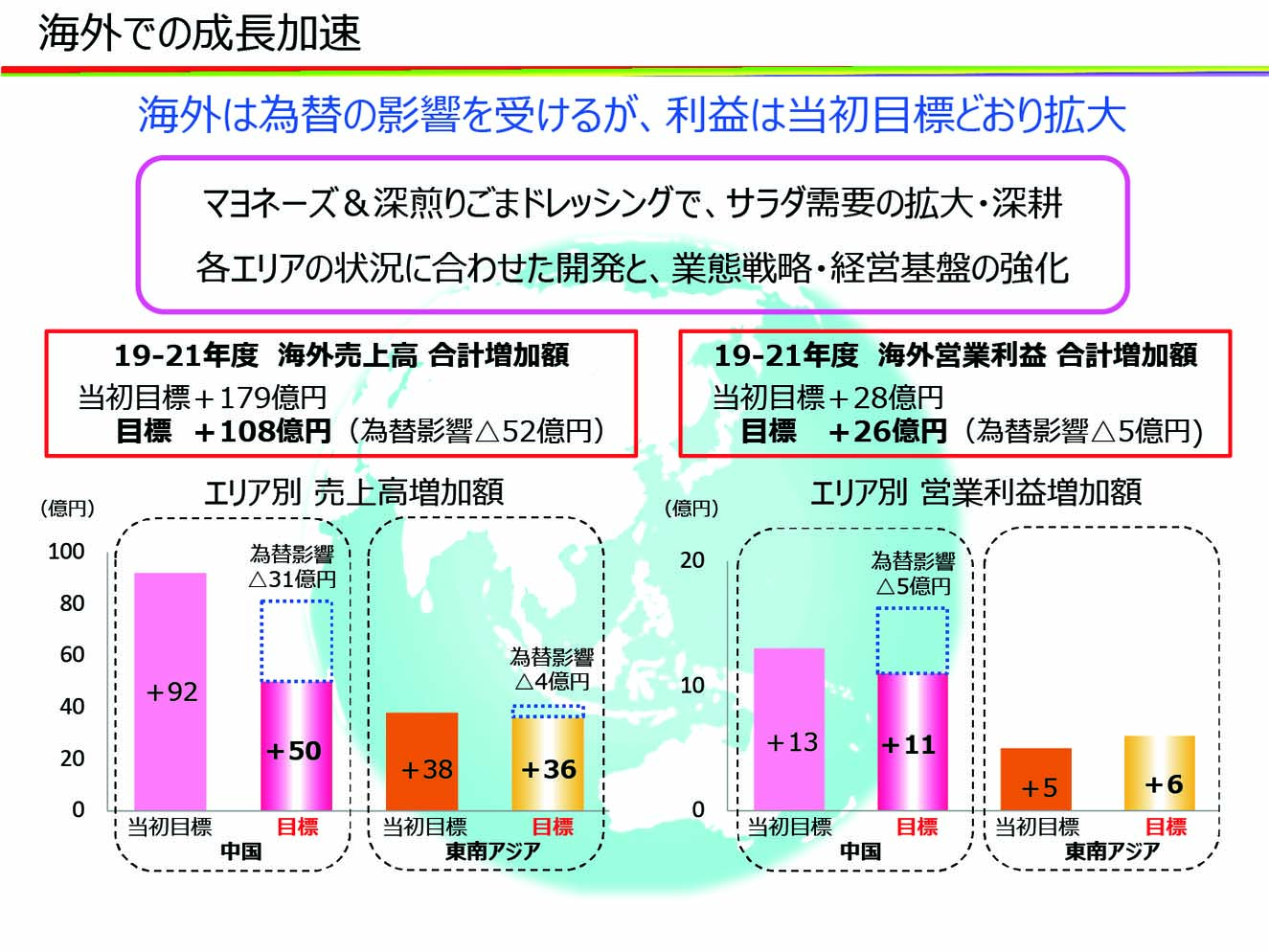
海外全体では売上高において為替の逆風影響を受けることから71億円減の修正を行います。
利益については、順調に推移しており、現地通貨ベースでは当初目標を超えますが、為替影響により若干の下方修正を行います。
東南アジアについては為替の逆風を乗り越え、円ベースとしても当初目標を上回る増益計画を推進していきます。 -
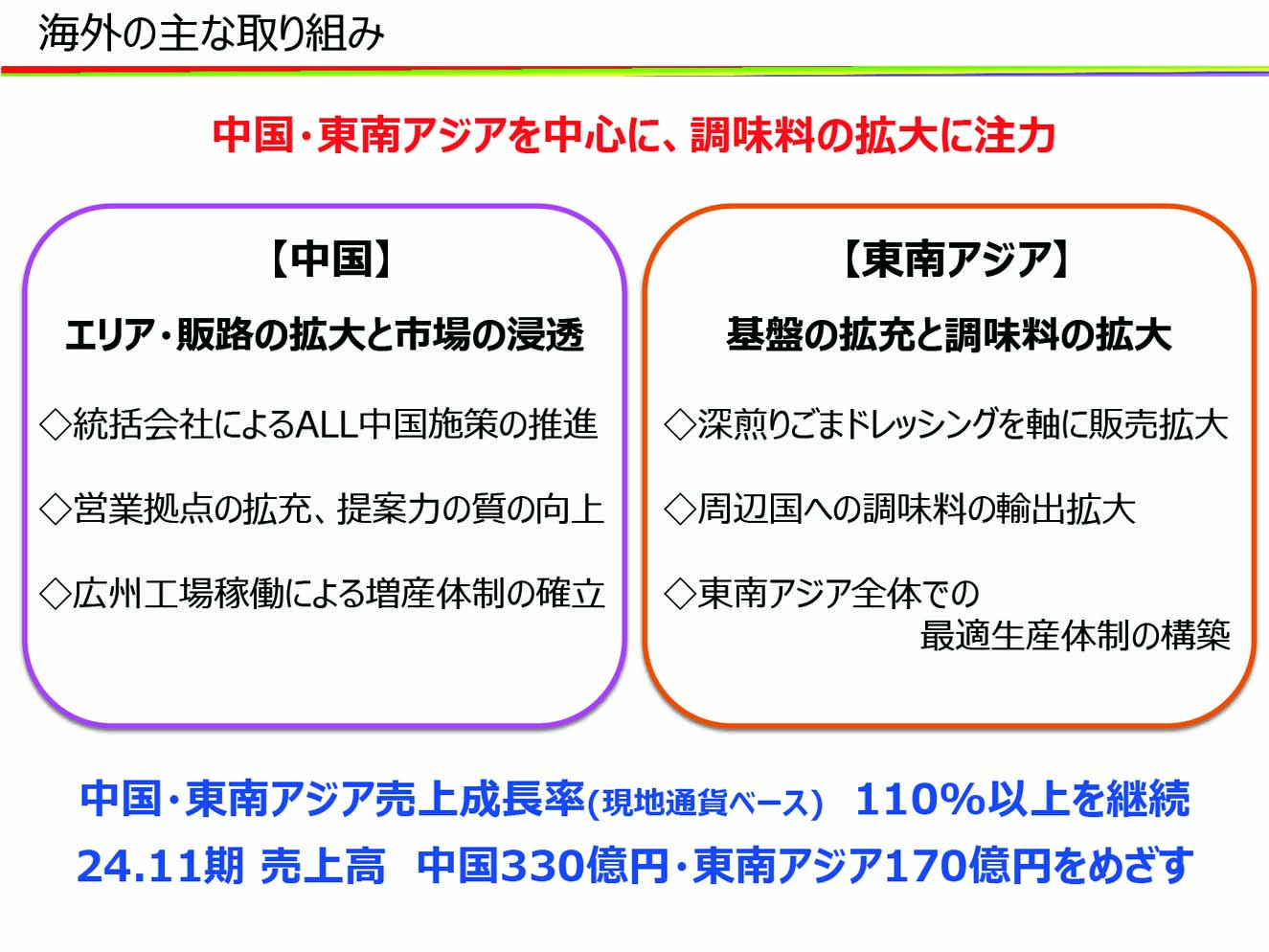
中国・東南アジアでは現地通貨ベースで2ケタ成長を継続します。
中国では20年度に商品バーコード統一のための一時的な費用が発生しますが、統括会社の機能強化や第4の拠点となる広州工場の稼働により、21年度からは継続的な利益創出を実現します。東南アジアでは、タイ・マレーシア・ベトナム・インドネシア、そして販売会社であるフィリピンとの間で協業を進め、成長を加速させることで、安定的な収益を生み出せる仕組みを構築していきます。
またラオス・カンボジア・ミャンマーなどの周辺国への輸出拡大により新たな市場の開拓を行っていきます。これらの取り組みにより2024年には売上高で中国では330億円、東南アジアで170億円、合計で500億円をめざします。
-
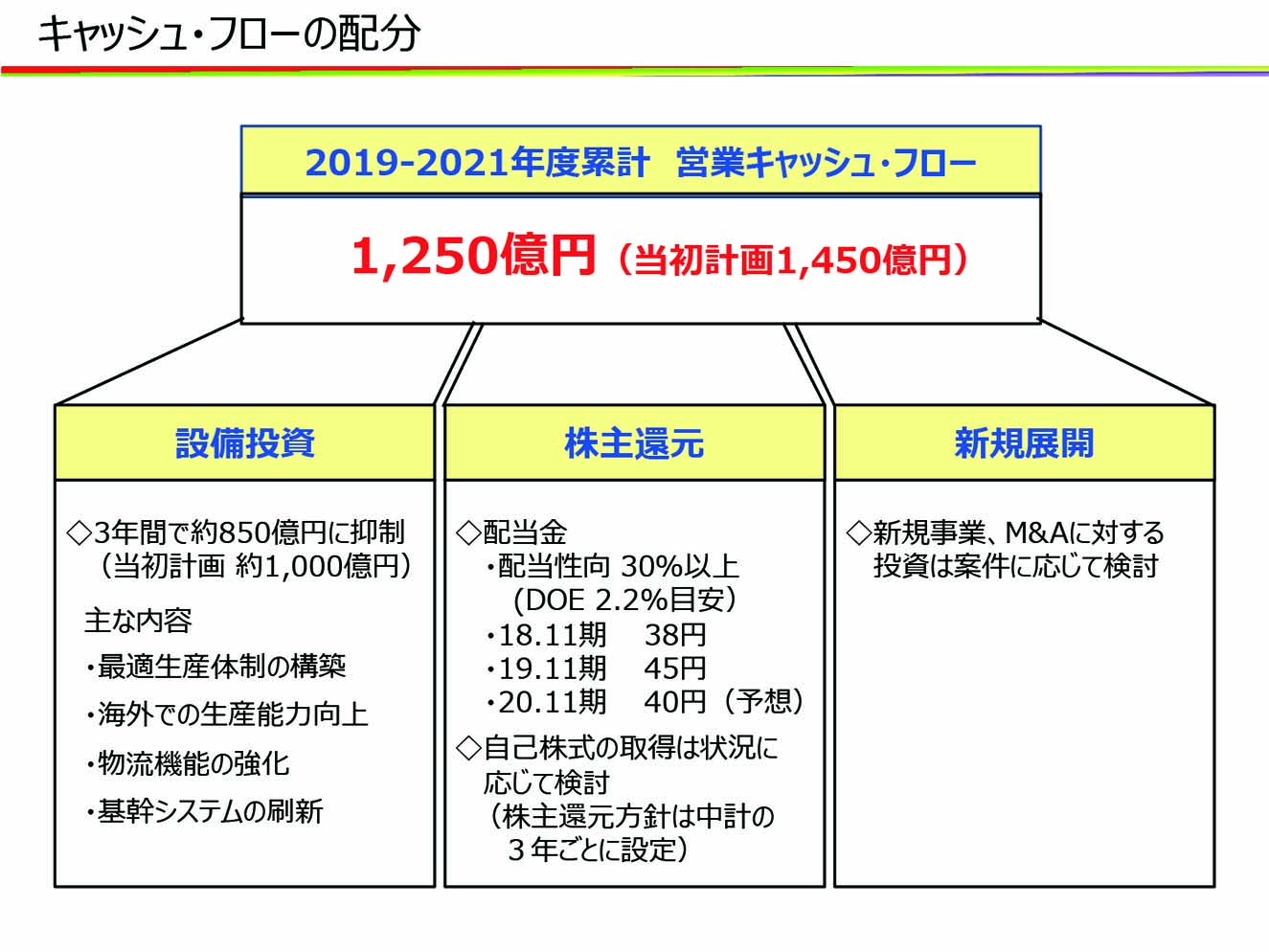
次にキャッシュ・フローですが、当初の計画では3年間累計の営業キャッシュ・フローは1,450億円を目標に進めてきましたが、今回の業績目標の修正により税引前利益の減少を見込んでいるため、1,250億円に修正します。
設備投資については当初の計画で1,000億円を予定していましたが、850億円に抑制します。 -

20年度11月期の計画
-
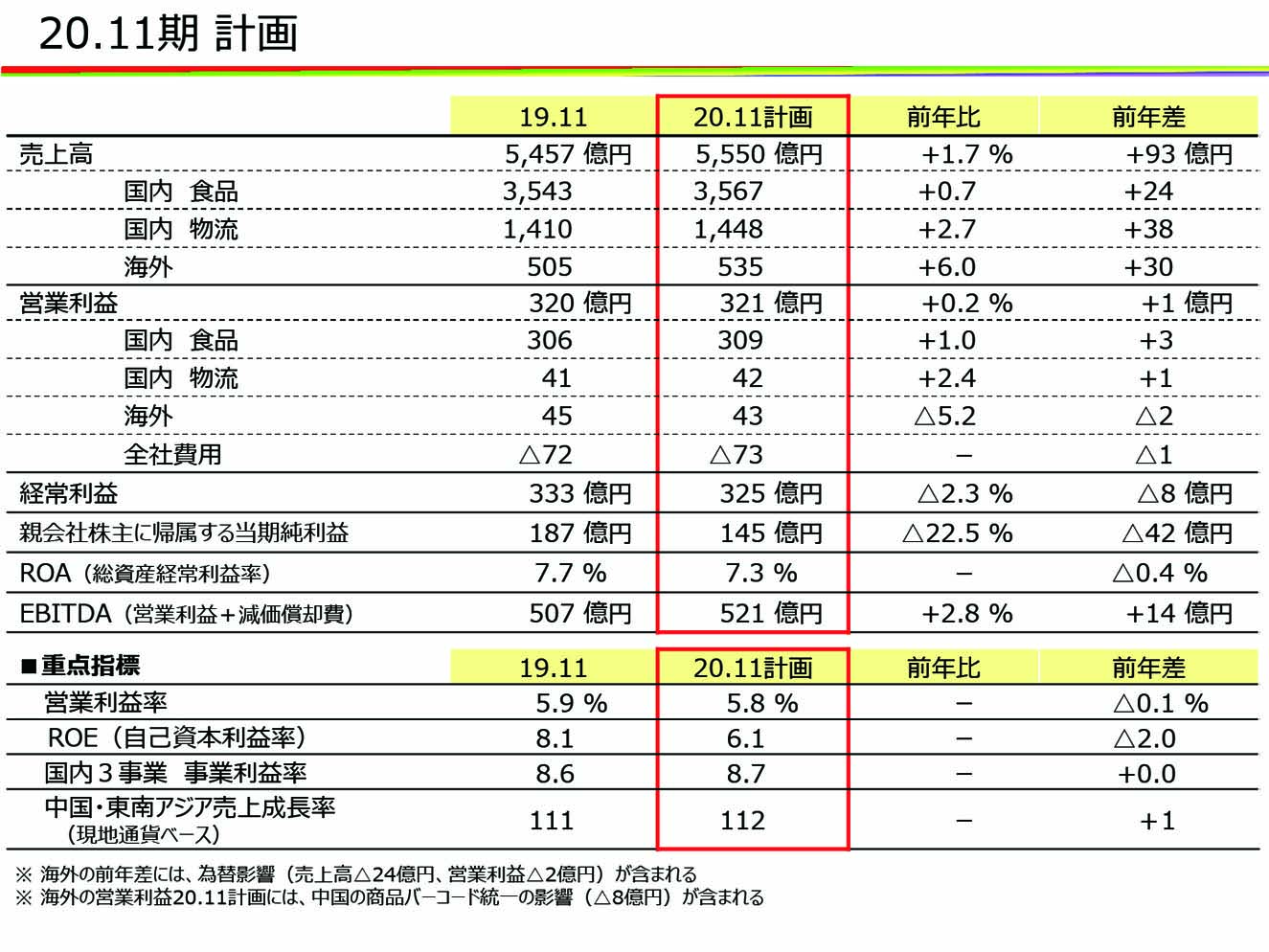
売上高は前年差93億円増の5,550億円、営業利益は1億円増の321億円を計画しています。
また経常利益は前年差8億円減となる325億円、親会社株主に帰属する純利益は前年差42億円減となる145億円を計画しています。重点指標の営業利益率は前年差0.1%減の5.8%、ROEは2.0%減の6.1%、主力3事業の事業利益率はほぼ前年同様の8.7%を計画しています。
-
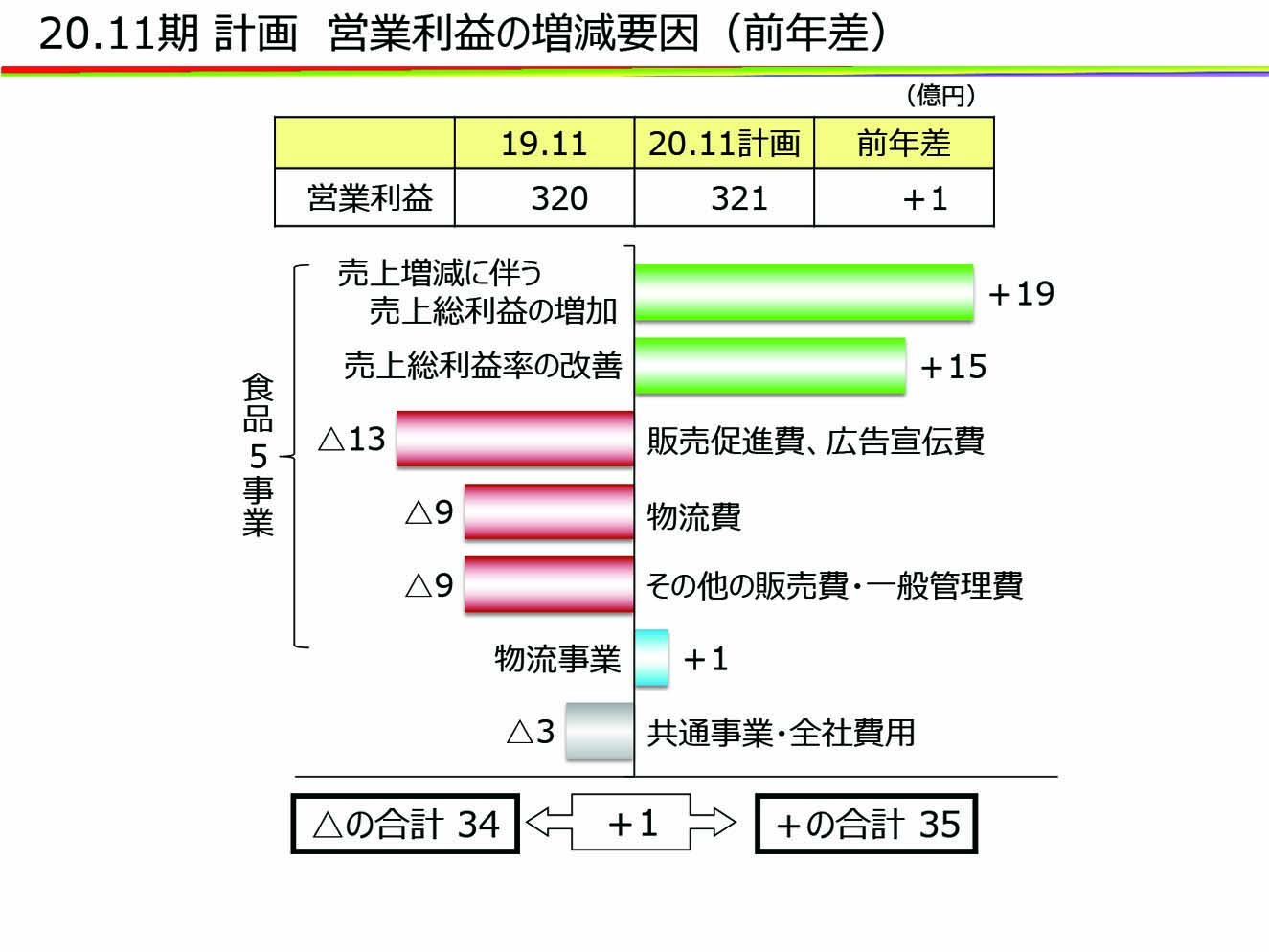
営業利益の増減要因
-
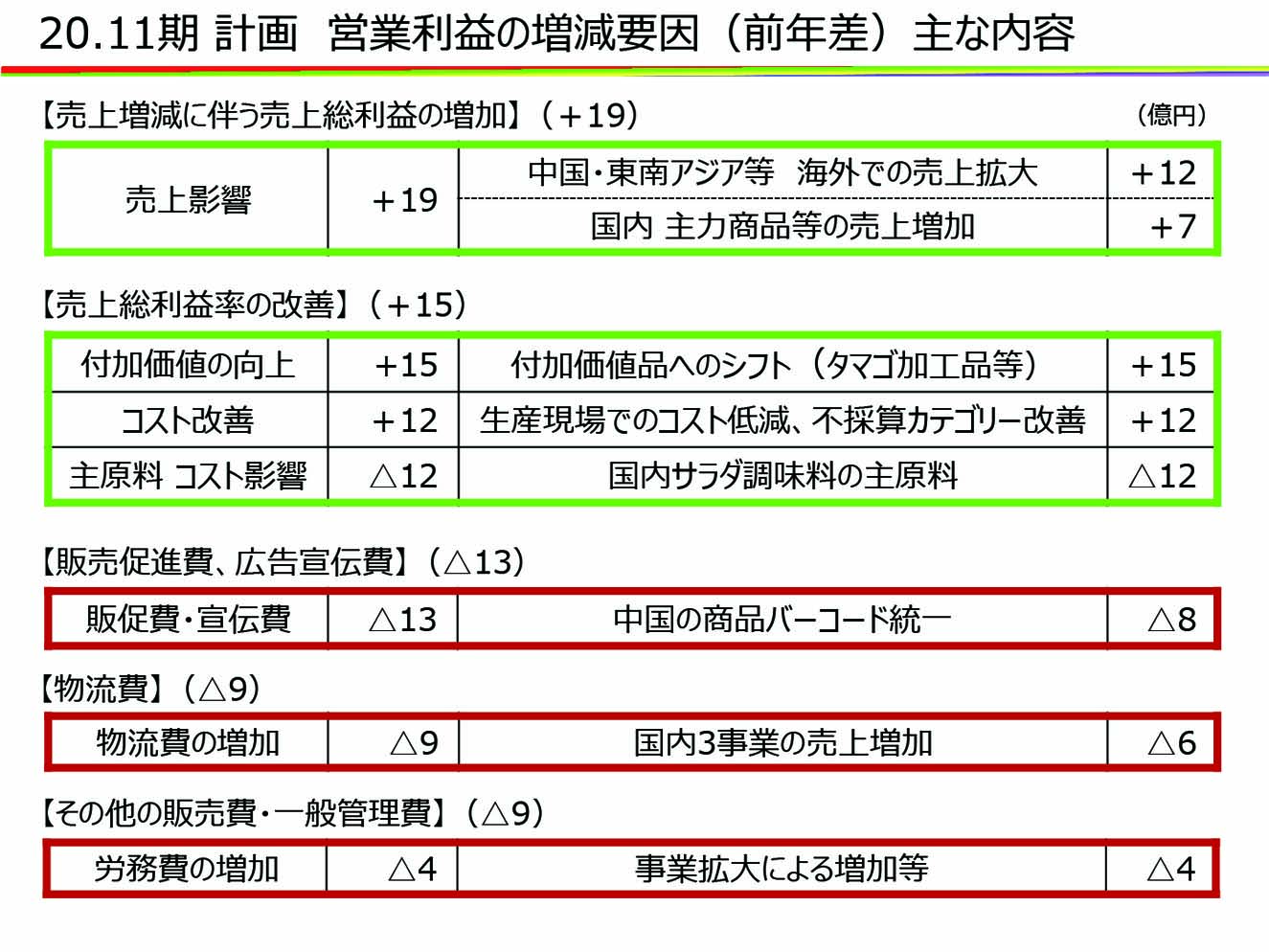
19年度実施した創業100周年にかかる費用は15億円でしたが、そのうち5億円は通常予算からの捻出とし、経費の抑制をしたため実質10億円のプラスとなります。
さらに、20年度の特殊要因として、中国の商品バーコード統一による費用が8億円、主原料コストの上昇が12億円の減益要因となり、トータルとして10億円の逆風の中、主力商品の販売回復や付加価値品へのシフト、コスト改善により、前年差1億円の増益を計画しています。売上増減に伴う売上総利益の増加は、海外での継続的な成長やドレッシングやカット野菜などの主力商品の販売回復を進めることで収益性を高めていきます。
売上総利益率の改善では、とろっとたまごやPPピローなどの付加価値品へのシフトを継続することや製造現場でのコスト改善によるメリットを最大化し、低収益なカテゴリーを改善することで、収益性を高めていきます。
販売促進費・広告宣伝費は中国の商品バーコード統一の影響からコスト増となり、物流費・労務費も上昇する見込みです。
-
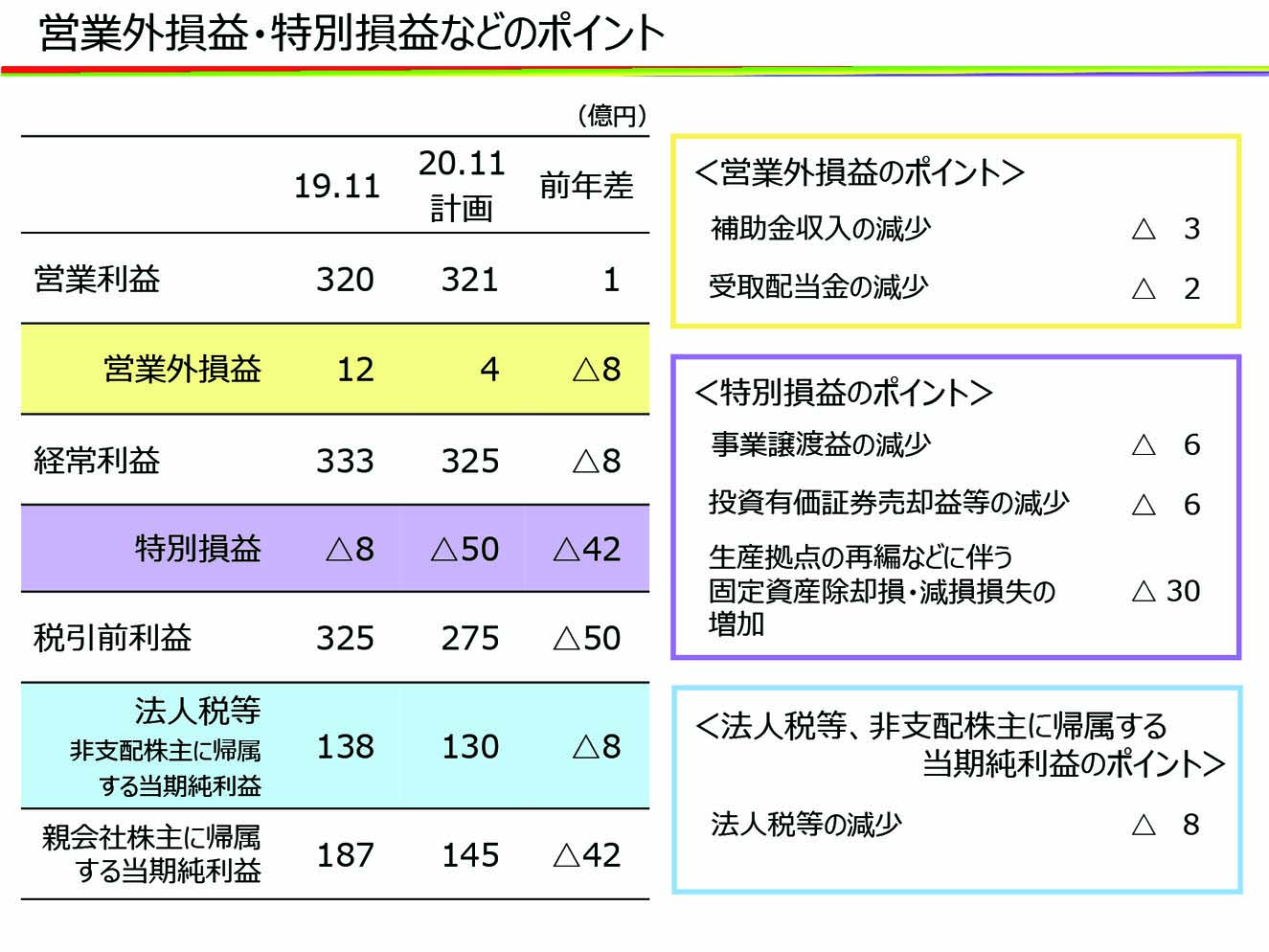
経常利益は、前年差8億円減となる325億円、親会社株主に帰属する当期純利益は、前年の事業譲渡益や有価証券売却益の反動、固定資産除却損による影響などから42億円減となる145億円を計画しています。
-
-
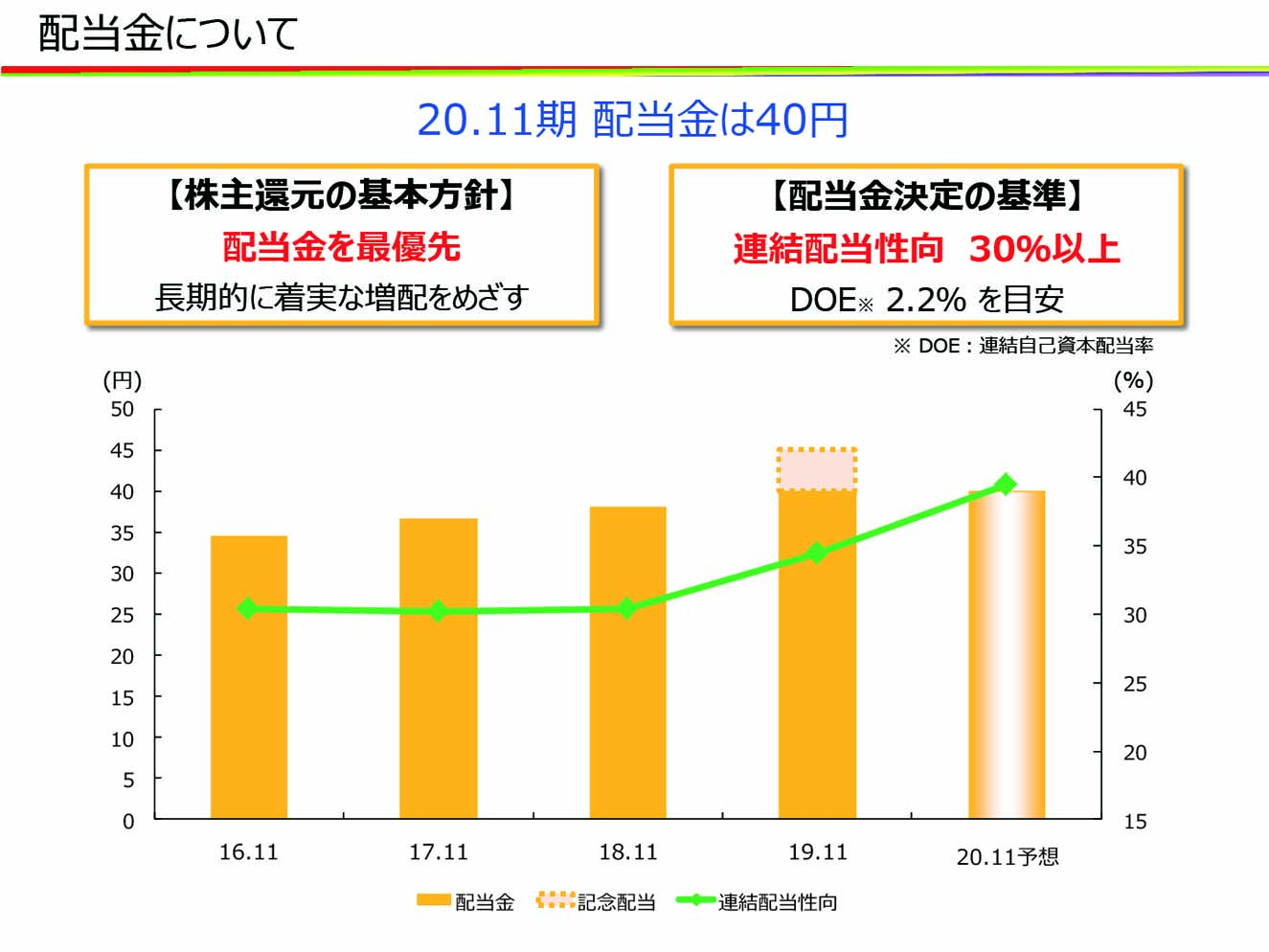
20年度の配当金については、当社基本方針にのっとり、連結配当性向30%以上、DOE2.2%を目安とし、40円を予定しています。
-

最後になりますが、101年目のスタートにあらためて当社グループの経営を振り返ると、1970年の上場以来、売上高はおかげさまで順調に伸長してきました。
また、グループ経営をスタートした2005年以降、この15年間で売上高1.2倍、営業利益2.5倍まで成長しました。
この力を活かしながら、海外展開については成長加速を進め、安定的に成長できるよう、進めていきます。また、国内においては単身・共稼ぎ世帯の増加、超高齢社会にしっかり向き合い、それに伴うお客様の変化に対して、各事業が磨いてきた市場との接点を活用することで、次の成長をめざします。
Q&A (Japanese only)
-
We feel a sense of management responsibility for revising the medium-term management plan, and we have changed our approach to ensure that the management team commits to supporting strategies and measures with KPIs in order to achieve our goals.
Furthermore, in order to accelerate product development from the customer's perspective, we have established a cross-functional organization that transcends our previous business areas, and we are also coordinating research and development. By changing our current approach, we will lead the domestic market. -
For the past three years or so, we have continued to compensate for weak sales growth with cost improvements. As we anticipate continued sluggish sales growth, we will proceed with cost improvements through our "3 Plus 1" initiative. ① We will thoroughly review and simplify our operations to reduce management costs. ② We will change the allocation of resources. ③ We will steadily work towards the optimal staffing levels, with targets for 3 and 5 years from now. The "Plus 1" is a review of our core systems. Our group's systems have become complex, and the amount of work required is a challenge, so we will work to improve the workload from 2021 to 2023.
-
We position our fruit solutions and fine chemicals businesses as unique businesses; while Net sales are not large, they contribute to profits through technology and concepts. fine chemicals business is beginning to show promising results. We believe that continuing technologically driven initiatives, such as the launch of products for hay fever relief, will contribute to corporate value. fruit solutions business is still in its early stages, and we will work with the business manager to identify challenges and revitalize it. The logistics business faces an uncertain outlook for fiscal years 2020 and 2021 due to rising costs. Even in these challenging times, the various initiatives we undertake together to deliver better food logistics are extremely valuable to our group, and we intend to continue this situation.
-
Up until now, we have explained mayonnaise price revisions solely based on the price of edible oil by tanker truck, which has been well-received by supermarkets and has allowed for smooth price adjustments. Going forward, we believe we must also consider rising costs such as logistics and labor costs, but currently, costs have not risen to the point where we need to consider price revisions. Following the consumption tax increase in October 2019, consumers tend to tighten their belts, so we will prioritize providing customers with reasonable prices.
-
Previously, we explained that we would review low-profit businesses over a five-year period, but if there is no prospect of improvement even before five years have passed and we are forced to make a decision in the short term, such as one or two years, we may take such action. Furthermore, our group's growth to this point is due to the continuation of a culture that values each and every employee, and we intend to continue to value our employees as we move forward with selection and concentration.
-
Roughly half of the 100th-anniversary expenses were related to sales promotion and advertising, with 70% targeting consumers (product buyers) and 30% targeting the general public. The gift campaign conducted for consumers contributed significantly to the strong sales of mayonnaise.
Furthermore, half of the 100th-anniversary expenses were allocated to our employees, reflecting our desire to reward them in some way for their diligent efforts to increase the company's value, even amidst challenging business conditions. -
Amid rising labor costs due to labor shortages, unexpected costs arose due to delays in the launch of a large-scale automated freezing and refrigeration facility in Tokorozawa. This automation is an initiative to address future labor shortages and is expected to reduce costs by 1.7 times compared to a warehouse of the same size. In fiscal year 2020, the key will be to fill the space of this warehouse and get it operational.
-
There are three synergies with K.R.S. Corporation which operates a logistics business.
① Our strengths lie in our considerable sales volume in the processed food sector, our wide range of business partners with many products that have high store adoption rates, and our large number of product items. We possess the ability to reliably deliver these companies' products nationwide. These strengths are a major asset to K.R.S. Corporation, and at the same time, we have been able to build an efficient logistics network across the entire group.
② Similar to our company, K.R.S. Corporation also has a wide range of users. By providing sales support to the same users through both companies, our group's involvement will increase, contributing to the creation of strong relationships.
③ Logistics issues are a social challenge and difficult to resolve without involving government agencies and industry associations. However, both companies are significant players in the food and food logistics industries, and by taking the lead in logistics reforms being implemented in the food industry (e.g., delivery two days later), they are beginning to generate positive feedback within the industry and receive support from the government. By working together on logistics initiatives, both companies will enhance the presence of our group. -
We will pursue both value creation and cost improvement. Approximately 85% of our egg business sales come from raw materials such as liquid eggs, but if the weight of processed products increases by 1%, we can improve Operating income by 100 million yen.
In addition, we distribute pre-cut vegetables primarily in the produce sections of approximately 10,000 supermarkets nationwide. However, our group's sales in the produce section amount to 25 billion yen, almost entirely from pre-cut vegetables, and we haven't been able to expand our specialty, dressings, to a significant extent. We plan to increase the proportion of highly processed products in the produce section to ensure stable Gross profit. In delicatessen foods, we are working to improve costs by reducing the number of items and utilizing AI. -
In fiscal year 2019, domestic mayonnaise sales increased by 104% compared to the previous year. This was due to factors such as the company's 100th anniversary celebrations, a shift in awareness regarding the calories and cholesterol in cooking oils, and a growing recognition of mayonnaise as a high-quality condiments with low carbohydrate content. Furthermore, 50% of dishes other than salads use mayonnaise, suggesting that its versatility condiments has contributed to the development of various menu suggestions, including stir-fry dishes. For fiscal year 2020, we are planning for a 101% increase compared to the previous year. Maintaining the current level will be quite challenging, but we will continue to grow steadily.
-
For fiscal year 2020, Net sales in our salad and delicatessen foods business by 1 billion yen for packaged salads (due to extended shelf life, etc.), 1.9 billion yen for processed salads such as potato salad (due to extended shelf life, etc.), and 500 million yen for the combined sales of the three businesses, totaling 3.4 billion yen. However, we are also planning a decrease of 2.6 billion yen in sales due to streamlining our product lineup, so overall Net sales for the business will be increased by 800 million yen. Taking into account increased costs due to labor shortages, we will prioritize profit improvement over sales.
The cut vegetable market is facing challenges due to a shrinking market, increased competition, and retailers shifting to in-house production. However, products with extended shelf life are experiencing double-digit growth, and we aim to contribute to profits by increasing the number of such products. -
We will unify the product barcodes to those of the two companies located in the north and south, using the one from the north (Beijing). Based on past experience, the implementation cost for the 97,000 stores that currently carry products from the south (Shanghai) company is estimated to be around 800 million yen.
-
In China, there is a shift from glass bottles to tubes for household mayonnaise. Net sales 102% year-on-year, with tube sales increasing by 110%, while glass bottle sales have decreased to 97%. Although glass bottles still account for slightly less than 70% of Net sales, companies are strengthening their promotional activities for tubes with an eye on the future.
-
We plan to increase food service Net sales in China by 110% year-on-year in fiscal 2020. In fiscal 2019, Net sales increased by 113% to 116% year-on-year for the food and beverage sector and 108% to 110% for the bakery sector. The growth in the food and beverage sector was higher, and with the number of Japanese restaurants also increasing, we believe that focusing on the food and beverage sector has the greatest potential for growth.
-
Based on our Guangzhou plant, which is scheduled to begin operations in July 2020, we will strengthen our presence in the South China area. Our presence in the South China area, which has many food service customers, has been weak until now, so we will increase our sales offices and personnel in conjunction with the start of operations at the Guangzhou plant.
-
For Operating income by 2.4 billion yen compared to the previous year, with 1.9 billion yen of that coming from overseas expansion. Of that 1.9 billion yen increase, 800 million yen will be the return on the costs of standardizing product barcodes in China, resulting in a net increase of 1.1 billion yen. This is not a particularly high figure considering the growth in Operating income over the past few years. On the other hand, we plan to increase our domestic business by 500 million yen, with 200 million yen coming from food products and 300 million yen from logistics. home-cooked meals is in a period of consolidation and transformation, and we intend to make a steady transition.
-
Of the 5 billion yen in extraordinary losses, slightly more than one-third is attributable to the ongoing production restructuring. The impact of the production restructuring on depreciation expenses is that in FY2019, depreciation expenses decreased by 600 million yen due to the business transfer in FY2018 (effectively a 1 billion yen increase in FY2019). Depreciation expenses in FY2021 are projected to increase by 500 million yen, a smaller increase than in FY2020, suggesting that the depreciation cost-controlling effect of the production restructuring is beginning to show in these areas.
The remaining extraordinary losses include factors such as the potential for worsening business performance and the consideration of selling off some businesses.
2Q Financial Results Briefing
July 5, 2019 (first half of the fiscal year ending November 2019)
-
19.5期 決算説明会
国内での持続的成長と
海外での成長加速を実現する
1st Stage 中間報告 -

2019年5月期 業績
-
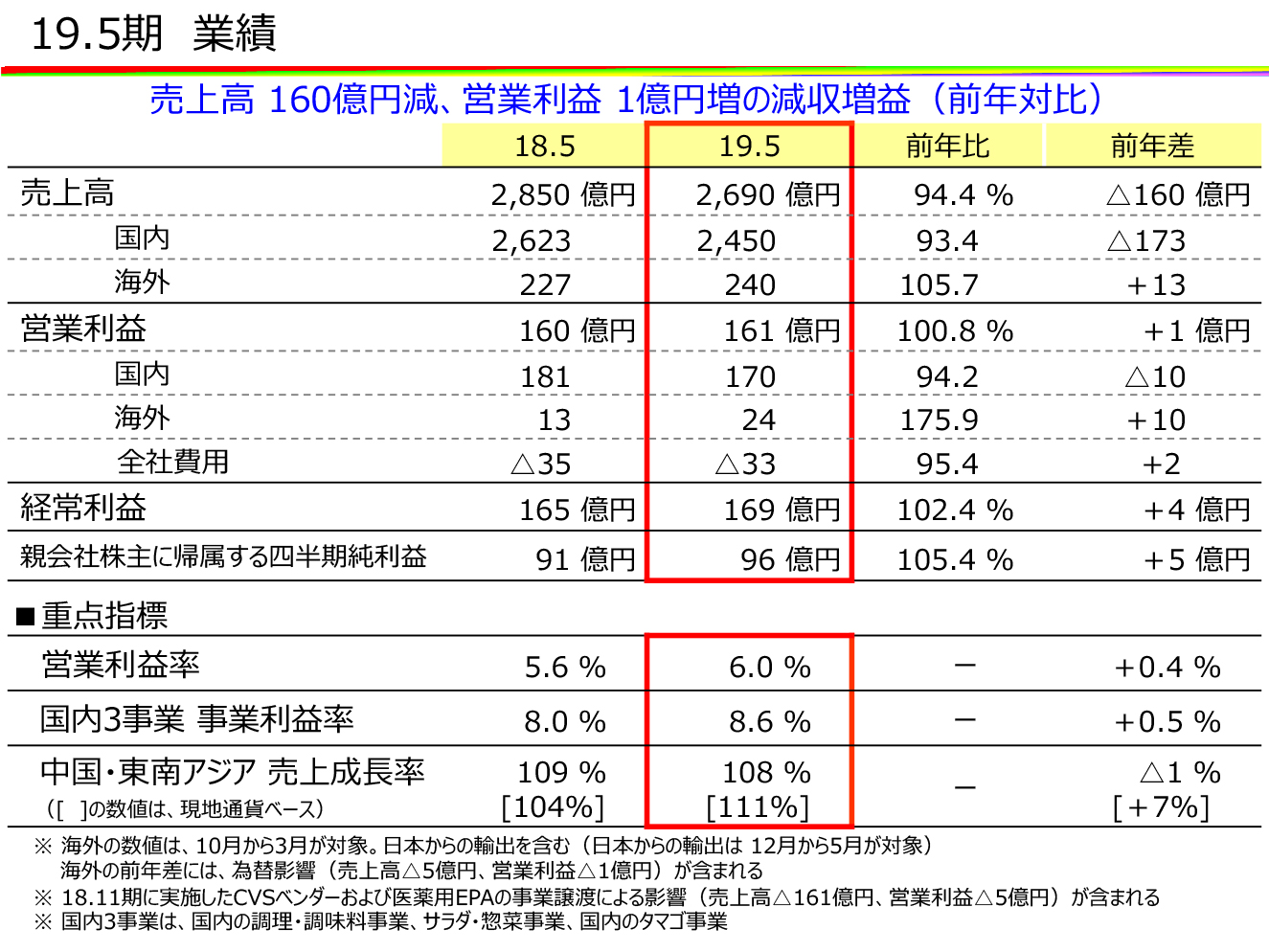
2019年5月期の業績について、売上高は2,690億円、前年に対して160億円の減収となりましたが、昨年実施しましたCVSベンダーとEPAの事業譲渡による影響161億円を加味すると、実質的には前年並みの状況となります。
売上を牽引した海外は、為替による5億円のマイナス影響がありましたが、13億円の増収となりました。営業利益は海外での増加により、1億円増の161億円となりました。
なお、2019年上期は事業譲渡によるマイナス影響5億円、100周年費用8億円、合計13億円の特殊要因があり、それらの影響を加味すると、実質的には14億円の増益となります。 -
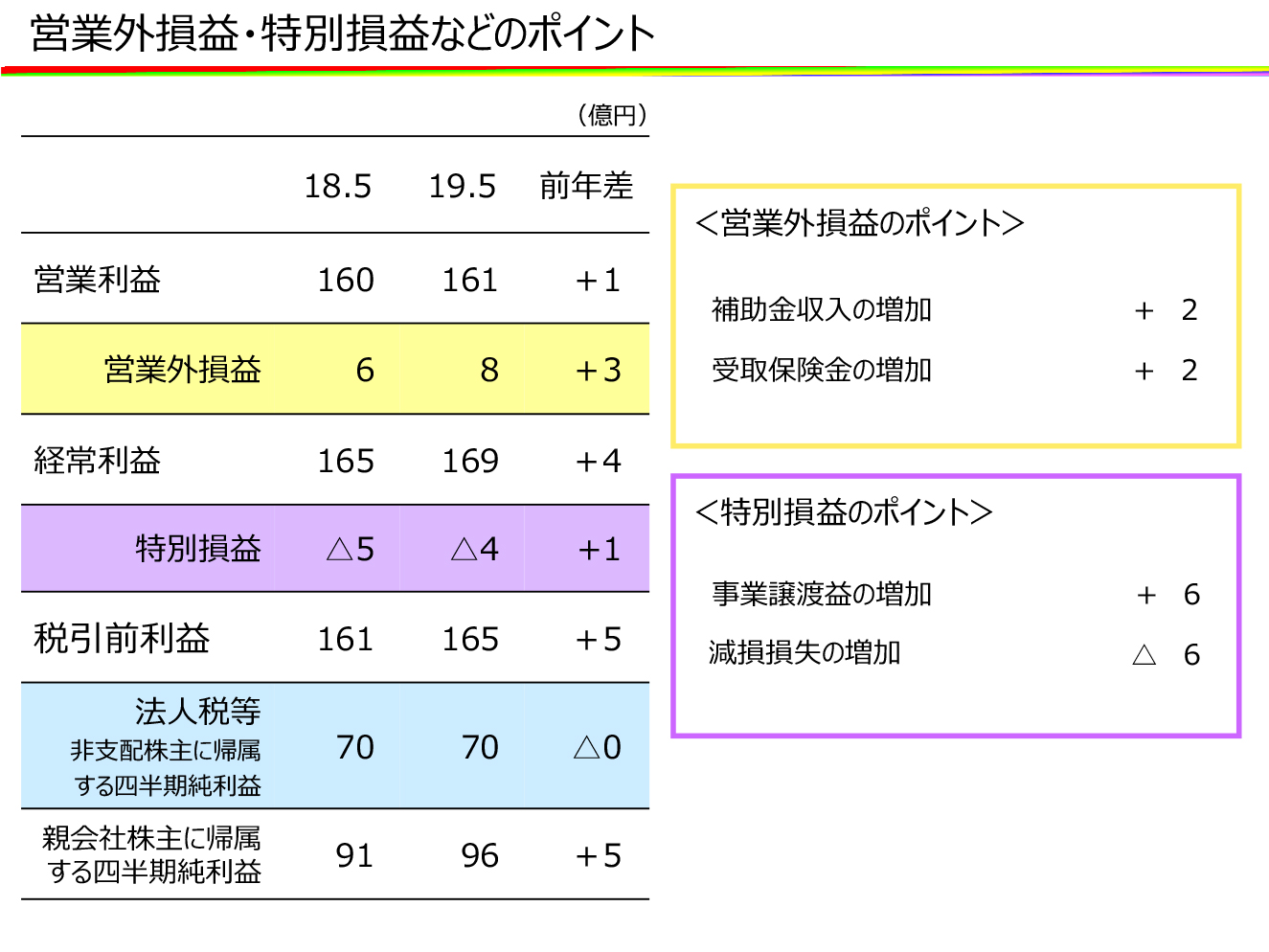
営業外損益は、環境対策への補助金収入などにより3億円増加し、経常利益は4億円増の169億円となりました。
なお、営業利益、経常利益については、上期としては5期連続の最高益となります。特別損益は、濃厚流動食の事業譲渡による特別利益が6億円生じましたが、生産拠点再編にともなう減損の影響も含めて、1億円の増加となりました。
これらの要因により、四半期純利益は、前年に対して5億円増加の96億円となりました。
-
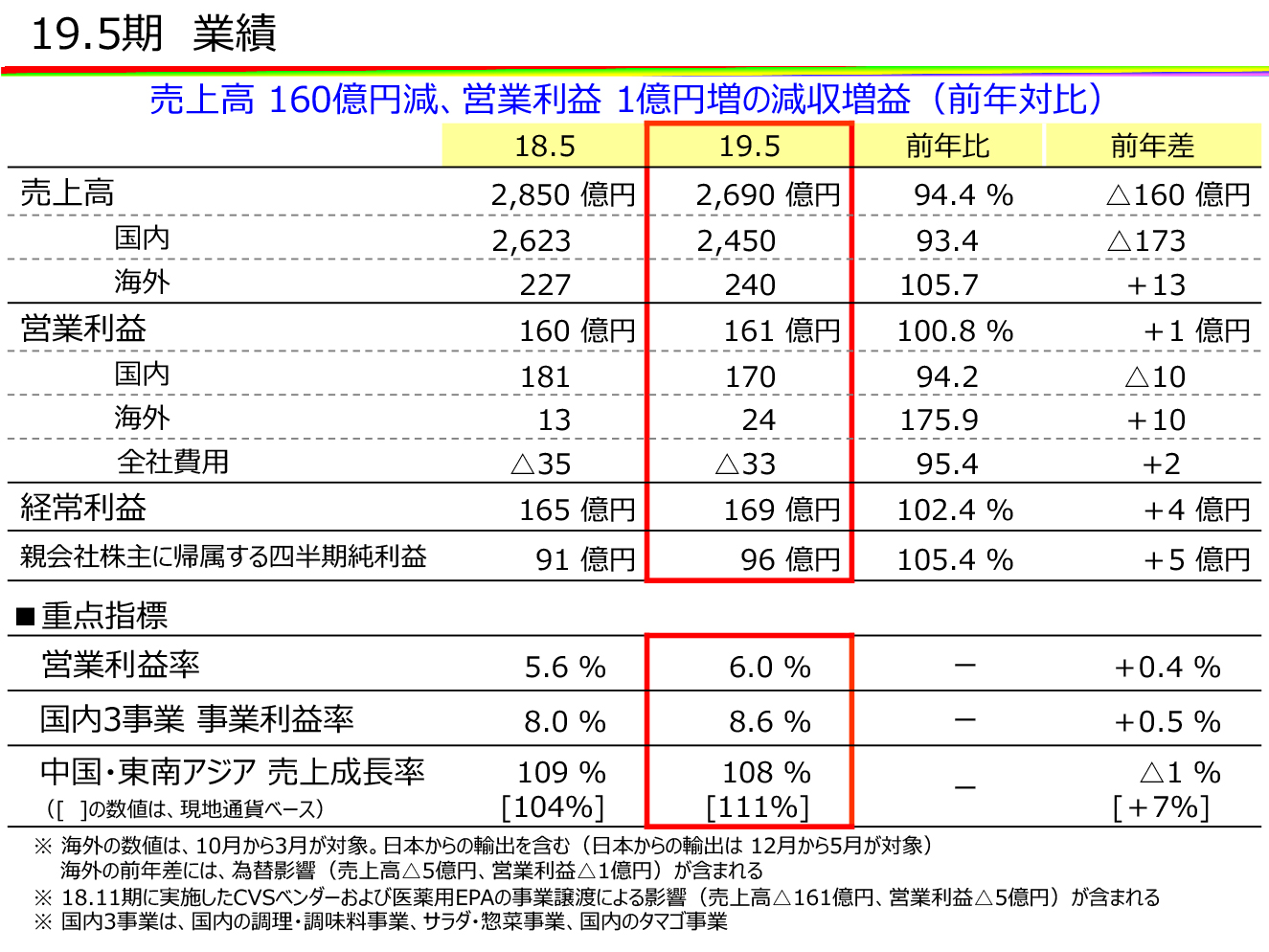
9次中期計画で掲げた重点指標については、国内での収益性改善や、海外での売上拡大が進んでいます。今後も着実に向上できるよう、取り組んでいきます。
-
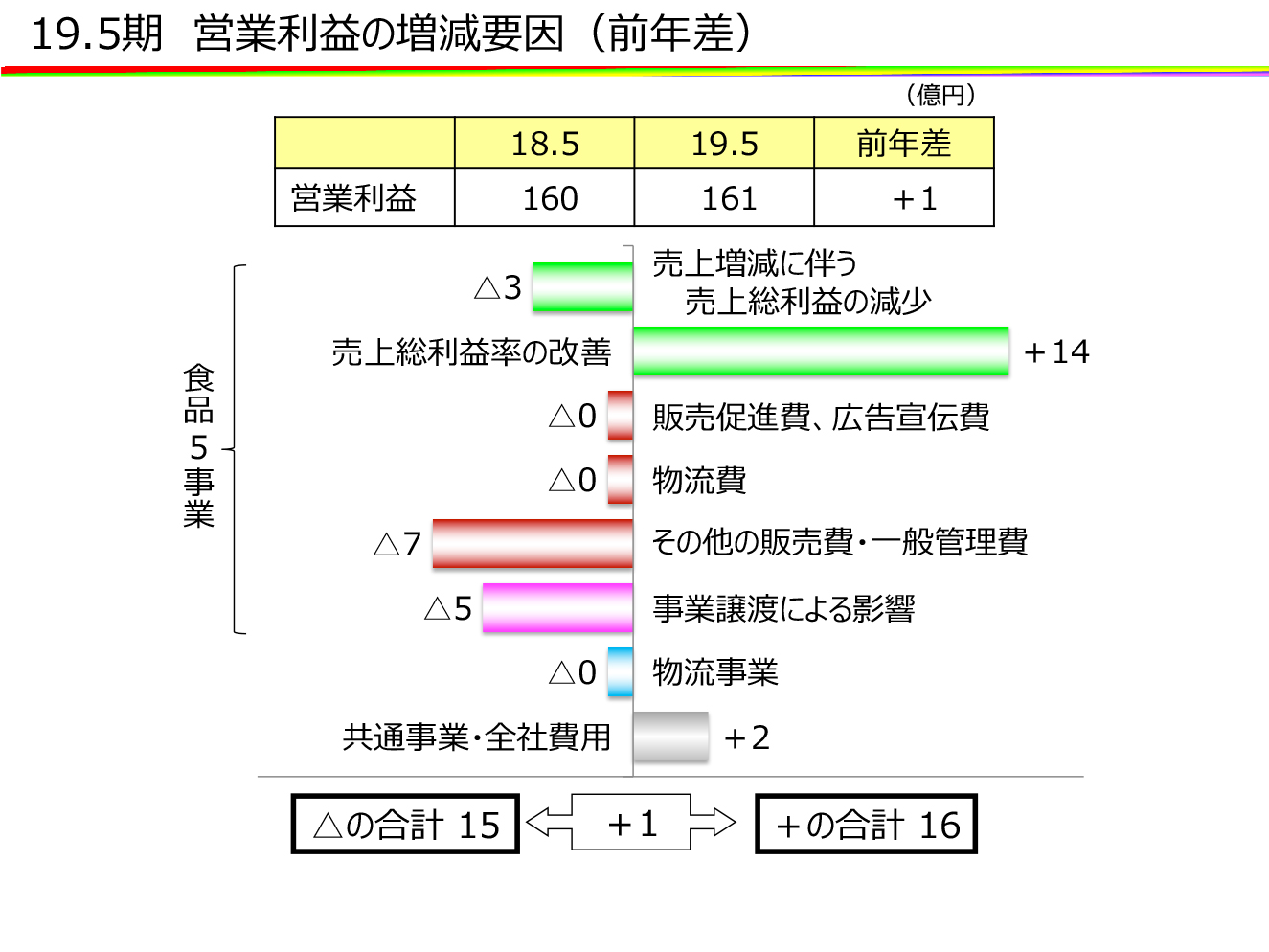
営業利益1億円増の要因です。
食品事業では、売上総利益率の改善が大きく寄与しました。
「販売促進費・広告宣伝費」には100周年関連費用が4億円含まれていますが、通常費用の抑制などにより、概ね前年並みとなります。
「その他の販売費・一般管理費」は主に労務費の増加によるものです。なお、事業譲渡の影響5億円は、サラダ・惣菜事業に含まれるCVSベンダーで4億円、ファインケミカル事業に含まれるEPAで1億円となります。
-
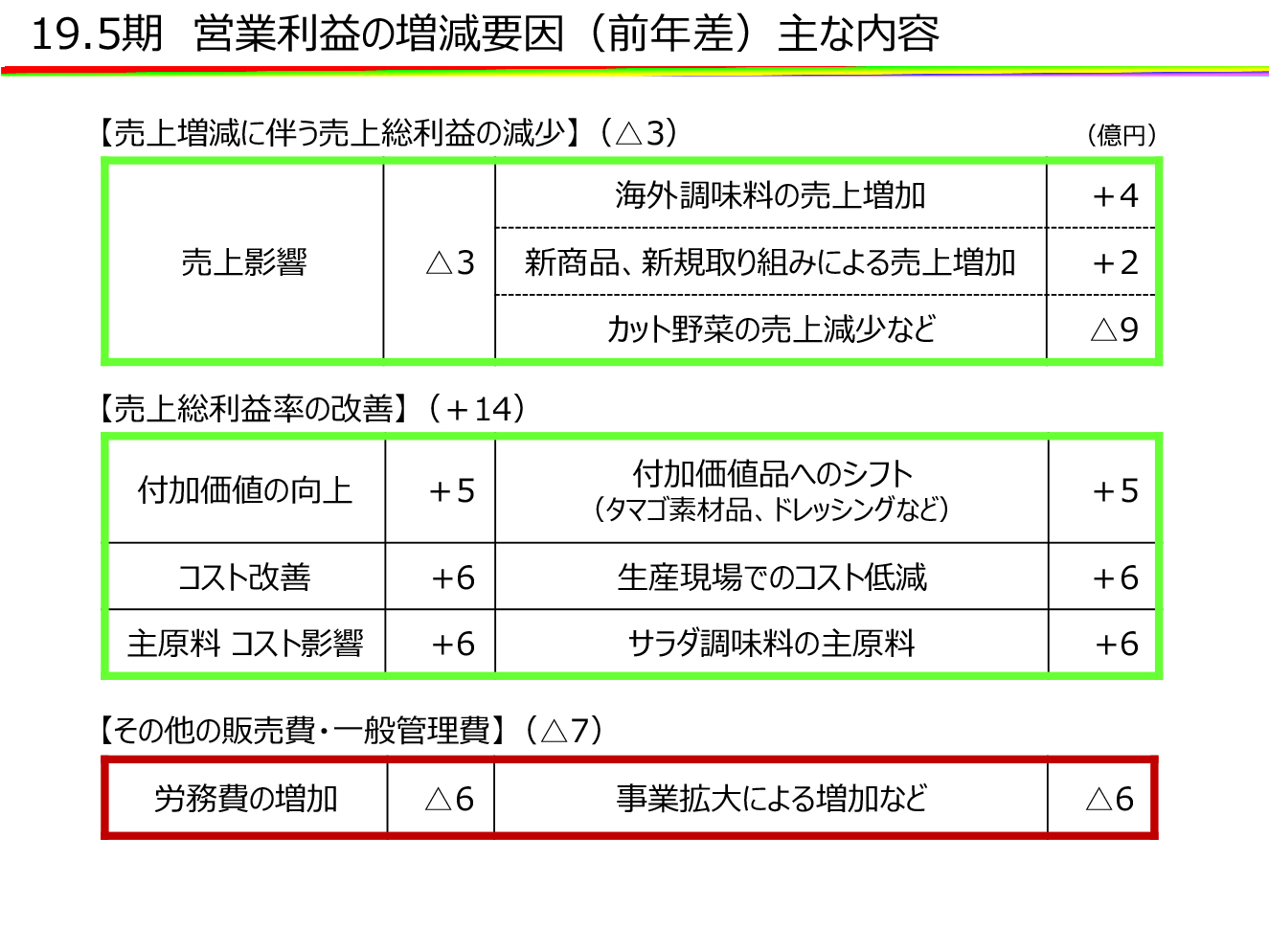
売上増減に伴う売上総利益の減少では、海外での販売拡大などが貢献したものの、葉物野菜の相場下落によるカット野菜減少の影響が大きく、3億円の減少となりました。
売上総利益率の改善による利益増は、付加価値の高い商品の販売ウエイトを上げていく取り組みで5億円、これは、タマゴ事業と調理・調味料事業が貢献しています。
生産の効率化などのコスト改善の取り組みでは、6億円を創出しました。
また、サラダ調味料の主原料コストは、6億円の増益要因となります。 -
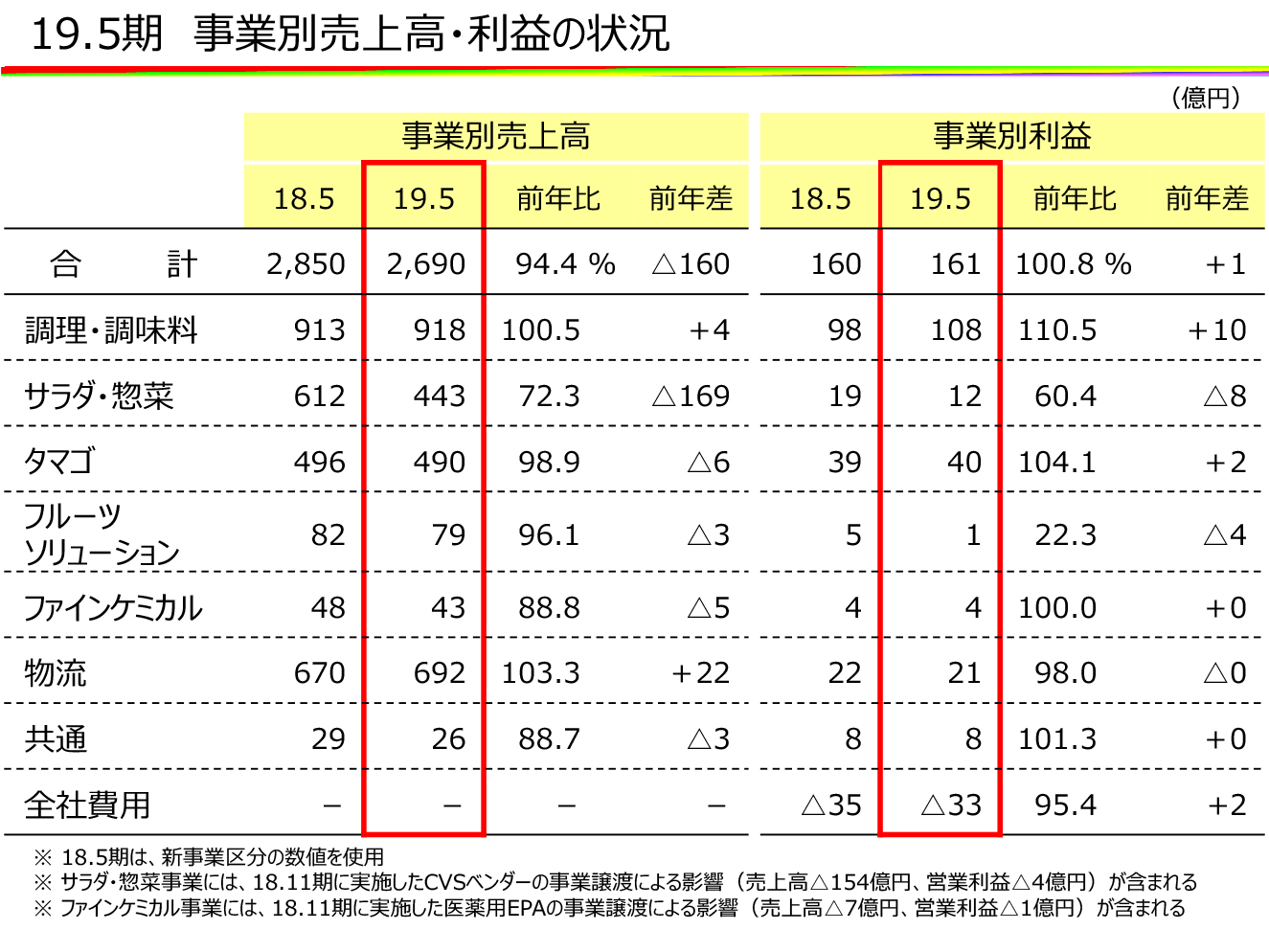
事業別の状況です。
-
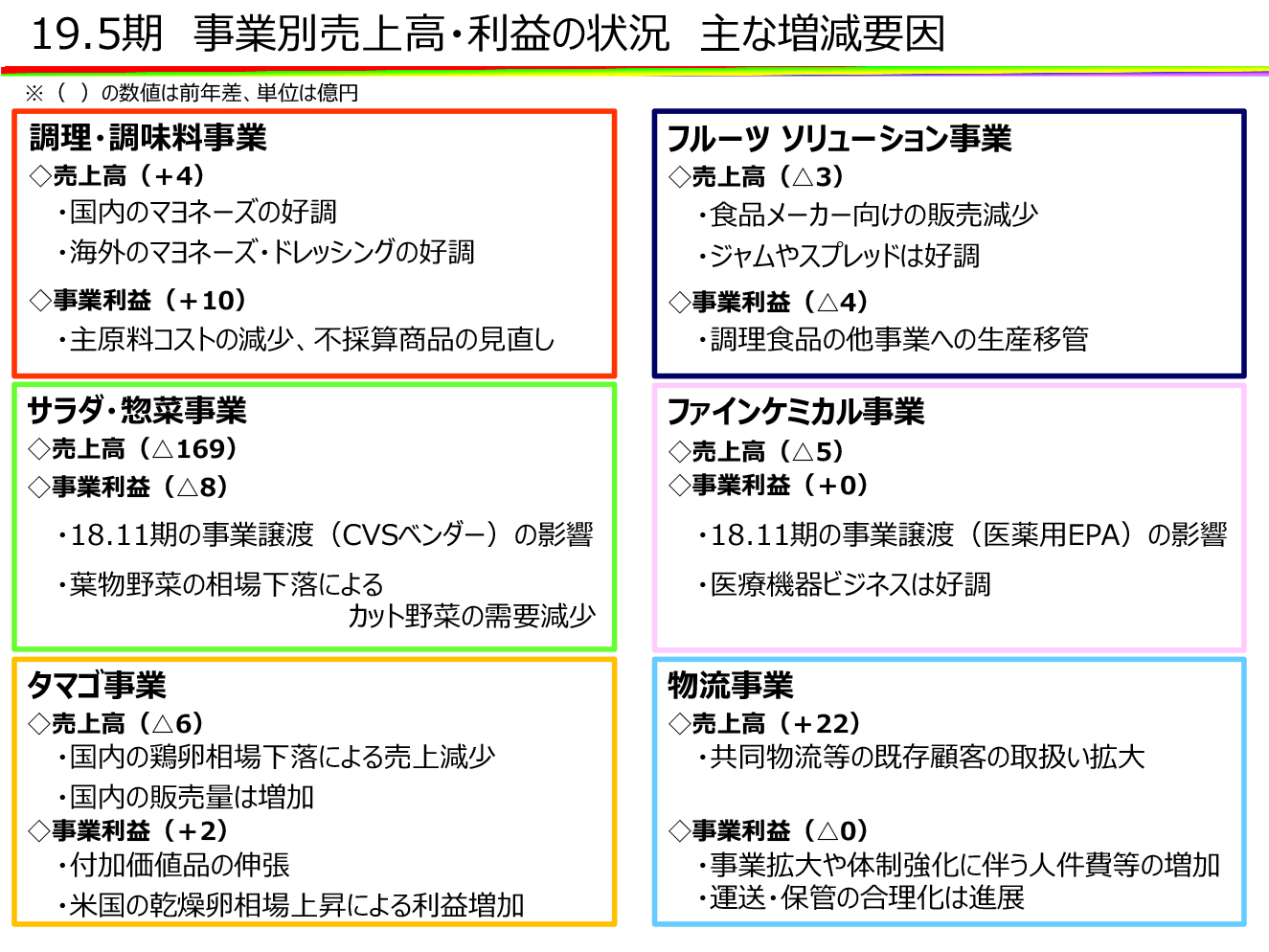
調理・調味料事業の売上は、国内のドレッシングが伸び悩みましたが、国内のマヨネーズと海外が好調に推移したことにより、4億円の増収となりました。
利益については、主原料コストの減少や不採算商品の見直しにより、10億円の増益となりました。サラダ・惣菜事業は、2018年実施した事業譲渡の影響や、カット野菜の売上減少などにより、169億円の減収、8億円の減益となりました。
タマゴ事業は、売上面では外食・中食向けの小型パック液卵や、半熟技術を活用した加工品など、付加価値の高い商品は伸びましたが、国内の鶏卵相場の下落が17億円の減収要因となり、6億円の減収となりました。
利益については、付加価値の高い商品の売上増加や国内の鶏卵相場の下落、米国の乾燥卵相場の上昇の影響により、2億円の増益となりました。フルーツ ソリューション事業は、まるごと果実などの売上は好調でしたが、食品メーカー向けの販売が減少したことにより、3億円の減収となりました。
また、従来アヲハタで生産していた商品の移管を行った影響などで、4億円の減益となりました。ファインケミカル事業は、昨年開始した医療機器のビジネスは順調に推移しましたが、EPA事業譲渡の影響により、5億円の減収、利益はほぼ前年並みとなりました。
物流事業は、共同物流の受託拡大などにより、22億円の増収となりました。利益については、事業の拡大に伴うコスト増加などにより、前年並みとなりました。
共通事業は、食品機械設備販売の減少で3億円の減収となります。
-

年間計画について。
2019年の上期は、カット野菜の需要減少や事業譲渡の影響などのマイナス要因はありましたが、付加価値の高い商品へのシフトや生産現場でのコスト改善などを進め、利益は年初の想定どおり進めることができました。2019年は、第9次中期計画の初年度であり、当社の創業100周年でもありますので、しっかりと進めていきたいと考えています。
-
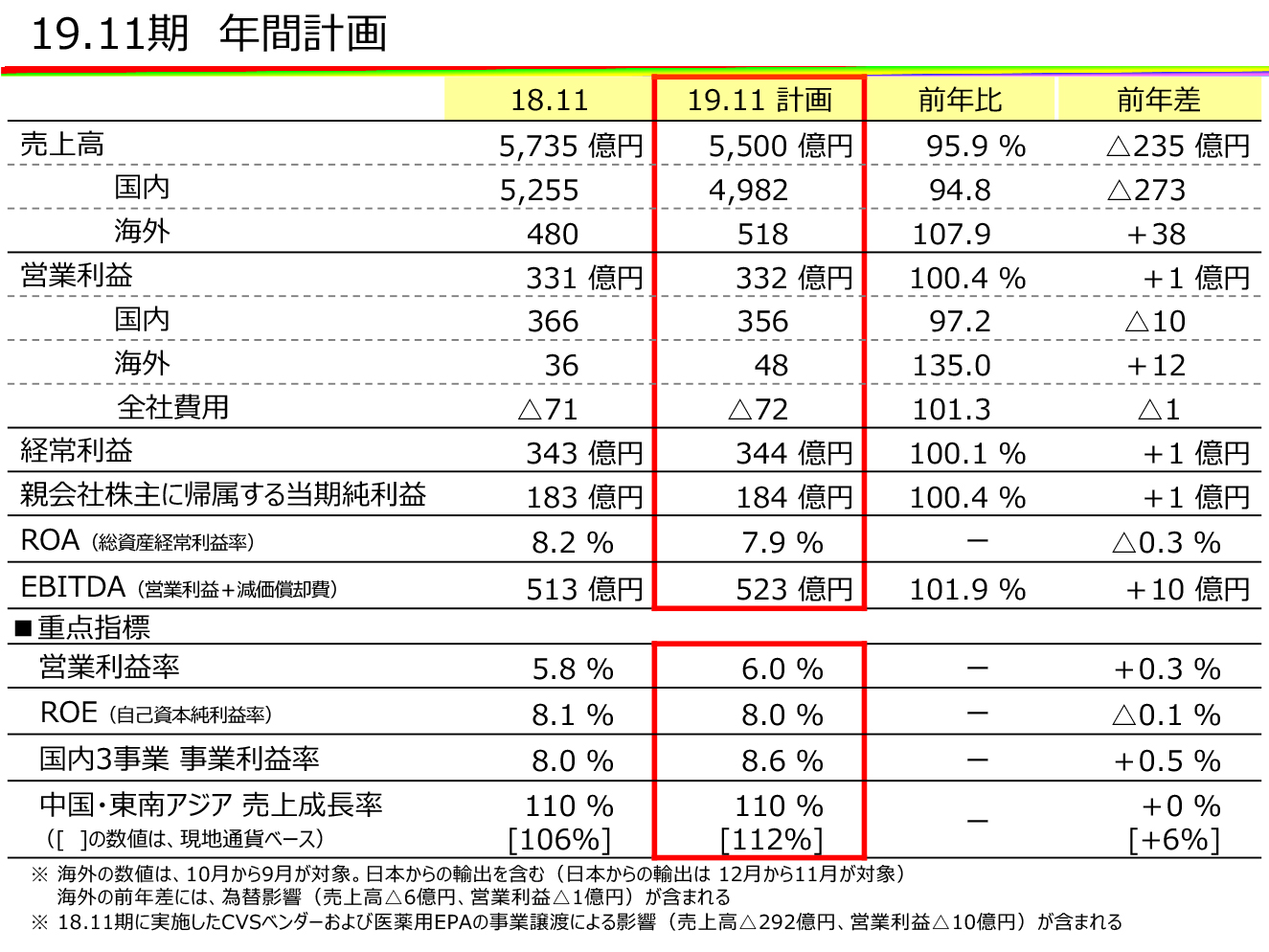
2019年度の売上高は前年差235億円減の5,500億円、営業利益は前年差1億円増の332億円を計画します。
国内は、昨年の事業譲渡による影響が、売上高でマイナス292億円、営業利益でマイナス10億円となっており、その影響を除くと、売上高57億円、営業利益11億円を伸ばす計画となります。
また、創業100周年企画の費用として16億円見込んでいます。経常利益は前年差1億円増の344億円、当期純利益は1億円増の184億円とします。
年初計画に対して売上高は下方修正していますが、この要因は主に2つあり、1つは、上期の国内の鶏卵相場が想定より下落したこと、もう1つは、国内のドレッシングとカット野菜の売上が想定より下回ったことを織り込みました。
下期は、国内のドレッシングとカット野菜の売上を回復できるよう、しっかりと進めていきます。なお、為替相場の前提については、年初指標の1ドル112円に対し、上期の実績は112円、年間は111円で想定しており、為替によるマイナス影響は売上高で6億円、営業利益で1億円を見込んでいます。
9次中期計画で掲げた、国内での持続的成長と海外での成長加速を実現させるため、重点指標を常に意識し、国内での3事業への集中と中国・東南アジアでの2桁成長を着実に進めていきます。
-
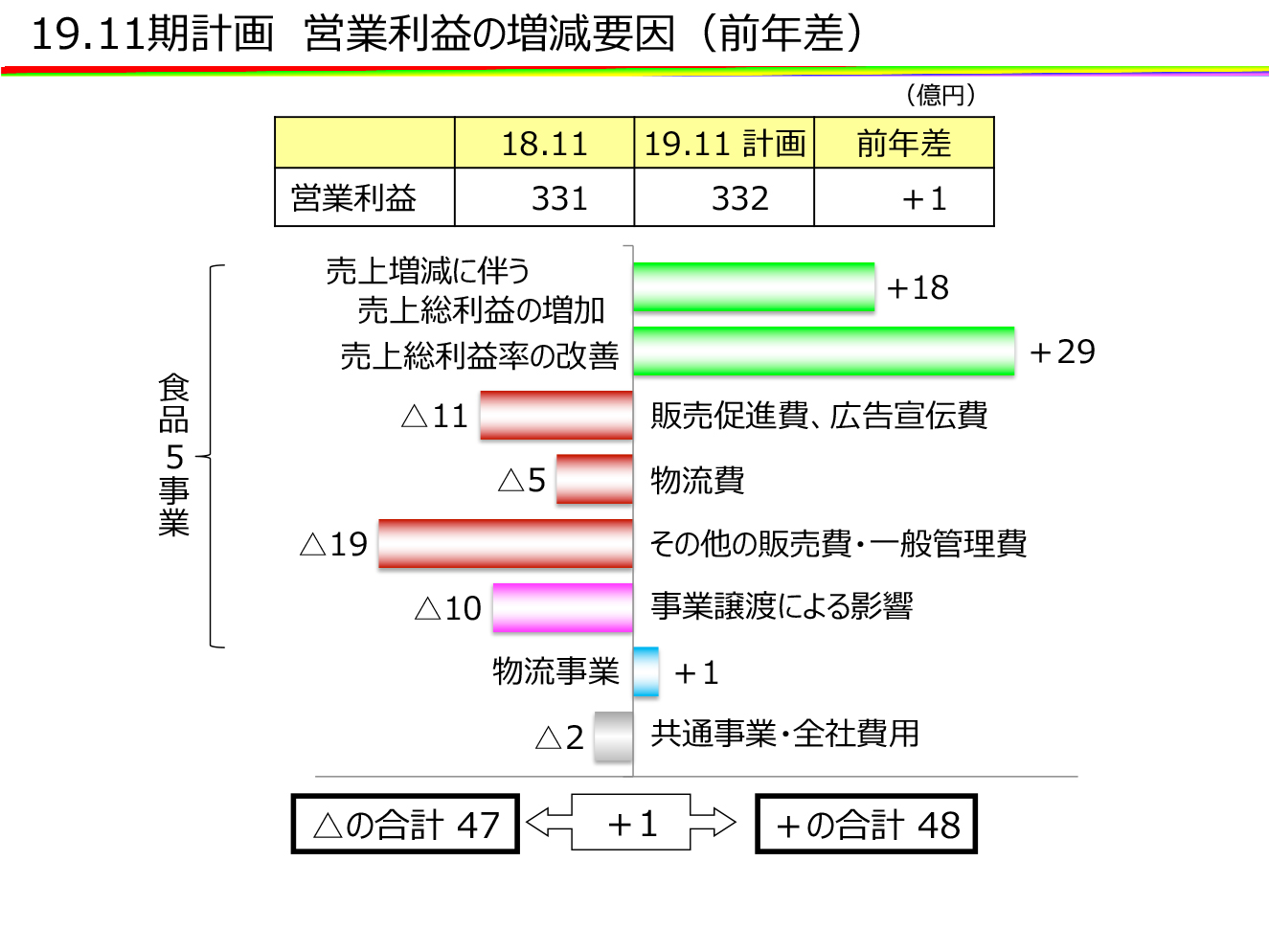
営業利益1億円増の前年差での要因について。
-
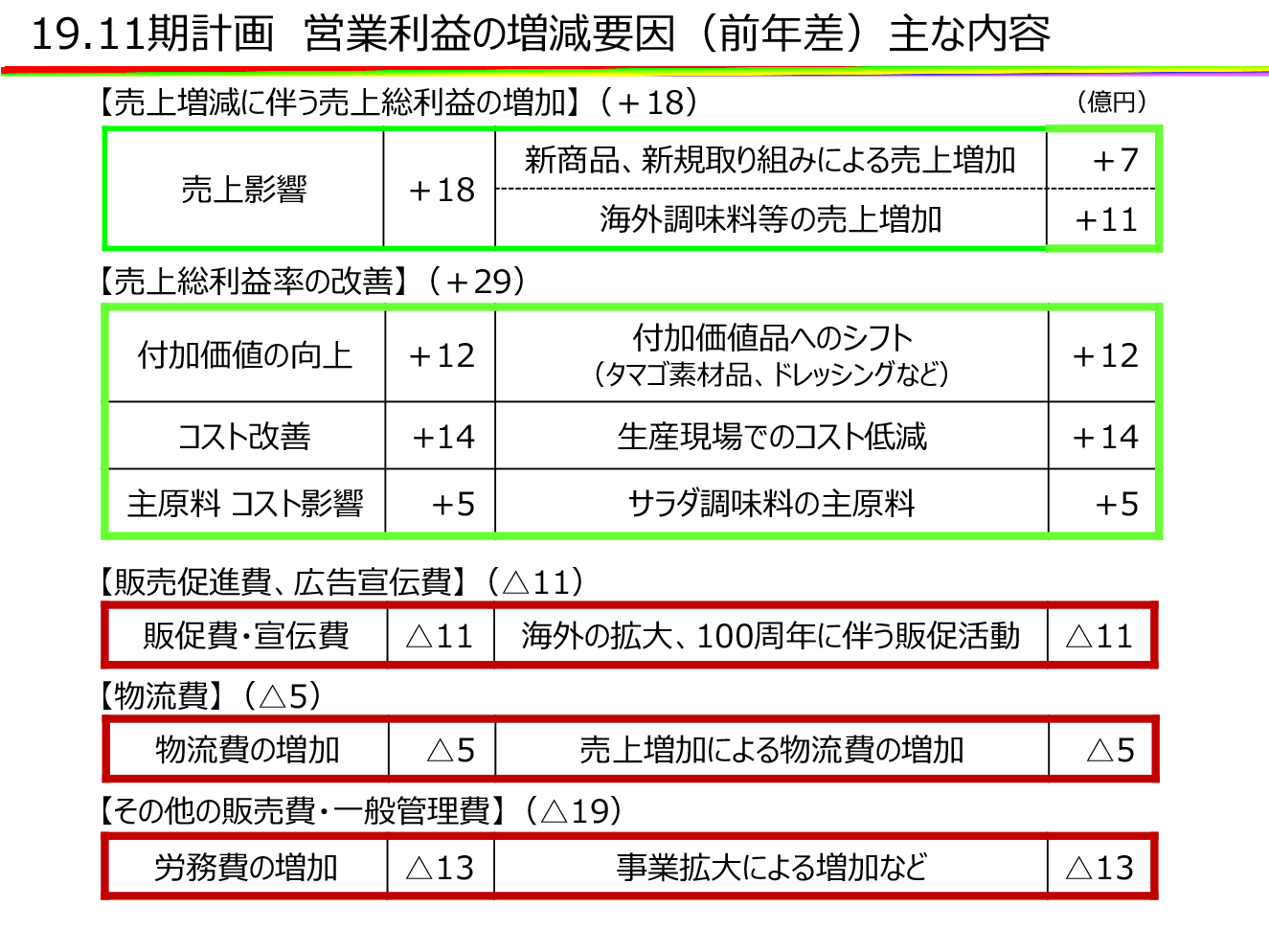
売上増加に伴う売上総利益の増加のおもな内容は、国内のマヨネーズや、海外でのマヨネーズとドレッシングの売上増加です。
売上総利益率の改善による利益増は、付加価値の高い商品の販売ウエイトを上げていく取り組みで12億円、生産性の向上などのコスト改善の取り組みで14億円を創出していきます。
主原料コストにつきましては、5億円のプラス影響を見込んでいます。
販売促進費と広告宣伝費の増加は、おもに創業100周年に関する費用や海外展開などによるものです。物流費については、おもに国内のタマゴ事業の販売量増加によるものです。
その他の販売費・一般管理費は、事業拡大などの労務費の増加によるものですが、創業100周年に伴い、従業員にも報いて行きたいと考えています。
-

国内での主な取り組みについて。
就任以来、コンビニエンスストア向けベンダーや医薬用EPAなどの事業譲渡を行い、持続的な成長に向けて、体質を強化してまいりました。
9次中期経営計画に入り、3事業が融合し、マヨネーズ・ドレッシングを中心にサラダとタマゴで主役化を実現していく動きが始まっています。
-
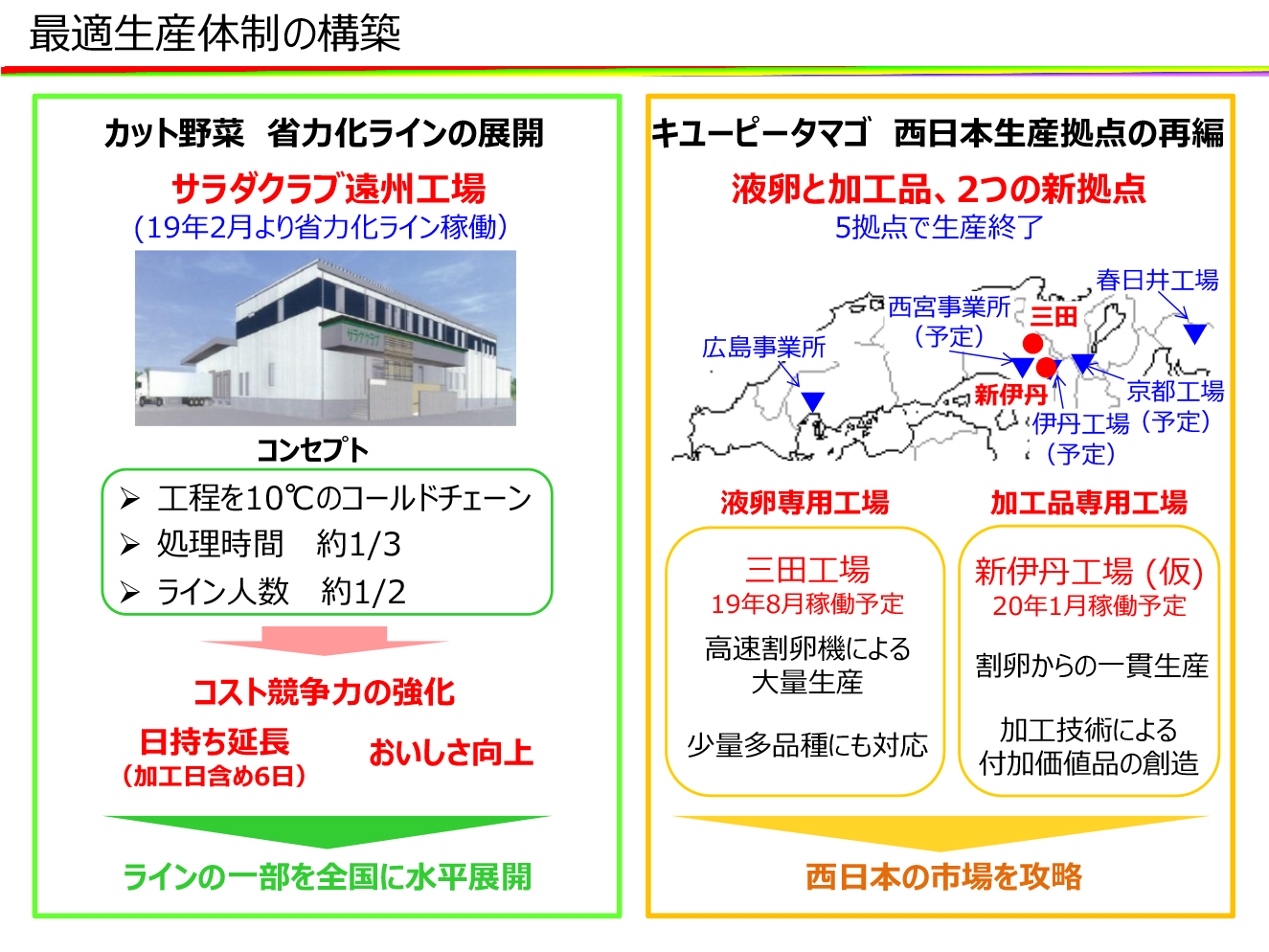
まず、最適な生産体制の構築です。
サラダ・惣菜事業においては、2019年2月、静岡県にあるサラダクラブの遠州工場に、省力化ラインを導入しました。
このラインは従来のラインと比べ「処理時間を3分の1」、「人員を半分」にすることができるラインです。また、原料を受け入れのときから一貫した、野菜にやさしい温度帯で管理できることから、主力品である千切りキャベツの消費期限を1日延長することができました。
加工日含めて6日の消費期限は、カット野菜では国内で初めてであり、従来の市場の商品より2日ほど長くなっています。販売店様やお客様が在庫を管理しやすく、廃棄ロスを削減できることから、工場を見学され、コンセプトとその品位の良さを理解されたお客様が、他社の商品から切り替えていただくケースも出てまいりました。
この省力化ラインの経験と実績をもとに、より良い形にしながら、全国の生産拠点への導入を進めていきます。
コスト改善はもちろんのこと、商品の価値を高めて需要を創出し、サラダ・惣菜事業の売上拡大と収益性の向上につなげていきます。タマゴ事業では、昨年12月からスタートした新生キユーピータマゴにおいて、西日本の生産拠点の再編を進めています。
この再編では、現時点で決まっているものとして5拠点での生産を終了する予定です。一方、液卵と加工品を生産する拠点を1つずつ新設します。
8月に兵庫県三田市で新たな液卵の工場がスタートします。
従来の工場では、1分間に約600個のタマゴを割っていましたが、この工場では、1分間に約2,000個のタマゴを割る機械を導入し、効率の良い生産を行うことで、コスト競争力を高めていきます。また、キユーピー伊丹工場の跡地に、来年の1月、キユーピータマゴ新伊丹工場を稼働します。
キユーピータマゴとしては初めて、卵を割る工程から加工品を製造する工程まで一貫した生産が可能となります。
これまで培ってきたタマゴの加工技術を活かした付加価値の高い商品を創出していきます。
同じ敷地内には営業も常駐し、製販一体となって、タマゴの価値をお客様へお届けする体制が整います。この2つの新拠点により、液卵の競争力強化と加工品の需要拡大を進め、西日本のタマゴ市場を攻略していきます。
-
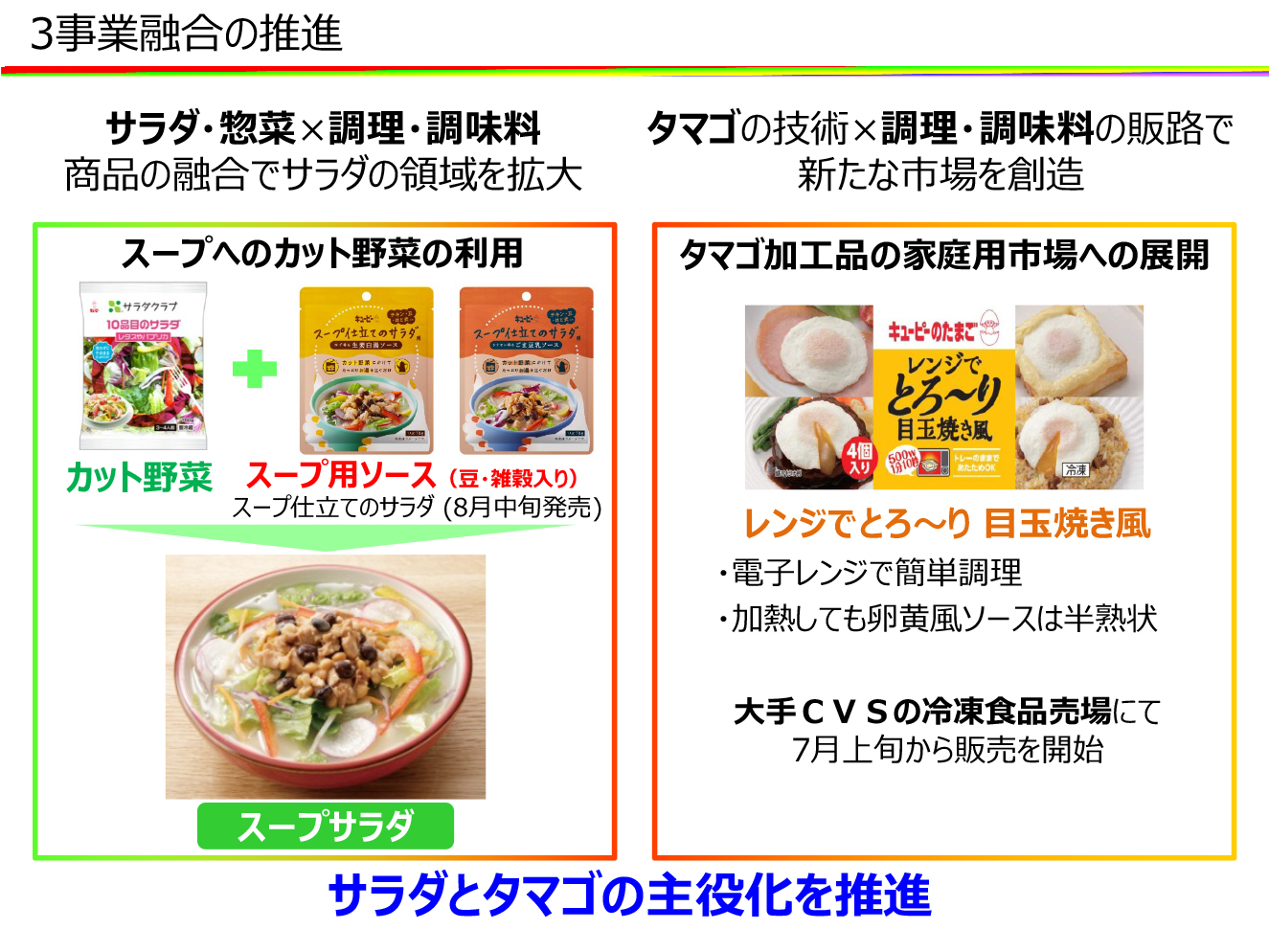
事業の融合による新しい野菜の食べ方の提案で、サラダの領域を広げていく取り組みをご紹介します。
「スープ仕立てのサラダ用」という新発売の商品は、深めの器にカット野菜と一緒にソースを入れ、お湯を注ぐと「スープサラダ」ができ上がります。
簡便調理で健康感のある新しい食べ方を通して、野菜を簡単に摂りたいというニーズに、サラダ・惣菜事業の基幹商品であるカット野菜と、新しい調味料でこたえていきます。
サラダで食べるウエイトは、野菜全体の30%程度ですが、このような提案により、サラダの概念を広げ、サラダで食べる野菜の量を拡大させていきたいと考えています。
また、タマゴ事業の半熟技術をいかした商品を、家庭用市場に向けて、新たな売場で展開していきます。
この「レンジでとろ~り 目玉焼き風」はフードサービス市場で培ってきた技術をご家庭にお届けする取り組みとなります。大手のコンビニエンスストアで7月上旬より発売します。
電子レンジで加熱しても卵黄が半熟状なことから、手作り感のあるタマゴ料理を失敗することなく、約1分で簡単に提供することができます。最近、朝の忙しい時間に、フライパンを利用して目玉焼きをつくる人が減少しており、栄養価の高いタマゴを簡便調理で食べていただく機会を増やしていく取り組みを進めていきます。
このような取り組みで、サラダとタマゴの主役化を進めていきます。
-

海外の業績と主な取り組みについて。
-
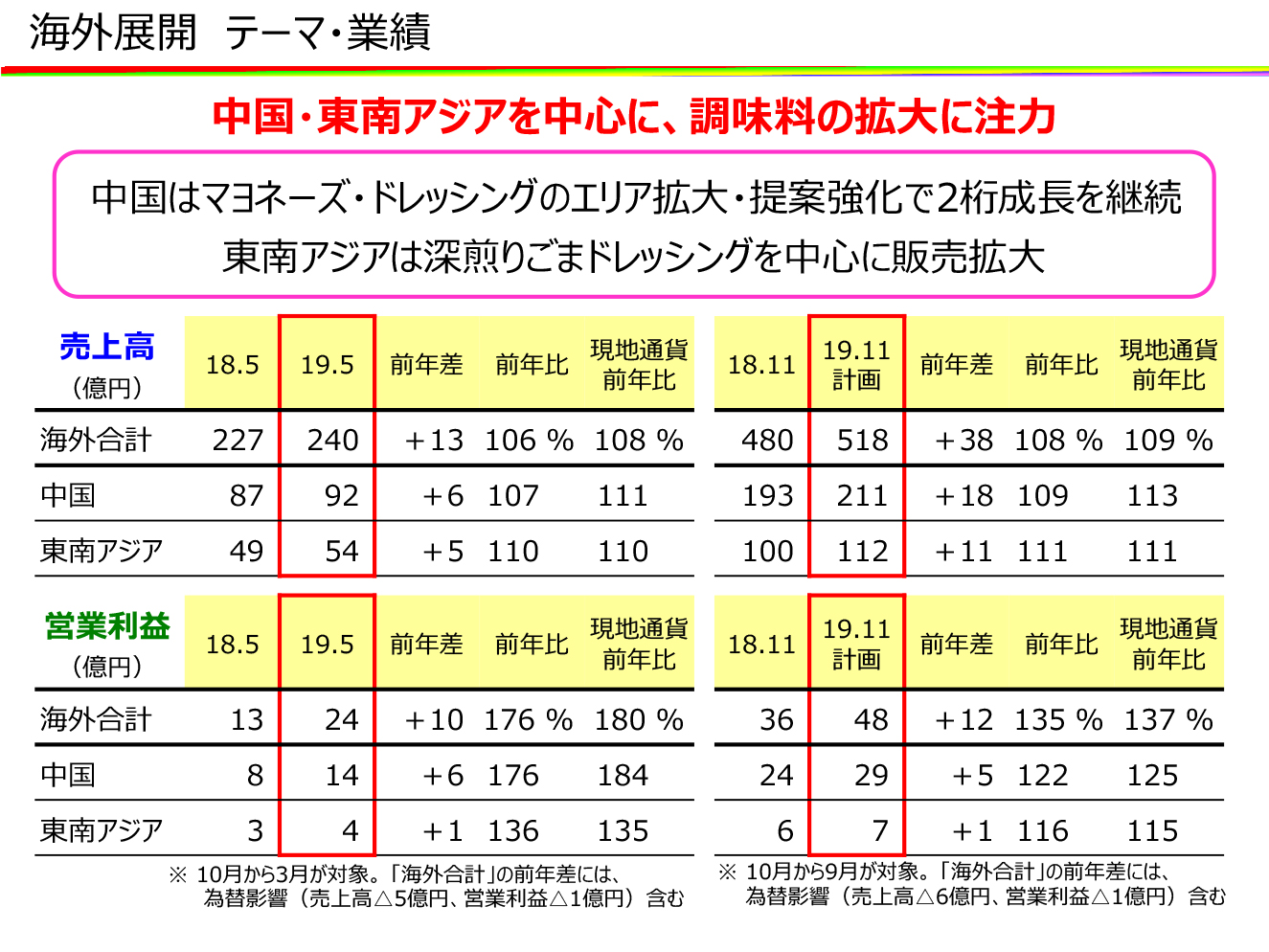
海外展開は、中国・東南アジアを中心に、調味料の拡大に注力しています。
2019年度5月期の売上高は、海外全体で前年に対し13億円増の240億円、現地通貨ベースでは前年に対し108%となりました。
中国が2桁成長に回復し、再び成長軌道に乗っていること、東南アジアも順調に拡大し2桁成長を継続していることが寄与しています。営業利益は、海外全体で10億円増の24億円となりました。
中国の販売回復と原価低減、また東南アジアの販売拡大と米国タマゴ事業の回復が寄与しました。2019年度11月期の売上高は、海外全体で前年に対し38億円増の518億円、現地通貨ベースでは109%を計画します。
下期も中国・東南アジアを中心に2桁成長を継続していきます。営業利益は、海外全体で12億円増の48億円を計画します。
中国と東南アジアの順調な販売拡大とポーランドの回復が寄与します。 -
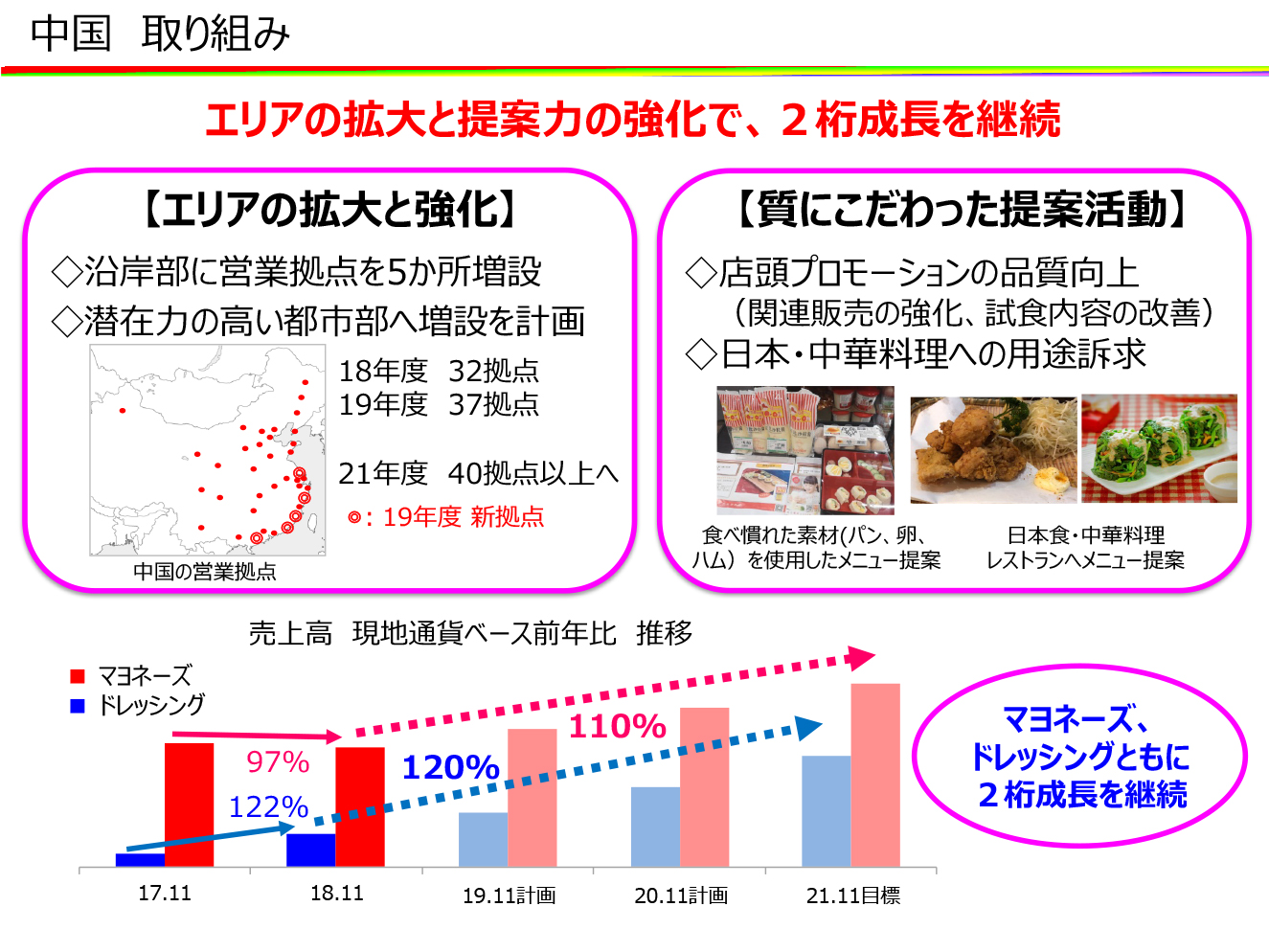
中国では、マヨネーズとドレッシングのエリア拡大と提案強化を進めていきます。
まず、販売エリアの拡大を進めていきます。
2019年度は沿岸部への販売を強化するため、営業拠点を5か所増設し、中国全土で37か所になる予定です。
今後も、都市別の人口や一人当たりGDPなどからエリアの潜在力を割り出し、将来性の高いエリアから営業拠点を増設し、成長が続くフードサービス市場への対応力を高めていきます。そして、営業による提案活動を強化していきます。
家庭用市場では、店頭プロモーションの品質向上を図っていきます。
家で食べ慣れた食材であるパンや卵などの売場において、関連販売やメニュー提案を強化していきます。
また、日本食レストランや中華料理店へのメニュー提案も強化します。マヨネーズやドレッシングの家庭での使用率は10~15%と低いことから、馴染みのあるメニューの提案で使用機会を増やし、需要の拡大を進めていきます。
これらの取り組みを進めることにより、現地通貨ベースでマヨネーズ110%、ドレッシング120%を計画し、今後も2桁成長を続けていきます。
-
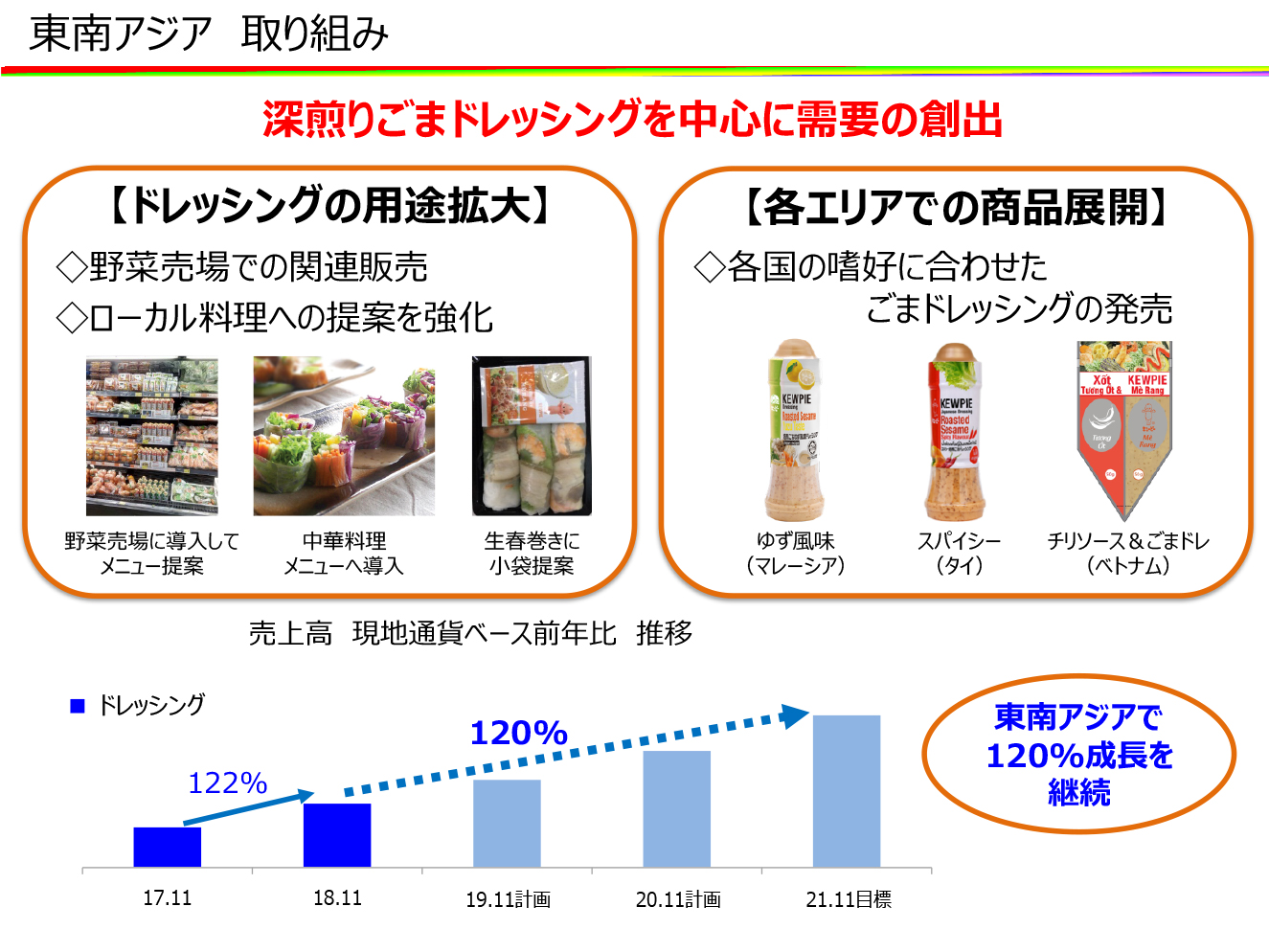
次に、東南アジアの取り組みについて。
東南アジアでは、世界戦略商品であり、販売している国々でドレッシングの売上No1である深煎りごまドレッシングを中心に、需要の創出を進めていきます。
生野菜を食べる文化のある東南アジアでは、地元の野菜を使用したメニューや地元の料理に、深煎りごまなどのドレッシングを使用する提案を行うことで、家庭やフードサービス市場でのドレッシングの用途拡大を進めていきます。
また、各国の嗜好に合わせた、ごまドレッシングのシリーズ化を進め、需要創出を進めていきます。
これらの取り組みによって、ドレッシング全体では、現地通貨ベースで120%の成長を続けていきます。
-

事業別の主な取り組みについて。
-
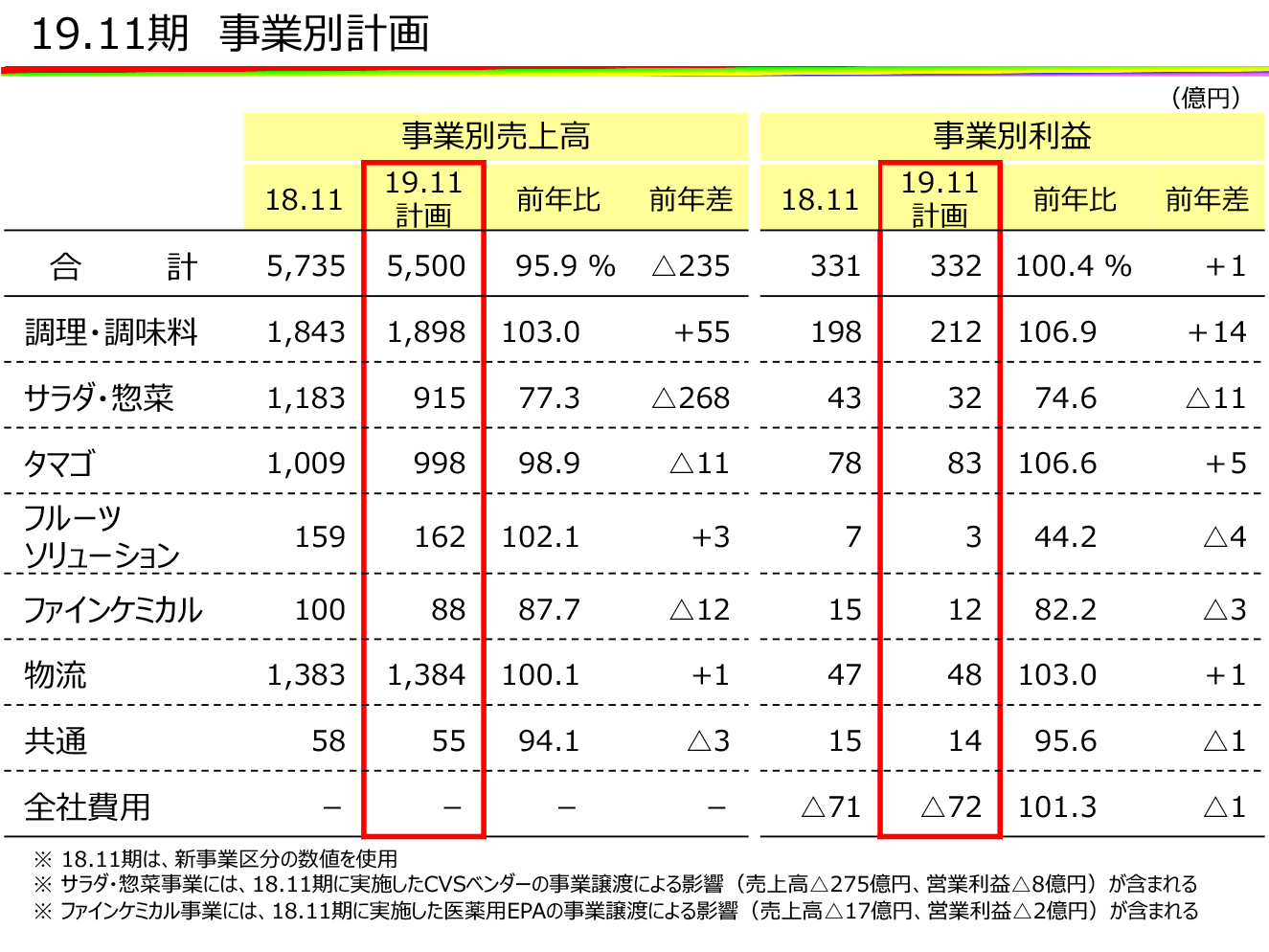
2019年度の事業別の売上高と利益です。
なお、年初計画に対しては、上期に売上が想定より下回ったタマゴ事業で60億円、調理・調味料事業とサラダ・惣菜事業でそれぞれ20億円、売上高を下方修正しています。
-
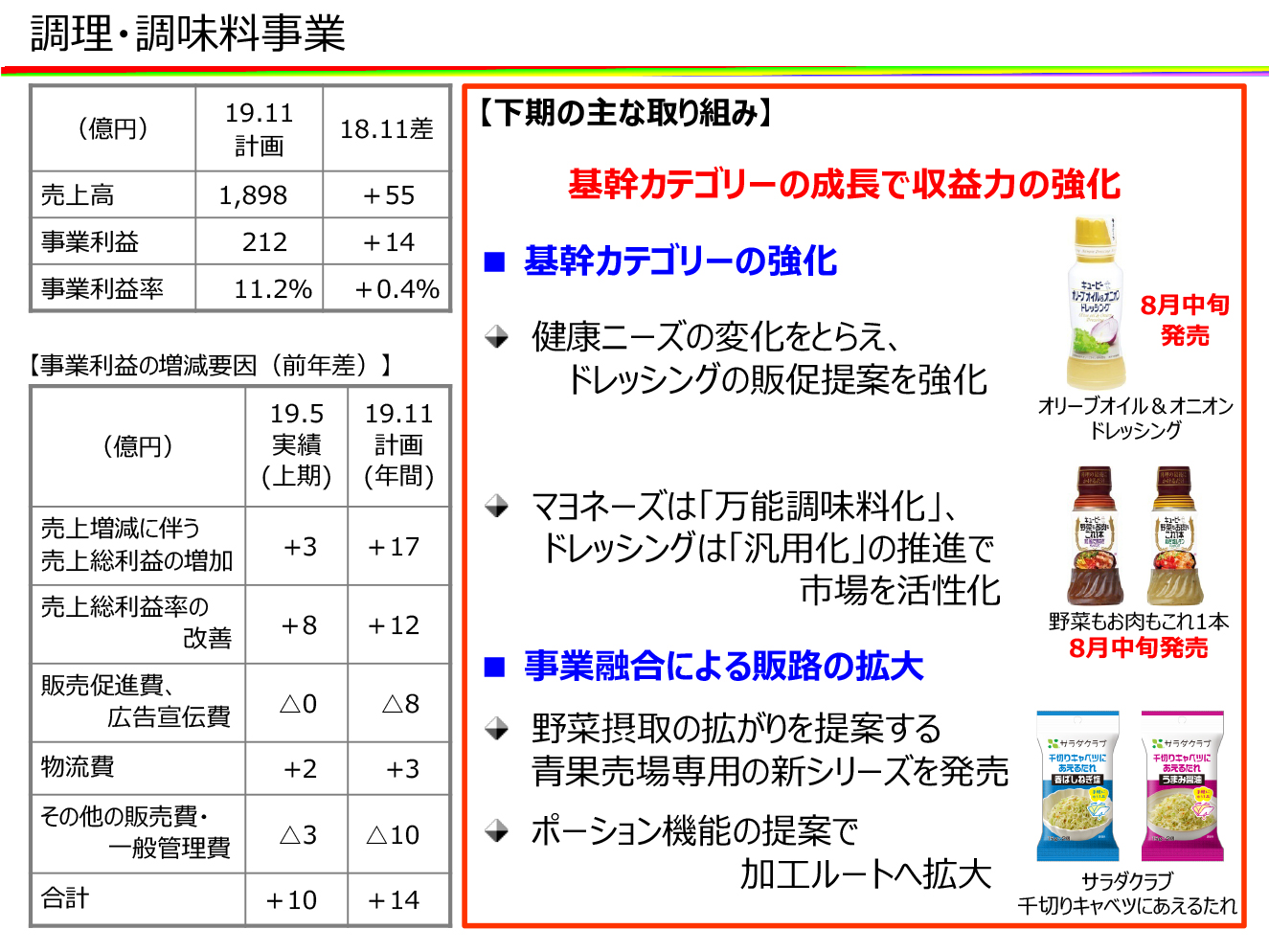
調理・調味料事業です。
健康感の変化から植物油の需要が高まっており、ドレッシングのノンオイルの状況は厳しく、上期の国内のドレッシングは伸び悩みました。
下期の国内のドレッシングについては、新商品を2品発売し、上期の遅れをカバーしていきます。
ニーズが高まっているオリーブオイルを使用した「オリーブオイル&オニオンドレッシング」は、主力の金キャップシリーズで発売し、深煎りごまドレッシング含めてシリーズでの販促強化を図ります。
「野菜もお肉もこれ1本」は肉との相性ぴったりで肉料理全般に使えるドレッシングであり、サラダの領域を広げていきます。
電子レンジなどで調理した肉や野菜にかけるだけで、おいしい料理が簡単にできる、働く女性を応援するメニューを提案していきます。汎用性を広げる提案は、主力品である深煎りごまドレッシングでも行い、先ほどお伝えしました「スープサラダ」の展開も含めて、サラダの概念を広げていきたいと考えています。
また、上期、好調に推移したマヨネーズは、万能調味料化の提案を進め、下期の売上拡大をリードしていきます。他の事業の販路を活用した展開としては、カット野菜の千切りキャベツ用の「たれ」を発売し、カット野菜の売場で販売します。
タマゴ事業が得意とする食品メーカーへは、小袋などの小型容器に入った調味料を先方の商品に使用していただく提案を進めていきます。
このような、サラダ・惣菜事業やタマゴ事業との融合を、この事業が中心となって進めていきます。 -
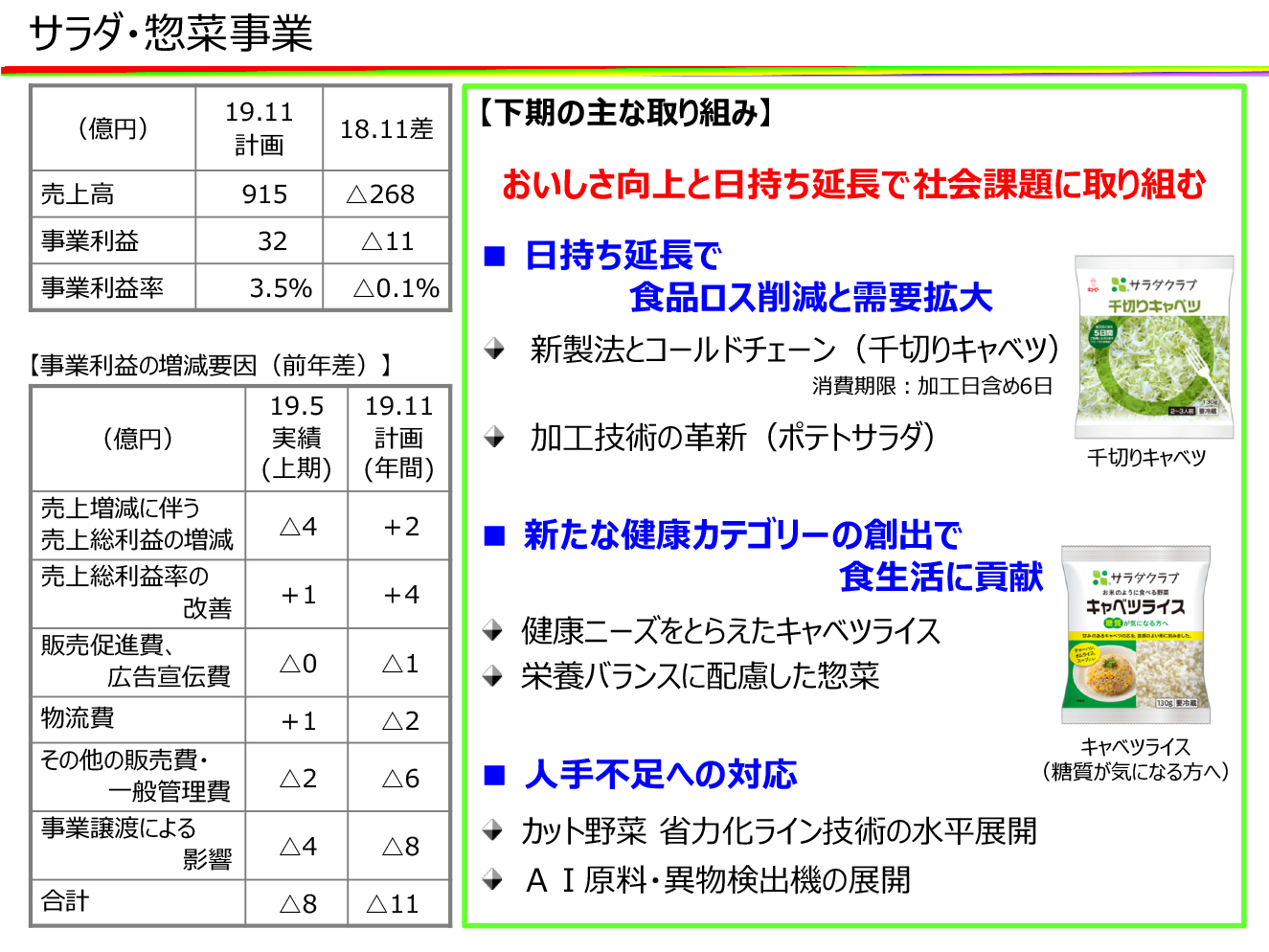
サラダ・惣菜事業は、「おいしさの向上と日持ち延長」を最大のテーマとして、社会課題に取り組み、需要拡大を進めていきます。
日持ち延長については、主力商品であるカット野菜の千切りキャベツと、惣菜のポテトサラダにおいて、それぞれ新たな技術を構築したことにより、実現することができました。
日持ち延長によりおいしさも向上できましたので、廃棄ロス低減も含めて、お客様に商品の価値を伝え、需要拡大に努めていきます。そして、栄養価は高いものの、これまで活用できていなかった、キャベツの芯を使用した「キャベツライス」については、お米に比べカロリー8分の1、糖質16分の1のコンセプトが評価され、糖質を気にされる方を中心に支持をいただき、キャベツの芯が足りなくなるほど、ご好評をいただいています。
栄養バランスに配慮した惣菜の販売など、健康ニーズをとらえた展開を進め、健康で豊かな食生活を創造するとともに、需要拡大につなげていきます。サラダ・惣菜事業では多くの従業員が従事しており、人手不足への対応が重要な課題です。
先ほどお話しました、カット野菜の省力化ラインや、AIを活用した異物検出機など、新たな技術革新を推進し、深刻になる人手不足にも対応していきます。 -
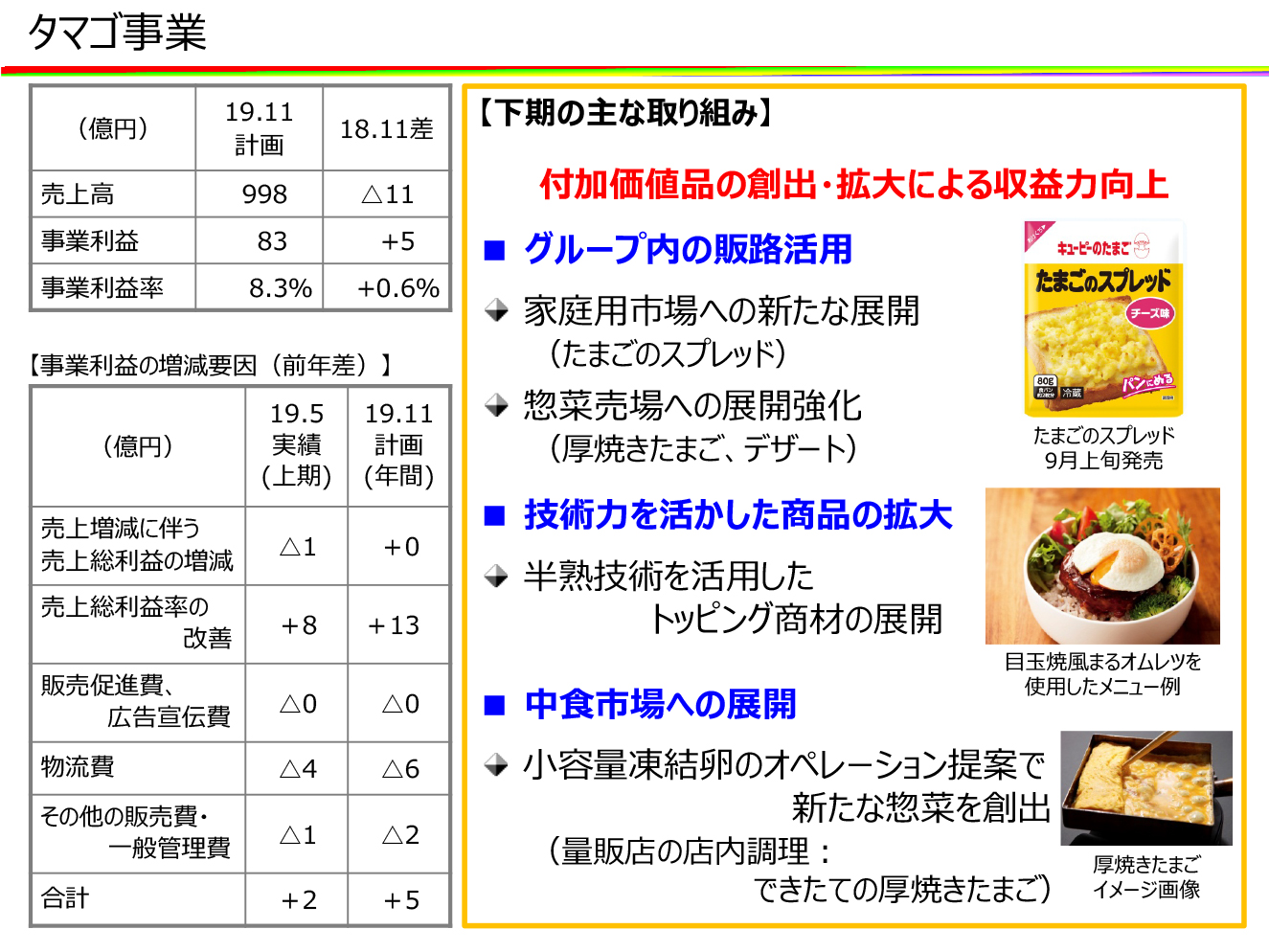
タマゴ事業は、他の事業が得意とする販路も活用しながら、付加価値の高い商品の提案に注力していきます。
調理・調味料事業が得意とする家庭用市場では、「たまごのスプレッド」という商品をチーズの売場で展開し、パンを使用した新たなメニューを提案することで、需要を創出していきます。
サラダ・惣菜事業が得意とする惣菜売場では、厚焼きたまごや取引先で製造していただいたデザートの販売を進めていきます。コンビニエンスストアやスーパーマーケットの弁当や惣菜、レストランやホテルなどのメニューなどに、半熟技術を活用した商品の提案を引き続き進めていきます。
小容量の凍結卵については、スーパーマーケットの店内調理において、作業工程も含めた提案を行い、新たな惣菜の展開につながっています。
このようなグループの販路の活用により、付加価値の高い商品の用途を拡大していきます。
-
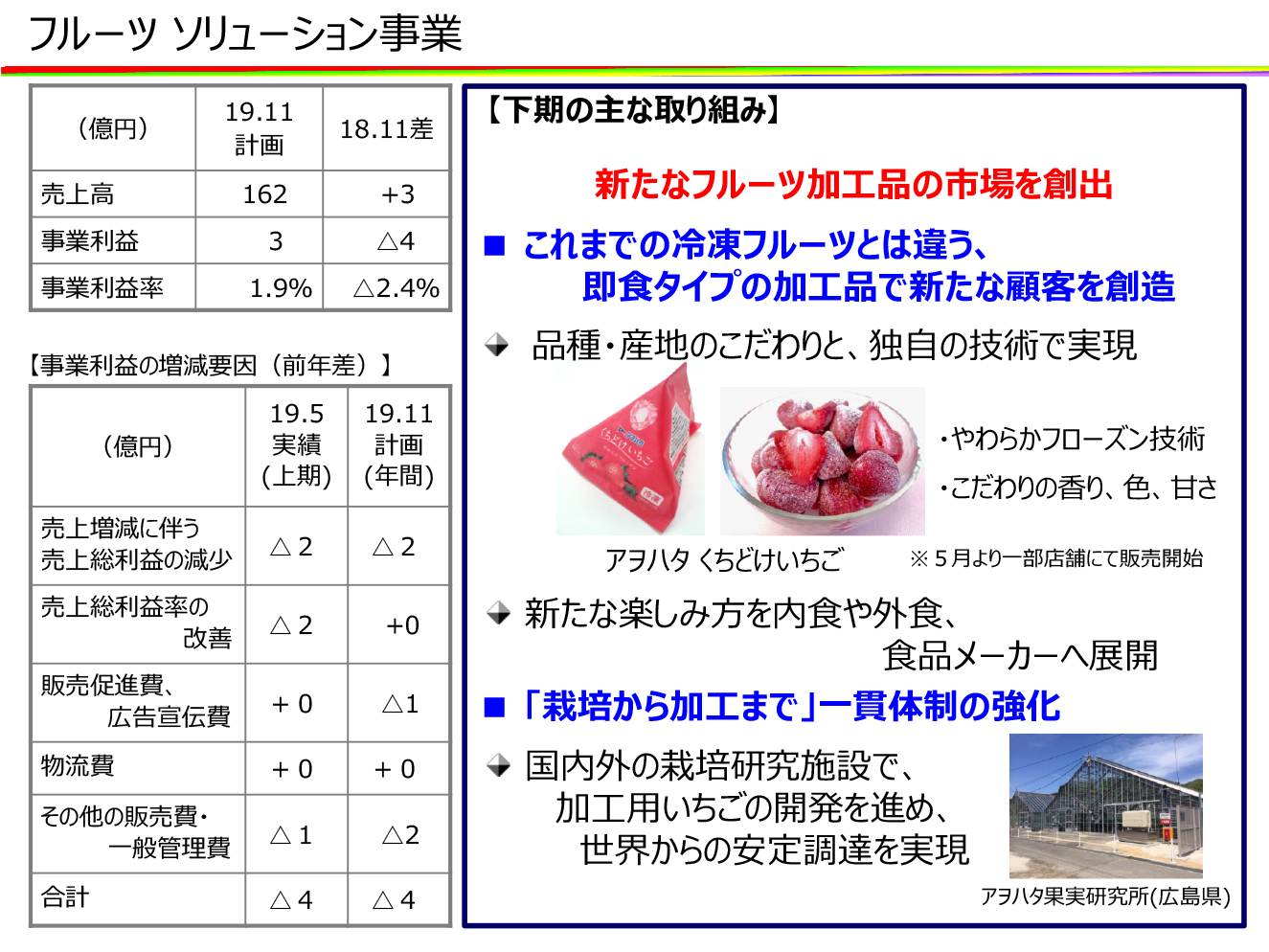
フルーツ ソリューション事業は、新たなフルーツ加工品の市場を創出していきます。
日持ちを気にせず、フルーツを楽しんでいただきたいという思いから、新しい即食タイプのフルーツ加工品、「くちどけいちご」の発売を開始しました。
栽培から加工までの一貫体制を持つ強みと、素材本来のおいしさを引き出す技術を活かし、これまでの冷凍品では難しかった、柔らかな食感と、こだわりの香り、色、甘さを実現しています。
今後も引き続き、このような技術を活かして商品開発を進めるとともに、外食や食品メーカーへの提案を行い、ジャムのアヲハタからフルーツのアヲハタに向け、顧客の創造につなげていきます。
-
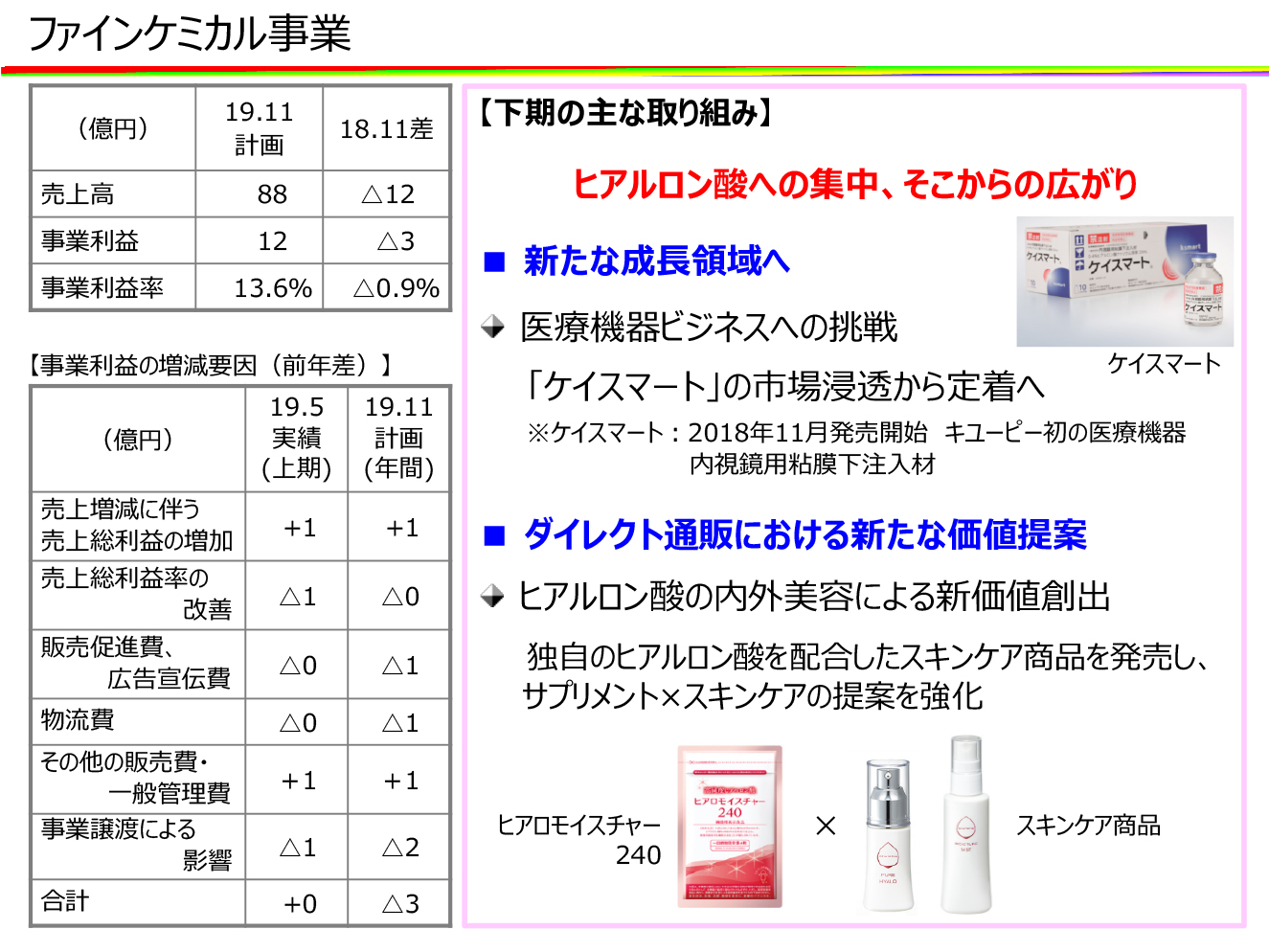
ファインケミカル事業は、ヒアルロン酸に集中するとともに、新たな展開を進めていきます。成長領域への展開としては、ヒアルロン酸を活用した医療機器ビジネスに挑戦していきます。
昨年、発売を開始したケイスマートの育成に注力し、市場への定着をめざします。ケイスマートは、内視鏡手術の際に使用される医療機器であり、ユーザーからの評価が高く、順調に市場への浸透が進んでいます。ダイレクト通販では、独自のヒアルロン酸を活用した新しいスキンケア商品を発売することで、サプリメントとの組み合わせによる内外美容の提案を強化していきます。
-
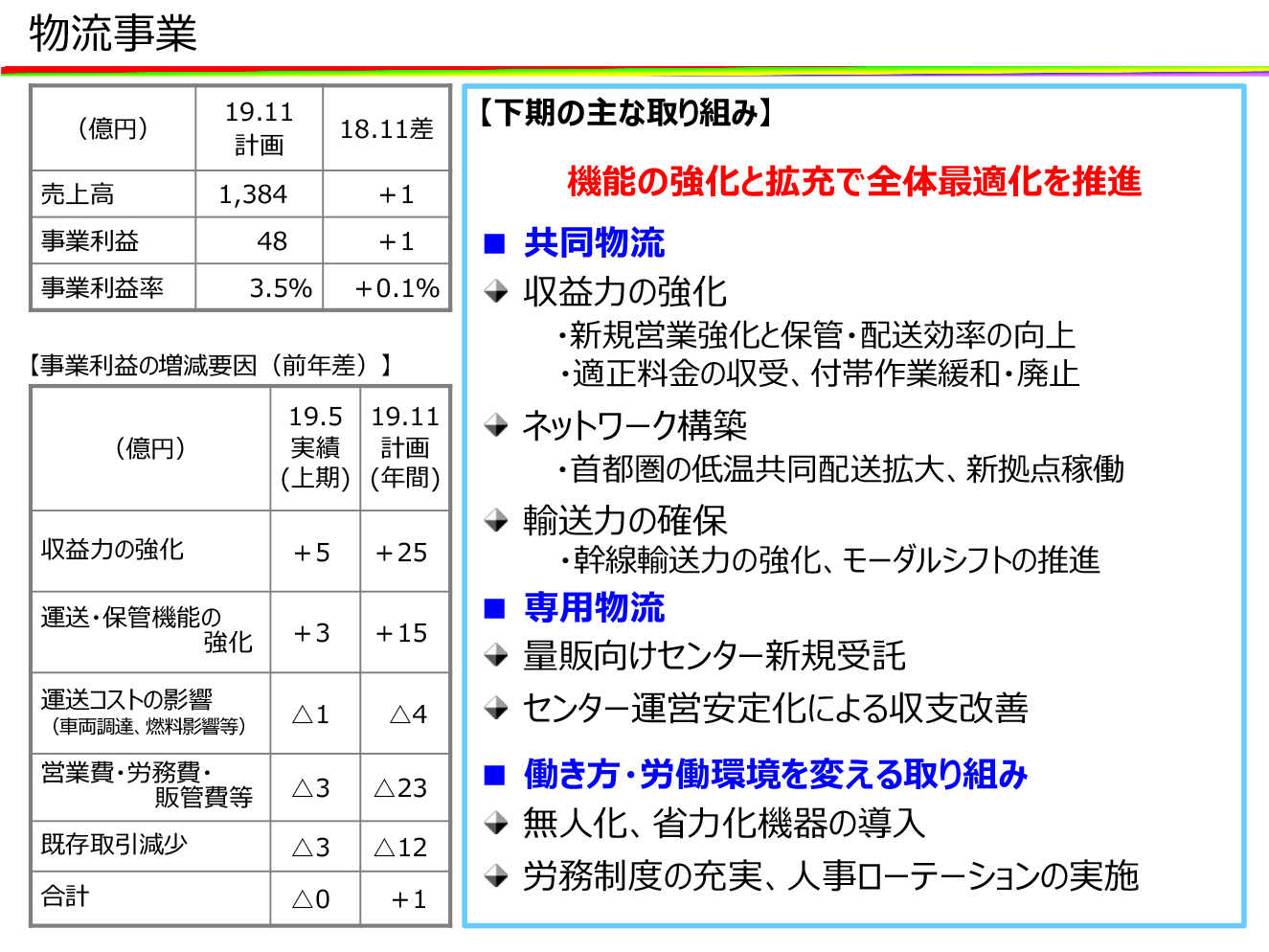
物流事業について。
共同物流では、メーカー共同配送で物量が堅調に拡大する中、配送・保管効率を向上させていきます。
また、首都圏の低温共同配送の拡大や新しい拠点の稼働などにより、ネットワークを再編し、効率化を進めていきます。
ドライバー不足に対しては、長距離運行での中継輸送や、トラックから鉄道や船舶へのモーダルシフトの拡大など、運び方を工夫することで、輸送力の確保を進めていきます。専用物流では、量販店向けの新規受託やセンター運営の安定化を進めていきます。
食品物流業界も、慢性的な人手不足に加え、車両調達コストの高騰など厳しい環境が続いています。物量拡大や効率化を進めながら、吸収できないコストは、継続的に適正料金化を進めていきます。
-

最後に、社会的な課題である「健康寿命の延伸」について、当社グループの取り組みをご説明します。
人生100年時代に向かう中、平均寿命と健康寿命の差は男女平均で約10年あり、健康寿命をいかに平均寿命に近づけていくかが大きな課題と考えています。
健康長寿には「栄養」「運動」「社会参加」の3つが重要であると言われています。
当社グループは食品に携わるものとして、特に「栄養」面で、強みである「サラダ」と「タマゴ」に関する食生活提案を通して、健康寿命延伸に貢献し、我々だけではできない「運動」や「社会参加」は、スポーツジムや流通、自治体、大学など、社外と連携し取り組んでいきます。サラダの材料である野菜については、「噛むことで健康生活につながること」、「ミネラル、特にカリウムが塩分を体外に排出すること」、「食物繊維の摂取が善玉菌を増やし、腸内環境を整える効果があること」、
また、卵については、「カラダに必要な栄養素のほとんどが含まれていること」、「体内で効率よく利用される良質なたんぱく質であること」、
そして、「サラダに卵を加え、マヨネーズやドレッシングをかけることで、栄養バランスが良くなること」をお伝えしています。このようなサラダとタマゴの魅力を発信していくことで、健康寿命の延伸に貢献し、サラダとタマゴのリーディングカンパニーとなるよう、取り組んでいきます。
Q&A (Japanese only)
Cooking and condiments (domestic)
-
Net sales of household mayonnaise had previously been around 100% year-on-year, but in the first half of fiscal year 2019, it grew by 106%. This is due to a shift in metabolic syndrome prevention efforts from calorie restriction to carbohydrate restriction, as well as our efforts to promote mayonnaise as a versatile condiments through suggested grilling and stir-frying recipes, and the implementation of our 100th anniversary celebration projects.
On the other hand, sales of non-oil dressings for home use have been declining. We suspect that this is because people with high blood pressure need to limit their salt intake, and the high salt content of non-oil dressings has become a negative factor. As the image of vegetable oils has changed for the better, we will shift our product lineup in the second half of the year to focus on vegetable oils.
In food service market, a significant impact from the consumption tax increase is anticipated, leading to an increase in low-priced products. -
To commemorate our 100th anniversary, we launched local mayonnaise products in seven areas across Japan, generating approximately 200 million yen in sales. We also conducted a consumer campaign called "Kiyupi Collection," which received the highest number of entries ever.
As part of our budget for our 100th anniversary, we have allocated 800 million yen for the first half of the year and 800 million yen for the second half, totaling 1.6 billion yen for the year. Of this, 700 million yen will be allocated to advertising and promotion, and 900 million yen will be allocated to rewarding employees, including commemorative gifts. -
We have designated August 31 as “Vegetable Day” and August 24—which falls directly above Vegetable Day on the calendar—as “Dressing Day.” We will designate August 24–31 as “Salad Week” and hold large-scale in-store events featuring our new products to boost overall sales.
Additionally, to make up for the lag in non-oil dressings, we will launch new products featuring health-conscious olive oil and work to develop them into strong sellers.
As we anticipate consumers tightening their purse strings following the consumption tax hike, we will concentrate our TV commercials and sales promotion activities from the second half of September through October.Furthermore, we will conduct an in-store campaign—at 2.5 times the number of stores compared to previous years—offering a set consisting of a “Kewpie” doll dressed in a zodiac-themed costume and a bottle of mayonnaise featuring our 100th-anniversary logo.
Salads and delicatessen foods
-
The significant decrease in Salad Club, Inc. 's pre-cut vegetable sales in the first half of fiscal year 2019 was largely due to a reaction to the previous year's situation. In 2018, natural disasters such as heavy snow, torrential rains in western Japan, heat waves, and typhoons occurred from the beginning of the year, causing vegetable prices to rise considerably throughout the year, resulting in an overwhelming number of orders that we could not keep up with. In contrast, in the first half of fiscal year 2019, vegetable prices fell significantly compared to the previous year, leading to a substantial decrease in demand for pre-cut vegetables.
However, we anticipate that the growth of pre-cut vegetables will continue in line with changes in the social environment. We will explore options such as developing root vegetables, which are less susceptible to fluctuations in vegetable prices due to climate change.
China
-
Regarding our sales offices in China, we will establish three new locations in the first half of fiscal year 2019 and two more in the second half. However, since most of these will become operational in the second half, the associated costs are already factored into the second-half figures. In addition, the rise in raw material prices compared to the previous year will be a factor contributing to a decrease in profits in the second half.
-
We increased our number of locations by four over the three years from fiscal year 2016 to 2018. We plan to increase to five locations in fiscal year 2019 and to add three more locations by fiscal year 2021.
Regarding our bases, we consider factors such as population, GDP, and disposable income to determine the most efficient locations. If there is a large market nearby, we can expand, and newly established bases have grown by about 140%. On the other hand, increasing the number of bases indiscriminately increases costs such as labor expenses, so we are considering whether we should increase the number of bases or improve the quality of existing bases. -
In 2018, we conducted research on the entry of our competitors, carefully considered what our strengths were and where we should concentrate our resources, and decided to increase our number of locations by five in a short period of time.
-
In China's second quarter, Net sales year-on-year were 105% for households and 120% for food service in local currency terms. By category, Mayonnaise is up 110% (household 99%, food service 118%) and dressings 130% (household 119%, food service 134%), both showing growth for food service users.
China has about 6 million restaurants, including around 40,000 Japanese restaurants and about 720,000 bakeries, making the restaurants market well-developed.
In the second half of the year, we will continue to propose menu items in the food service market and increase sales. Additionally, in the home market, in-store promotions will be conducted to increase the usage rate of mayonnaise dressings at home.
Overseas
-
We plan to increase our overall overseas Operating income margin from 7.4% in FY2018 to 9.6% in FY2021, an increase of approximately 2%. In addition, we aim to raise our profit margin in China from 12.3% in FY2018 to 12.8% in FY2021, and improve profit margins in Southeast Asia as well.
-
In our US cooking and condiments business, we primarily manufactured products for other companies, but now we are focusing on developing our own KEWPIE brand. Combining local manufacturing in the US with exports from Japan, Net sales of KEWPIE brand products have grown by 114% year-on-year. Although still on a small scale, KEWPIE mayonnaise and Deep-Roasted Sesame Dressing are gaining traction.
In Europe, Poland's Mosso company recorded an impairment loss in fiscal year 2018, resulting in a 300 million yen increase in Operating income for fiscal year 2019. Mosso brand mayonnaise is performing well thanks to in-store promotional activities. On the other hand, while Deep-Roasted Sesame Dressing has received high praise for its taste, it is taking time for the dressing to gain widespread recognition. -
In Net sales, we aim for an annual growth rate of 115% and to exceed 100 billion yen in our 10th medium-term management plan. Compared to other areas, China has a larger population per city, higher GDP, and higher per capita income, so we believe that focusing on expansion in China is our top priority going forward.
On the other hand, given the high level of risk associated with China, we will also be investing our resources in Southeast Asia. Our dressing business in Southeast Asia is growing at 120% year-on-year, and we expect further growth in the future.
9th Medium-Term Management Plan
-
Regarding our domestic production bases, we have set a goal of consolidating 20 bases over the nine-year period from the 8th to the 10th Medium-Term Management Plan (FY2016-FY2024). Under the 8th Medium-Term Management Plan, we have completed the consolidation of 6 bases, and under the 9th Medium-Term Management Plan, we will proceed with the consolidation of 10 bases. Under the 9th Medium-Term Management Plan, we anticipate a benefit of 400 to 500 million yen, including depreciation expenses.
We anticipate an asset reduction effect of approximately 13 billion yen from consolidating 16 locations. While the establishment of new locations will increase assets by about 32 billion yen, we believe we can reduce this by 30-40%.
Infrastructure investment (maintenance and renewal investment) accounts for 40 billion yen of the 100 billion yen investment in the 9th Medium-Term Management Plan, but we expect to reduce it by 2.5 to 3.5 billion yen. Regarding the production restructuring in the 9th Medium-Term Management Plan, we will proceed in a way that will have an effect on the P&L (profit and loss statement), BS (balance sheet), and investments. -
Regarding our egg business in western Japan, we will cease production at five locations and start operations at two new factories. One of the new factories, the Sanda factory, will begin operations in the second half of fiscal year 2019, and the other, the Shin-Itami factory, will begin operations in fiscal year 2021. This production reorganization will increase our production capacity in western Japan by 30%. In addition to liquid eggs and processed products sold externally, we will also reduce logistics costs by manufacturing egg yolks used at our Kobe factory at the Sanda factory. Going forward, we will focus on processed products with high growth potential, and develop products that utilize our unique soft-boiled egg technology.
-
For fiscal year 2019, we plan to increase Operating income by 100 million yen compared to the previous year, reaching 33.2 billion yen. Excluding special factors of 2.6 billion yen, such as the business transfer and 100th anniversary expenses incurred in fiscal year 2018, the figure would be 35.8 billion yen, but we believe our actual performance is around 35 billion yen. We will use this as a base to further grow in fiscal year 2020, but we anticipate incurring expenses of approximately 1 billion yen as a special factor related to our barcode standardization initiative in China. In China, we have been operating separately with two companies in Beijing and Shanghai, resulting in different barcodes for the same products. By standardizing, we will be able to distribute products throughout China regardless of which factory manufactures them, significantly changing the coordination of sales promotion activities and the costs and processes involved in product introduction. This will result in a temporary decrease in profit of 1 billion yen, but we believe it will lead to further development in the future.
Furthermore, Operating income target of 38 billion yen for fiscal year 2021, the final year of the 9th Medium-Term Management Plan, is largely within our sights. -
We don't review everything with an Operating income margin of 6.5% or less. Our review criteria are based on three points: Is this work that our company should be doing? Can it strengthen our brand? Can it lead to sustainable profit growth? We believe that if the company doesn't grow, we can't make our employees happy, and if our employees aren't happy, we can't make our customers happy. Therefore, if we can't envision growth within five years, we proceed with a review.
On the other hand, when proceeding with the review, thorough explanations are necessary, and philosophy is also important. By taking this approach, we aim to become a leading company in salads and eggs, and we will make the necessary investments to make salads and eggs the main focus of our business. -
We began reviewing the number of items around 2015, and by the first half of fiscal year 2019, we had reduced the number of items by approximately 400, or about 12% of the total.
By reducing unprofitable items, we have achieved a cumulative improvement of approximately 400 million yen since fiscal year 2015. Currently, the review of unprofitable items has shifted from individual items to categories, and we are moving towards discontinuing about four categories over the next two years, which we anticipate will reduce our losses by approximately 100 million yen.
Year-End Financial Results Briefing
January 11, 2019 (term ending November 2019)
Materials
-
18.11期 決算説明会
グループの新たな挑戦で飛躍的な成長を実現
3rd Stage 報告 -

18.11期 業績
-
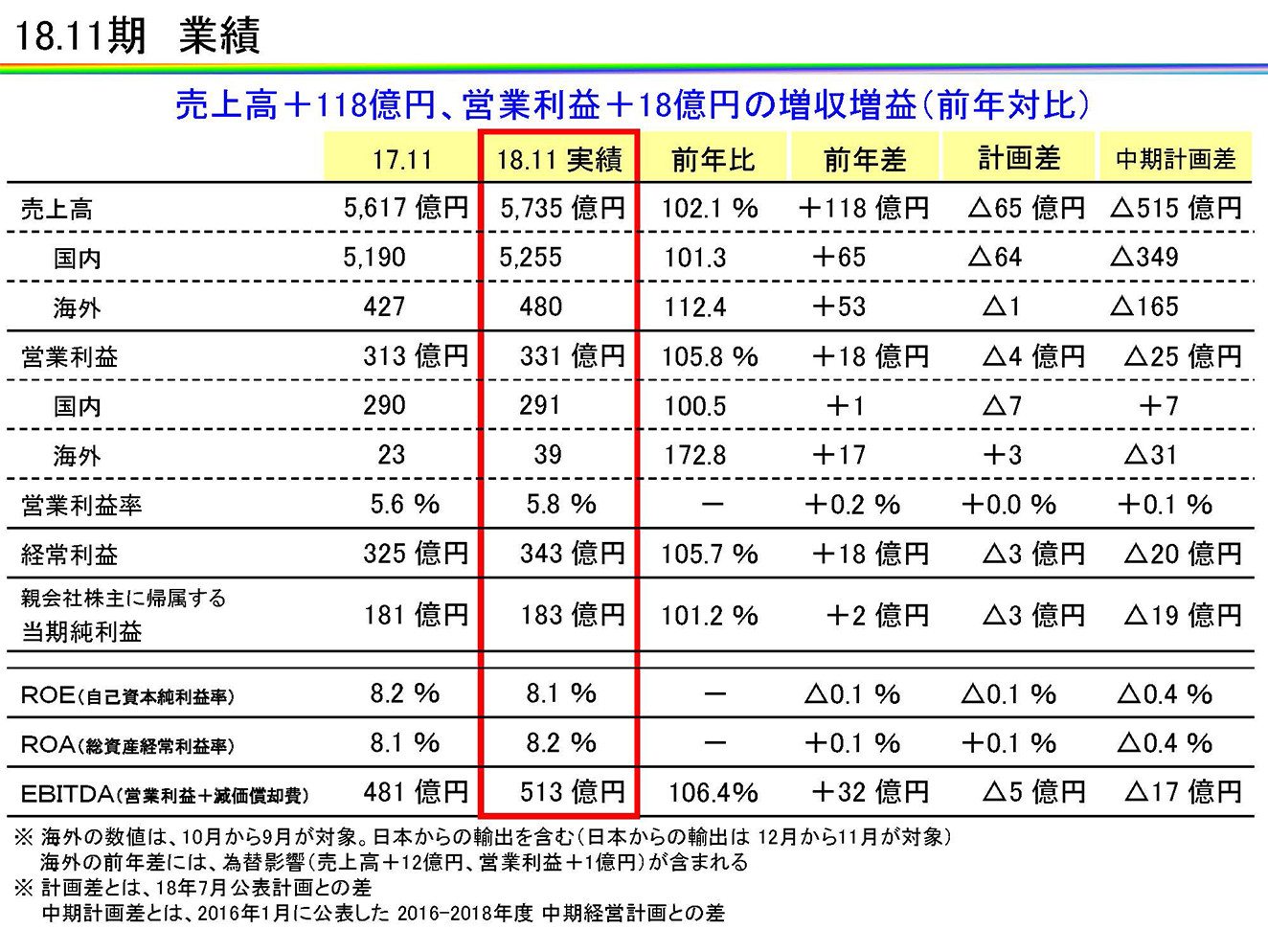
2018年度の業績について、売上高は、5,735億円、前年に対して118億円の増収となりました。
国内は65億円の増収、海外は円安による為替影響12億円を含め、53億円の増収となりました。
営業利益は前年に対して18億円増加の331億円、国内、海外ともに増益となりました。
-
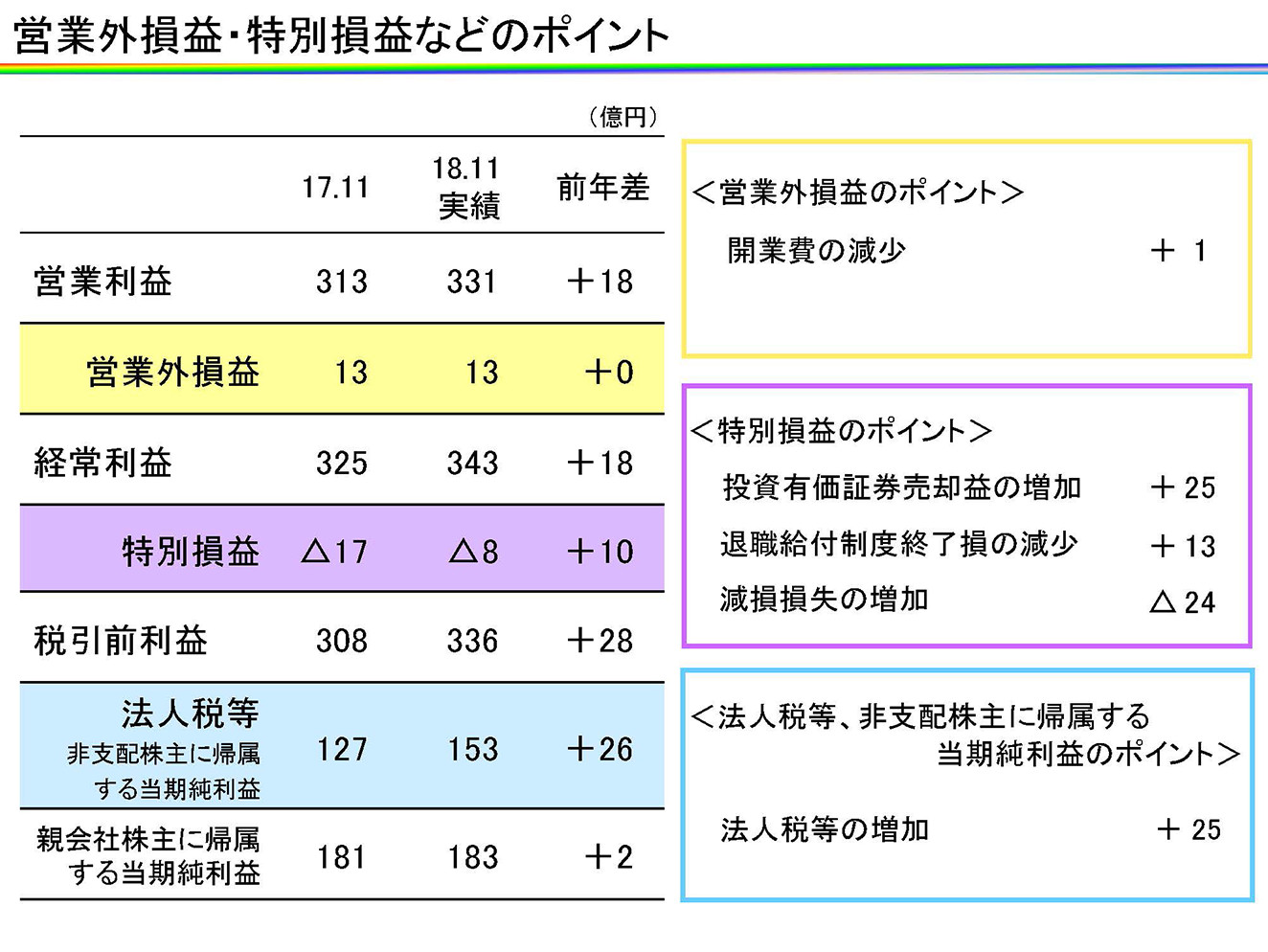
経常利益は18億円増加の343億円となりました。
特別損益は、ポーランドの子会社などの減損損失が24億円生じましたが、投資有価証券の売却益や事業譲渡益により10億円増となりました。
親会社株主に帰属する当期純利益は、税引前利益の増加により法人税等は増加しましたが、前年に対して2億円増の183億円となりました。
-
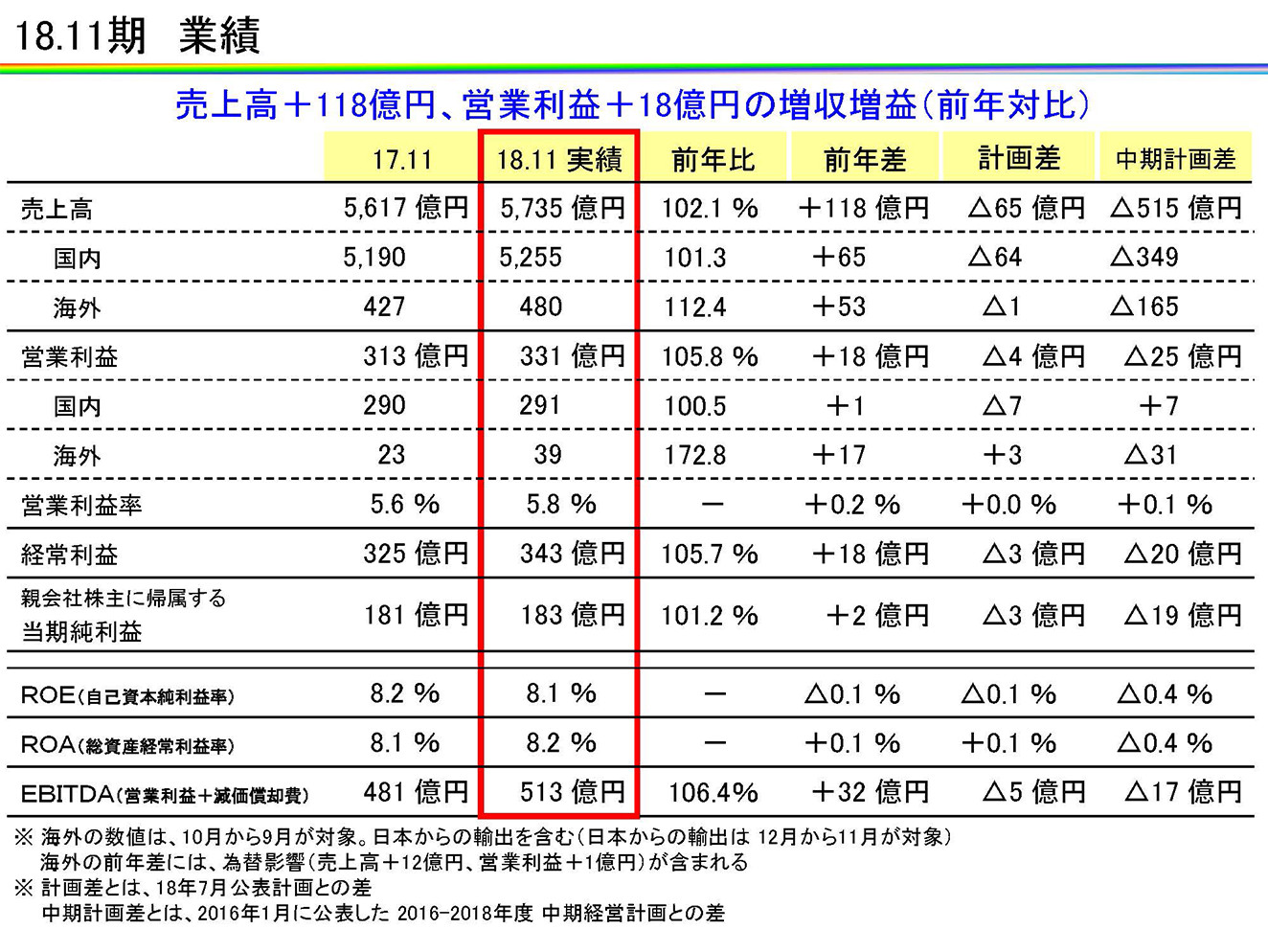
7月の公表計画に対しては、売上高、利益ともに未達でした。主に、国内の売上高の未達と、夏から秋にかけて頻発した災害が影響しています。
2016年度からの中期計画に対しては、売上高、利益ともに未達に終わりましたが、国内の営業利益計画は達成することができました。
-
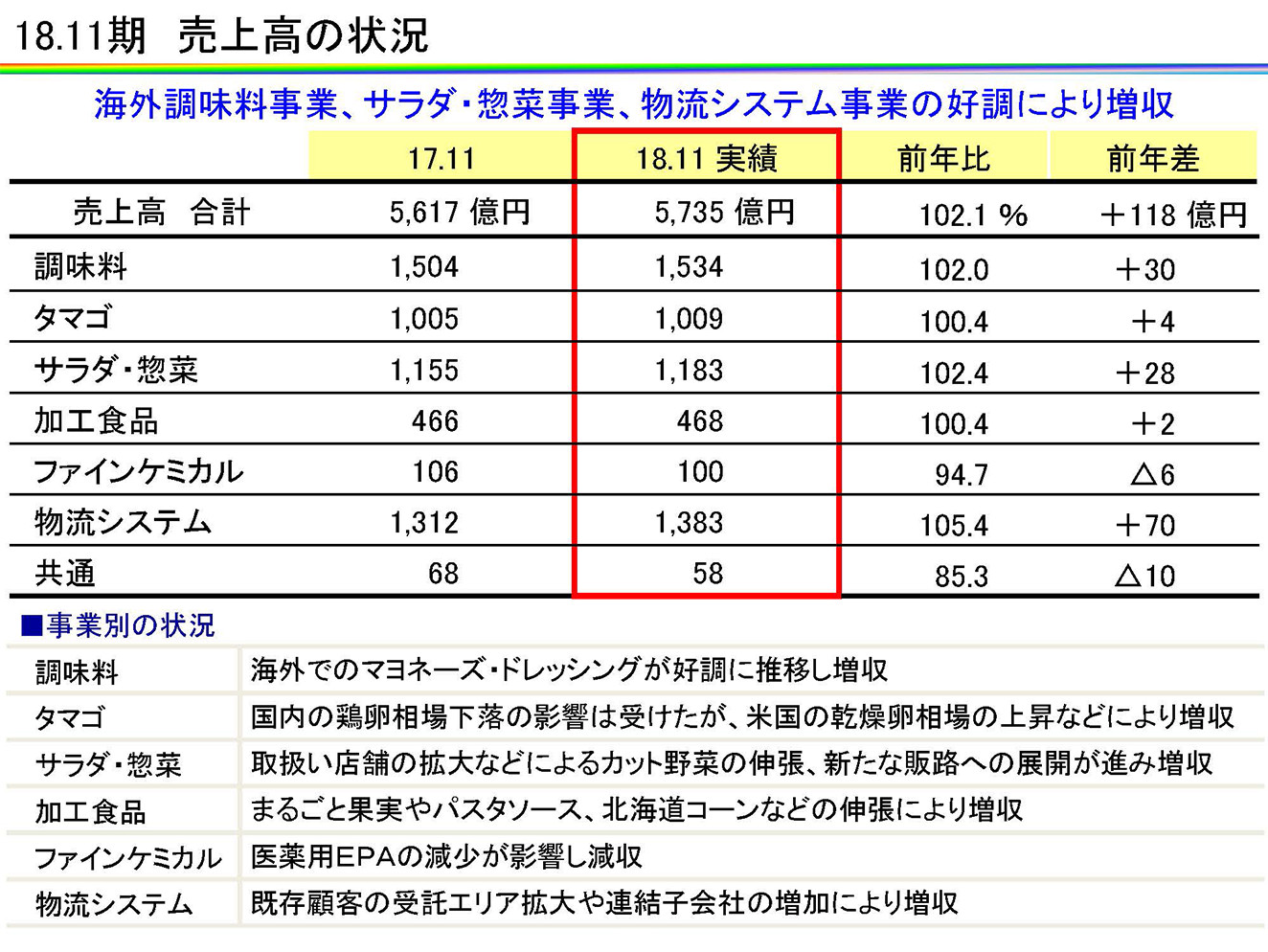
事業別の売上高の状況です。
調味料事業は、国内では野菜高の影響を受けサラダ調味料が伸び悩んだものの、海外のマヨネーズやドレッシングが好調に推移し、30億円の増収となりました。
タマゴ事業は、国内の鶏卵相場の下落が15億円の減収要因となりましたが、外食・中食向けの小型容器の凍結卵などの付加価値の高い商品が伸びたことや、米国の乾燥卵相場の上昇などにより、事業全体で4億円の増収となりました。
サラダ・惣菜事業は、2018年10月1日付けで行ったコンビニエンスストア向けベンダーの事業譲渡が、28億円の減収要因となりましたが、カット野菜で31億円、新たな販路の開拓を進めた惣菜が26億円増加したことにより、事業全体では28億円の増収となりました。
加工食品事業は、付加価値の高い商品が着実に伸張し、2億円の増収、ファインケミカル事業は、医薬用EPAの減少が影響し、6億円の減収となりました。
物流システム事業は、既存取引先の受託拡大や、連結子会社の増加などにより、70億円の増収となりました。
共通事業の減収は、食品機械設備販売の減少によるものです。
-
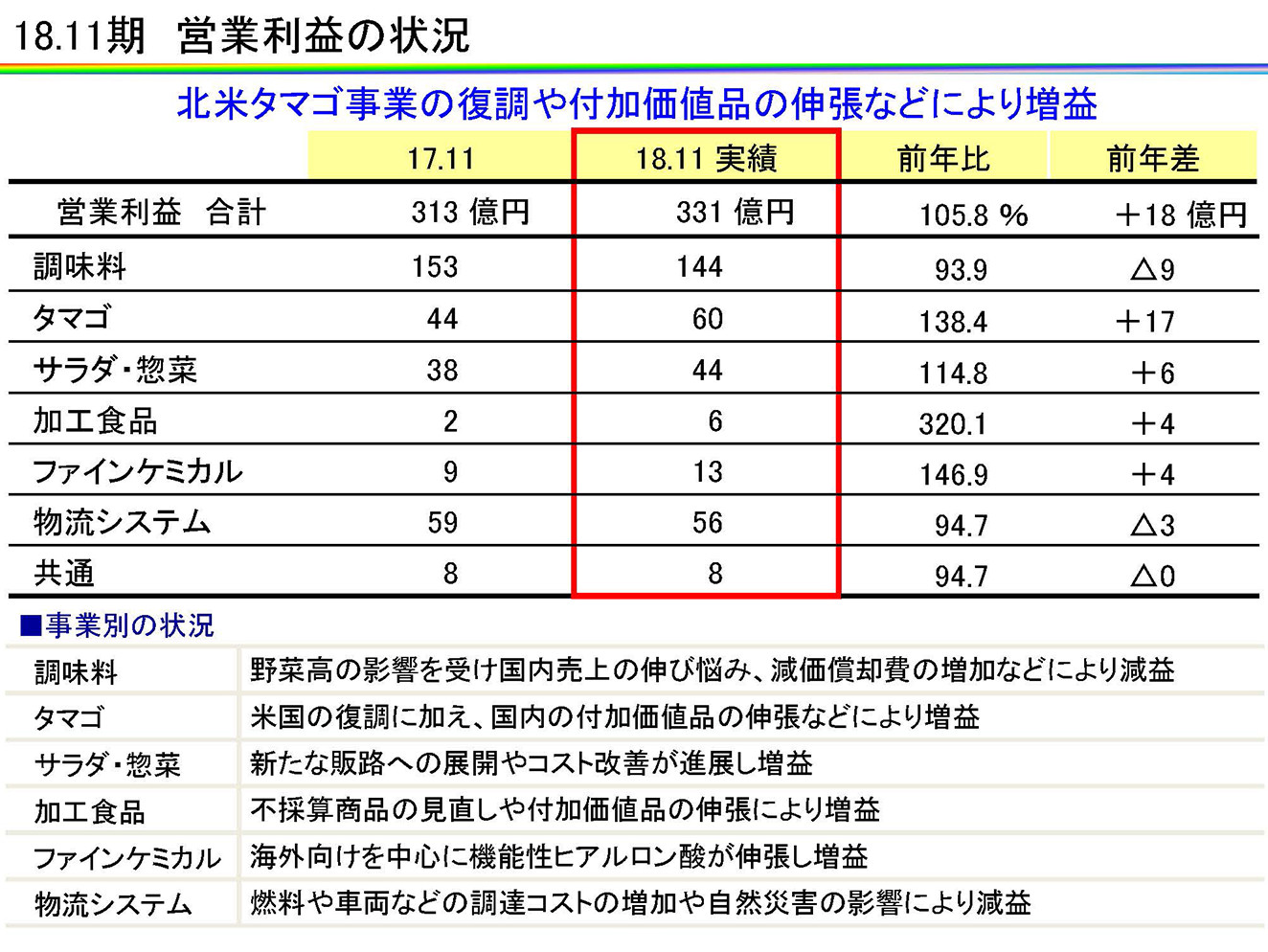
事業別の営業利益の状況です。
調味料事業は、国内売上の伸び悩みや、減価償却費の増加が影響し、9億円の減益となりました。
タマゴ事業は、米国が乾燥卵相場の上昇などにより12億円の増益、国内の付加価値の高い商品の伸張効果を含めて、事業全体で17億円の増益となりました。
サラダ・惣菜事業は、売上拡大と省力化などのコスト改善が進展し、6億円の増益となりました。
加工食品事業は、不採算商品の見直しが進んだことに加え、付加価値の高い商品が伸張し、4億円の増益となりました。
ファインケミカル事業は、主に海外でのヒアルロン酸の伸張が貢献し、4億円の増益となりました。
物流システム事業は、保管・運送の合理化は進みましたが、燃料や車両の調達コストの増加、自然災害の影響などにより、3億円の減益となりました。
なお共通事業の減益は、売上高の減少によるものです。
-
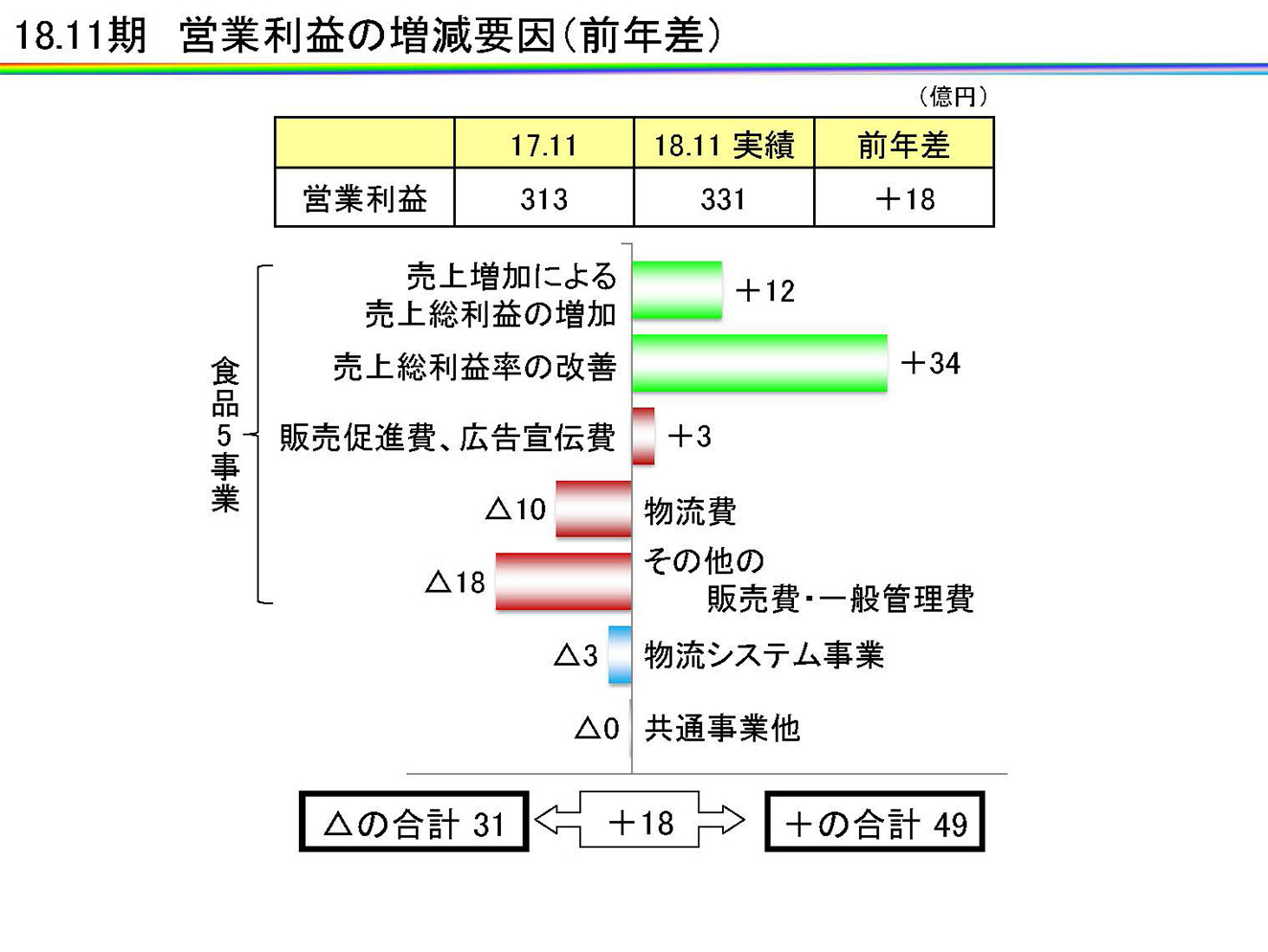
営業利益18億円増については、食品事業の売上総利益率の改善が大きく寄与しました。
-
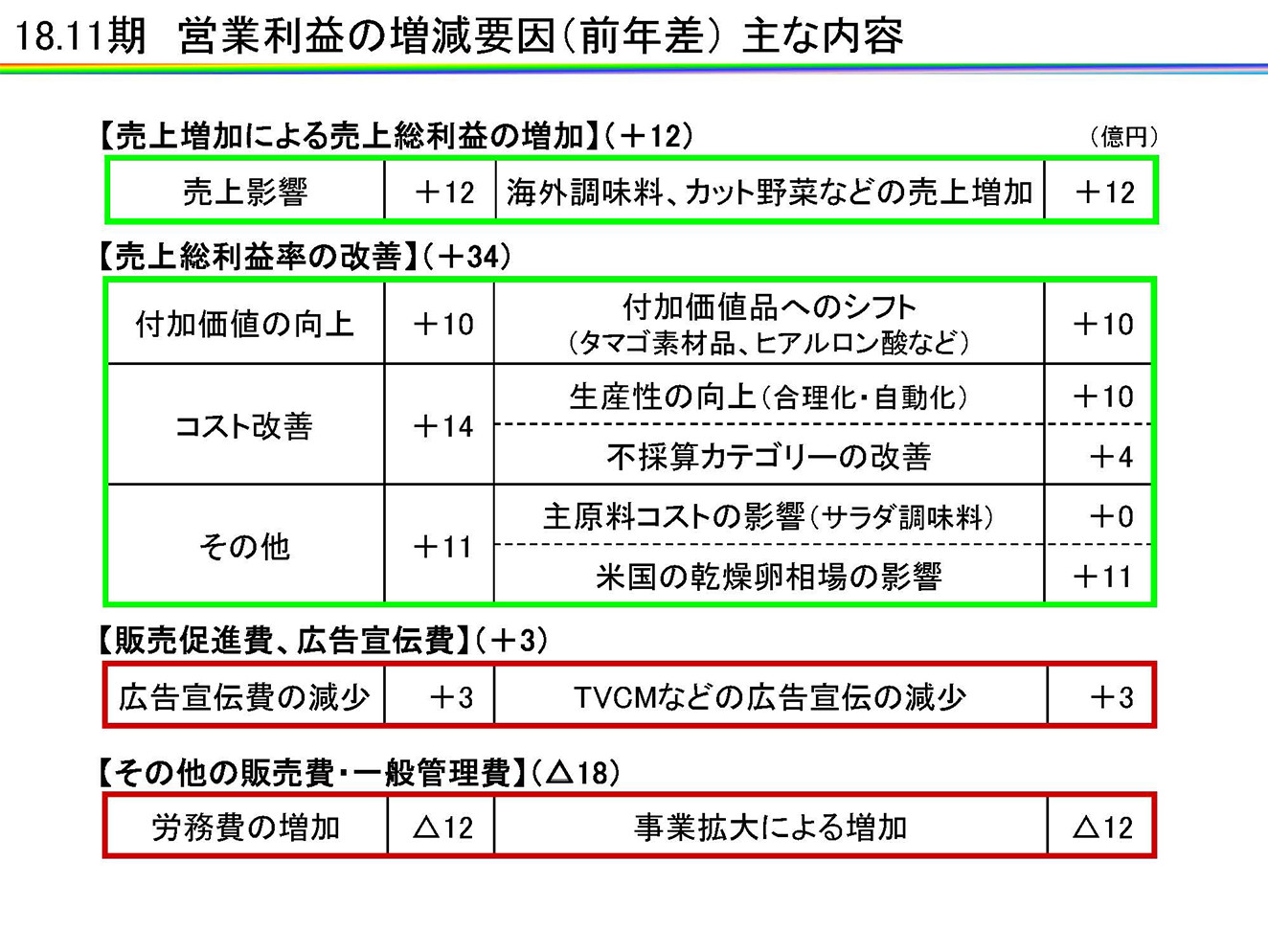
売上増加による売上総利益の増加は、海外のマヨネーズやドレッシング、国内のカット野菜や惣菜などの売上増加により、12億円を創出しました。
売上総利益率の改善の主な内容は、付加価値の高い商品の販売ウエイトを上げていく取り組みで10億円、これは主にタマゴ事業が貢献しています。
また、生産性の向上や不採算カテゴリーの改善などのコスト改善の取り組みで14億円を創出しました。
また、米国の乾燥卵相場の上昇も、売上総利益率の改善に寄与しました。広告宣伝費の減少は、2017年度に実施したカット野菜の広告を、2018年度は実施していないことなどによります。
その他の販売費・一般管理費は、海外を含めた事業拡大による、労務費の増加が主な内容です。
-
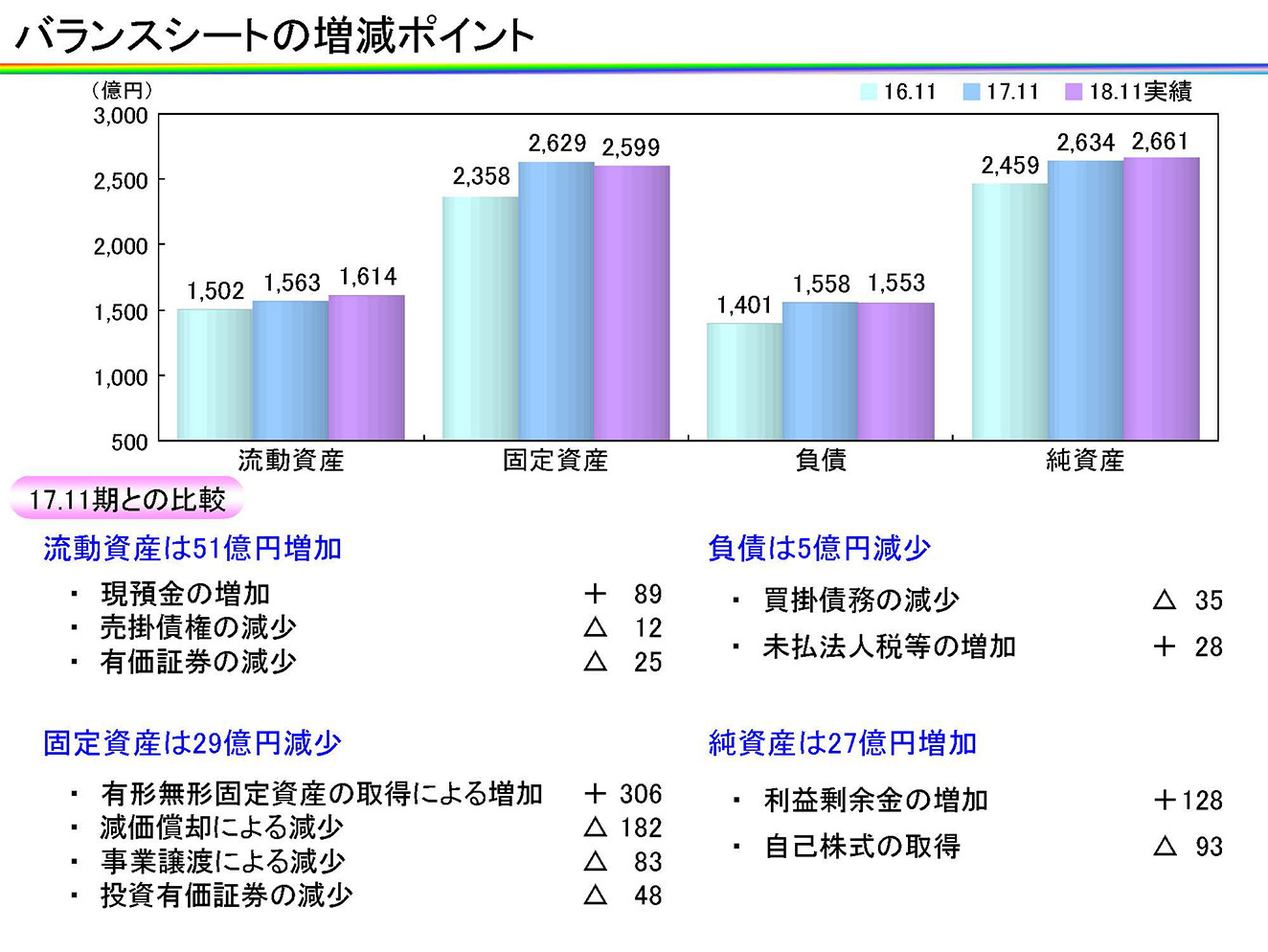
-
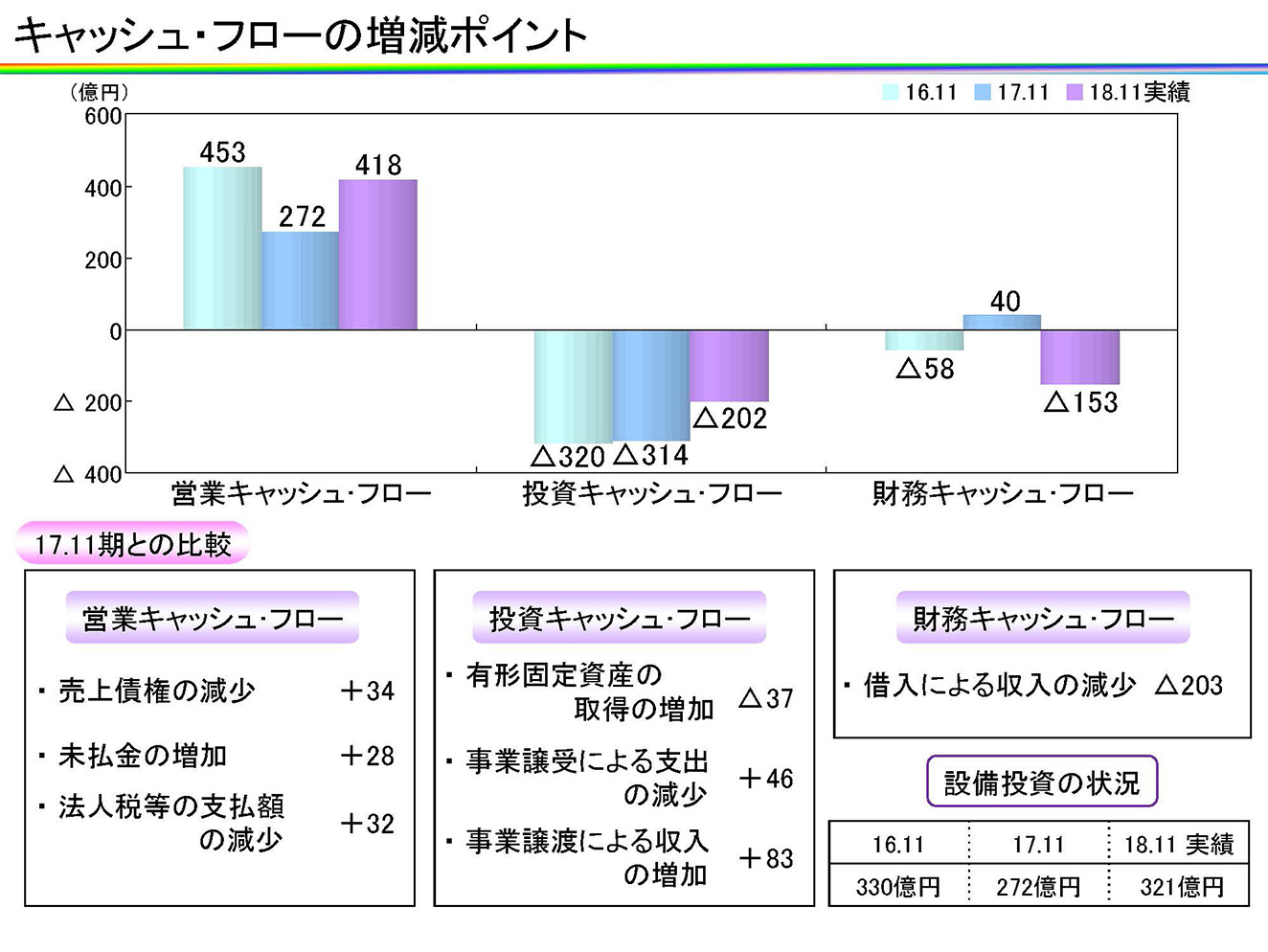
なお、2018年度の設備投資は321億円を実行しました。これにより、2016年度から3年間の設備投資の合計は923億円となりました。
-

-
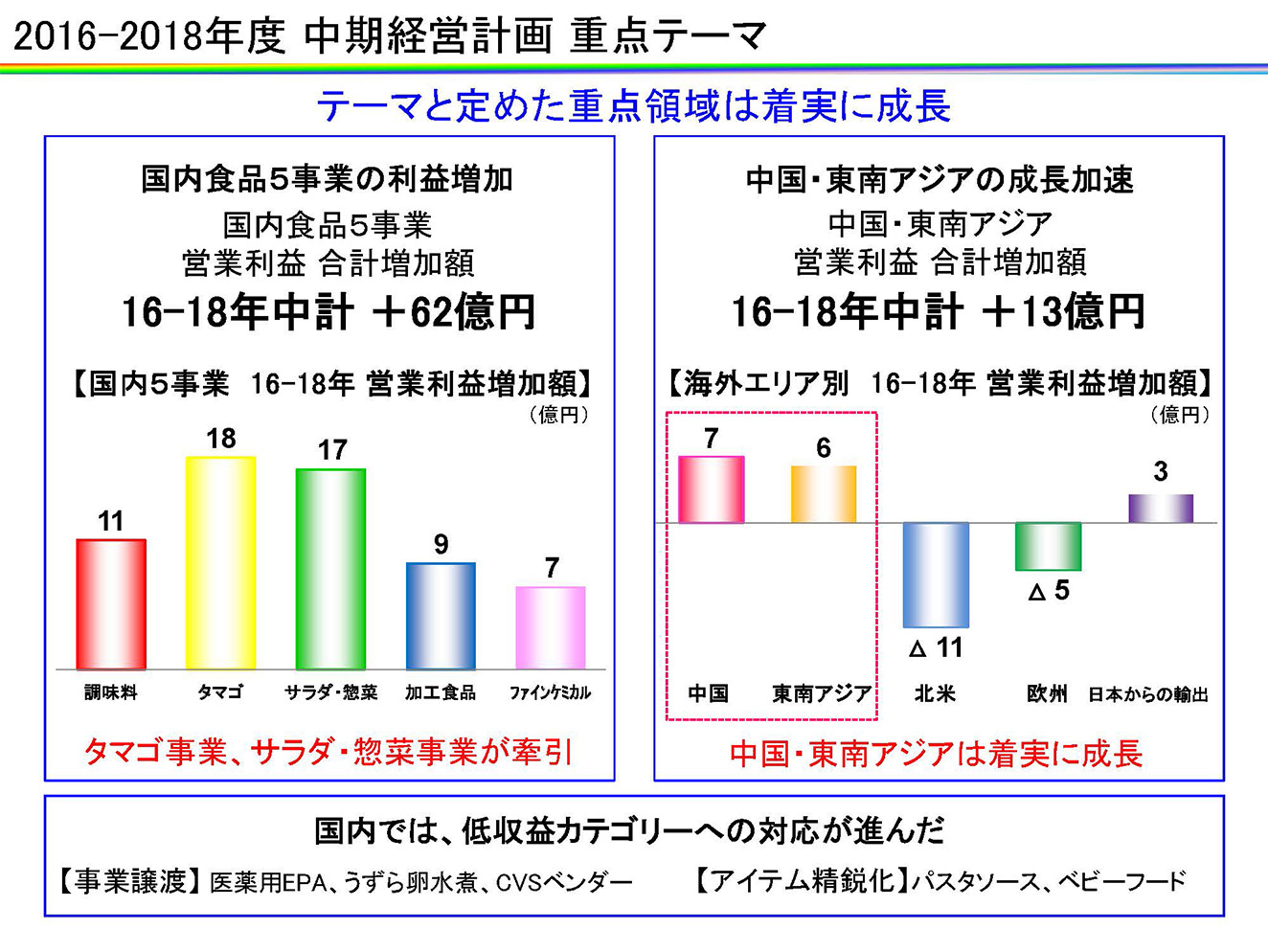
2016年度から18年度までの中期計画の重点テーマの状況として、「国内食品5事業の利益増加」と、「中国・東南アジアの成長加速」の2つを進めてきました。
国内食品5事業は、売上総利益率の改善の取り組みに注力し、特にタマゴ事業とサラダ・惣菜事業の牽引で、目標としていた60億円増を上回る結果となりました。
次の中期経営計画におきましても、タマゴ事業やサラダ・惣菜事業を中心に、利益の拡大を図ります。海外の利益計画は未達でしたが、重点エリアである中国・東南アジアで、マヨネーズやドレッシングの需要拡大を進め、営業利益が13億円増加しました。 海外においては、今後も中国・東南アジアに重点的に注力し、拡大を図ります。
また、2018年までの中期計画では、国内の低収益カテゴリーへの対応を進めてきましたが、次の中期計画においても引き続き取り組んでいきます。
-

2019年度から2021年度までの第9次中期計画では、国内の持続的成長と、海外での成長加速を実現していきます。
2018年までの第8次中期計画では、グループの力を最大限に発揮して価値を創出する「グループ協働」をテーマに掲げ、売上総利益の拡大に向け、付加価値の高い商品へのシフトやコスト競争力の強化を進めてきました。
第9次中期計画の初年度にあたる2019年は、当社の創業100周年となりますが、次の100年を見据えて、利益を創出する力を高めていきます。
-
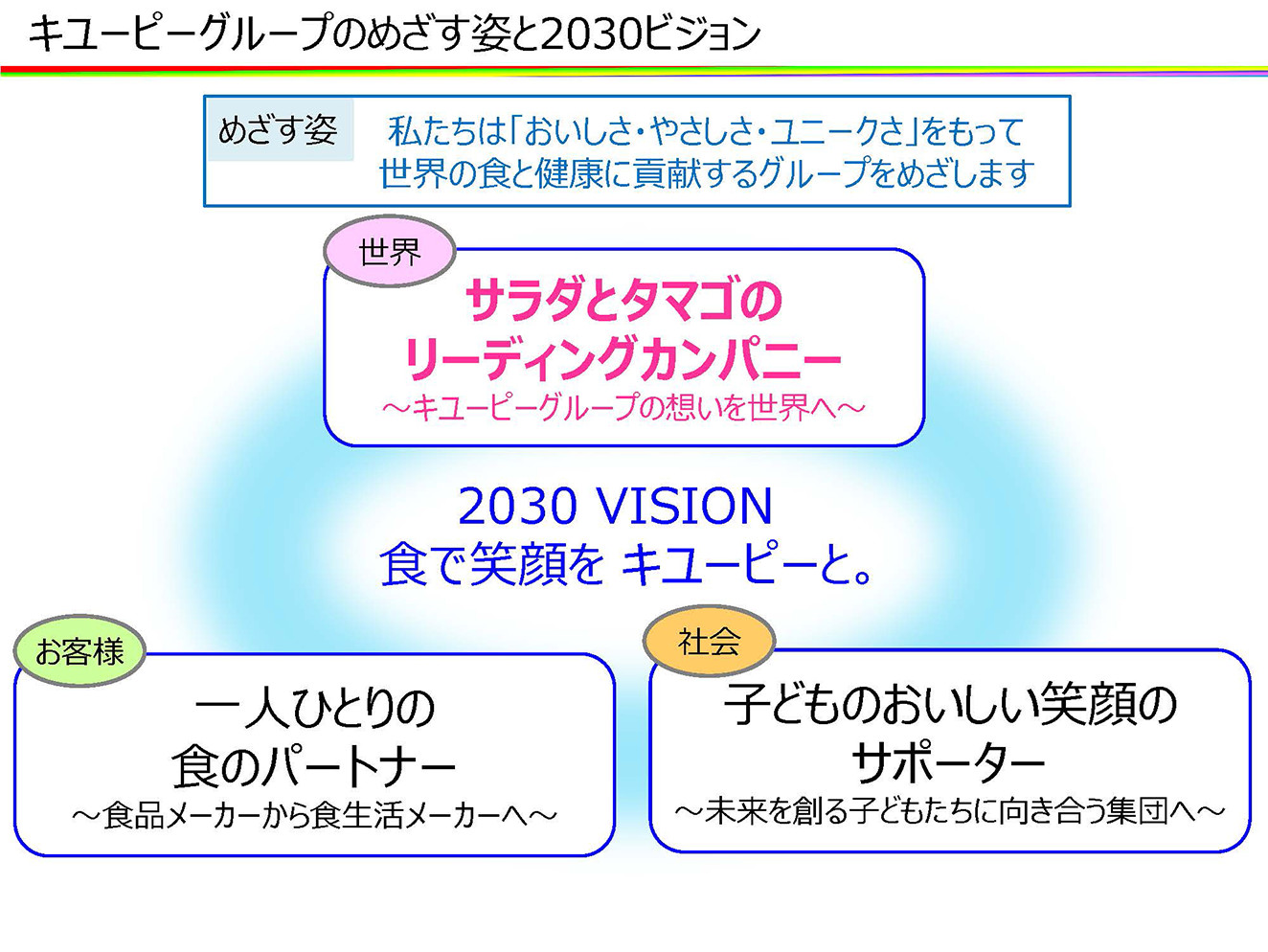
このたび、グループの長期ビジョンとして「2030ビジョン」を策定しました。
社会の変化が加速する中、次の100年に向けて成長を続けていくために、2030年にはこうありたい、というグループの姿について、様々な角度から検討しました。
社会の変化を多角的に予測し、自ら変えていく力を身に付けていきたいと考えています。2030ビジョンでは、マヨネーズとドレッシングを中心に、サラダとタマゴの魅力を世界へ広げるため、メニューなどの提案力や技術力で、食卓をたのしくすることができるような、「サラダとタマゴのリーディングカンパニー」をめざしていきます。
第9次中期計画は、この2030ビジョンに向けた第1ステージと位置づけ、得意な分野を伸ばすとともに、社会的な課題にも取り組んでいきます。
-
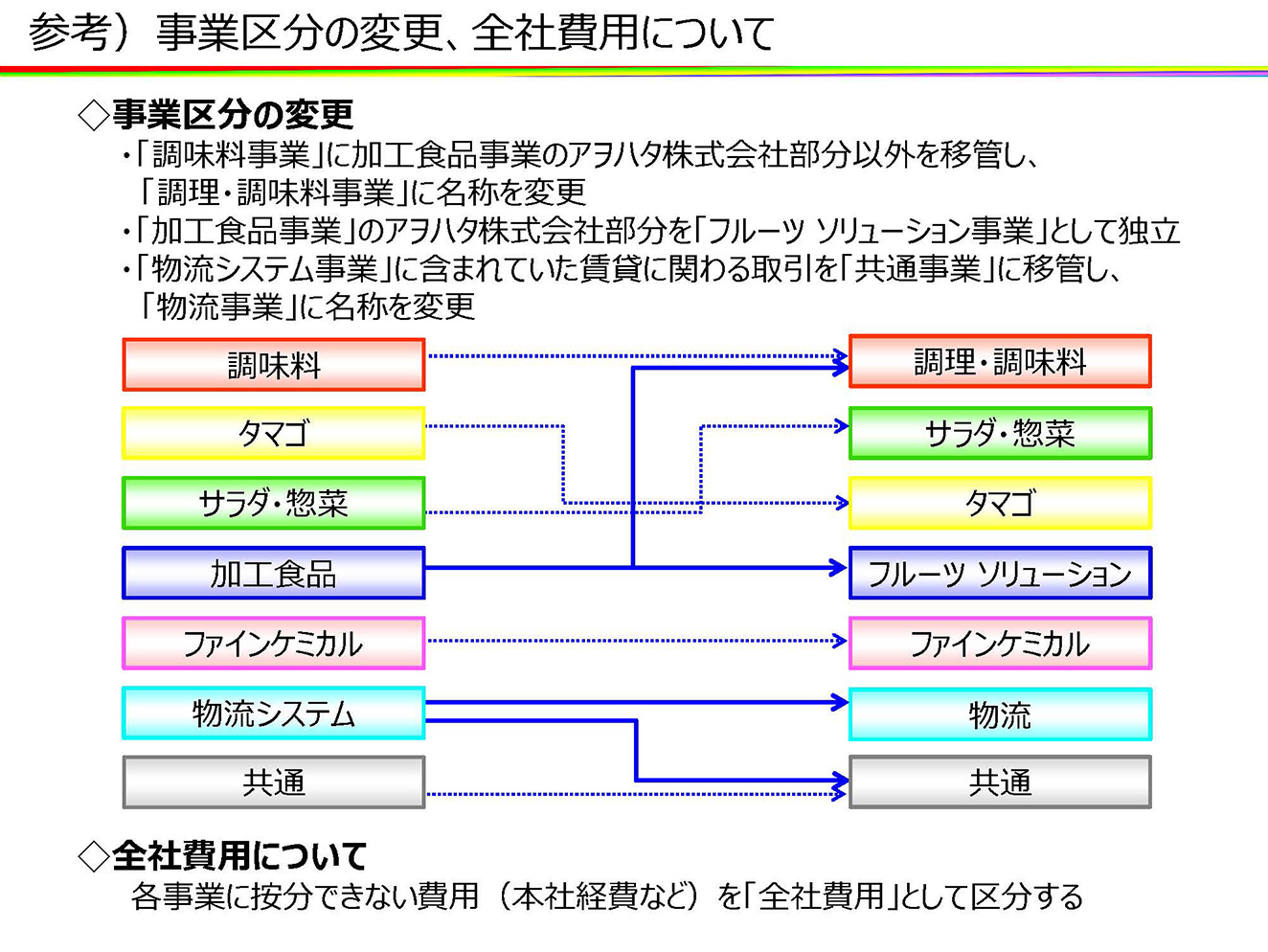
なお、第9次中期計画では、事業などの区分の変更を行います。
「調味料事業」は、加工食品事業に含まれていたアヲハタ株式会社以外を調味料事業に移管するとともに、名称を「調理・調味料事業」に変更します。
「加工食品事業」のアヲハタ株式会社については、「フルーツ ソリューション事業」として独立します。
「物流システム事業」は、賃貸に関わる取引を共通事業に移管するとともに、名称を「物流事業」に変更します。
また、各事業の利益をできるだけ実際の状態に近づけるため、事業に按分できない費用を「全社費用」として区分することにしました。
これに伴い、各事業の利益は事業利益と表現します。 -
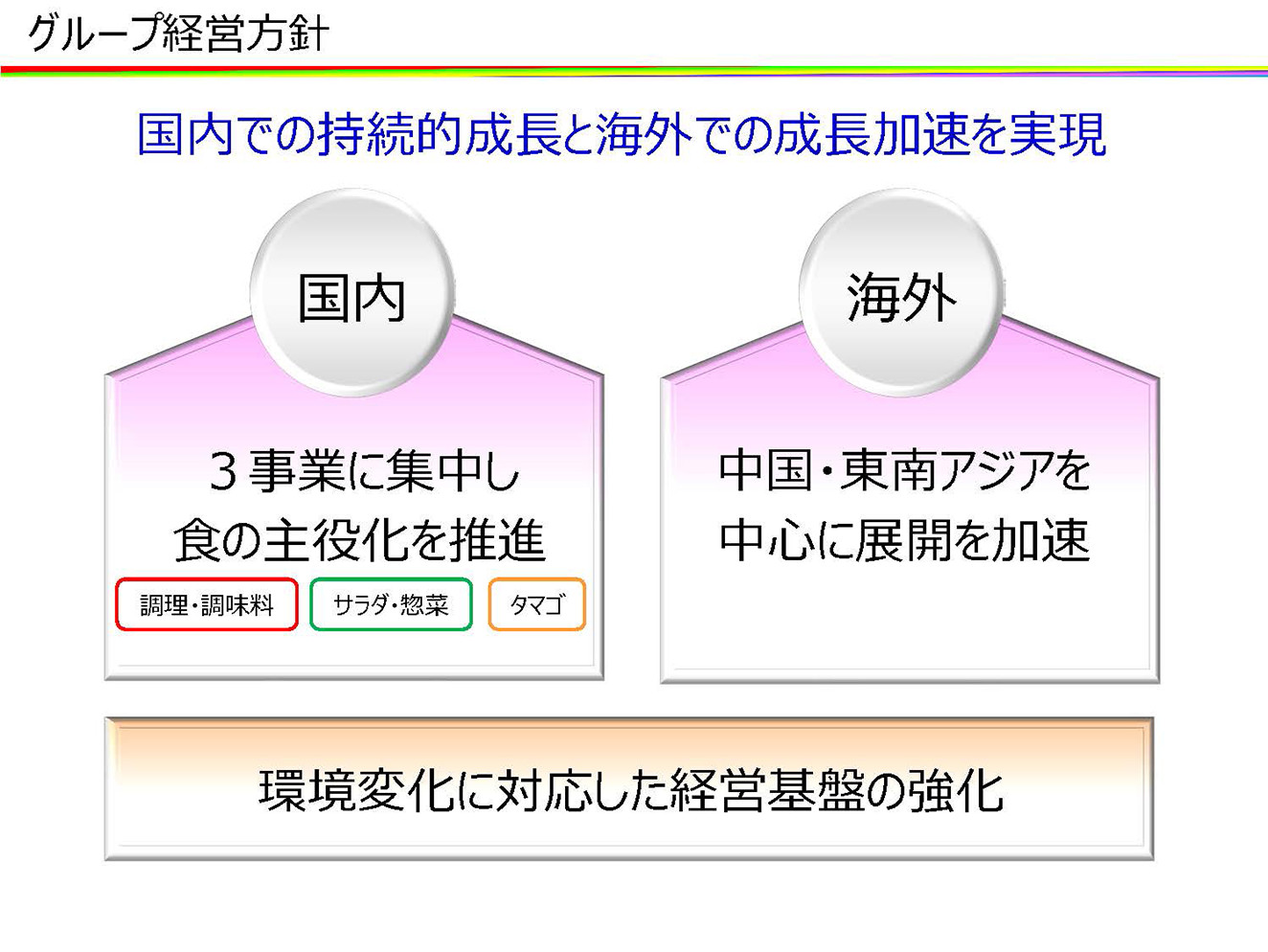
第9次中期計画は、3つの経営方針で進めます。
国内では、調理・調味料事業、サラダ・惣菜事業、タマゴ事業、この3事業に集中し、食の主役化を推進することで、持続的な成長を実現します。
海外では、中国・東南アジアを中心に展開を加速していきます。
さらに、環境変化に対応した経営基盤の強化を進めます。 -
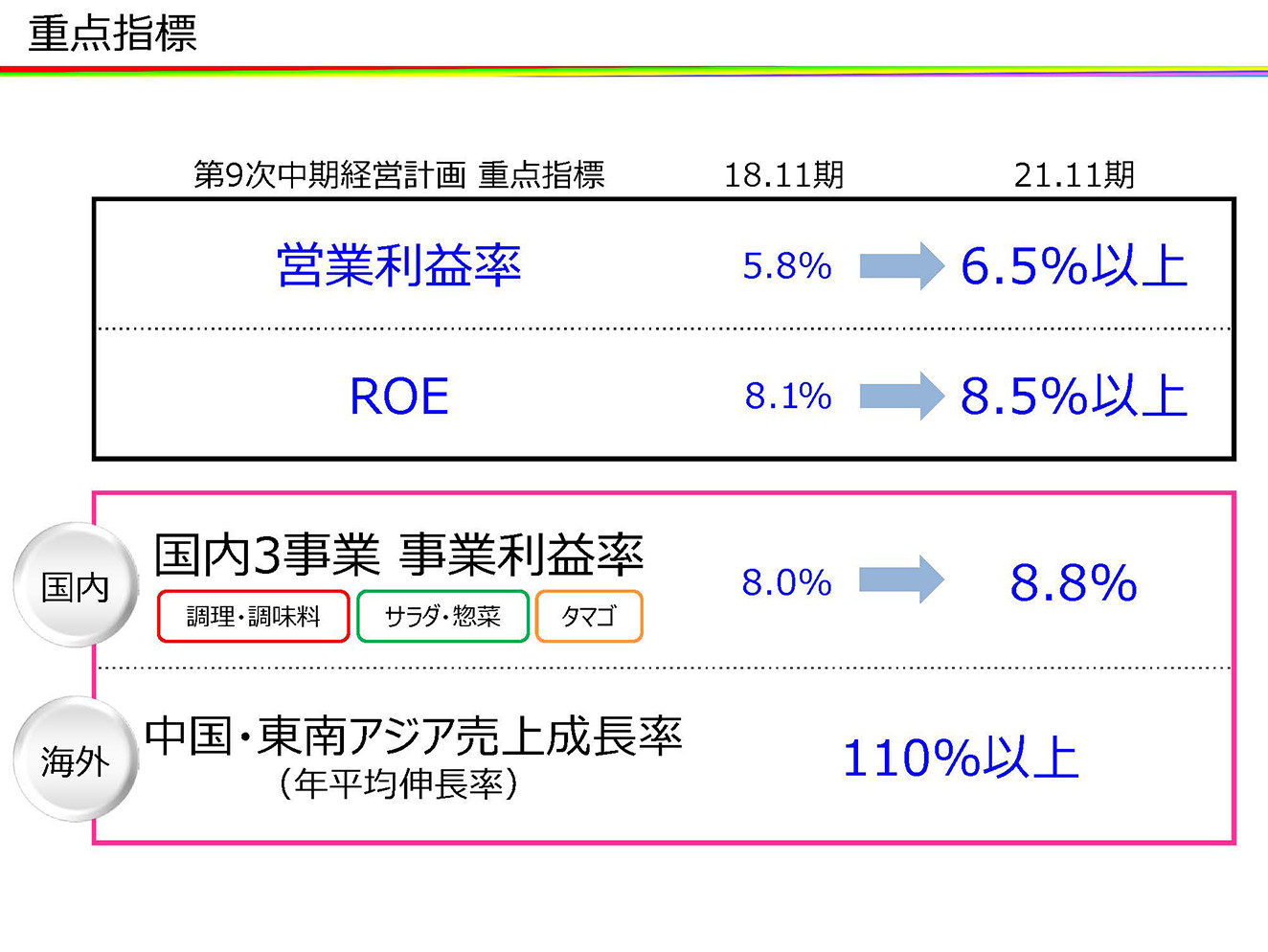
そして、4つの重点指標に注力します。
まず、営業利益率6.5%以上、ROE8.5%以上をめざします。
さらに、経営方針に紐づく指標として、国内の3事業における事業利益率は8.8%、中国・東南アジアの売上高成長率は110%以上をめざしていきます。
-
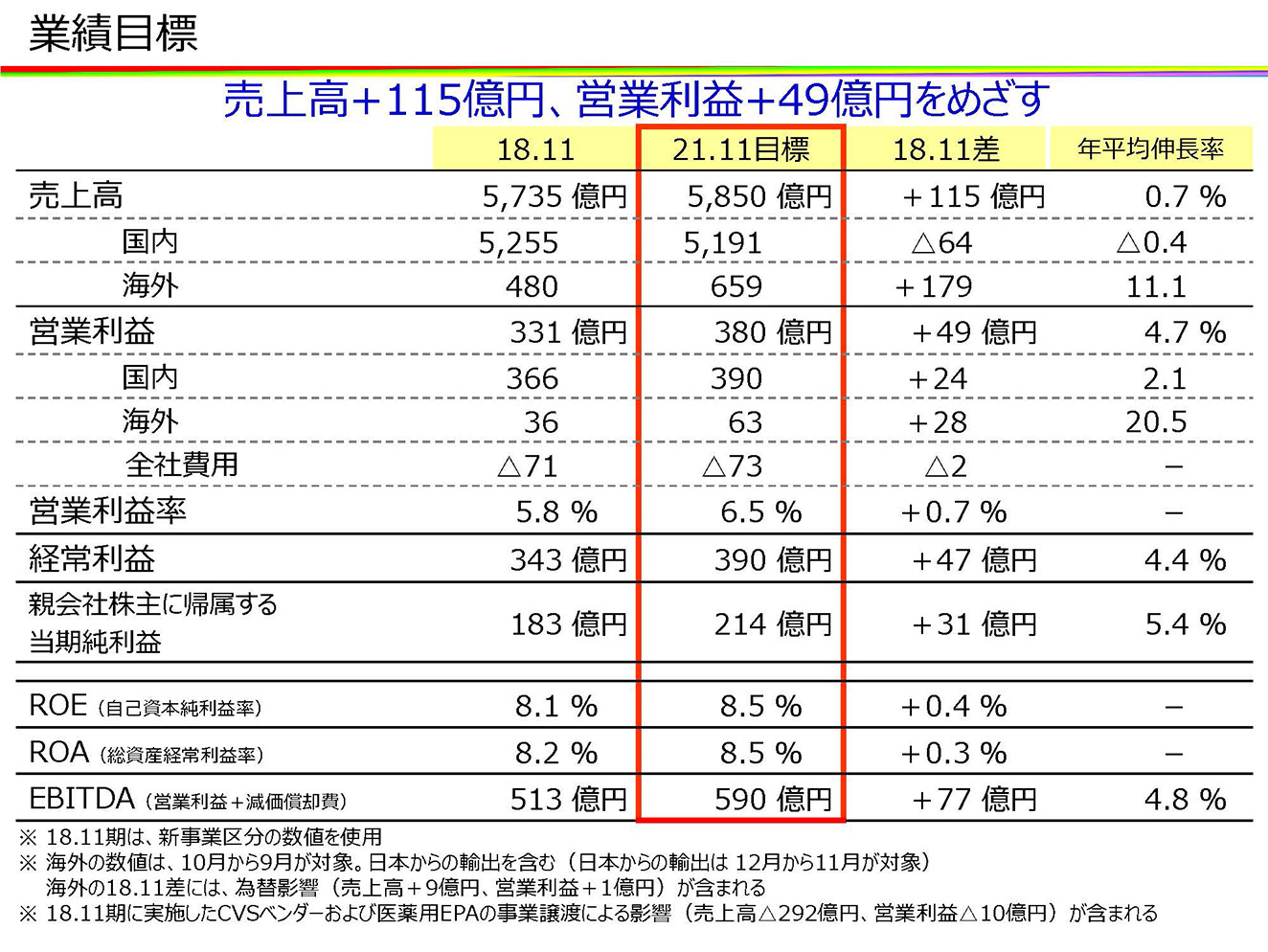
業績目標について、売上高は2018年度に対し、115億円増の5,850億円とします。
国内は64億円減となりますが、事業譲渡による影響を除くと、228億円伸ばすことになります。事業別の主な取り組みです。営業利益は49億円増の380億円とします。国内は、事業譲渡の影響を除くと、34億円伸ばすことになります。
経常利益は47億円増の390億円、当期純利益は31億円増の214億円をめざします。
為替影響は、売上高で9億円、営業利益で1億円の益を見込んでいます。
-
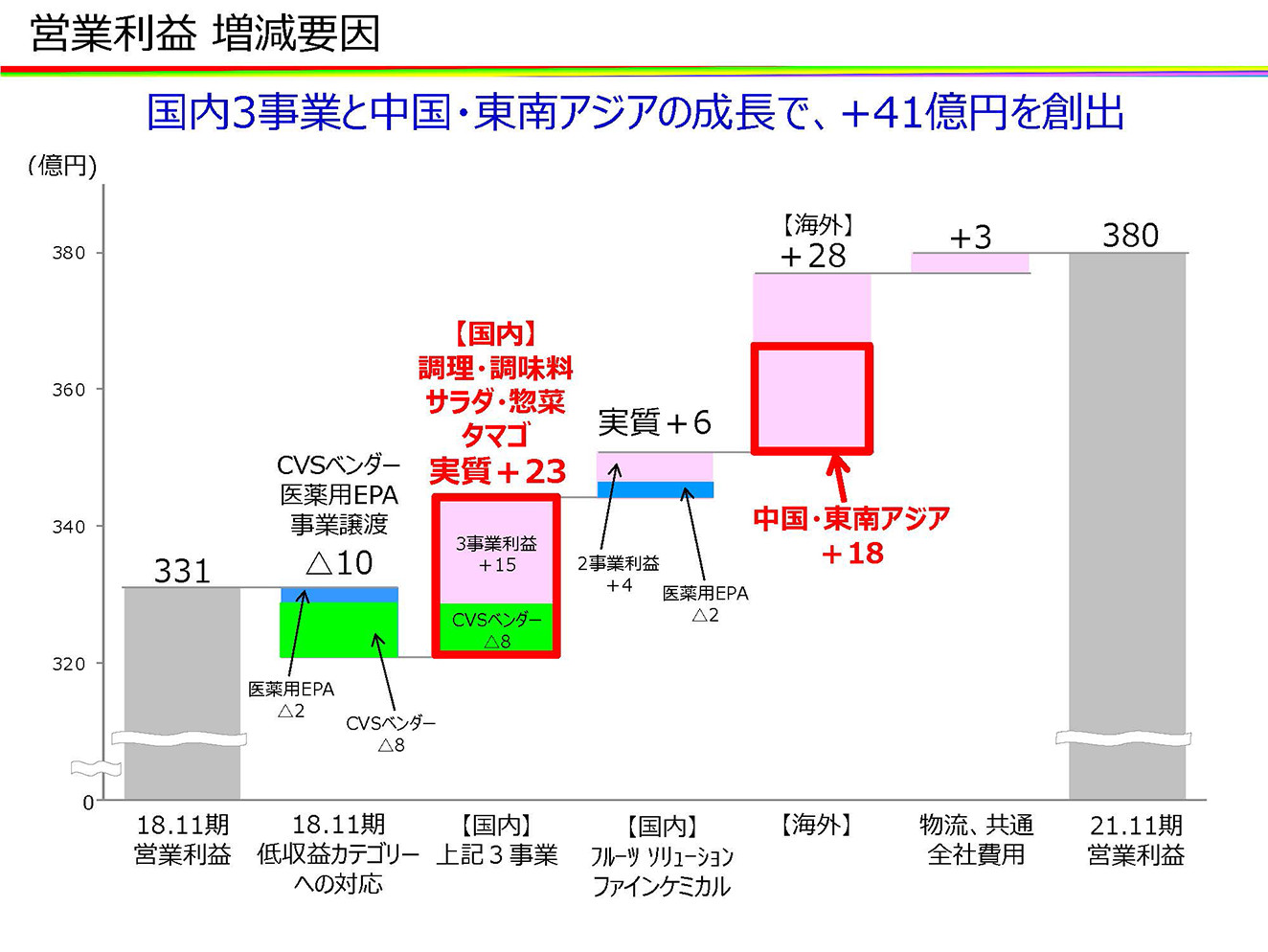
営業利益49億円増の内訳としては、国内で集中していく3事業は、コンビニエンスストア向けベンダーの事業譲渡による影響が8億円のマイナス要因となるため、実質23億円を伸ばしていきます。
また、海外全体では28億円増になりますが、そのうち中国・東南アジアでは、18億円伸ばしていきます。
注力する国内3事業と中国・東南アジアで、合計41億円を伸ばしていきます。
-
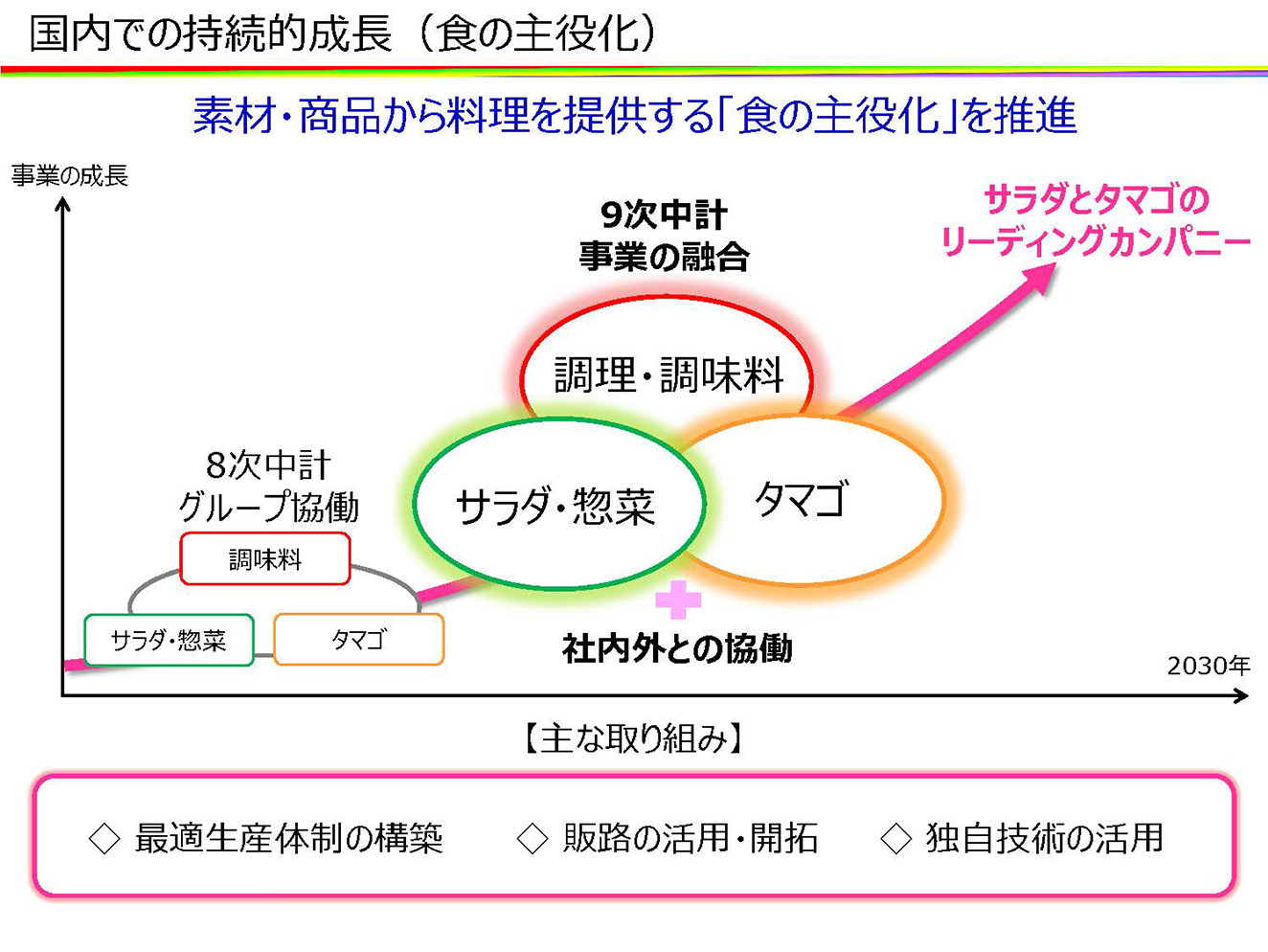
第8次中期計画では、「グループ協働」をテーマに、グループ全体で価値を創出してきました。
しかし、厳しくなる国内市場において、持続的成長を実現するためには、体質の強化を進めるとともに、社内外の協働で料理としてサラダとタマゴのおいしさを提供する「食の主役化」を進めていくことが必要になります。
3事業が融合し、マヨネーズやドレッシングを中心に、サラダやタマゴの領域を広げていくことで、伸び行く中食市場での拡大を進めるとともに、健康寿命の延伸にも取り組み、サラダとタマゴのリーディングカンパニーをめざしていきます。
その実現に向け、最適な生産体制の構築を進めるとともに、各事業の販路を相互に活用することも含めて、新たな販路への展開を進め、お客様へ提供する機会を拡大させます。
さらに、当社グループがもつ独自の技術を活用するとともに、事業横断の研究テーマを増やすことで、これまでに無いおいしさなど、新たな価値を創出していきます。
-
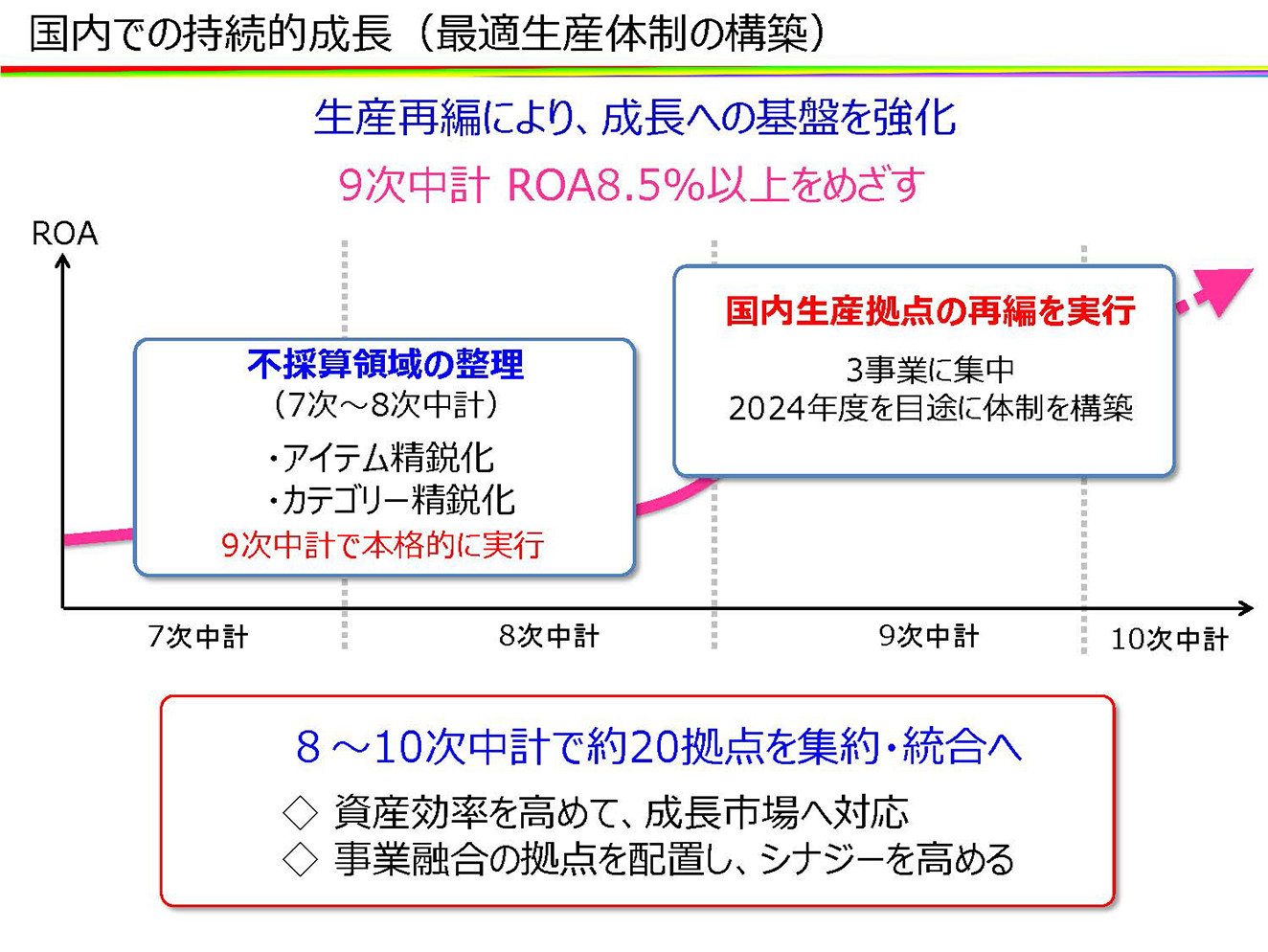
コスト競争力の向上に向けた取り組みとして、第7次から8次までの中期計画では、アイテムの精鋭化から、カテゴリーの精鋭化へと進化させてきましたが、第9次中期計画ではさらに本格的に実行していきます。
そして、9次以降、8次から進めてきた3事業に集中した国内生産拠点の再編を実行し、10次までには約20拠点の集約と統合を進め、最適な生産体制を構築していきます。
資産効率を高めて、生産合理化や生産能力向上を図るとともに、事業が融合する拠点を配置することで、シナジー効果を創出していきます。
-
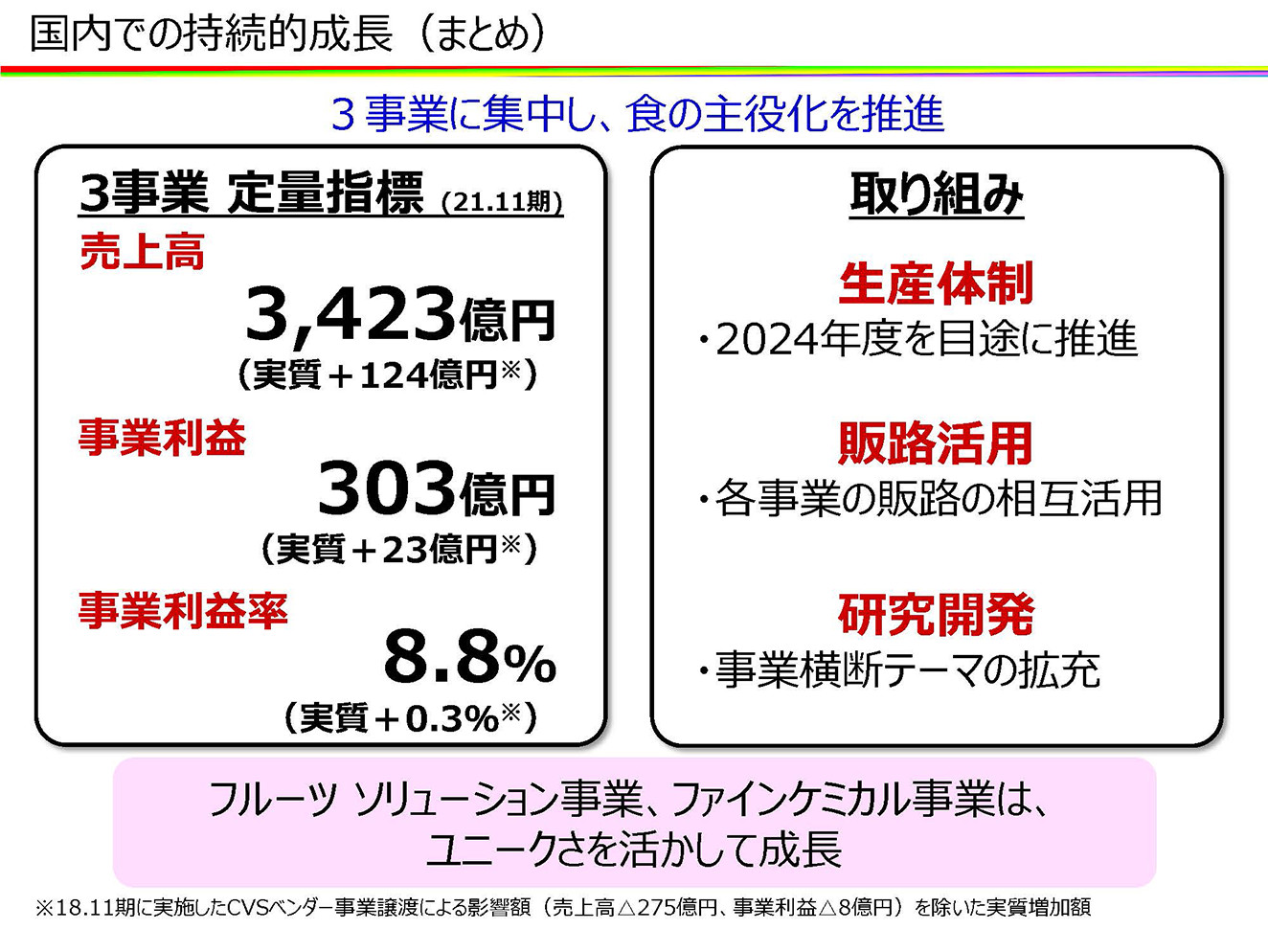
国内の3事業については、このような食の主役化に向けた取り組みを中心に、利益を創出する力を高め、事業利益率8.8%をめざしていきます。
また、フルーツ ソリューション事業とファインケミカル事業は、専門分野に特化することで、それぞれの分野において、なくてはならない存在に成長させていきたいと考えています。
-
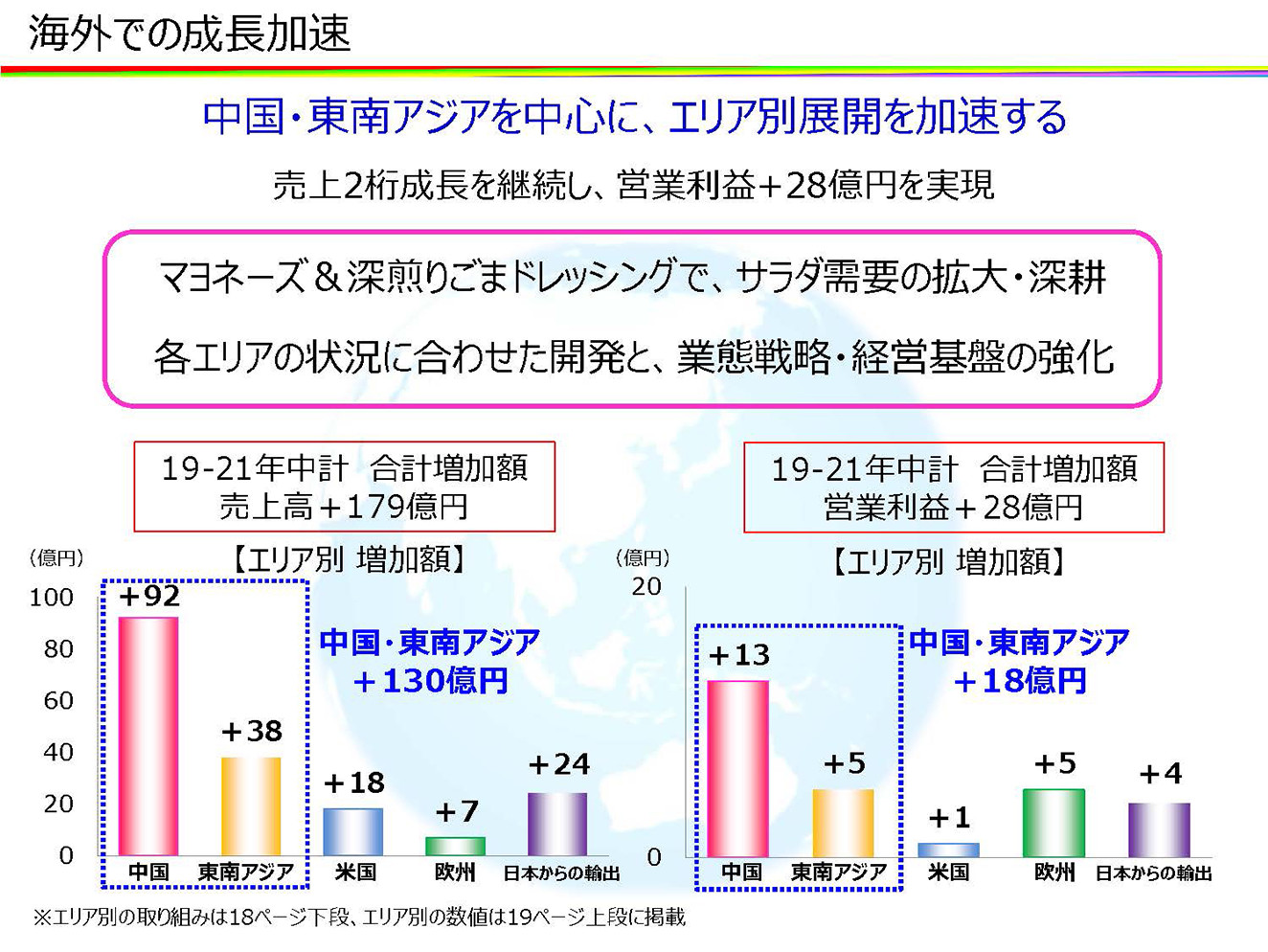
第9次中期計画では、海外でもたいへん評判の高い、キユーピー マヨネーズと深煎りごまドレッシングを世界戦略商品と位置づけ、サラダの需要を拡大していきます。
また、各エリアの状況をしっかりと捉え、スピードを上げて商品開発や業態ごとの戦略を進めるとともに、経営基盤の強化に取り組みます。
海外全体では、売上高179億円、営業利益28億円の増加を実現させるために、中国と東南アジアの売上高の年間平均成長率を110%以上継続することに、こだわっていきます。
中国と東南アジアでは売上高130億円、営業利益18億円を創出し、海外全体を牽引していきます。
-
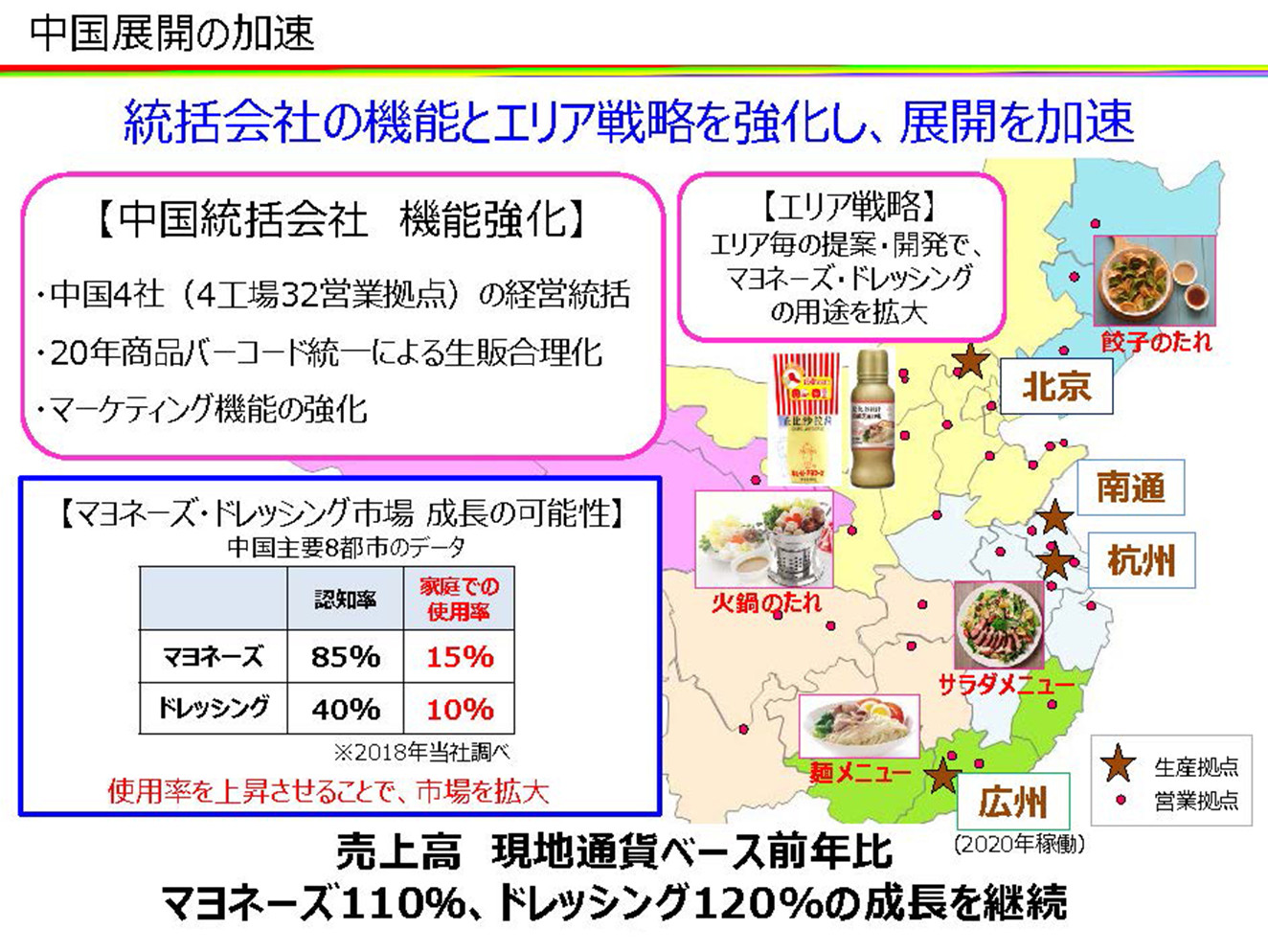
中国においては、2017年12月に設立しました統括会社の機能と、エリアでの戦略を強化していきます。
統括会社については、生産や販売での合理化を進めるとともに、広告宣伝などのマーケティング機能を強化します。
中国におけるマヨネーズやドレッシングは、データが示しているとおり、使用率が低い状況です。マヨネーズとドレッシングの用途拡大に向けた提案を継続的に行うことが、使用率を向上させ、市場の拡大に結びつくと考えています。
エリアによって、食の嗜好が異なることから、エリアごとの食の嗜好に合わせたメニュー提案や商品開発を行い、マヨネーズ110%、ドレッシング120%の売上成長を続けていきます。
-
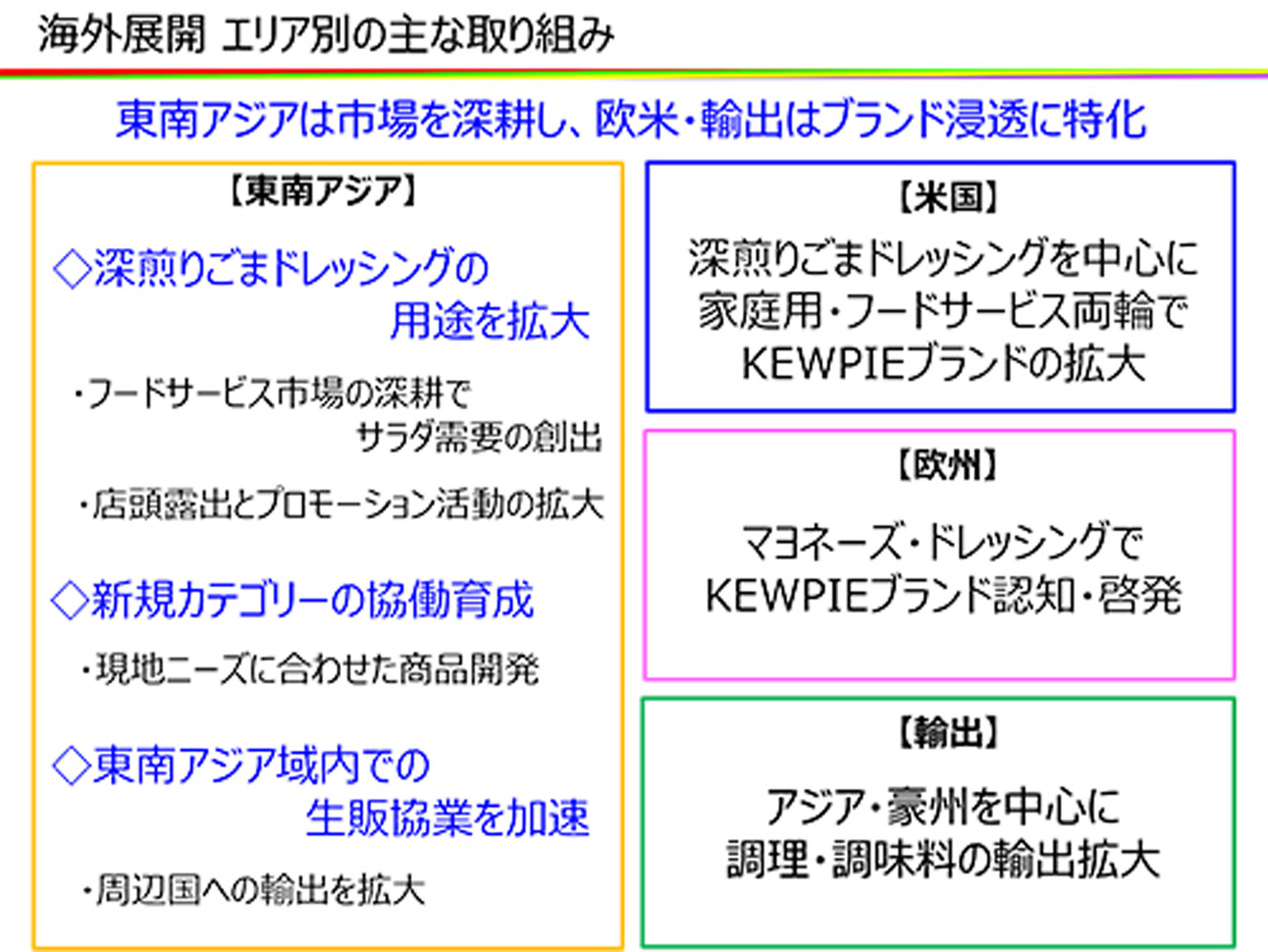
東南アジアについては、深煎りごまドレッシングの用途を拡大させるとともに、現地のニーズに合わせた新規カテゴリーを創出し、東南アジア全体で育成していきます。
米国や欧州、日本からの輸出については、世界戦略商品であるキユーピー マヨネーズや深煎りごまドレッシングの販売に注力し、KEWPIEブランドの浸透を図っていきます。
-
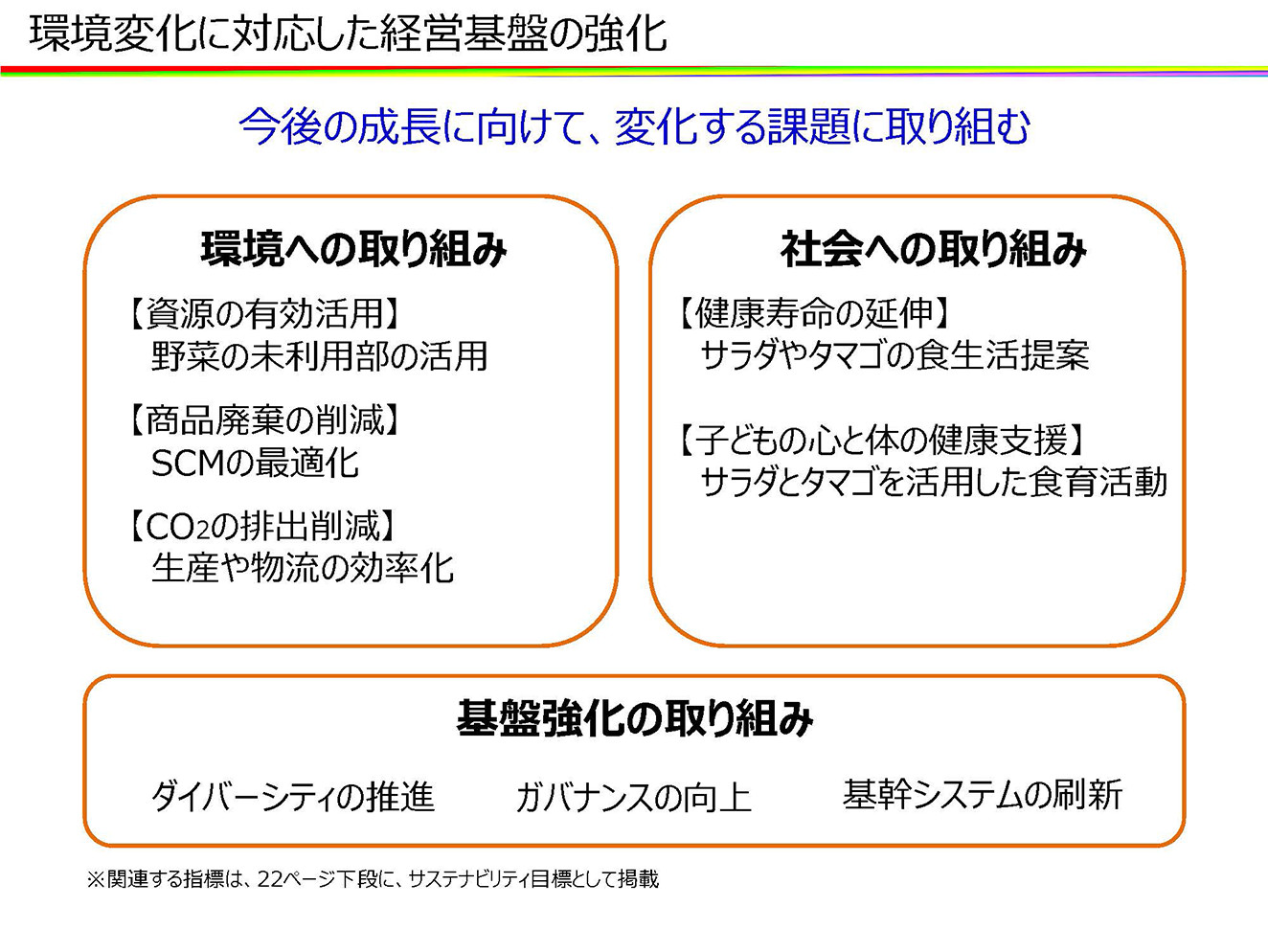
次の100年に向けて、社会的責任を果たし成長を続けていくために、変化していく社内外の課題に取り組んでいきます。
環境に対する主な取り組みは、資源の有効活用や商品廃棄の削減、CO2の排出削減などになります。
資源の有効活用の事例として、野菜の未利用部の活用をご紹介します。
-
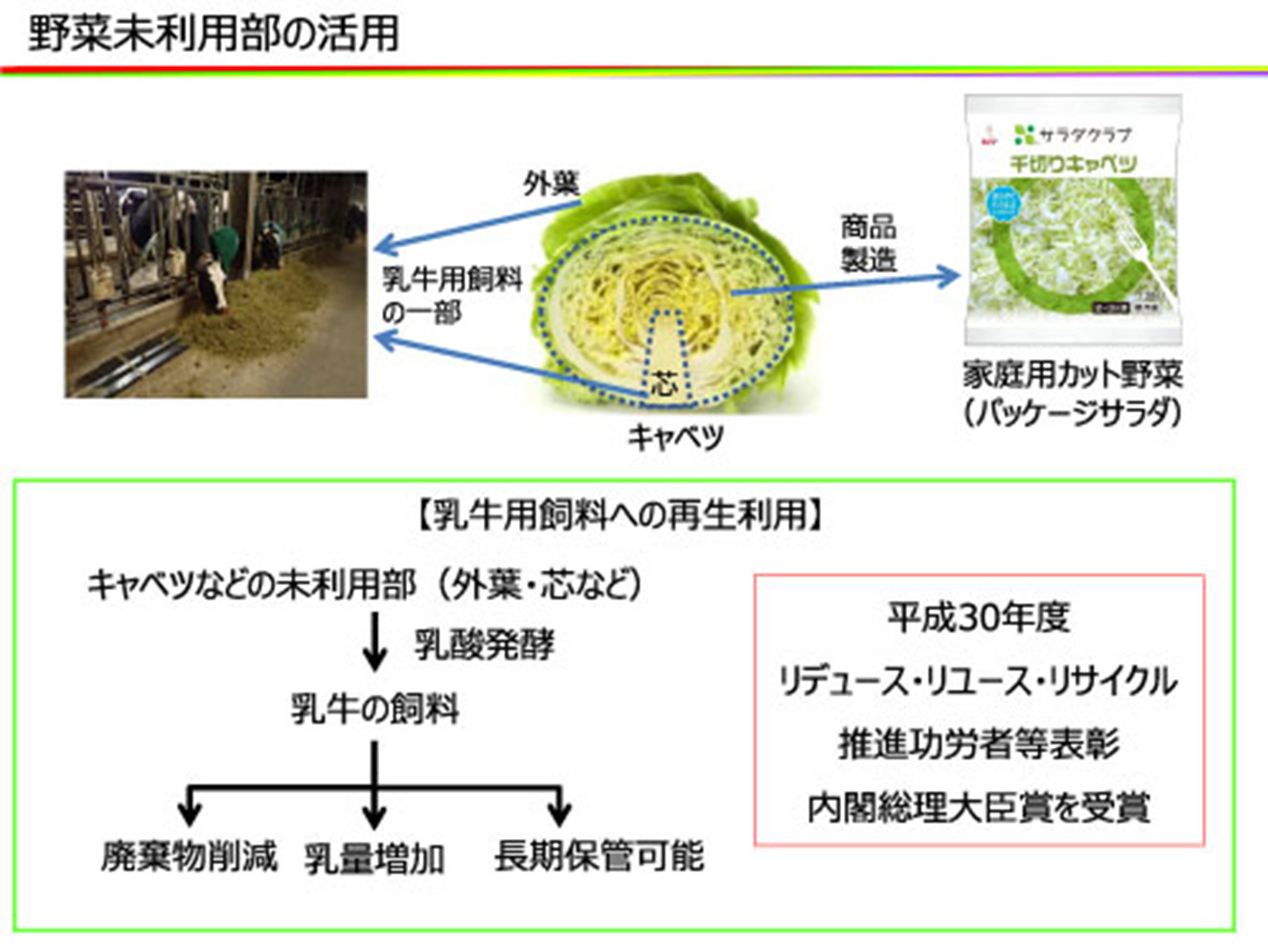
当社は、国内において、キャベツを原料として一番多く使用していることから、キャベツの未利用部の活用に取り組んでいます。
カット野菜の主力商品である「キャベツの千切り」を製造する工程において、利用していない芯や外側の葉を乳酸発酵し、乳牛の飼料にすることで、未利用部の有効利用とともに、牛が出す乳の量が増加するという効果も確認されています。
この取り組みに対して、昨年、内閣総理大臣賞をいただきました。
引き続き、野菜の未利用部の活用に向けて、行政や大学などの研究機関と取り組んでいきます。 -
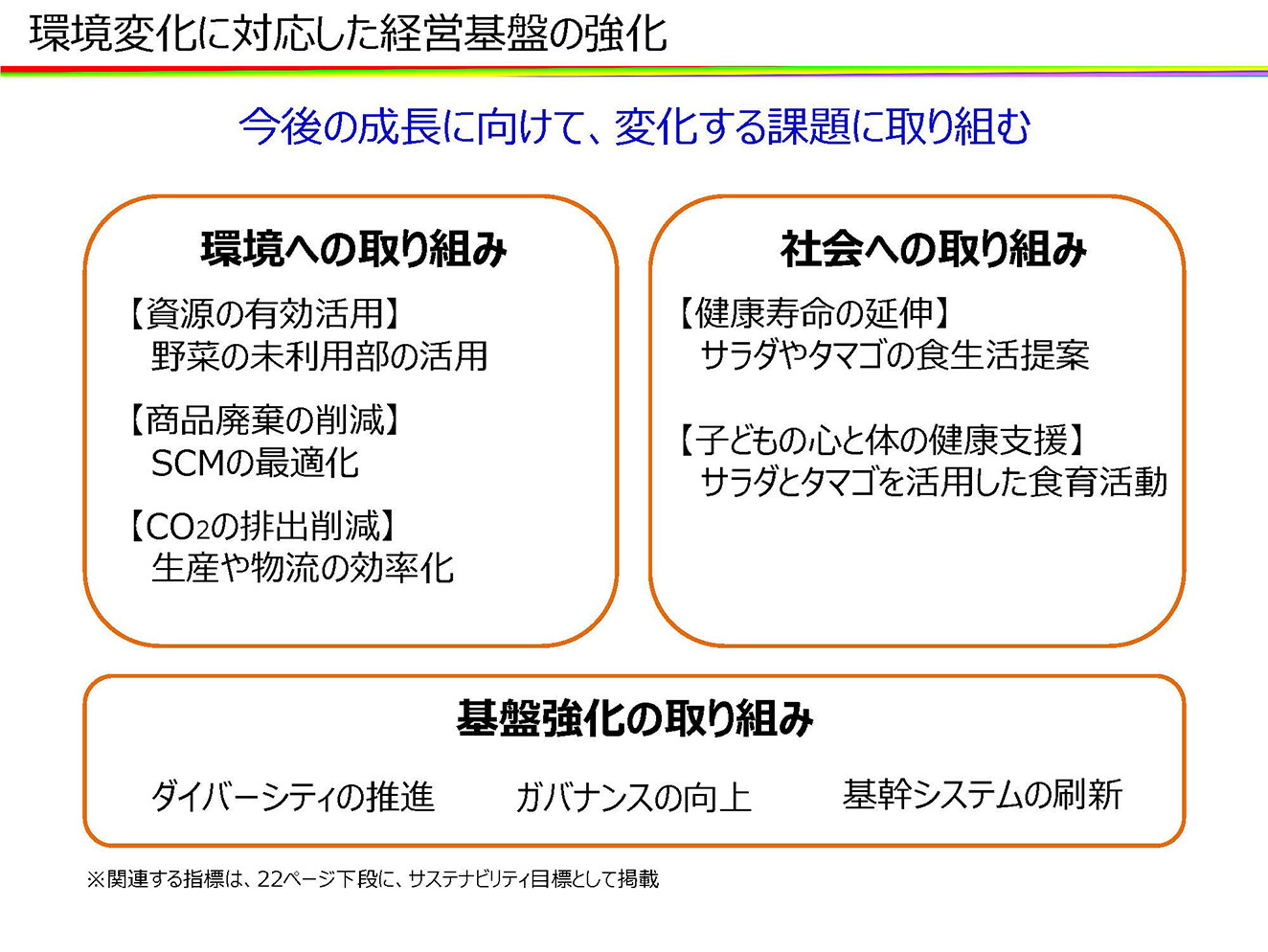
社会に対する主な取り組みは、サラダやタマゴを軸にした、食生活の提案や食育活動などになります。
また、ダイバーシティの推進や、ガバナンスの向上、基幹システムの刷新などを行い、基盤を強化していきます。
-
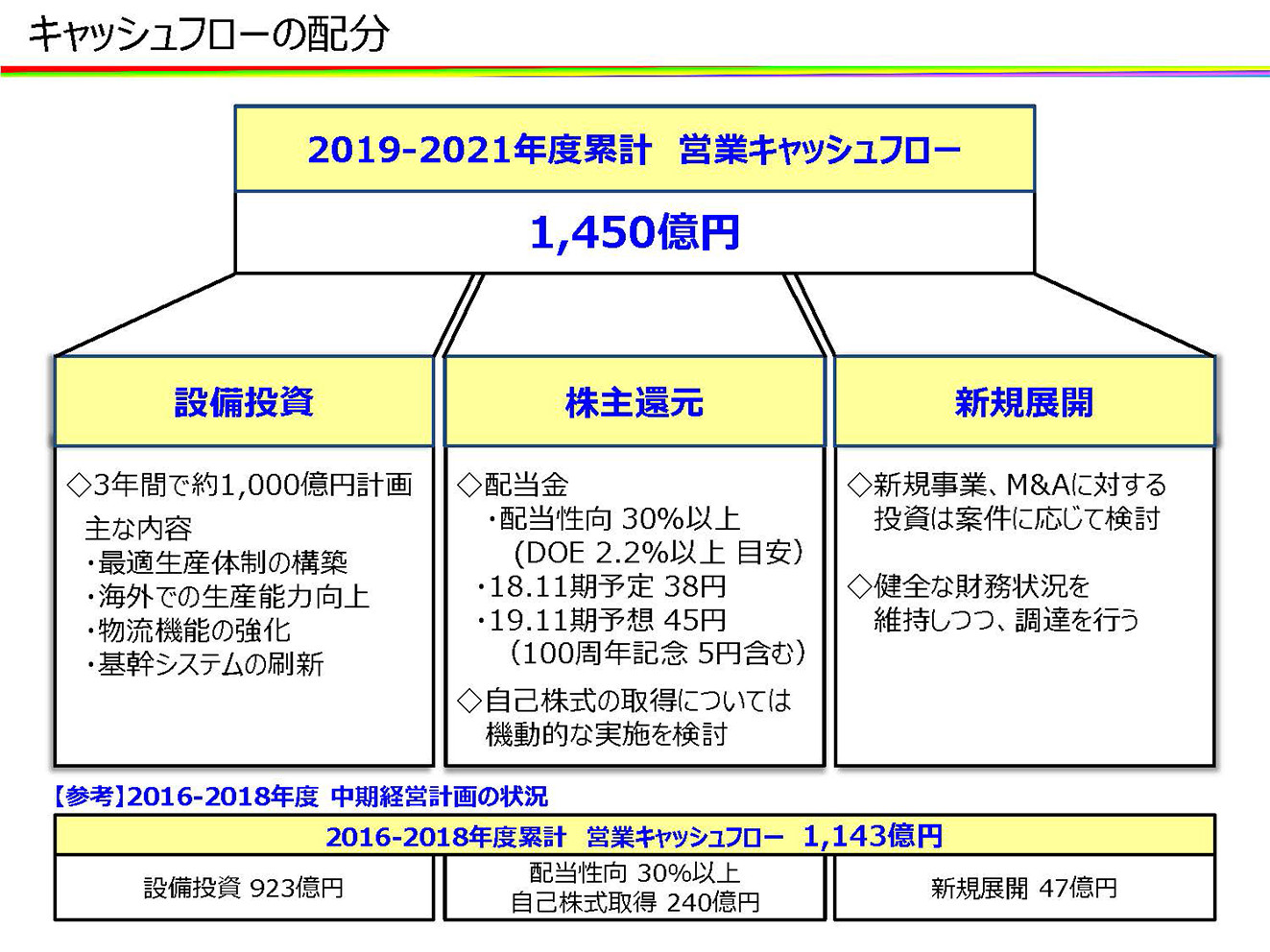
第9次中期計画の営業キャッシュフローは、累計で1,450億円を計画しており、設備投資で約1,000億円を使用する見込みです。
主に、最適生産体制の構築、海外での生産能力向上、物流機能の強化、基幹システムの刷新などに、投じていく予定です。株主還元については、配当金の決定基準として配当性向30%以上を継続していきます。今期末の配当金については、創業100周年記念の5円を含む、7円増配を予定しています。
-

-
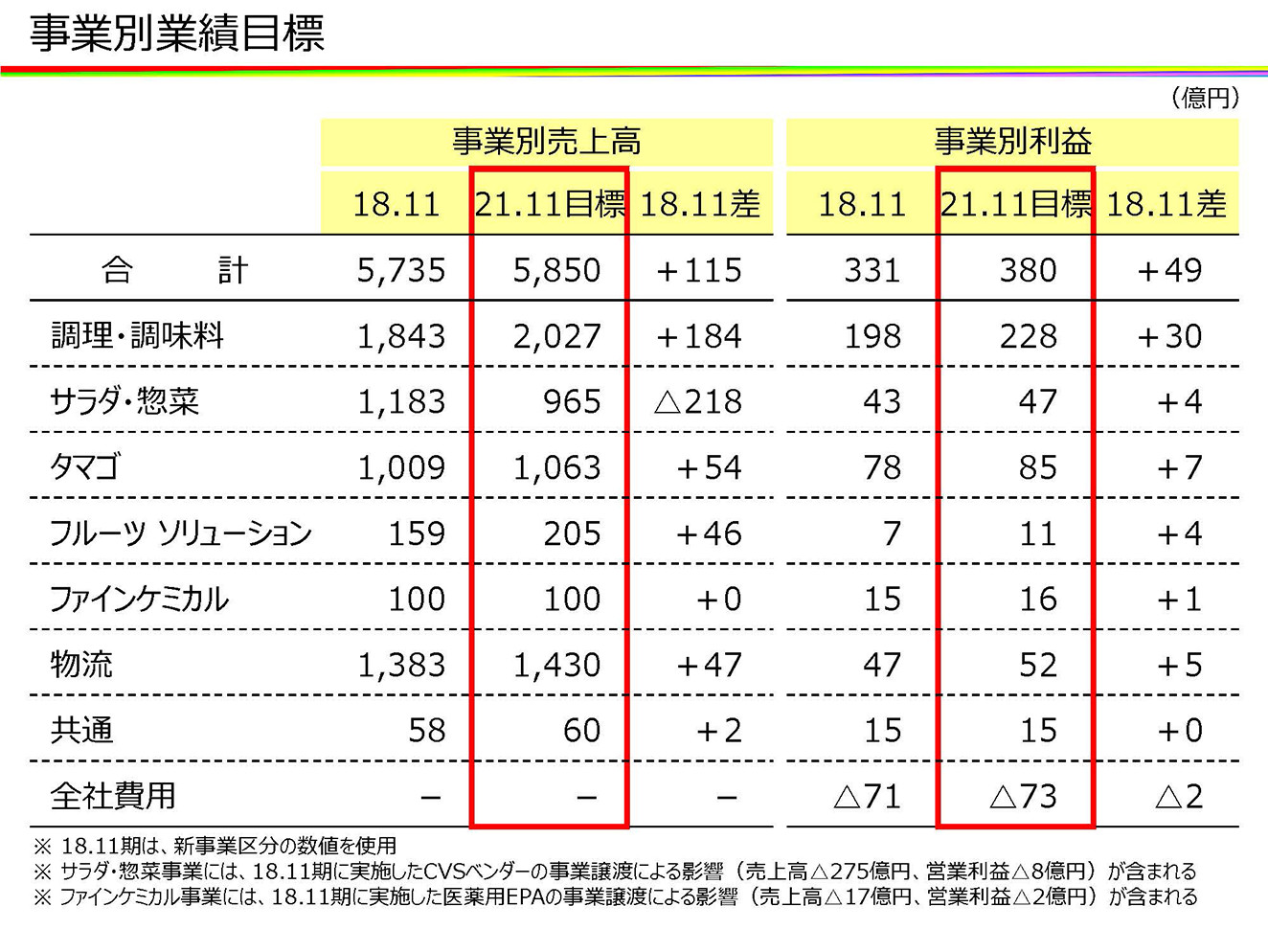
事業別の売上高と利益です。
売上高につきましては、調理・調味料事業が牽引します。
サラダ・惣菜事業については、事業譲渡によるマイナス影響が275億円含まれています。営業利益は、全ての事業で増益を見込んでいます。
-
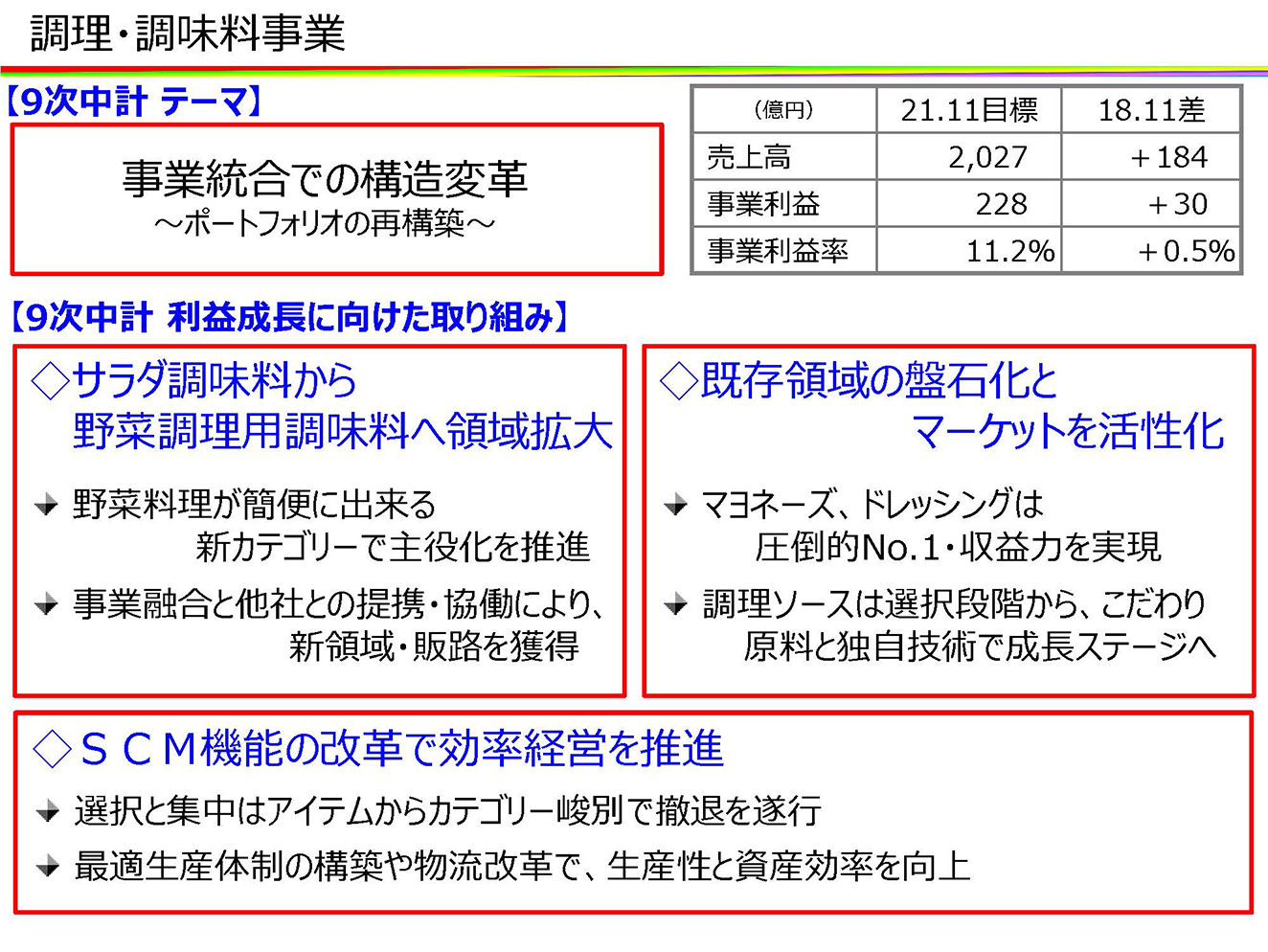
調理・調味料事業です。
第9次中期計画では、これまでの調味料事業とアヲハタ株式会社部分以外の加工食品事業をひとつに統合することで、野菜を調理するための調味料へ、領域を拡大させていきます。
さらに、カテゴリーごとのポートフォリオを見直すことで、これまでのアイテムの削減から、カテゴリーの峻別に取り組みを進化させていきます。
そして、最適生産体制の構築や、在庫削減などの物流改革を進めるとともに、万能調味料化や付加価値化への取り組みも進め、基幹であるマヨネーズやドレッシングの成長を実現していきます。
-
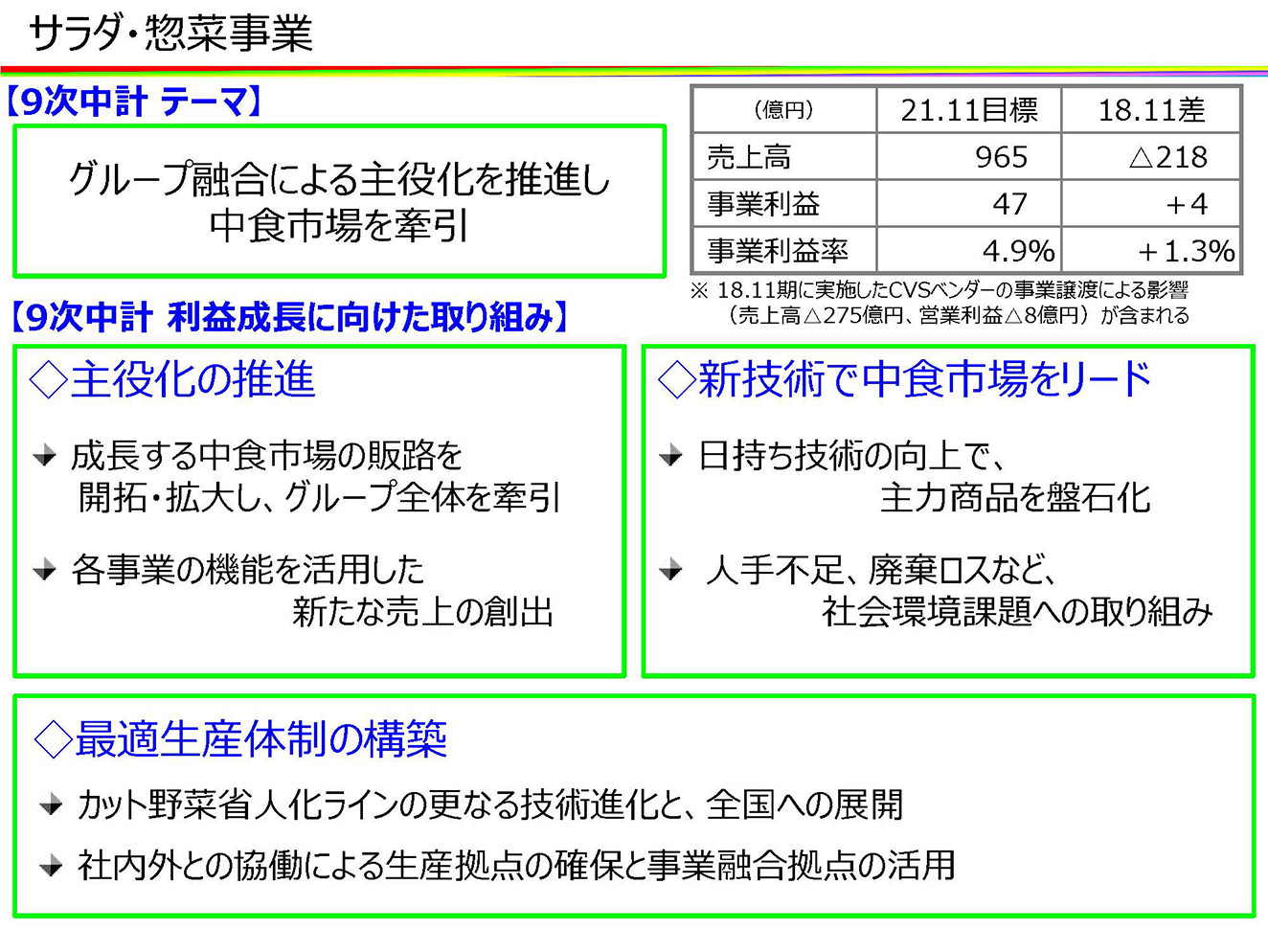
サラダ・惣菜事業は、調理・調味料事業やタマゴ事業との融合による食の主役化を、中食市場において牽引していきます。そのためにも、中食市場における新しい販路の開拓を進めていきます。
また、技術の向上や新技術の展開を進めることで、事業の成長を実現します。
日持ち技術の向上により、消費期限を延長することで、生産コストの削減、売場でのチャンスロスの低減、遠隔地への配送、さらには食品ロスの削減にも取り組んでいきます。
そして、2019年度に導入するカット野菜の省人化ラインについて、その技術を全国に展開することで、人手不足への対応に加え、品質向上にも活かしていきます。
-
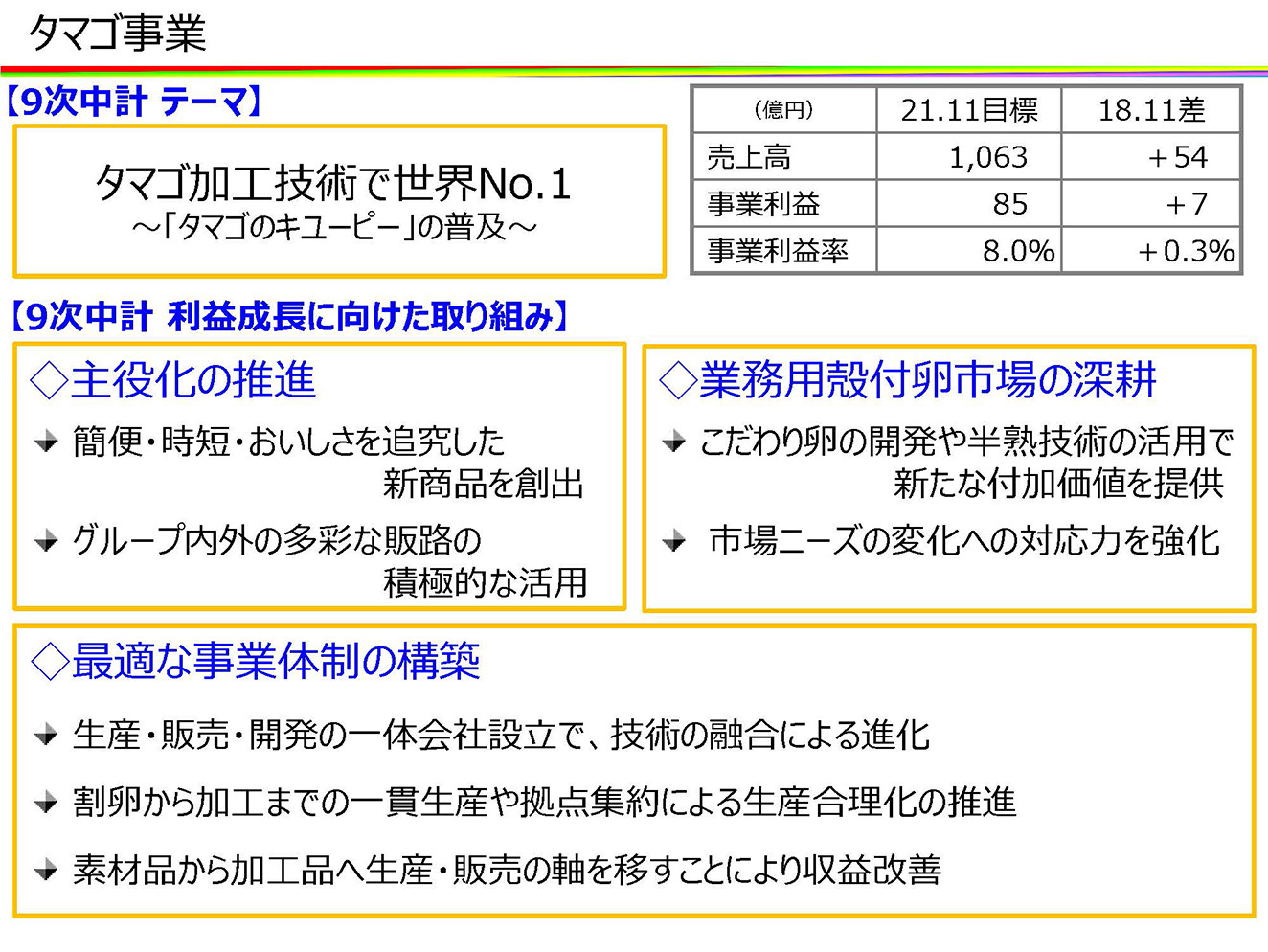
タマゴ事業は、新しい事業体制により、タマゴの加工技術を高め、タマゴの分野において確固たる地位を築いていきます。
2018年の12月、液卵などの素材品を製造・販売するキユーピータマゴが、加工品を製造するカナエフーズを吸収合併しました。
素材品と加工品の技術の融合により、新たな商品を創出していきます。
また、割卵から加工までの一貫生産や生産拠点の集約により、生産合理化を進めます。そして、素材品から加工品へ軸足を移し、利益を創出する力を高めていきます。
-
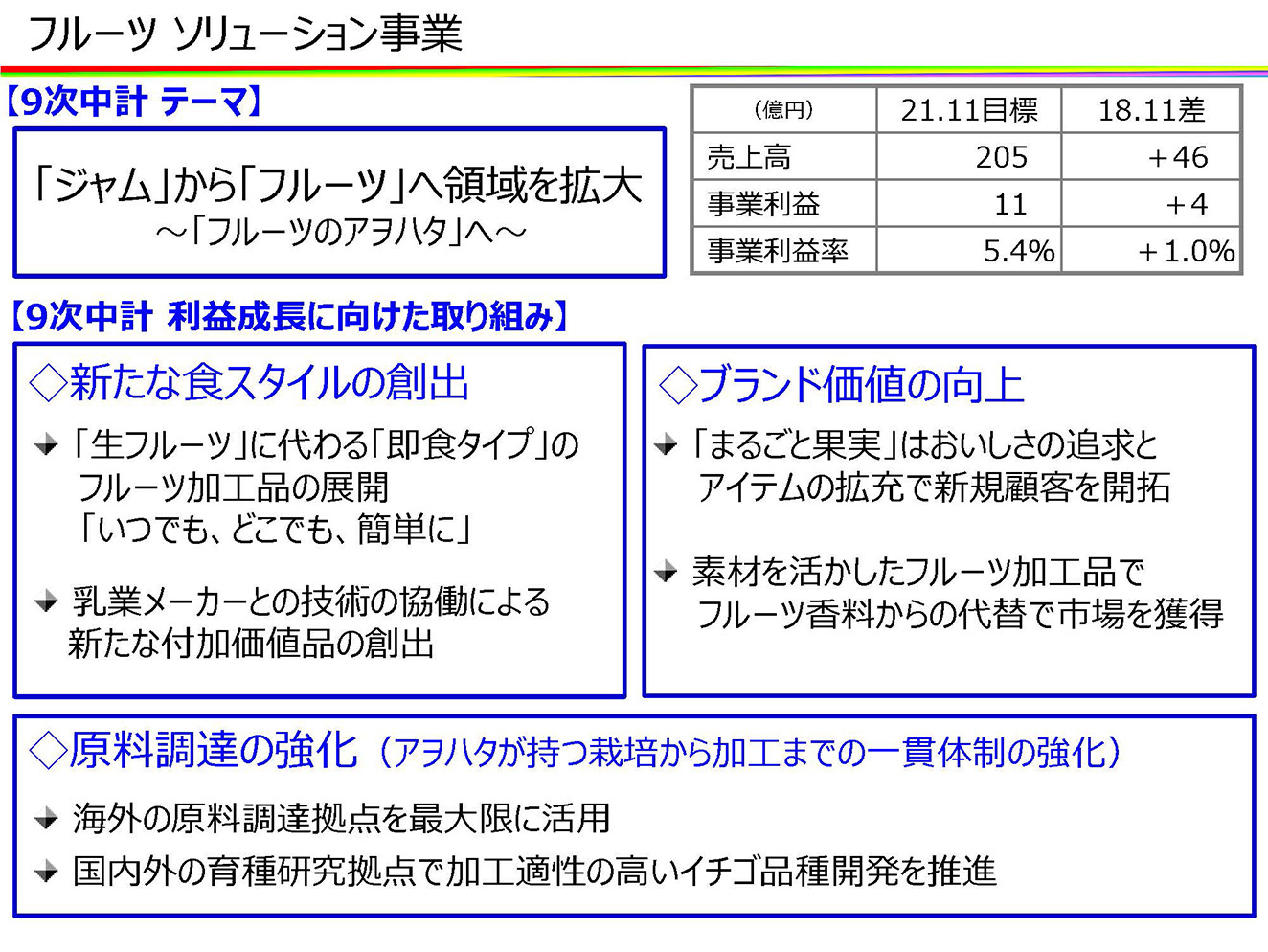
フルーツ ソリューション事業は、フルーツ加工に特化することで、市場での優位性を高め、付加価値の高い事業をめざします。
特に成長している乳製品市場に対しては、社外との協働も進め、新たなフルーツ加工品を創出し、フルーツの領域を拡大していきます。
-
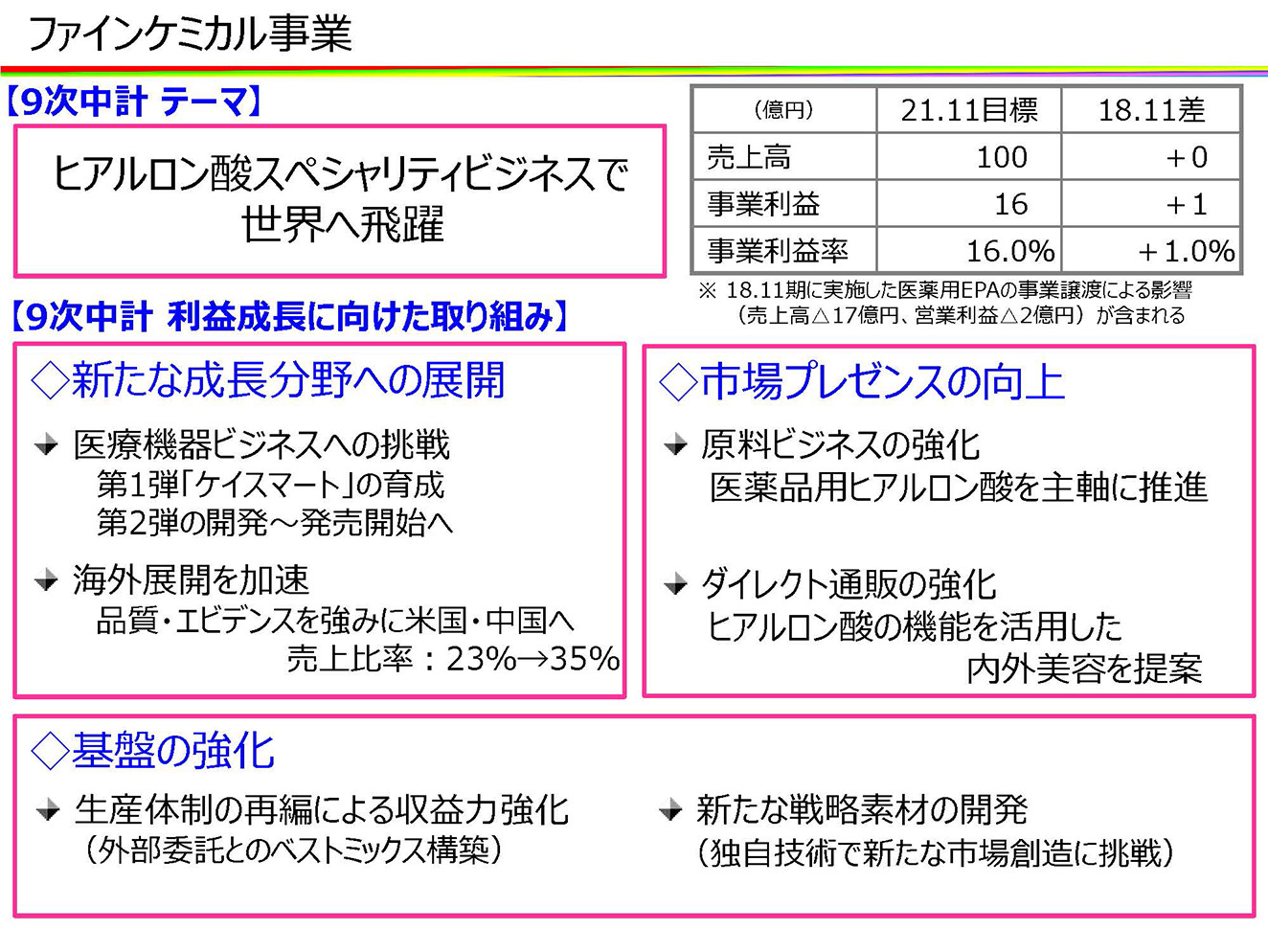
ファインケミカル事業は、ヒアルロン酸に特化していくことで、新たな価値を創出するとともに、市場での存在感を高めていきます。
また、医療機器ビジネスや海外展開といった、新たな成長分野への展開を進めていきます。
そして、外部委託の活用を含めた生産体制の再編も行うことで、コスト競争力も高めていきます。
-
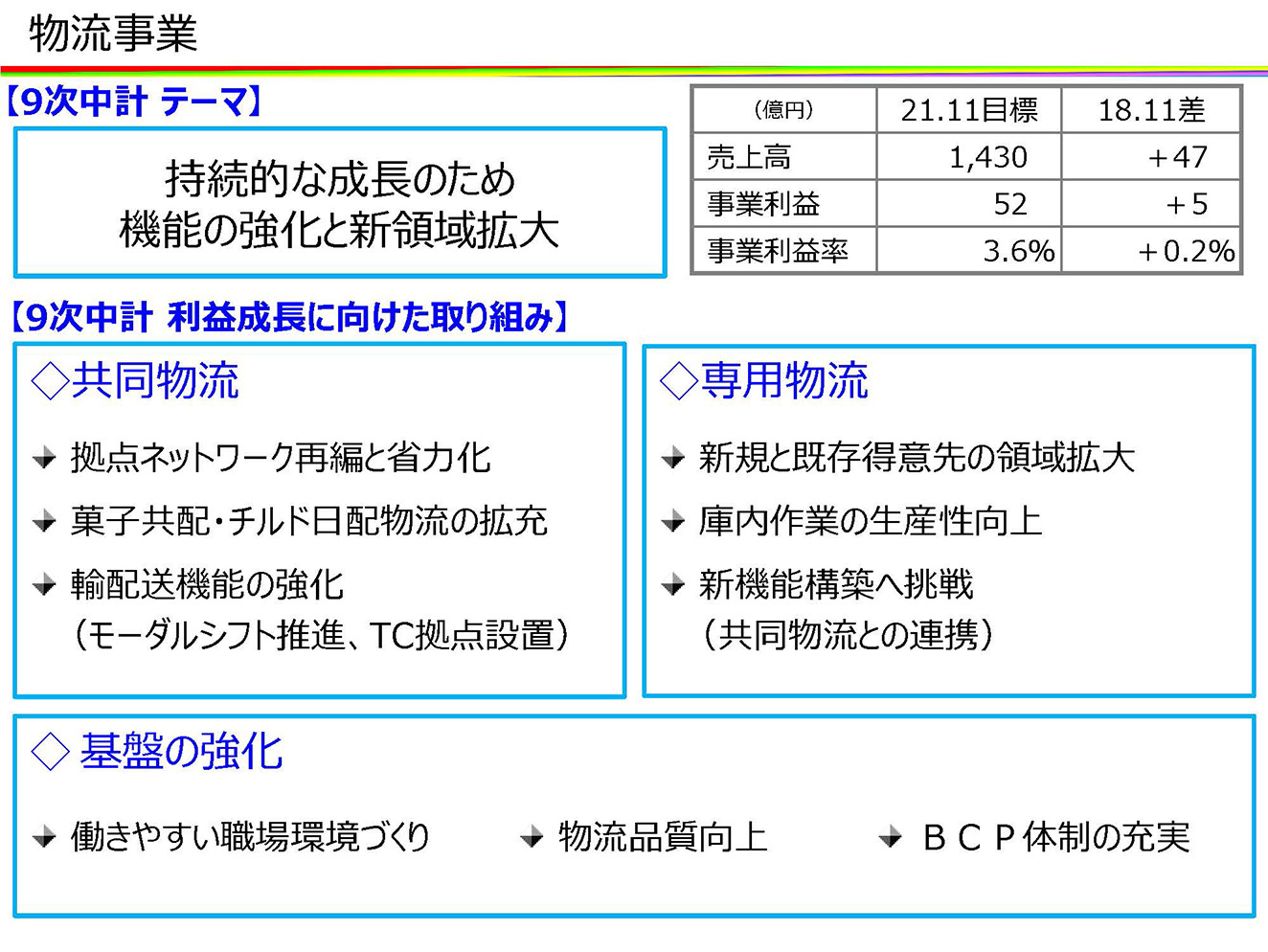
物流事業は、食品の安全・安心を守り抜く物流サービスにより、グループの品質を支えるとともに、物流の効率化を進めるうえで重要な機能です。
国内の食品物流業界をリードしていけるよう、より高品位の物流サービスを実現していきたいと考えています。
9次中期計画では、成長に向けた投資を行い、輸配送などの機能を強化するとともに、お客様への提案を強化し、新しい領域への拡大を進めていきます。
-

-
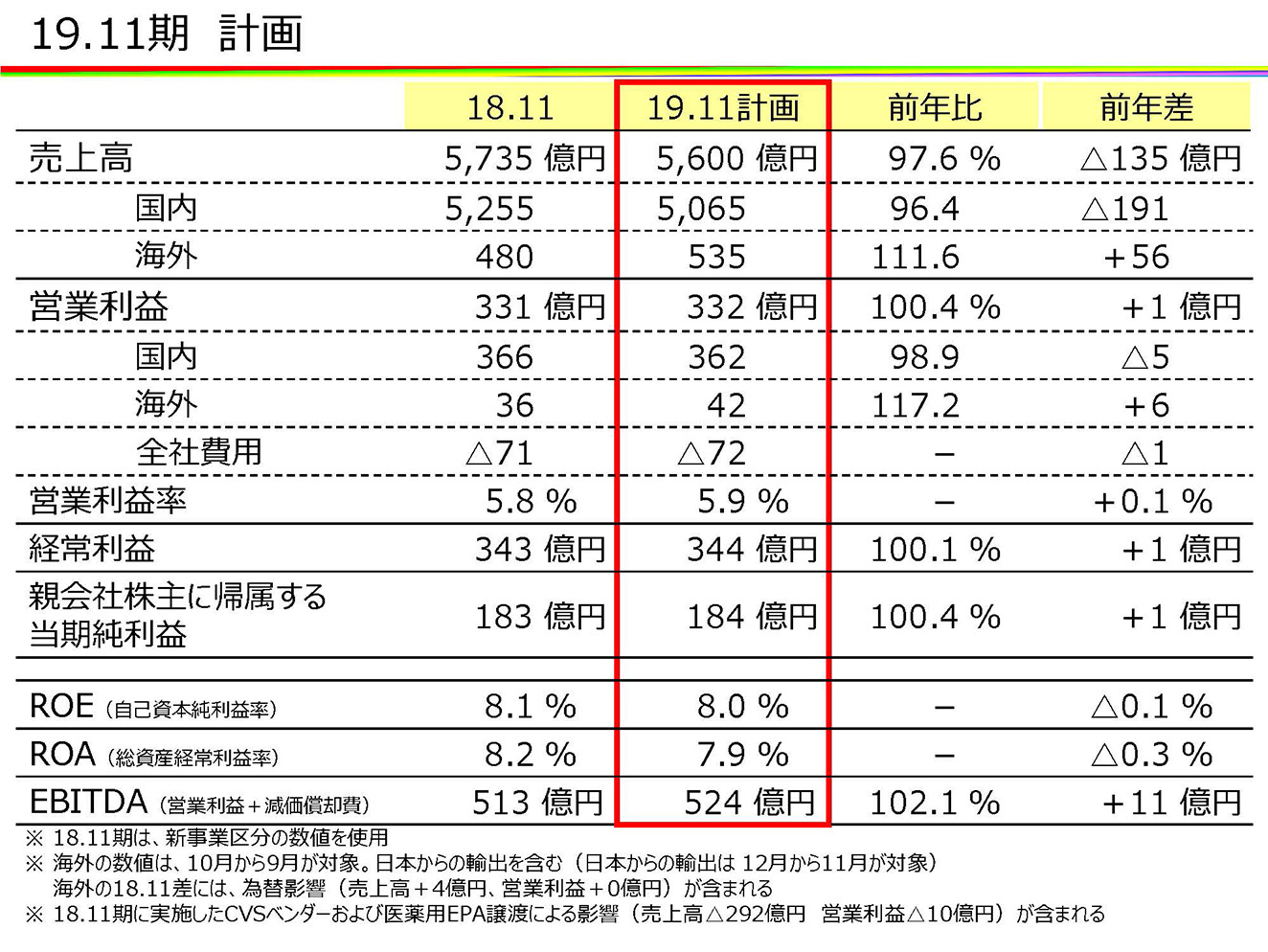
2019年度の計画について、売上高は、前年に対し、135億円減の5,600億円、営業利益は1億円増の332億円を計画しています。
国内は、2018年度の事業譲渡による影響が、売上高でマイナスの292億円、営業利益でマイナスの10億円となっており、その影響を除くと、売上高101億円、営業利益5億円を伸ばす計画となります。
また、2019年は創業100周年となることから、お客様への感謝を込めた記念企画などの費用を見込んでいます。
経常利益は1億円増の344億円、当期純利益も1億円増で184億円を計画しています。
-
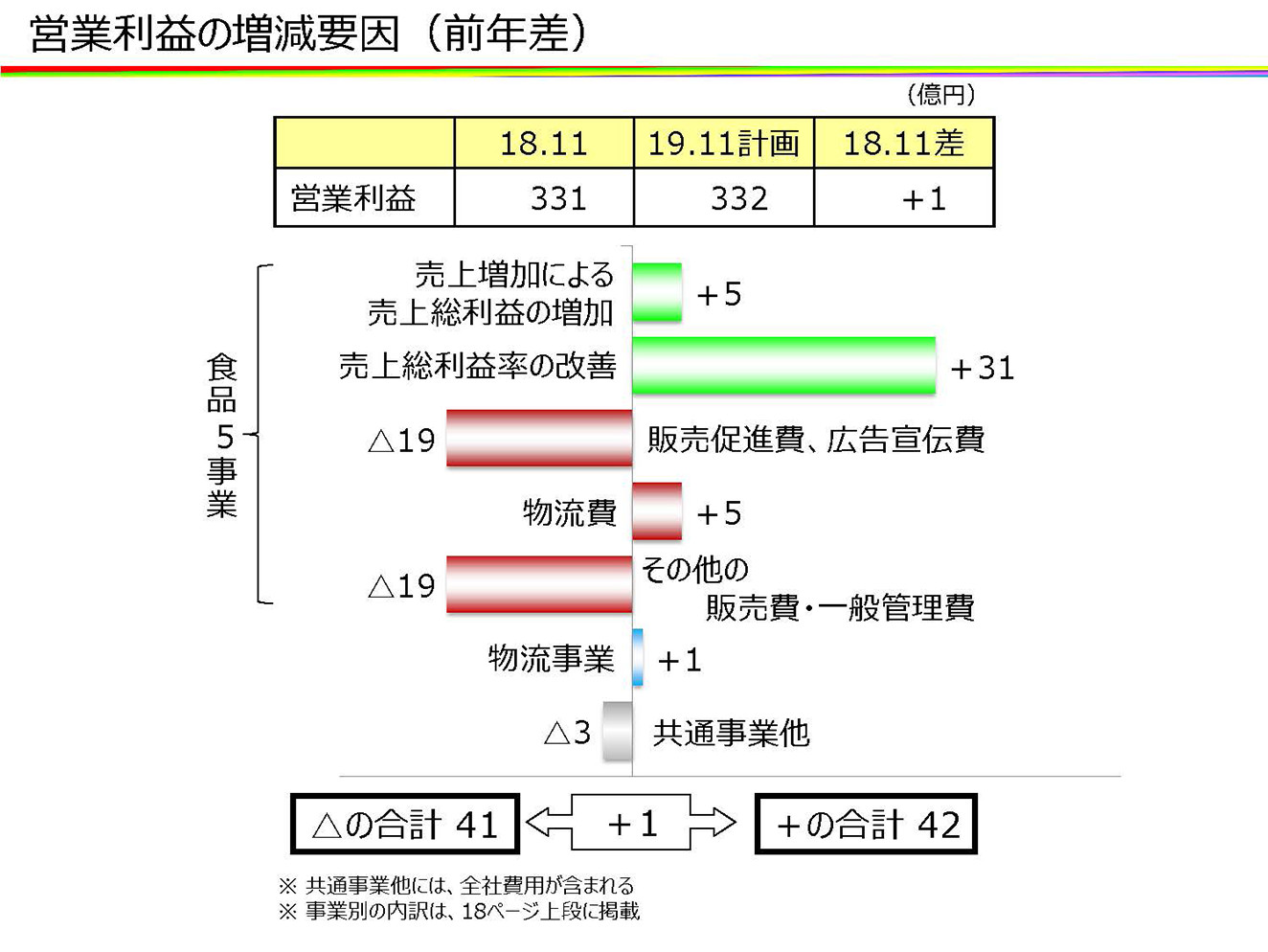
営業利益1億円増については、主に売上総利益率の改善が寄与する計画です。
-
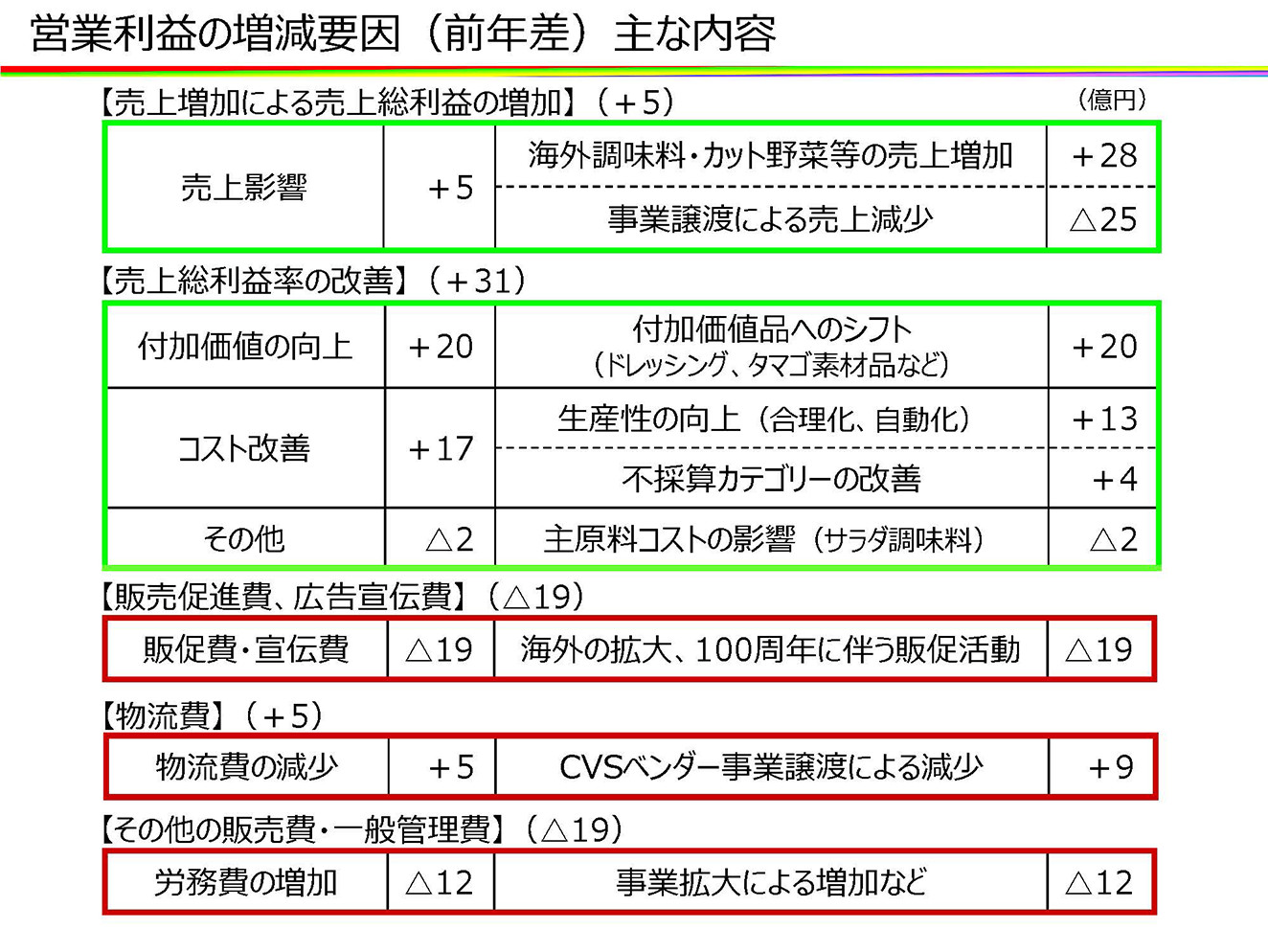
売上増加による売上総利益の増加は主に、海外のマヨネーズやドレッシング、国内のカット野菜の売上増加です。
売上総利益率の改善は、付加価値の高い商品の販売ウェイトを上げていく取り組みで20億円、生産性の向上などのコスト改善の取り組みで17億円を創出していきます。
主原料価格につきましては、2億円のマイナス影響を見込んでいます。
販売促進費と広告宣伝費の増加は、主に海外展開や創業100周年に関する費用によるものです。物流費については、コンビニエンスストア向けベンダーの事業譲渡により、9億円減少した影響によるものです。
その他の販売費・一般管理費は、主に事業拡大による労務費の増加によるものですが、創業100周年に伴い、従業員にも報いて行きたいと考えています。
-
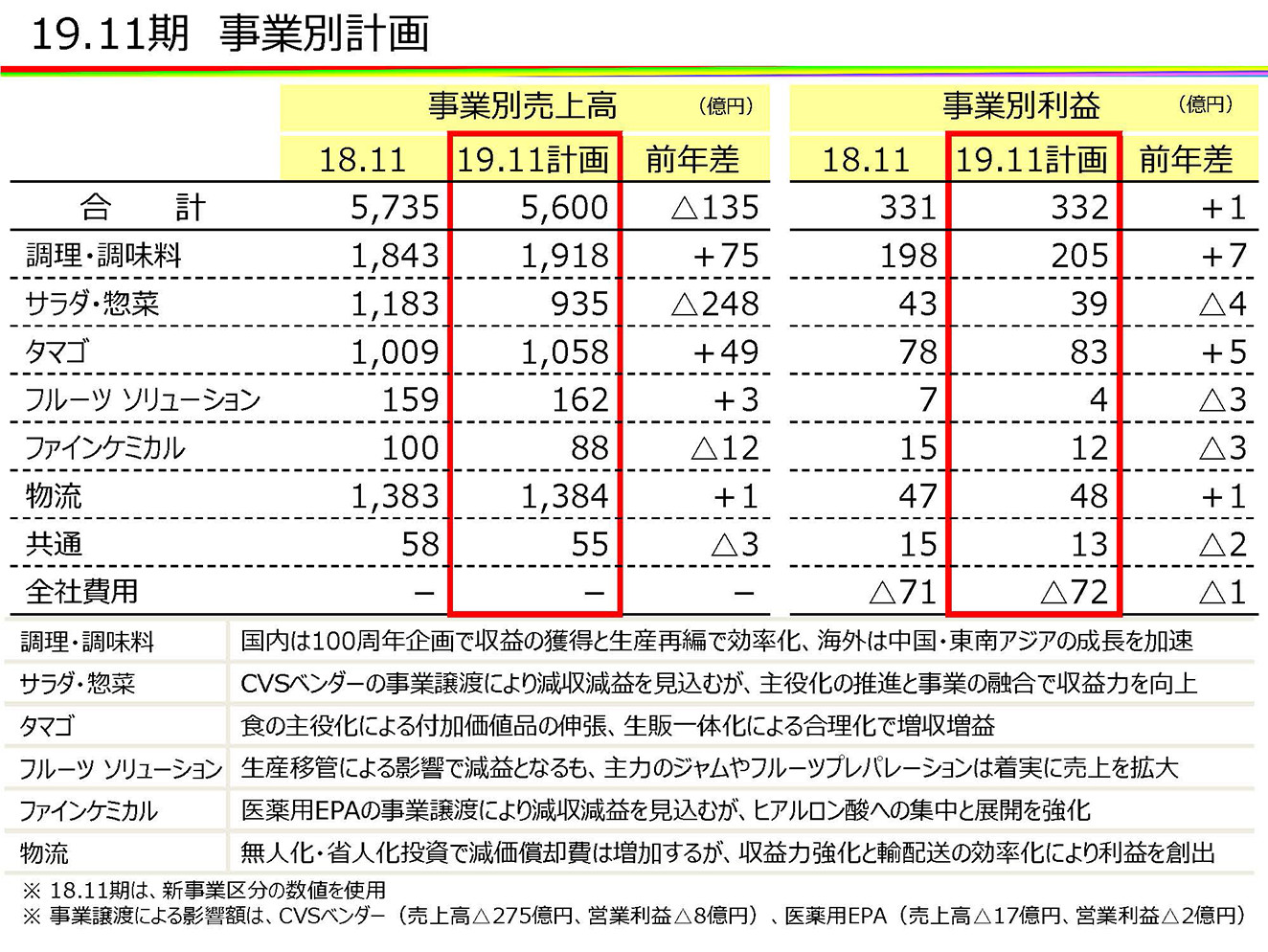
2019年度の事業別売上高と営業利益の計画です。
売上高については、調理・調味料事業の75億円増収のうち、海外が54億円となります。
国内については、創業100周年の記念企画を含め、盛上げていく予定です。
国内7つの地域で、地元に根付いた調味料とマヨネーズを合わせた商品を、創業100周年記念として、期間限定で発売します。
この他にも、記念企画を予定しています。
-

2019年度から始まった第9次中期計画は、2030年、そして、その先の100年に向けた第1歩です。国内・海外での利益成長をしっかりと進めていきます。
Q&A (Japanese only)
9th Medium-Term Management Plan
-
For example, while egg products were mostly sold to food service, recently, Deria Foods Co., Ltd., which manufactures and sells delicatessen foods to supermarkets, has started selling egg products to supermarkets as well. By utilizing their respective sales channels, the egg business and the salad/ delicatessen foods business are seeing increased sales. Furthermore, they will develop new products and expand sales channels for mayonnaise and dressings. They are also pursuing collaborations with external partners, commercializing egg dishes using meat and ham, and expanding their product range to include products for home use.
-
There are three concepts for building an optimal production system.
The first is consolidation. Our group currently has about 80 domestic production bases, but because we can supply products without them being scattered throughout the region due to the development of transportation networks, we will focus on the Kansai region in our 9th Medium-Term Plan.
The second is focus. By clearly defining which categories to focus on, space becomes available in existing factories, making it possible to consolidate factories and production lines.
The third is integration. We are increasingly being asked by our clients to propose solutions that encompass all three businesses. As the department that sells prepared delicatessen foods often handles products from our egg business, we can use production lines located on the same premises or in the same building for multiple businesses, enabling us to manufacture products that are not tied to a specific business in a single factory. -
Production restructuring can be difficult to quantify in terms of profits.
Domestically, we plan to reorganize and integrate approximately 20 locations by 2024. While we expect to see gradual improvements in efficiency and other areas, ROA will not increase significantly due to other investments, and we anticipate seeing changes from 2025 onwards. Towards 2030 VISION, we will continuously strive to improve ROA and quality, thereby achieving increased profitability. -
Because the scale of the investment is large, it will continue to increase for a while, but the rate of increase will gradually slow down.
-
The 9th Medium-Term Plan aims to change the organizational structure and is designed to curb sales growth. If sales growth is accompanied by increased profits, there is a possibility that profits will exceed expectations.
On the other hand, we do not anticipate any significant fluctuations in the price of key raw materials until fiscal year 2021, and any price increases would be a factor that reduces profits. -
Regarding shareholder returns, we aim for steady dividend increases, and we intend to increase the rate of increase to some extent, similar to the commemorative dividend in fiscal year 2019. We will gradually strengthen our share buyback program as part of our efforts to improve the efficiency of shareholder equity.
-
We do not anticipate an increase in interest-bearing debt over the next three years. Our target D/E ratio is 0.3.
100th anniversary
-
We are planning to spend approximately 1.6 billion yen on expenses for our 100th anniversary. These will mainly include advertising, consumer campaigns, and employee rewards.
The business that accounts for a relatively large portion of the cost allocation is the cooking and condiments business.
Cooking and condiments business
-
In fiscal year 2018, the frequency of salads appearing on dinner tables decreased by approximately 5% due to factors such as soaring vegetable prices. While the overall market is expected to see gradual growth as health consciousness increases and the need for vegetable consumption rises, our company will take measures to address the rising vegetable prices by expanding the uses of our dressings by making them more versatile condiments.
Furthermore, dressings offer a wide variety of flavors and tastes, and we will leverage these unique characteristics to add value, create new salad trends, and expand the demand for dressings. In addition, we will create new categories such as sauces for vegetable preparation to meet the growing need for vegetable consumption. -
In fiscal year 2019, we will absorb the 100th-anniversary expenses and achieve our plan by expanding our dressing business.
-
Compared to fiscal year 2018, we plan to increase domestic sales of mayonnaise by 101% and salad dressing by 105%, while overseas sales of mayonnaise by 108% and salad dressing by 116%.
-
We assume that the price of edible oil, our main raw material, will remain relatively stable. Although labor and logistics costs are rising, we believe we can absorb them through our own efforts.
Egg business
-
In our 9th Medium-Term Plan, our domestic egg business will see an increase in depreciation expenses of approximately 1 billion yen due to the operation of the new factory. However, we will shift towards high-value-added products utilizing small-packaged frozen eggs and soft-boiled egg technology, and increase profits through rationalization and consolidation at the new factory and other facilities.
Furthermore, at the newly established Itami factory, we will develop new products in conjunction with our salad and delicatessen foods business and our cooking and condiments business, thereby creating added value.
China
-
The main reason for not meeting the targets of the 8th Medium-Term Plan is the slowdown in mayonnaise sales. The entry of major foreign companies and the delay in implementing countermeasures have had a significant impact. Mayonnaise sales in fiscal year 2018 are recovering, with the first half at 93% and the second half at 101% compared to the previous year. Dressing sales remain strong, with the first half at 120% and the second half at 122% compared to the previous year. We are focusing on sales promotion in supermarkets and have reviewed the content of in-store displays. We expect sales in the first quarter of fiscal year 2019 to be around 109% compared to the previous year. In addition, while marketing and other activities have been conducted locally until now, we will promote initiatives across China by leveraging the functions of our holding company, aiming for 110% growth in mayonnaise and 120% growth in dressings in the 9th Medium-Term Plan.
-
Our estimates show that the market size for mayonnaise and dressing combined is approximately 41 billion yen (approximately 110% year-on-year), with mayonnaise alone at approximately 34 billion yen (approximately 108% year-on-year) and dressing at approximately 7 billion yen (approximately 120% year-on-year). We have not calculated the figures for the first and second halves of the year separately, but we do not anticipate any changes in the second half.
-
While mayonnaise is recognized by 85% of the population (according to our research), its usage rate is only 15%, and per capita consumption is about 1/40th of that of the average Japanese person. We believe this represents a market with significant growth potential. Usage rates vary by area, being lower in rural areas. By expanding our operations, including establishing new locations, while considering the regional balance, we believe we can increase usage rates and grow the market by about 10%.
-
It's unclear how this is impacting the mayonnaise and dressing market, but with labor and logistics costs rising, it's likely that consumers are tightening their belts somewhat.
Southeast Asia
-
The main factor is the increase in sales. Fixed costs at each production site have decreased compared to the previous year, and profits have increased even more than the growth in production volume. Since this is an area where mayonnaise and dressings are not widely used, we expect further growth. In the near future, we believe we will surpass China in momentum, and we have also started to expand into egg processing products.
Europe
-
To establish a business base in Eastern Europe, we acquired a company in Poland that manufactures and sells mayonnaise and cooking oil. The impairment loss was due to a decline in earnings caused by fluctuations in cooking oil prices and delays in our sales plan for salad dressings.
2Q Financial Results Briefing
July 6, 2018 (first half of the fiscal year ending November 2018)
-
 18.5期 決算説明会
グループの新たな挑戦で飛躍的な成長を実現
3rd Stage 中間報告 -
 18.5期 業績
 -
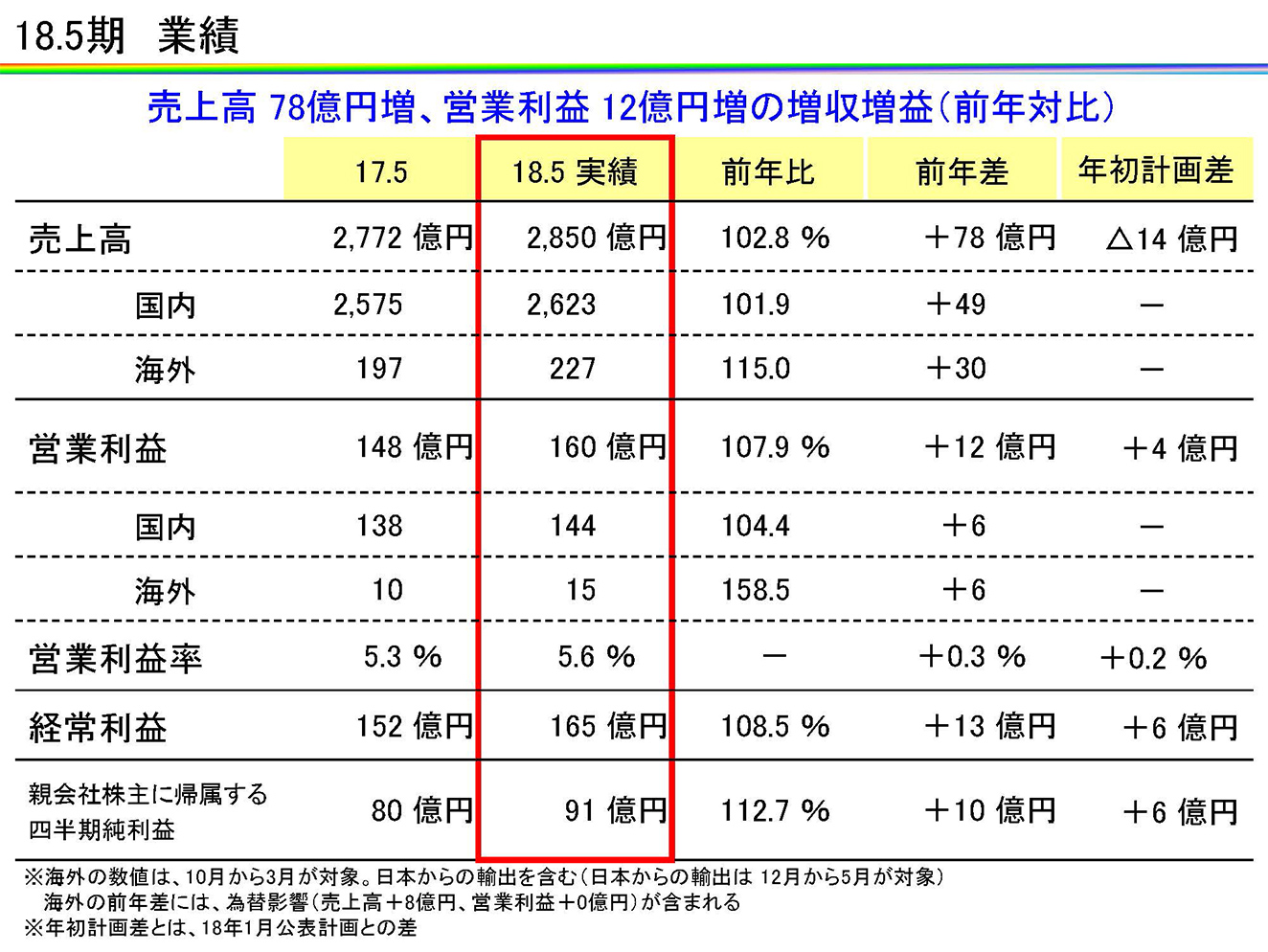
売上高は、2,850億円、前年に対して78億円の増収となりました。
国内は49億円の増収、海外は円安による為替影響8億円を含め、30億円の増収となりました。営業利益は前年に対して12億円増加の160億円、国内、海外ともに増益となりました。
-
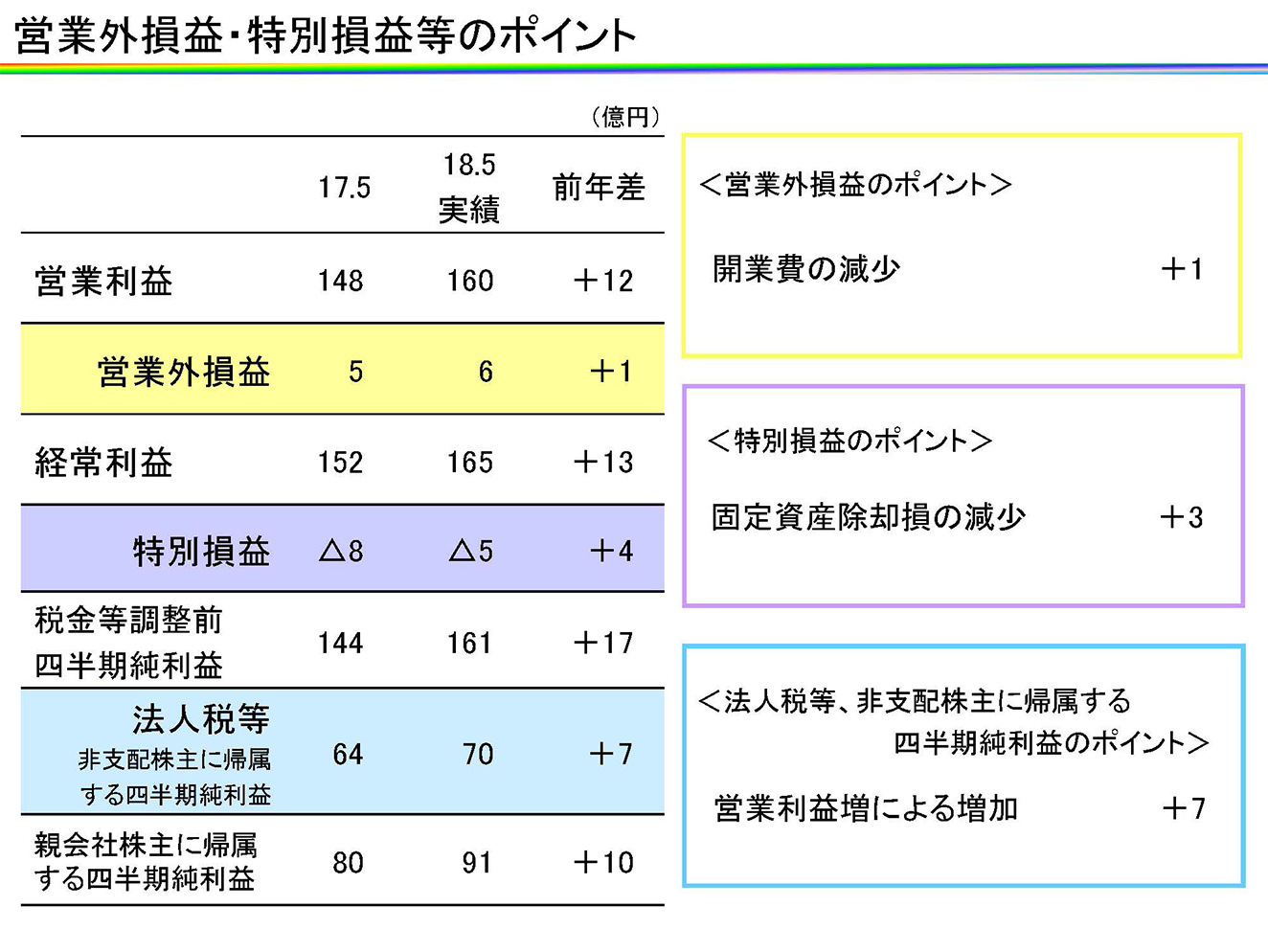
営業外損益は、前年発生した海外子会社の開業費がなくなることなどにより1億円増加し、経常利益は13億円増加の165億円となりました。
特別損益は、おもに前年発生した関西の生産拠点再編にともなう減損損失の反動などにより、4億円の増加となりました。
親会社株主に帰属する四半期純利益は、法人税等は増加しましたが、前年に対して10億円増加の91億円となりました。
-
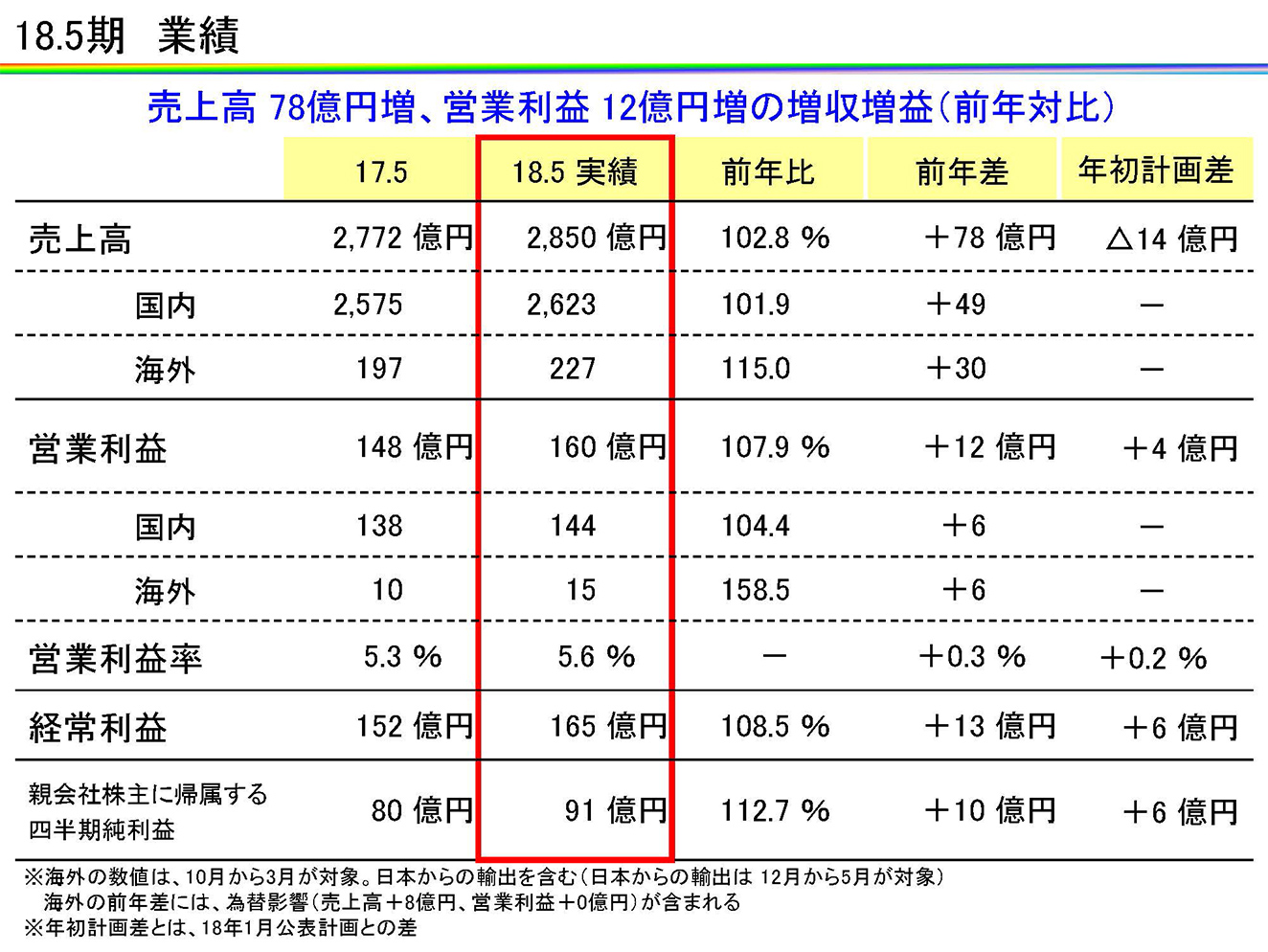
年初の計画に対する状況は、売上高は計画に届きませんでしたが、利益についてはそれぞれ達成することができました。
-
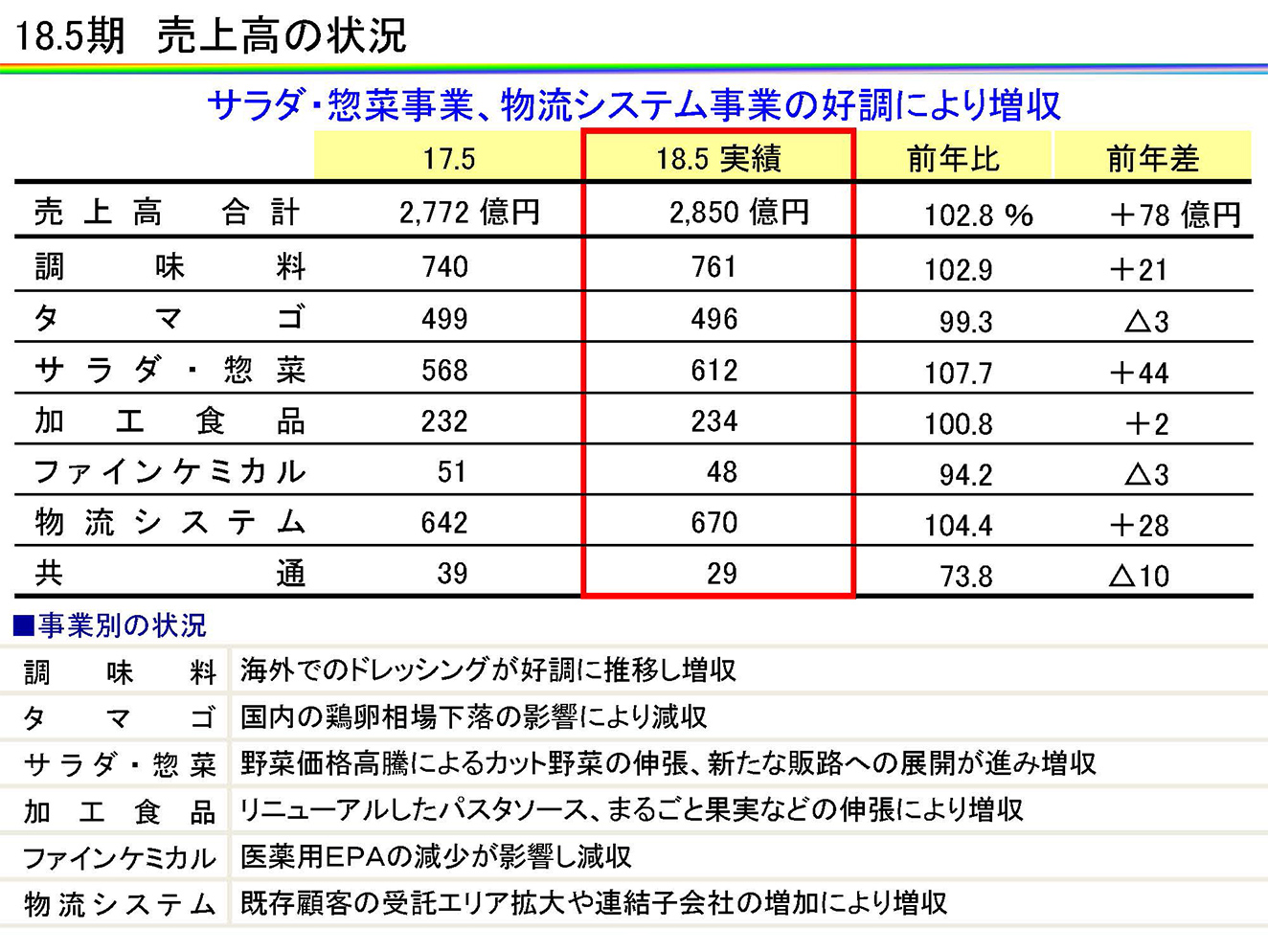
事業別の売上高の状況です。
調味料事業は、国内のサラダ調味料は伸び悩んだものの、海外でドレッシングが好調に推移し21億円の増収となりました。
タマゴ事業は、外食・中食向けの小型パックの液卵などの付加価値商品は伸びたものの、国内の鶏卵相場の下落が12億円の減収要因となり、事業全体で3億円の減収となりました。
サラダ・惣菜事業は、カット野菜が20億円増加、惣菜が外食ルートや宅配など新たな販路の開拓を含め10億円増加したことなどで、44億円の増収となりました。
加工食品事業は、付加価値の高い商品が着実に伸張し2億円の増収、ファインケミカル事業は、医薬用EPAの減少が影響し3億円の減収となりました。
物流システム事業は、既存取引先の受託拡大や、連結子会社の増加などにより、28億円の増収となっています。
共通事業の減収は、食品機械設備販売の減少によるものです。
-
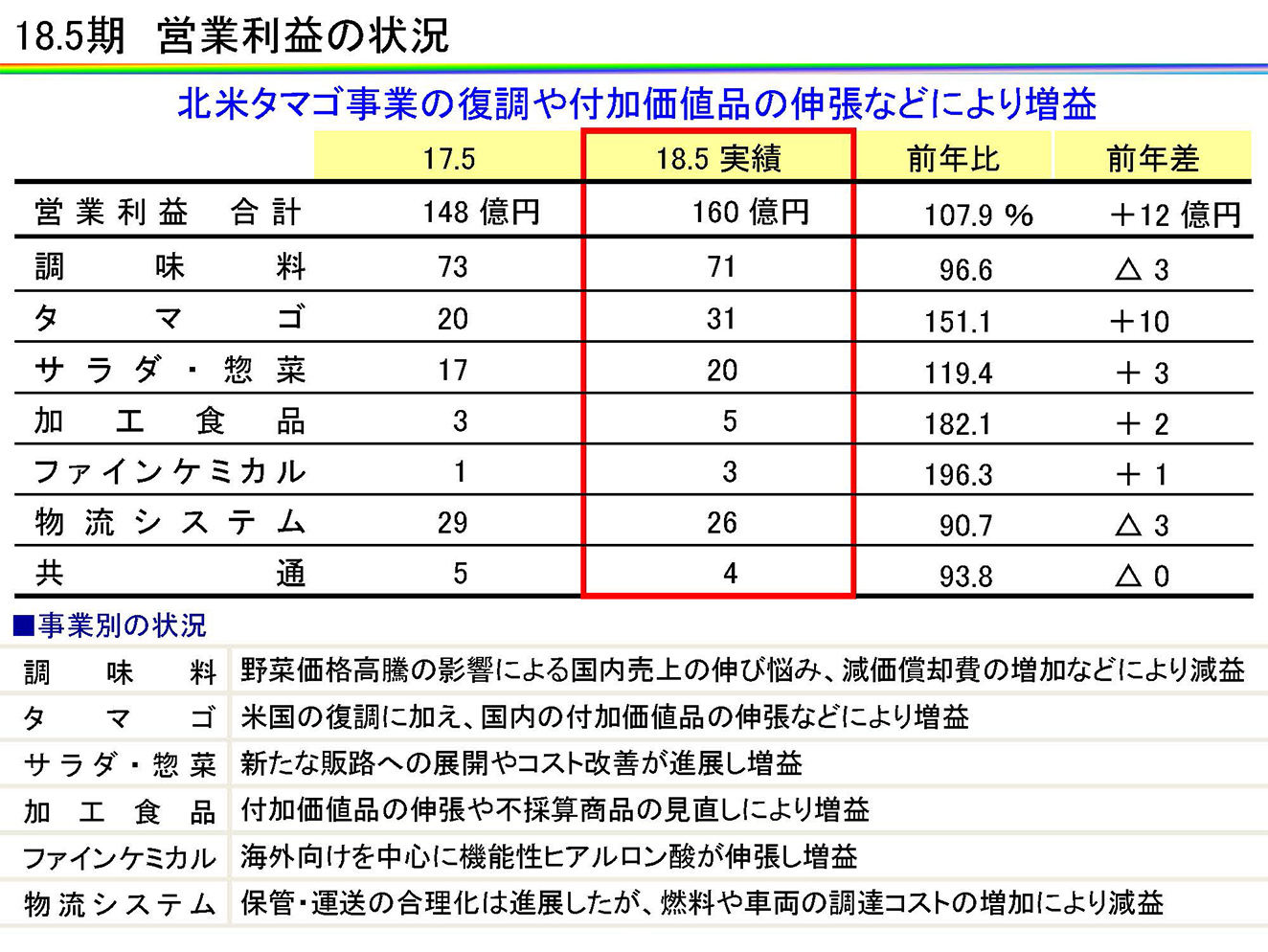
事業別の営業利益の状況です。
調味料事業は、国内での野菜価格高騰の影響による売上の伸び悩みや、減価償却費の増加が影響し、3億円の減益となりました。
タマゴ事業は、米国で5億円の増益、国内は付加価値品の伸張や鶏卵相場の下落効果があり、事業全体で10億円の増益となりました。
サラダ・惣菜事業は、売上拡大と省力化などのコスト改善が進展し、3億円の増益となりました。
加工食品事業は、ジャムなどの付加価値商品が伸張したことに加え、不採算商品の見直しなど、収益基盤の強化の取り組みを継続し、2億円の増益となりました。
ファインケミカル事業は、海外でのヒアルロン酸の伸張が利益に貢献し、増益となっています。
物流システム事業は、保管・運送の合理化は進めましたが、燃料や車両の調達コストの増加などにより、3億円の減益となりました。
なお共通事業の減益は、売上高の減少によるものです。
-
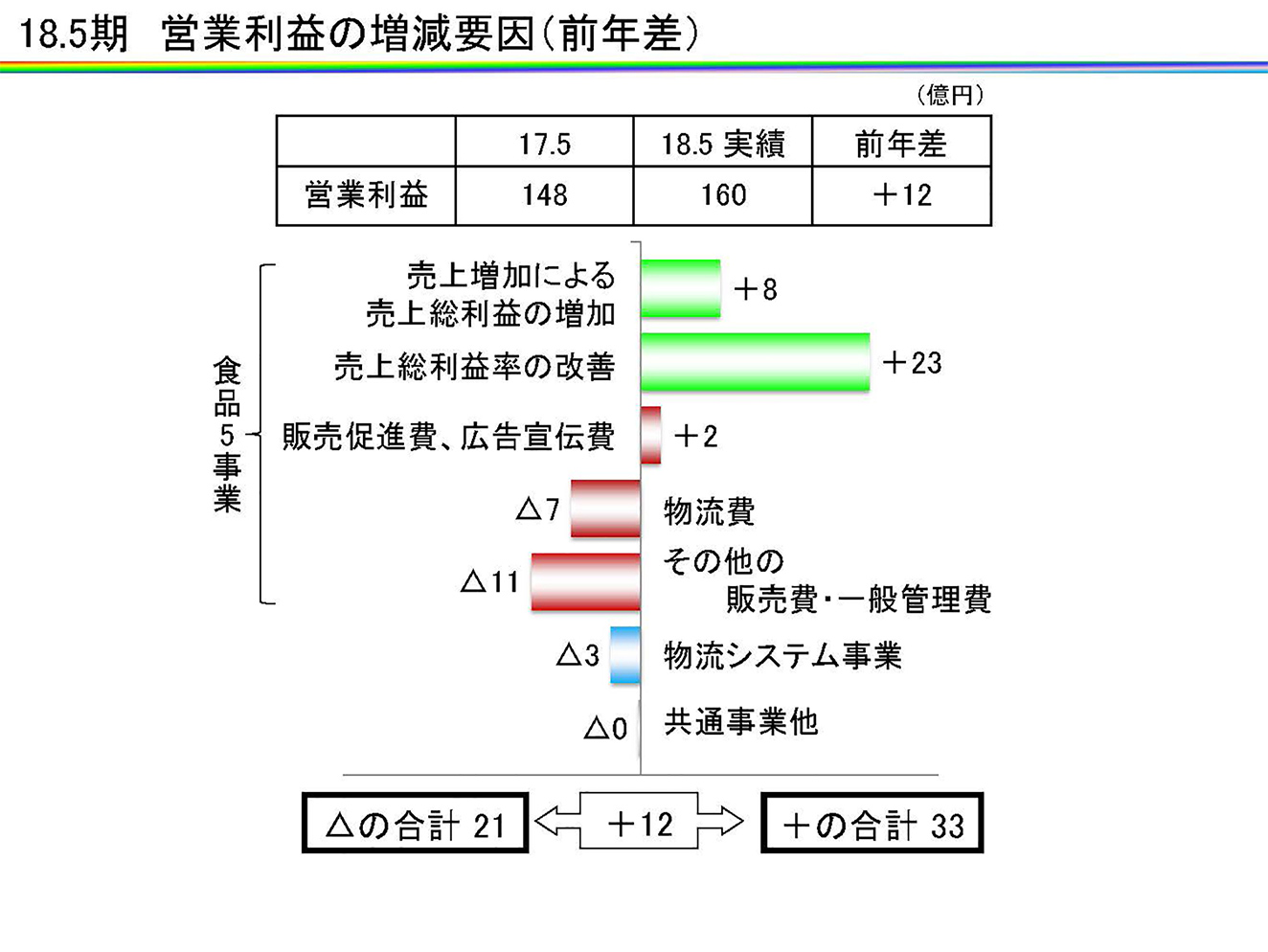
営業利益12億円増の前年差での要因は、食品事業では、売上総利益率の改善が大きく寄与しました。
-
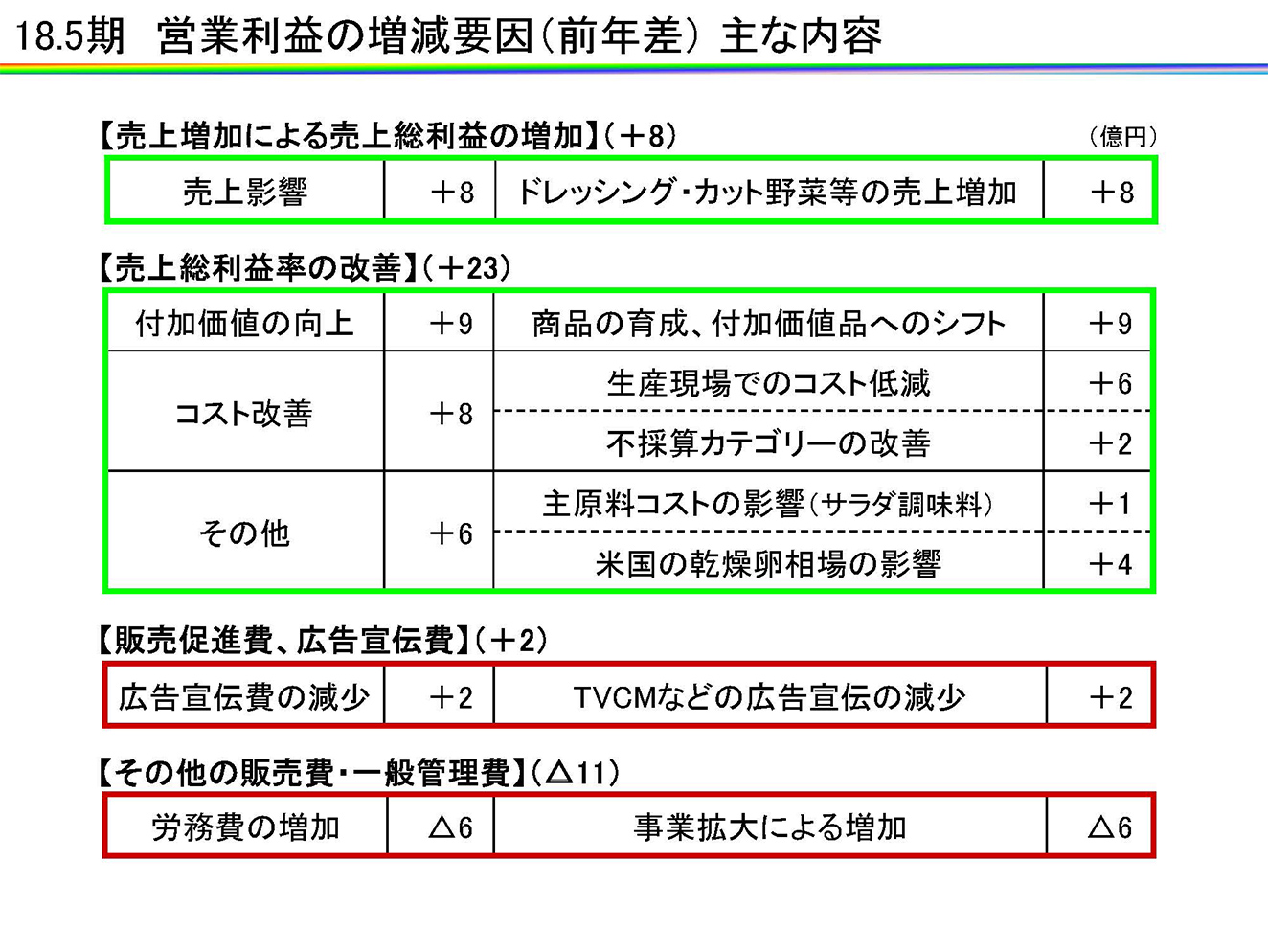
売上増加による売上総利益の増加は、カット野菜、惣菜や調味料の拡大などで、8億円を創出しました。
売上総利益率の改善による利益増のおもな内容は、付加価値の高い商品の販売ウエイトを上げていく取り組みで9億円、これはおもにタマゴ事業、ファインケミカル事業が貢献しています。生産の効率化や不採算カテゴリーの改善などのコスト改善の取り組みで8億円を創出しました。
なお、主原料コストと米国の乾燥卵相場の上昇は、増益要因となりました。広告宣伝費は、昨年実施したカット野菜の広告を、本年は実施していないことなどによります。
その他の販売費・一般管理費は、おもに事業拡大による労務費の増加によるものです。
-
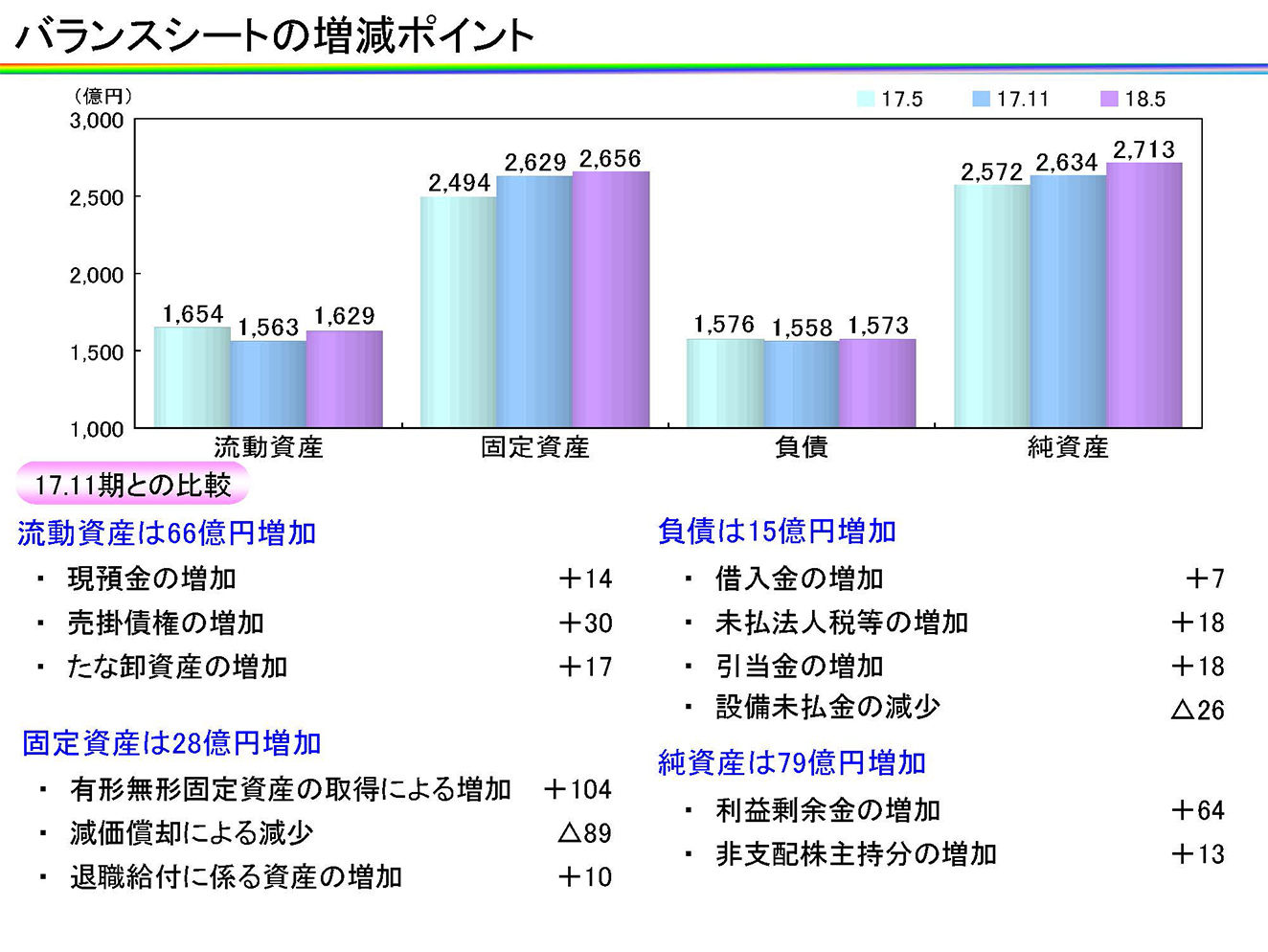
-
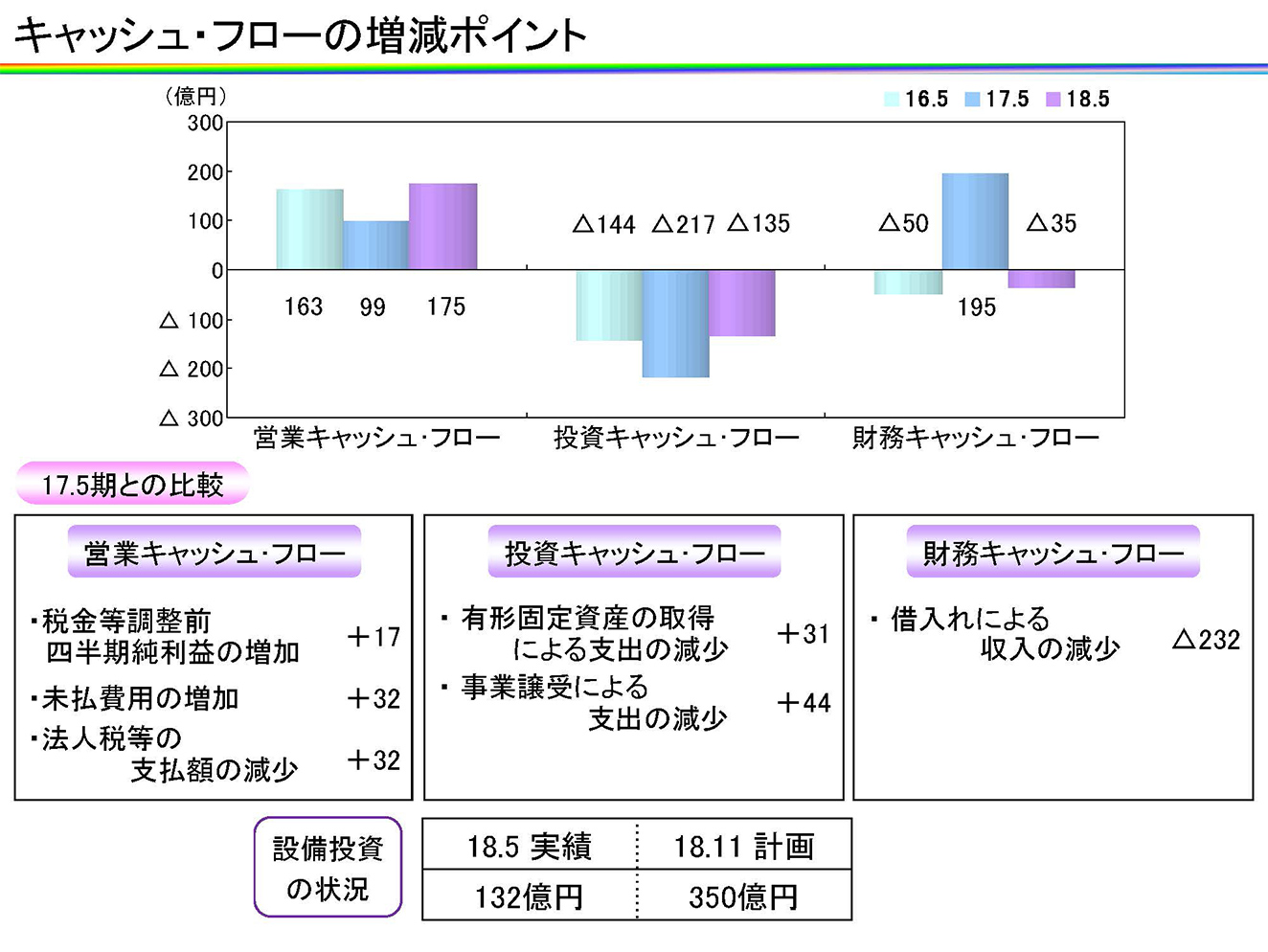
設備投資は132億円を実行しました。年間計画については、実施時期の見直しなどを行ったことにより、年初計画の396億円を350億円に修正いたしました。これにより、中期経営計画3ヶ年の設備投資は約950億円となります。
-

2018年度の上期は、増収増益を確保することができましたが、売上高の未達や、中国の伸張が少し弱まったことなど、課題も見えています。
第8次中期経営計画の最終年度をしっかり締めくくりたいと思います。 -
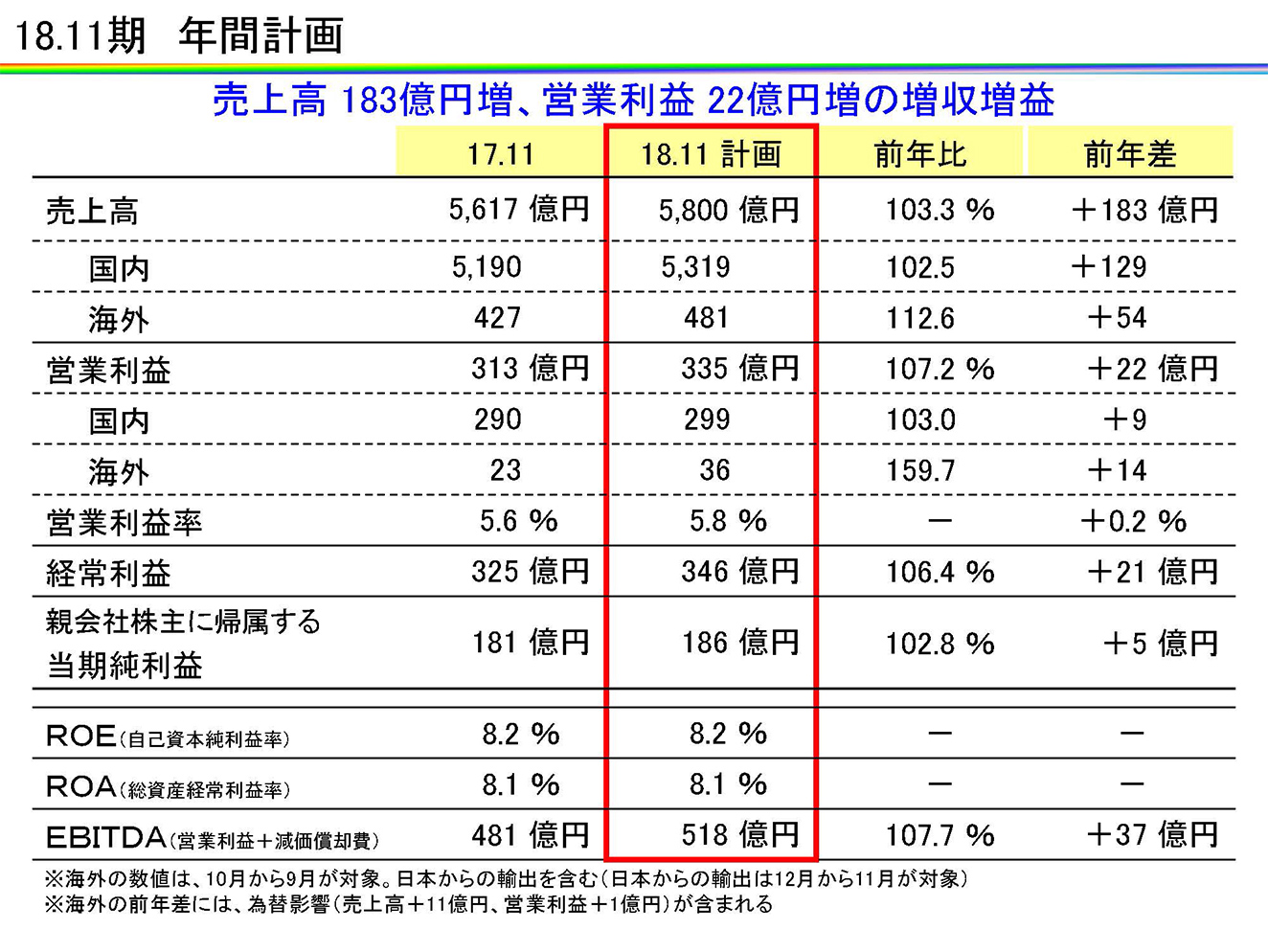
2018年度の売上高は前年差183億円増の5,800億円、営業利益は前年差22億円増の335億円を計画します。
経常利益は前年差21億円増の346億円、当期純利益は5億円増の186億円とします。
-
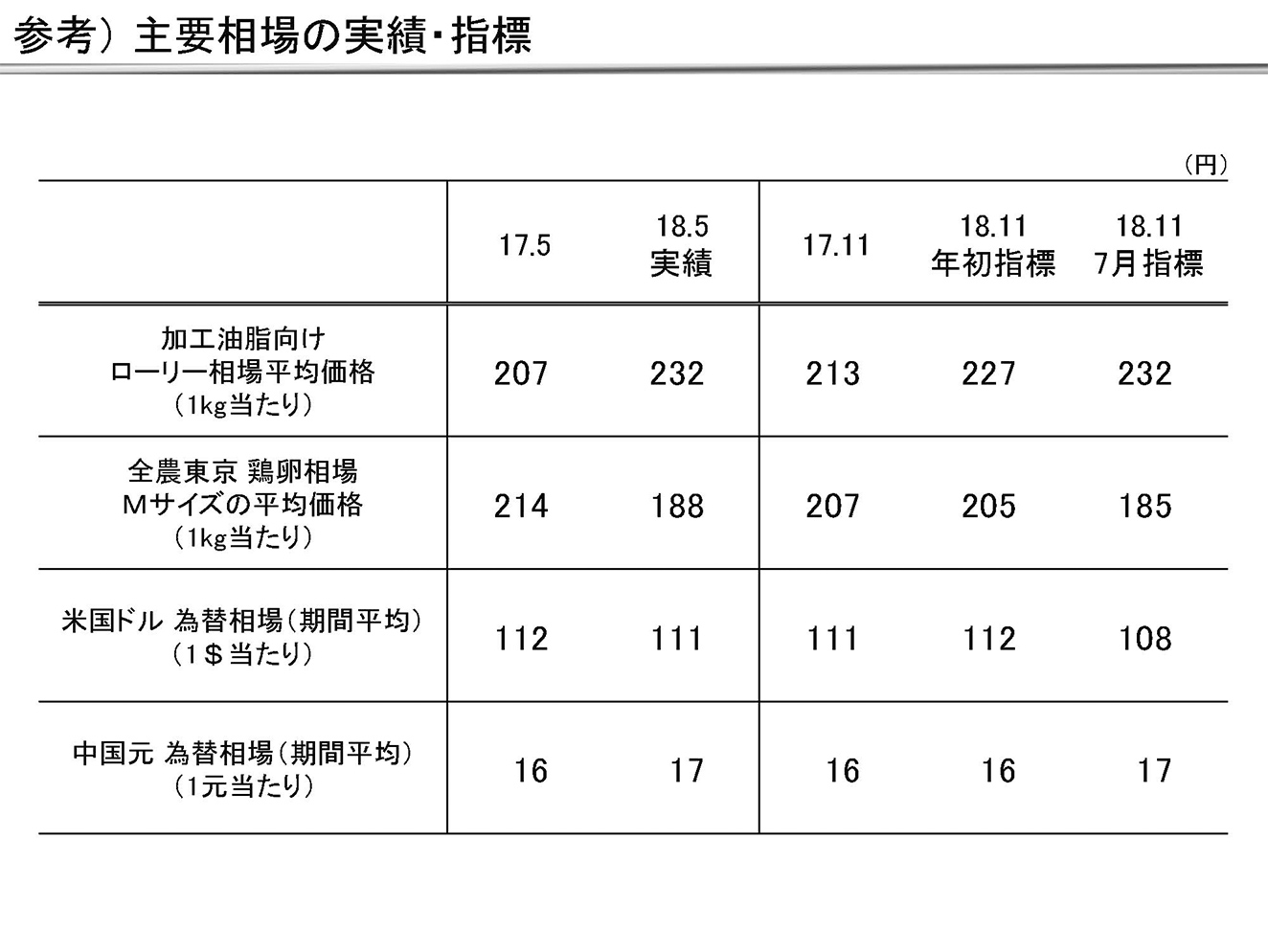
なお、為替相場の前提は、年初指標の1ドル112円に対し、上期の実績は111円、年間は108円で想定しており、為替影響は売上高で11億円、営業利益で1億円を見込んでいます。
-
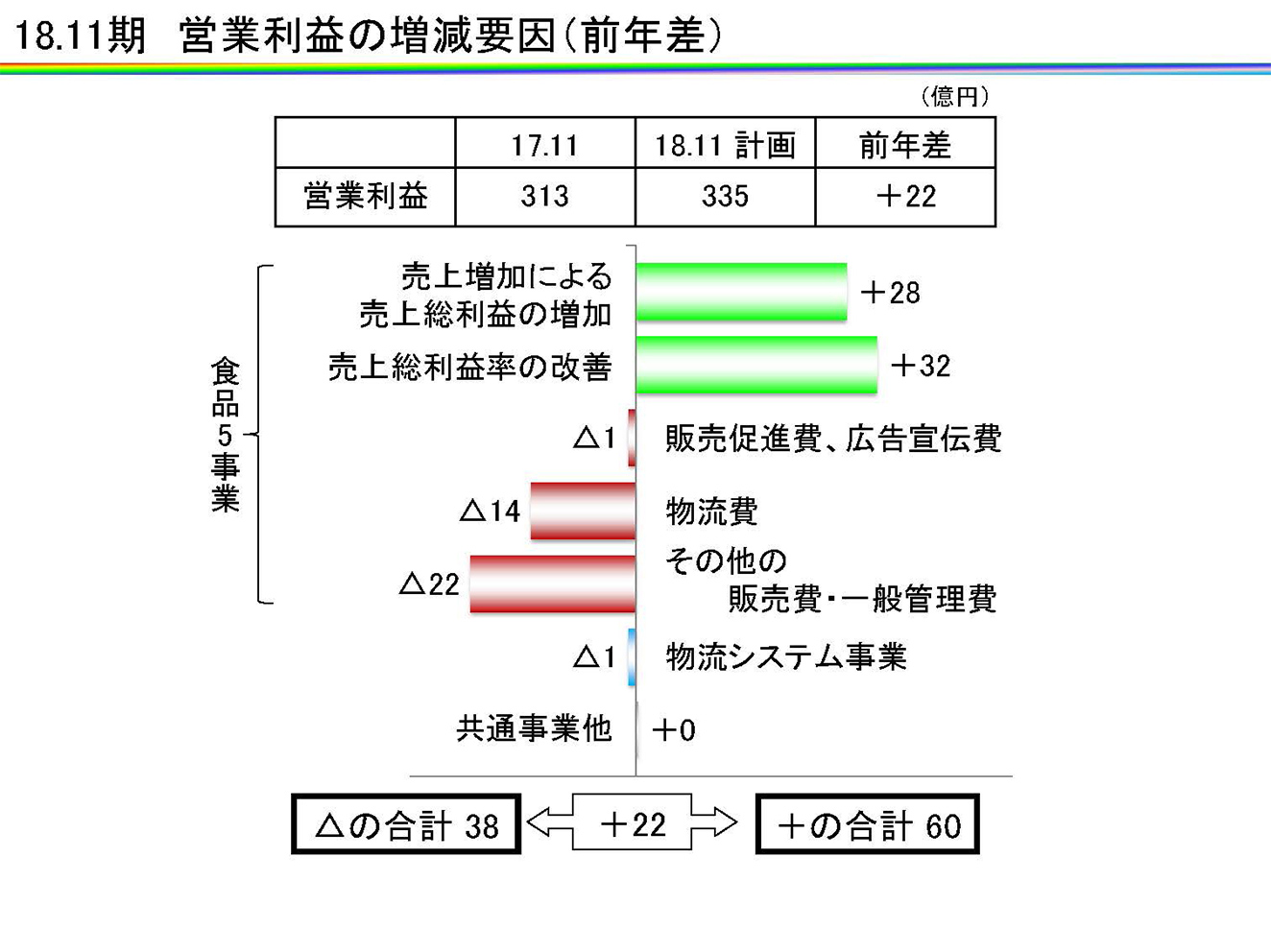
営業利益22億円増の前年差での増減要因です。
食品事業では、売上増加による利益を28億円確保し、売上総利益率の改善で32億円の利益を創出していきます。
-
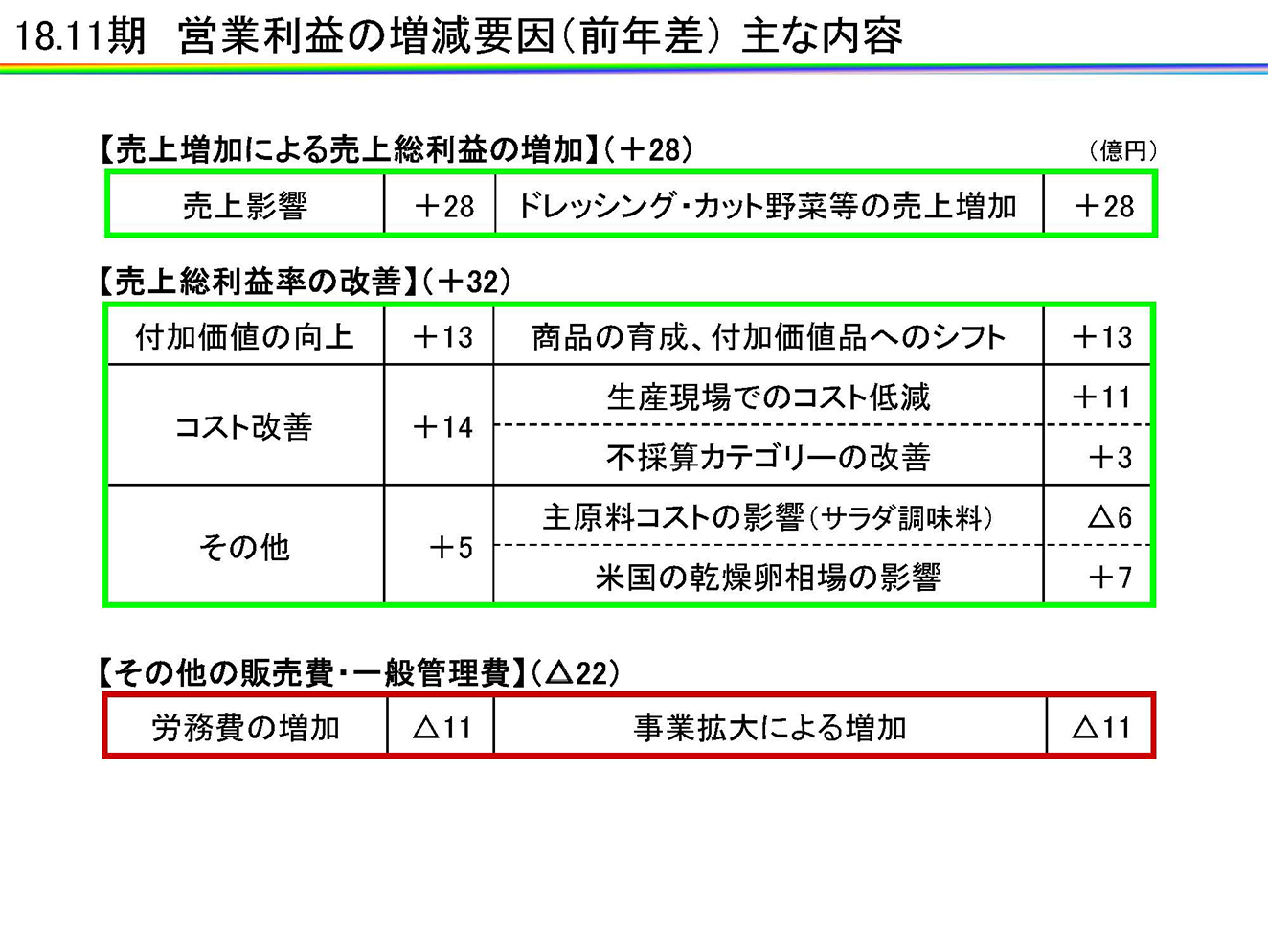
売上増加による売上総利益の増加は、サラダ調味料やカット野菜・惣菜など、既存品の拡充や新商品の発売により28億円になります。
売上総利益率の改善による利益増のおもな内容は、付加価値の高い商品の販売ウエイトを上げていく取り組みで13億円、生産の効率化や不採算カテゴリーの改善などのコスト改善の取り組みで14億円を創出していきます。
なお、主原料価格につきましては、6億円のマイナス影響を見込んでいます。食油の調達価格が、下期は上昇すると想定しています。
また、米国の乾燥卵相場の上昇による影響は、7億円の益要因となりました。
その他の販売費・一般管理費は、おもに労務費の増加によるものです。
-

-
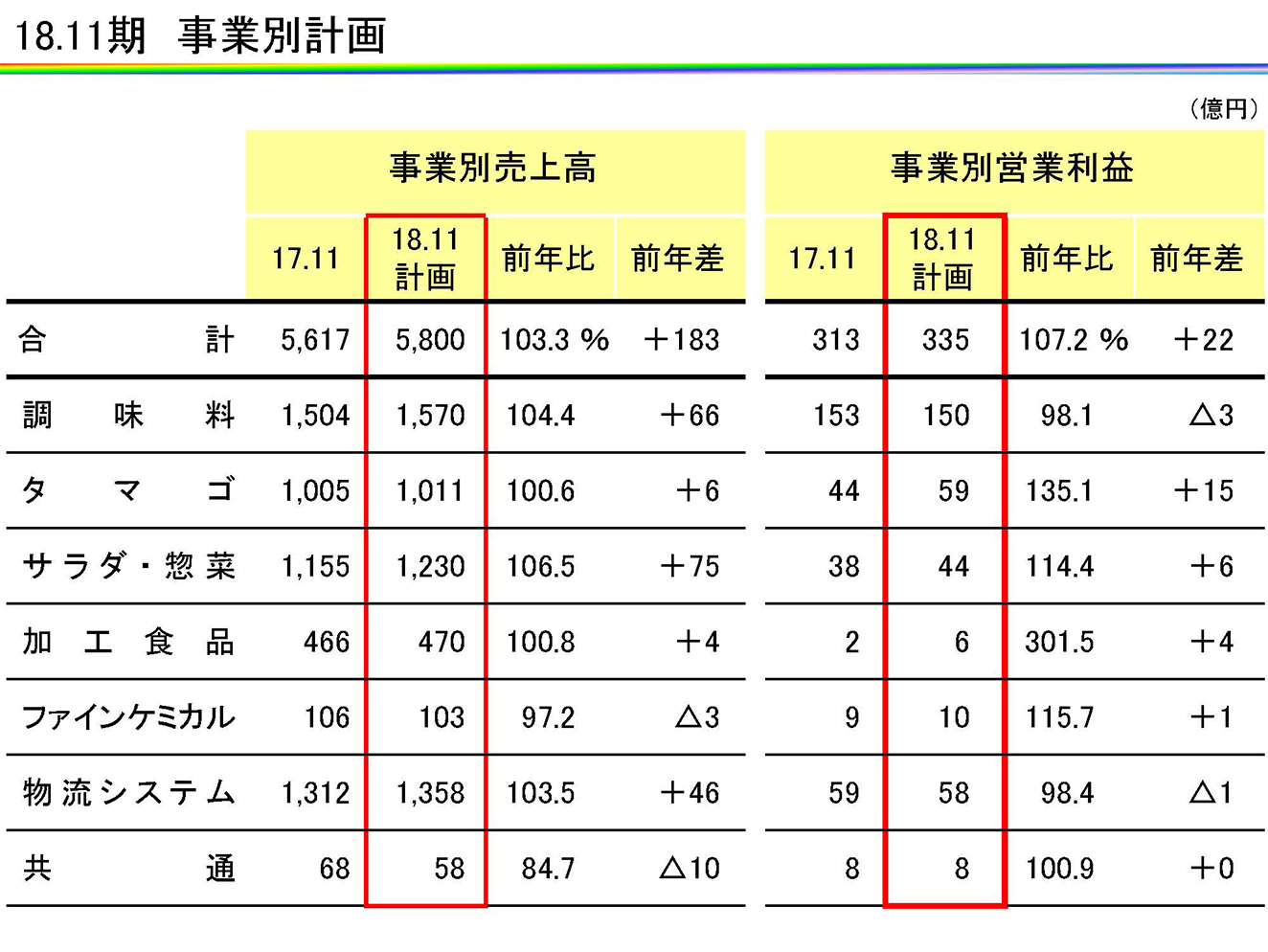
2018年度の事業別売上高と営業利益です。
上期の状況とほぼ同様ですが、売上高は、調味料事業、サラダ・惣菜事業、物流システム事業がけん引し、営業利益は、特にタマゴ事業がけん引します。
-
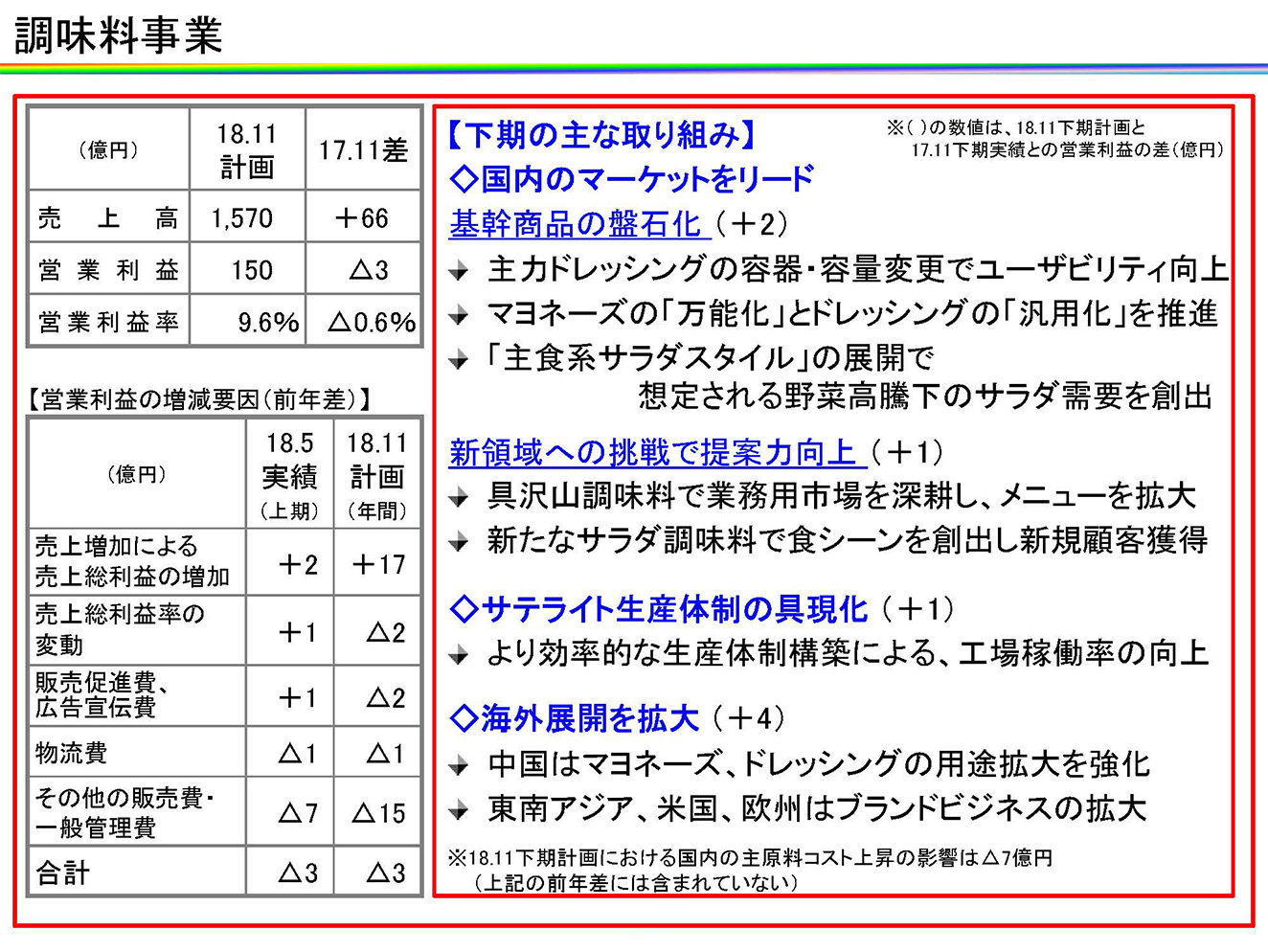
事業別の主な取り組みです。
調味料事業です。
売上高は、前年に対し66億円増の1,570億円、営業利益は、3億円減の150億円を計画します。
国内では、発売60周年を迎えるドレッシングを中心に、基幹商品の盤石化と顧客の獲得をテーマとして、サラダ調味料のマーケットをリードします。
-
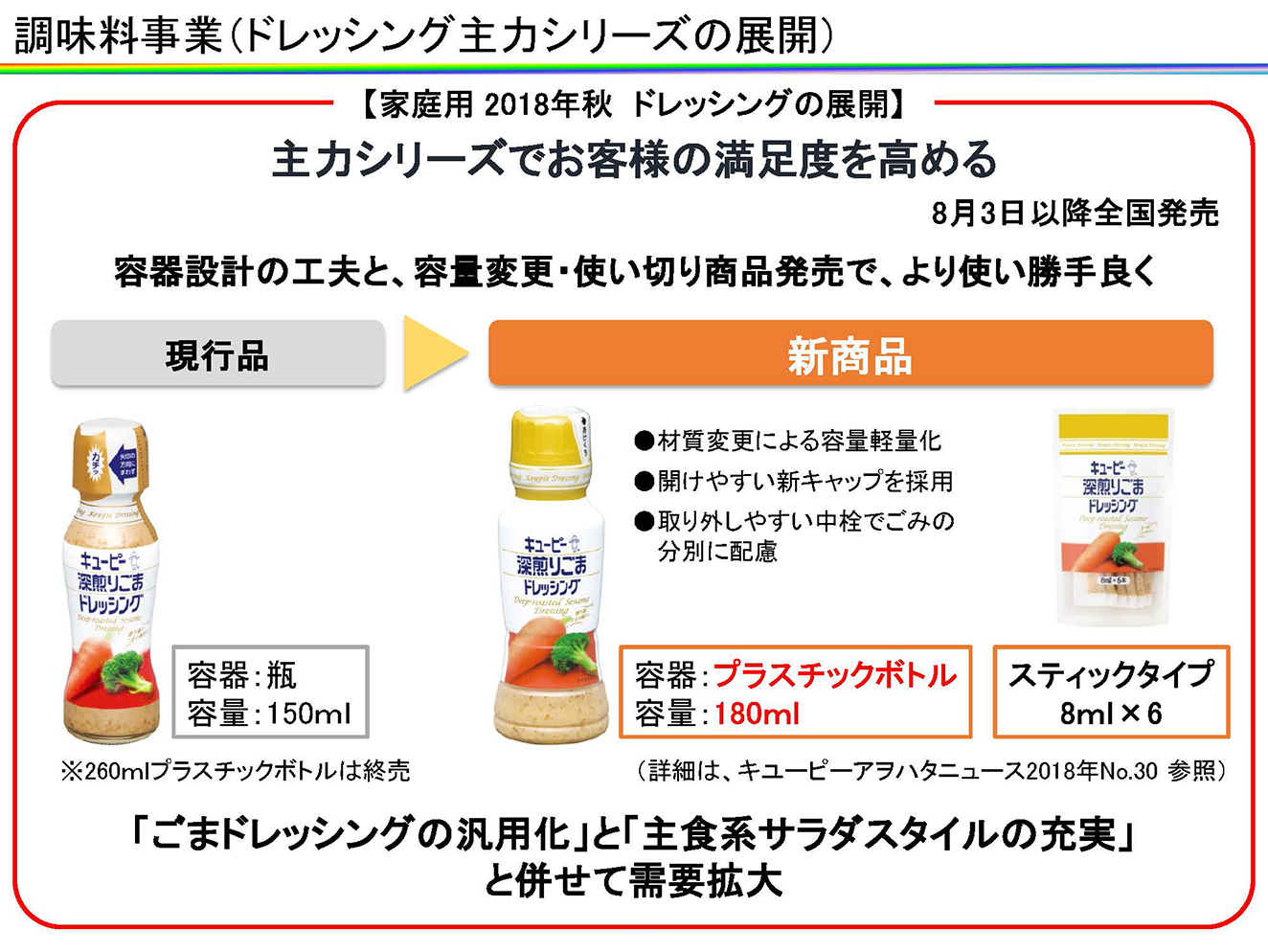
ドレッシングの主力シリーズで、容量と容器の変更を行います。容量は150mlから180mlにすることで、サラダを食べる頻度の増加に対応します。
また、容器を瓶からプラスチックボトルへ変更するのに合わせ、分別に配慮した取り外しが簡単な中栓、ひと回しで開栓できる新キャップを採用しました。変化する使用頻度への対応や使いやすさに優れた商品開発でお客様の満足度向上に努め、需要を拡大していきます。
-
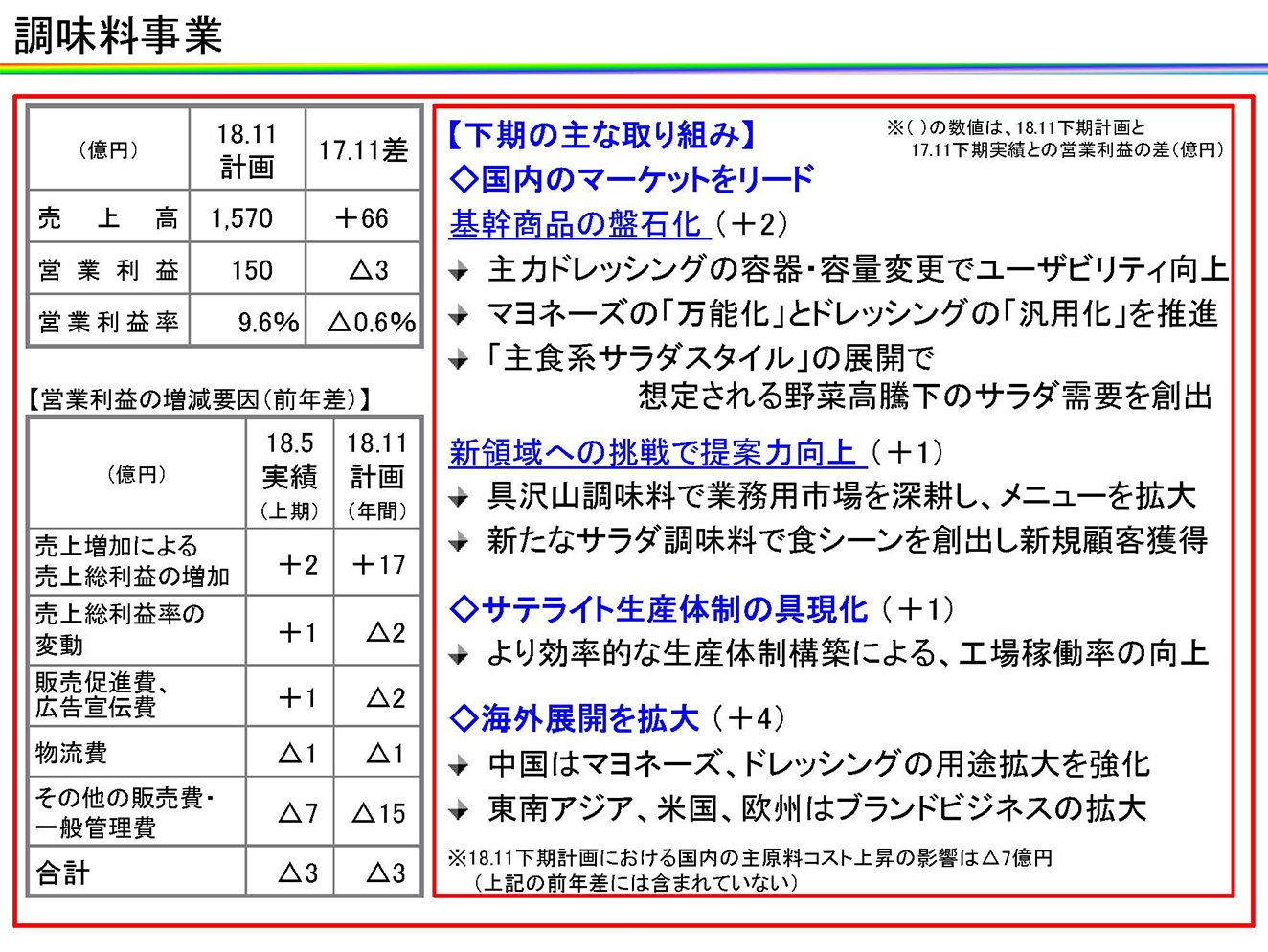
マヨネーズは「焼く」、「炒める」という万能調味料化、ドレッシングは深煎りごまドレッシングのサラダ以外への用途拡大、という汎用調味料化への取り組みを進めます。また、常態化する野菜高騰に対し、「主食系サラダスタイル」であるベジボウルの展開や「パッケージサラダとの連携強化」などの取り組みでサラダ需要を創出し、市場の活性化に努めます。
業務用市場では、お困りごとの解決をテーマに市場深耕を継続します。
具材感と手作り感で本格的なおいしさを実現した具沢山調味料で、調理オペレーション簡素化による提供時間の短縮とメニューの拡大で貢献します。また、生産工程の簡素化に加え、重点商品の育成や物流の効率化などによるサプライチェーン強化で生産効率を向上させ、利益体質を進めます。
海外では、主力商品のマヨネーズ・ドレッシングを強化し、調味料事業は、国内外でマーケットをリードし続けたいと考えます。
-
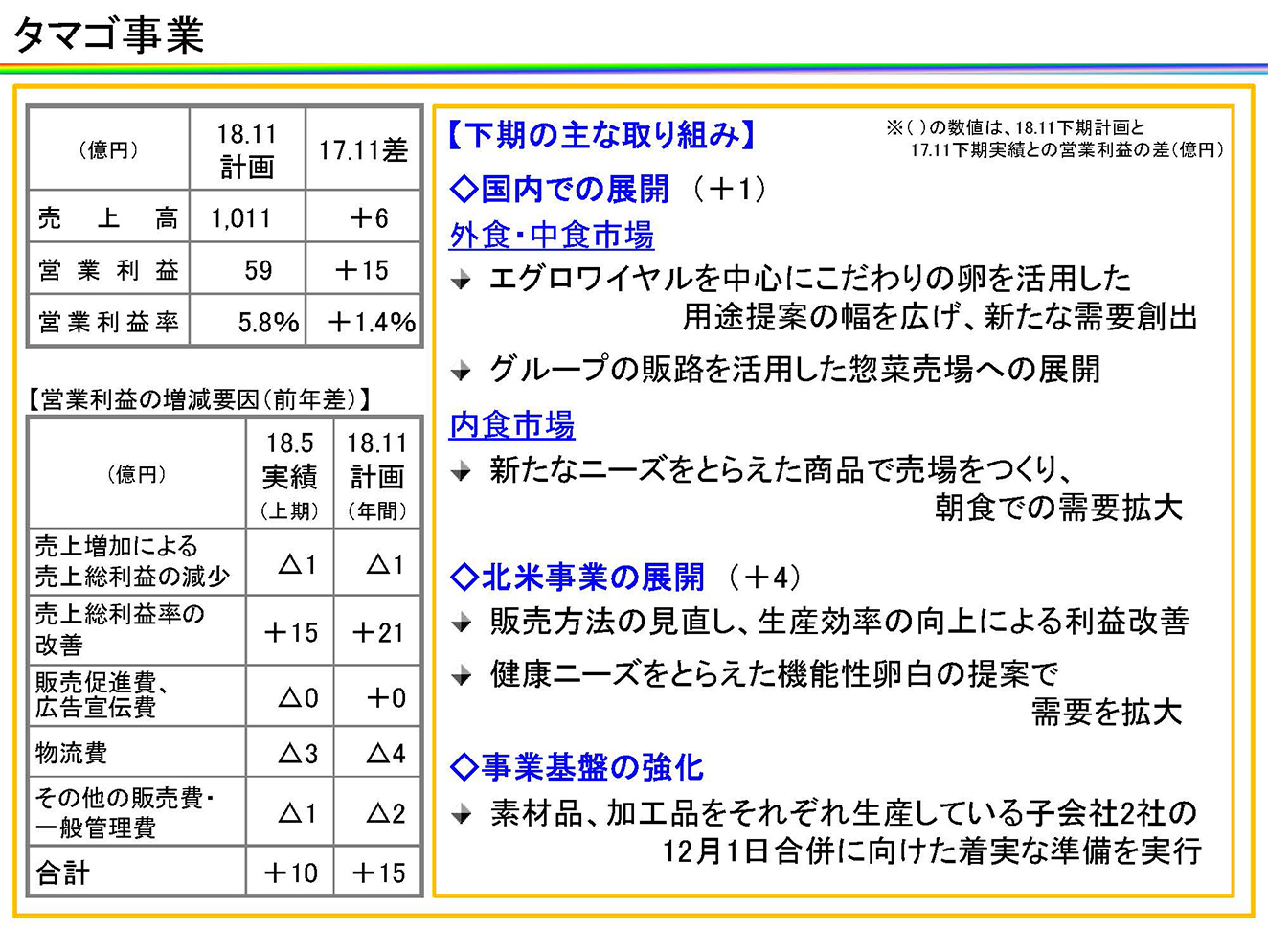
タマゴ事業です。
売上高は前年に対し、6億円増の1,011億円、営業利益は15億円増の59億円を計画します。
国内では市場の拡大、北米では収益改善を進めてまいります。
まず国内ですが、外食・中食につきましては、エグロワイヤルを中心とした、こだわりの卵を活用して用途提案の幅を広げ、製菓・製パン以外の業態へも供給を進めていきます。
また新たな販路としてグループの販路を活用し、厚焼きタマゴなどのタマゴ加工品を、スーパーマーケットの惣菜売場へ展開していきます。内食につきましては、外部とも連動した新たなニーズをとらえた商品で、朝食における主役化を進めていきます。
北米での収益改善については、長期契約の提案など販売方法の見直しを進めていき、生産効率の向上によるコスト削減を進めていきます。
また、機能性の高い乾燥卵白の提案を進め、需要創出を図っていきます。事業基盤の強化としては、グループ内のタマゴ素材品とタマゴ加工品の会社を合併し、原料調達から生産まで一貫した生産体制を構築し、コスト体質の強化を図るとともに、お客様のニーズへすばやく対応できる体制を整えていきます。
-
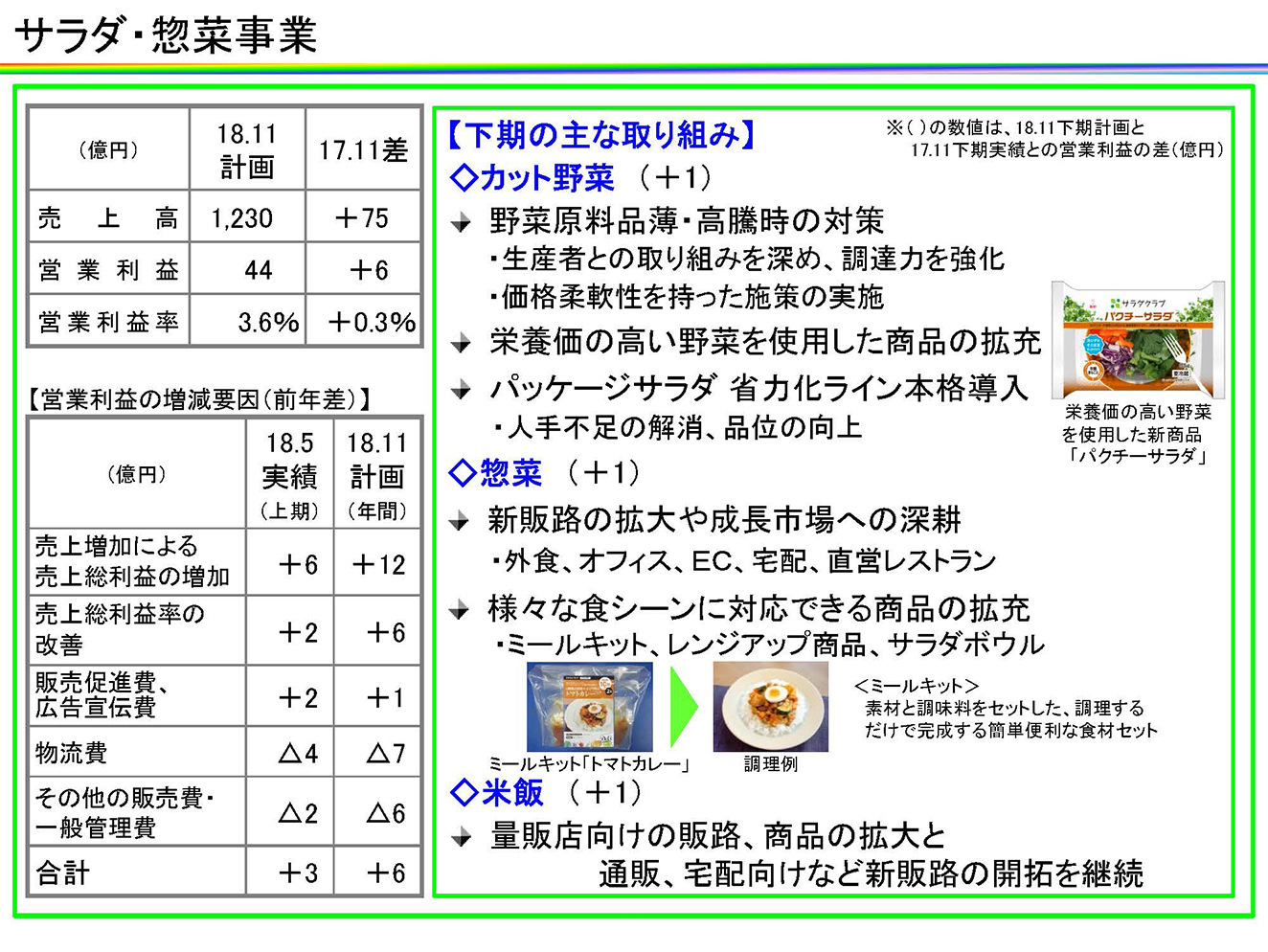
サラダ・惣菜事業です。
売上高は前年に対し、75億円増の1,230億円、営業利益は、6億円増の44億円を計画します。
カット野菜については、過去例のない野菜原料の品薄、高騰により、容量変更などを行うことで、供給責任を果たしてきました。今後もこのような状況に、しっかり対応できる体制を整えていきます。
商品面では、栄養価の高い野菜を使用した商品を拡充しており、5月に発売したパクチーサラダもご好評いただいています。
また、生産面では昨年よりテスト展開した省力化ラインを、今期から来年の上期にかけて本格導入します。コスト面に加えて、人手不足への対応、品位の向上を行い、さらなる市場競争力を高めていきます。惣菜につきましては、人手不足の課題がある外食や、健康ニーズの高いオフィスランチなどの新販路、成長市場であるEC・宅配を強化していきます。2017年5月にオープンしたサラダ専門レストランでは、テイクアウトやUber(ウーバー)を活用したデリバリーをスタートしました。また今年5月、ミールキットを中心とした期間限定店舗をオープンし、いずれもご好評いただいています。これらの展開から得られた知見を、商品開発やサービスにも活かし、利益創出につなげていきます。
米飯は、コンビニエンスストア向けに加え、グループの販路を活用した量販店向けや宅配ルートも順調に推移しています。
-
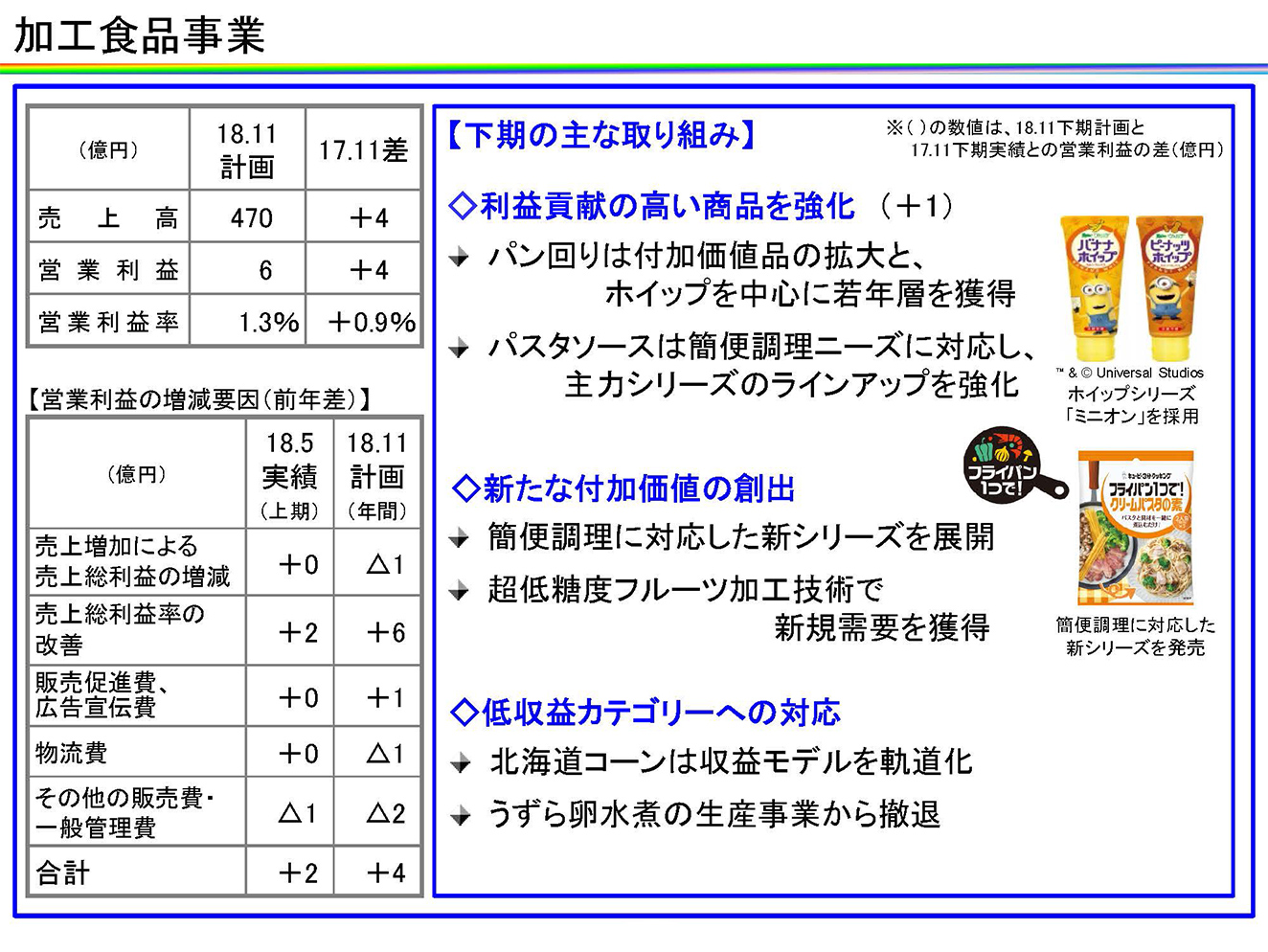
加工食品事業です。
売上高は前年に対し、4億円増の470億円、営業利益は、4億円増の6億円を計画します。
「利益貢献の高い商品を強化」「新たな付加価値の創出」「低収益カテゴリーへの対応」の3つの軸で進めていきます。
まず利益貢献の高い商品を強化ですが、ジャムなどでは、好調な「まるごと果実」でシニア層のロイヤリティを高める一方で、ホイップでは「ミニオン」のデザインを採用し、若年層の支持獲得を進めていきます。また、パスタソースでは、簡便志向に対応し「あえるパスタソース」シリーズのラインアップを強化していきます。
新たな付加価値の創出では、簡便性を追求した商品の発売や、独自の超低糖度フルーツ加工技術を活用した商品で、新たな需要を獲得していきます。
低収益カテゴリーの対応では、2016年夏の台風被害から再開した、北海道コーンの軌道化を進めていきます。また、うずら卵水煮は、生産工場を売却したうえで、収益性を改善していきます。
-
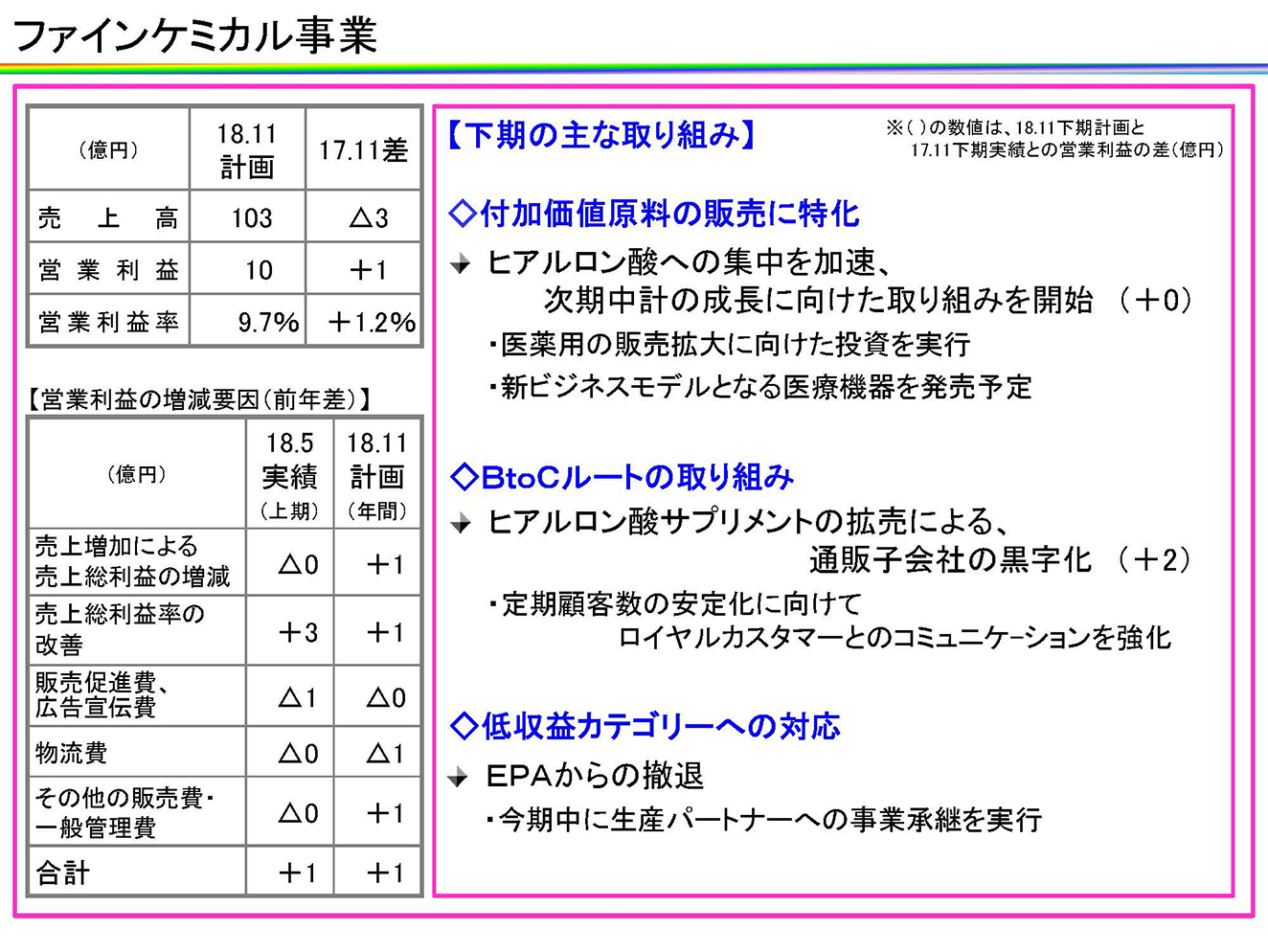
ファインケミカル事業です。
売上高は、前年に対し3億円減の103億円、営業利益は1億円増の10億円を計画します。
得意分野であるヒアルロン酸への集中を加速していきます。
医薬用ヒアルロン酸については、供給能力を高める投資を行い、一層の強化を進めます。また、新しいビジネスモデルとして挑戦している医療機器は、当初の予定通り、今期中の販売を予定しており、次期中計での利益成長をめざしていきます。BtoCルートへの取り組みにつきましては、通販子会社を通じて、ヒアルロン酸の機能性サプリメントを販売してきましたが、ようやく安定して利益を生み出せる状態に成長してきました。
一方で、苦戦が続いているEPAについては、当社として、事業撤退を判断しました。医薬品向けの原料供給ということもあり、事業については、今まで協力いただいてきた生産パートナーの会社様に、お引き受けいただくこととなりましたので、速やかに進めていきます。
-
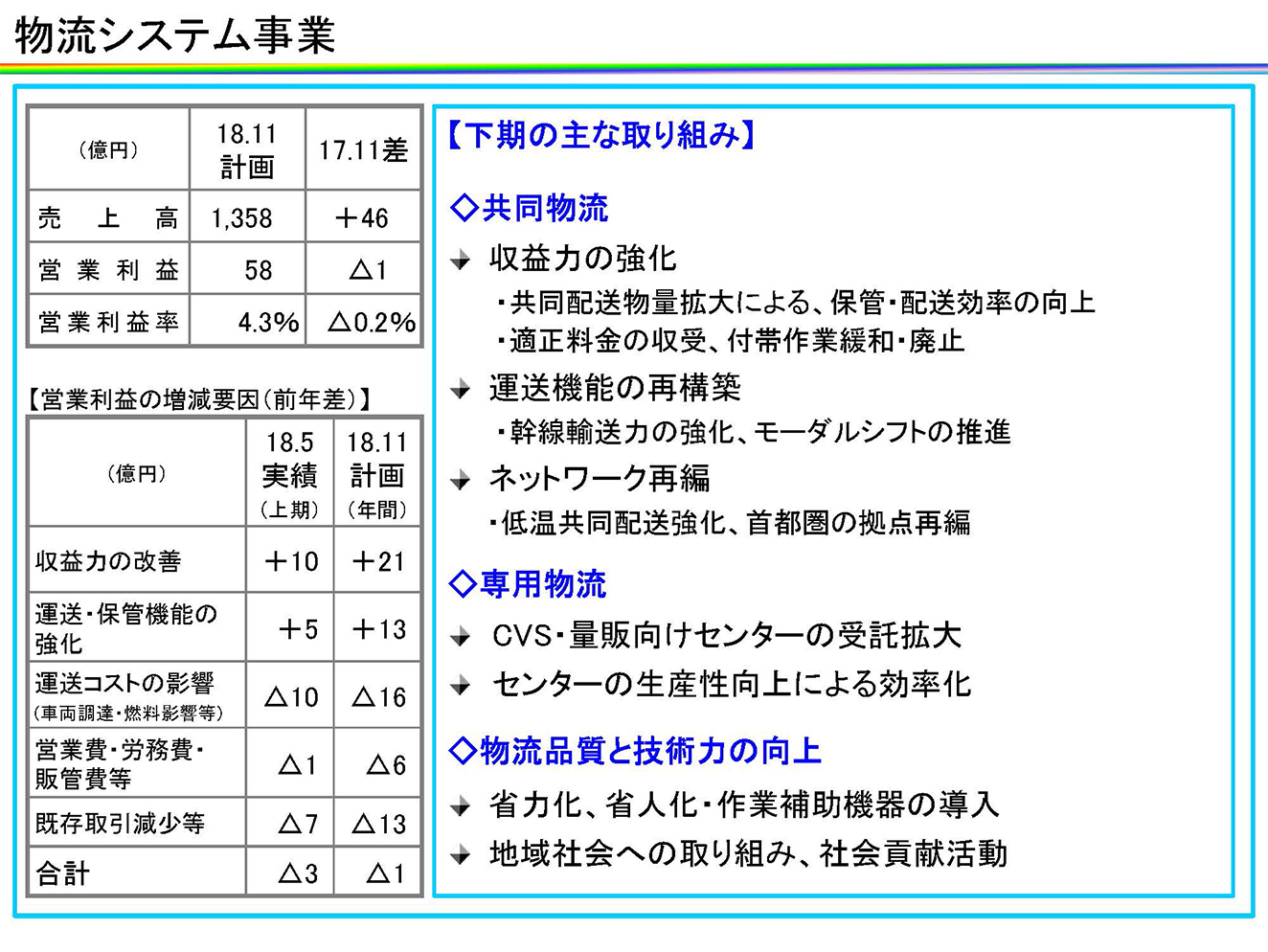
物流システム事業です。
売上高は、前年に対し46億円増の1,358億円、営業利益は1億円減の58億円を計画します。
共同物流では、メーカー共同配送で物量が堅調に拡大しており、それによる配送・保管効率の向上につなげていきます。また、ドライバー不足に対し、長距離運行での中継輸送や、トラックから鉄道へのモーダルシフトの拡大、さらには船舶の活用も視野に入れるなど、運び方を工夫することで、幹線輸送力の強化を進めていきます。
専用物流では、コンビニエンスストアや量販店向けの受託が堅調に推移しており、今後も拡大させていきます。
食品物流業界も、慢性的な人手不足に加え、車両調達コストや燃料費の高騰など引き続き厳しい環境を予測しております。物量拡大や効率化を進めながら、吸収できないコストは、適正料金収受の取り組みを進めています。
-

-
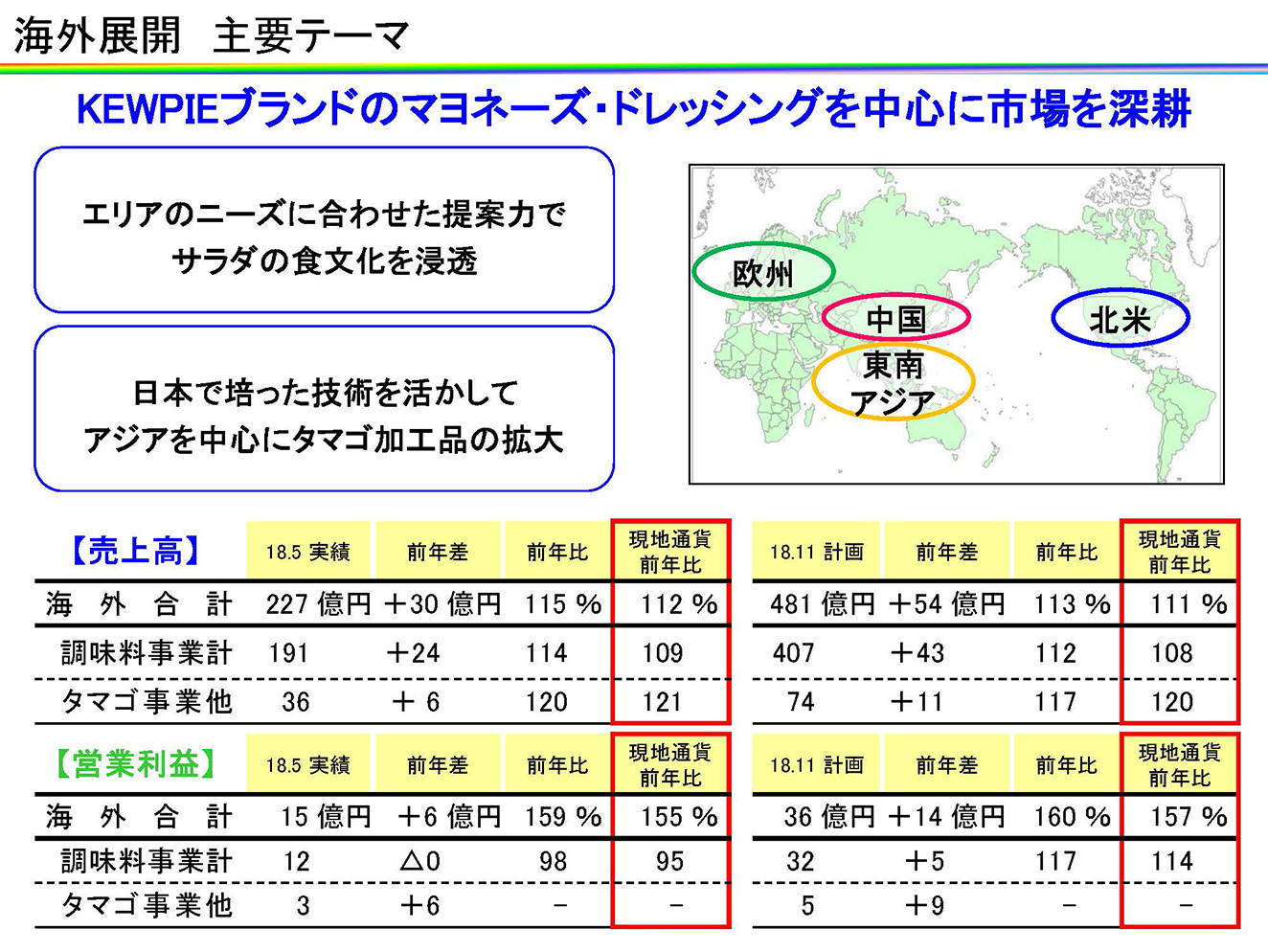
海外展開は、中国、東南アジア、北米、欧州の4つのエリアでマヨネーズ、ドレッシングの拡大に注力しています。
エリアのニーズに合わせ、日本で培った提案力を活かして、各国に貢献していきます。2018年度5月期の売上高は、海外全体で前年に対し115%、30億円増の227億円となりました。調味料事業は中国の減速影響はありましたが、東南アジアとポーランドでの展開が寄与し、現地通貨ベースで109%となりました。
営業利益は、海外合計で6億円増の15億円となりました。中国の減収による影響と、ポーランドの会社買収にともなう費用が影響しましたが、タマゴ事業の回復が寄与しました。
2018年度11月期の売上高は、海外全体で前年に対し54億円増の481億円を計画します。調味料事業は、下期の中国は増収となり、現地通貨ベースで108%を計画しています。
営業利益は、海外合計で14億円増の36億円を計画します。調味料事業の下期の売上拡大とタマゴ事業の回復が寄与します。
-
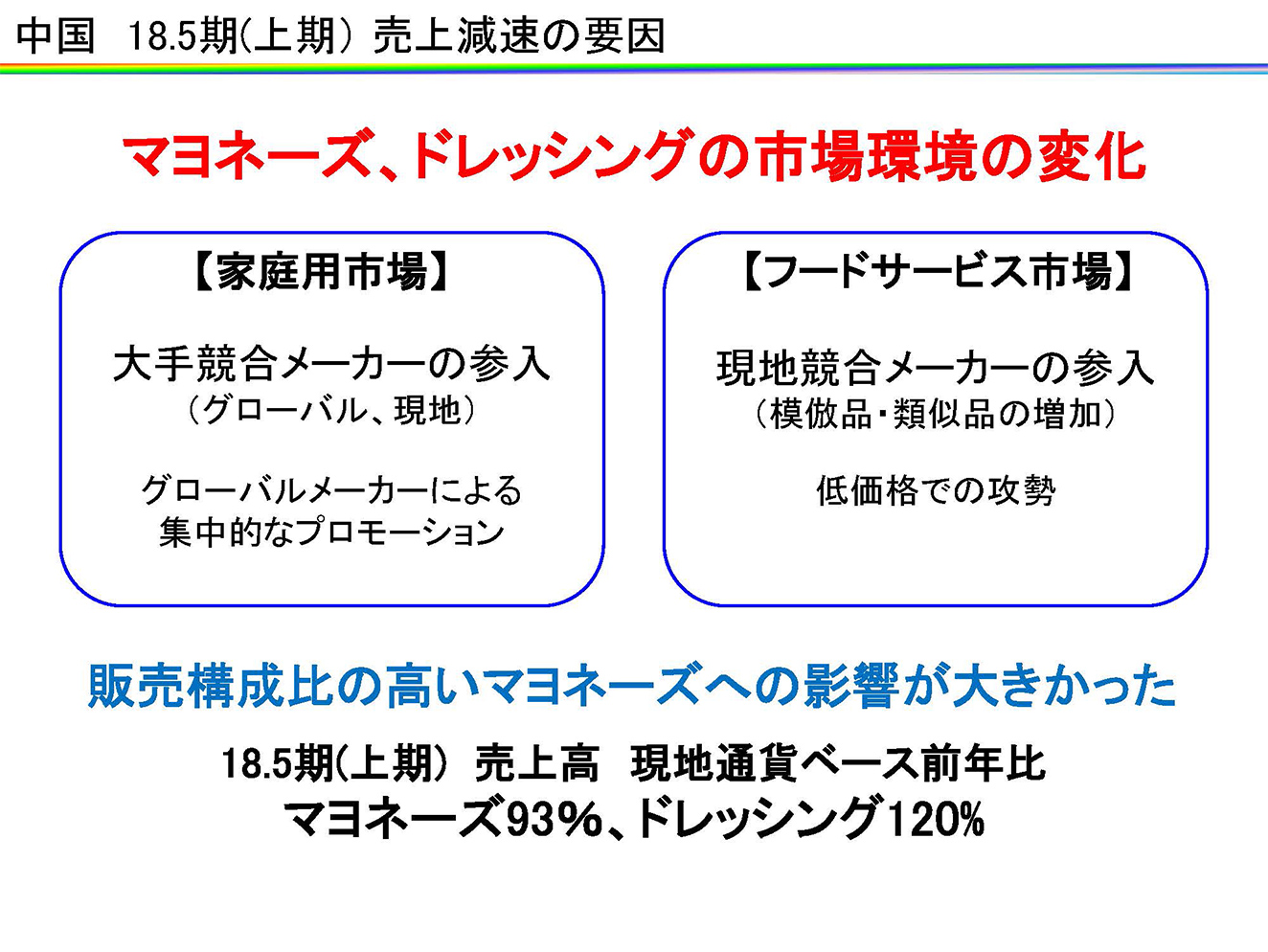
中国では、マヨネーズ、ドレッシングの市場環境に変化がありました。
家庭用市場では、市場参入した大手のメーカーが、おもに大手量販店に対し、集中的なプロモーション活動を実施してきました。
またフードサービス市場では、現地メーカーの参入により低価格での攻勢を受けました。競合参入への対策が遅れたことにより、特に販売構成比の高いマヨネーズが影響を受け、現地通貨ベースの前年比でマヨネーズが93%と落ち込みました。
-
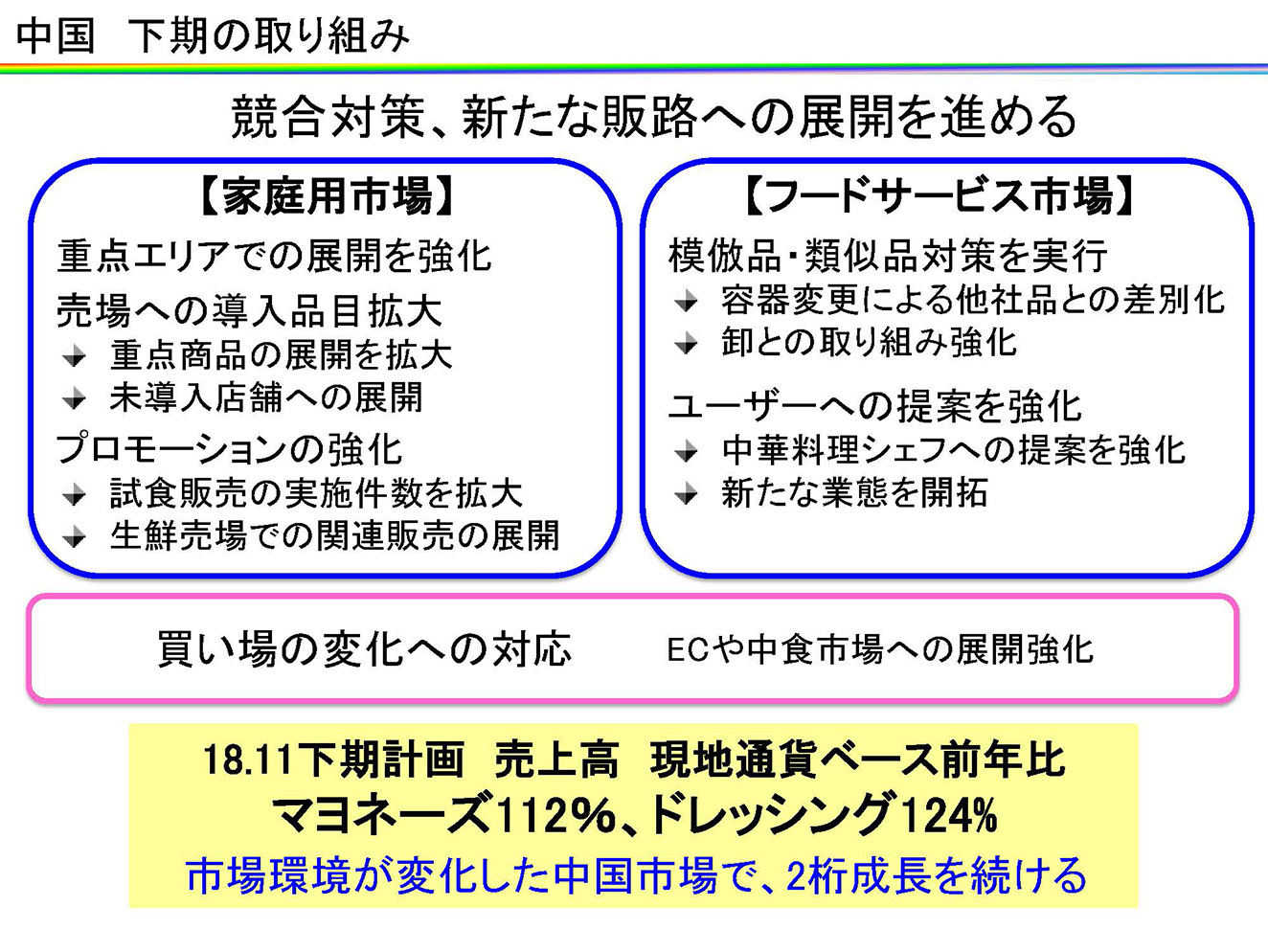
そういった状況に対し、家庭用市場では、まず競合に攻められたエリアでの展開を重点的に強化します。さらに、量販店での売場への導入品目を拡大し、プロモーションの強化として、試食宣伝や生鮮売り場での関連販売などのマヨネーズ・ドレッシングの用途訴求を図ります。
フードサービス市場では、模倣品・類似品対策を実行するとともに、ユーザーへの取り組みを強化していきます。メニュー提案だけでなく、オペレーションなども提案し、中華料理や新たな業態の開拓を進めます。
また成長著しいECや中食市場などの買い場の変化にも対応していきます。
これらの対策を進める中、下期は一定の手応えを感じており、現地通貨ベースでマヨネーズ112%、ドレッシング124%を計画し、今後も2桁成長を続けていきます。
-
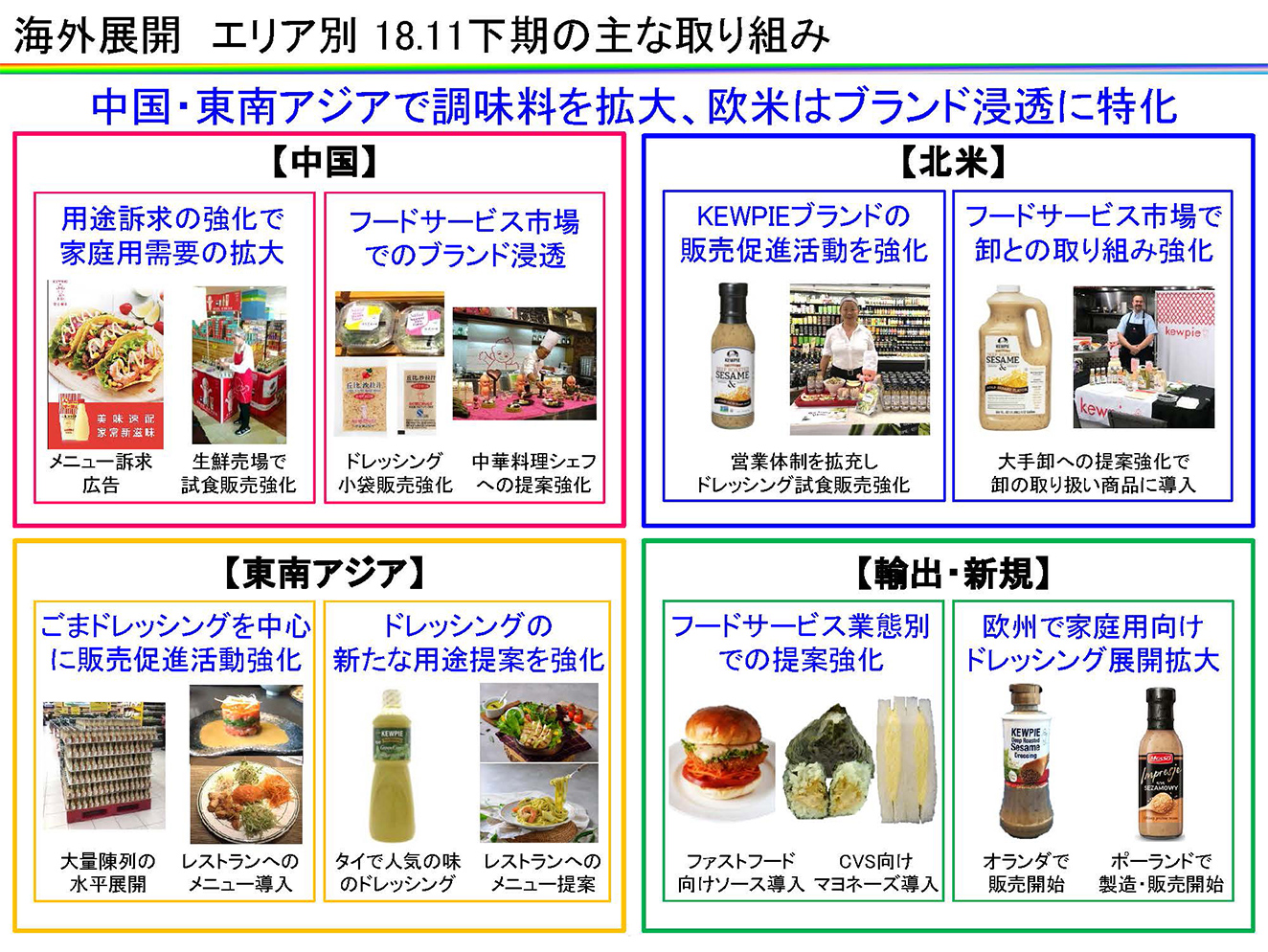
東南アジアでは、順調に拡大している深煎りごまドレッシングを中心に販売促進活動を強化してまいります。こちらはベトナムでの展開ですが、2012年に発売した深煎りごまドレッシングがドレッシング市場で売上ナンバーワンとなり、レストラン等でメニュー採用にもつながっています。また、ドレッシングの新たな用途提案を強化するため、タイで人気の味のドレッシングを開発し、東南アジアでの販売を進めていきます。
北米では、キユーピーブランドの深煎りごまドレッシングを中心に家庭用向けの販売を拡大しています。営業体制を拡充し、導入された量販店での試食販売活動を強化していきます。また、フードサービスの卸店への提案も強化していきます。
輸出では、海外拠点の無いエリアに対してもフードサービスの業態別での提案を強化し、マヨネーズなどの調味料の輸出を拡大していきます。
欧州では、オランダとポーランドでそれぞれ現地製造の家庭用向けドレッシングの発売を開始し、市場を開拓していきます。 -

Q&A (Japanese only)
Questions about China Q1-Q9
-
In the first half of fiscal year 2018, year-on-year Net sales figures in local currency showed household sales at 88% and food service at 106%.
Furthermore, the Net sales breakdown by category is as follows: mayonnaise 55%, dressings 27%, and jams 13%.
I believe that salad dressings will see significant growth because they are used as a versatile condiments not only for salads but also as a dipping sauce for hot pot dishes and other dishes. -
In the first half of fiscal year 2018, year-on-year Net sales in local currency were as follows: egg products 65%, long-life salads 95%, and vinegar 160%. Egg products were affected by menu cuts by major customers.
-
We have a store on Tmall, which holds a large market share in China's e-commerce market, and e-commerce accounts for 4% of our Net sales in China. There is a need for people who do not want to carry heavy items home, and the market is expanding. The size of the mayonnaise and dressing e-commerce market is still small, but we expect it to grow in the future.
-
Since the second quarter, Chinese condiments manufacturers have entered the market, and Net sales of household dressings have stagnated at 104% year-on-year.
Going forward, we will be actively promoting our products in stores, along with our mayonnaise. Furthermore, given the high level of fat consciousness in China, we will be launching two fat-free dressings to revitalize the market. -
In the first half of the year, the entry of global manufacturers had a significant impact on Guangdong, Shandong, and Northeast China. Therefore, we focused our sales promotion activities on these three areas and have newly stationed a representative in Guangdong. Across China, we are working to improve the sales floor in retail stores, expanding the number of items and stores that carry our products. We are also increasing the number of product sampling events and working to efficiently use sales promotion funds to let more people know the taste and uses of our products.
-
We will be working on our 2019 plan from now on, but we aim for double-digit growth. We anticipate growth in the e-commerce and restaurants / ready-made foods markets, and we will be working to address the diversification of sales channels.
-
In the first half of fiscal year 2018, food service-business sales composition was 65%, a 1% increase compared to the previous year, and this trend is expected to continue.
A risk associated with the expansion of food service is the possibility of customers switching to lower-priced counterfeit or similar products. We will thoroughly crack down on unscrupulous businesses that engage in counterfeiting or similar products. Furthermore, given the broad scope of food service market, we will ensure that we accurately grasp the diverse needs of each channel, offer menu suggestions that add value through our strength in "deliciousness," and propose efficient cooking operations to establish our brand. -
The combined market size for mayonnaise and salad dressings is estimated at approximately 37 billion yen. We believe that household use accounts for about 10% and food service for about 20%, and that the market continues to grow year after year, so we expect it to continue expanding.
We estimate that per capita mayonnaise and salad dressing consumption in China is about 1/40th of that in Japan, and we see the entry of competitors as an opportunity to expand the market. -
Setting product prices while taking into account environmental changes such as fluctuations in raw material prices is extremely difficult and will be a key point going forward. In China, the price of mayonnaise has been raised three times and lowered once so far, but based on the fundamental idea of valuing affordability, the culture of mayonnaise has spread even to rural areas.
While rising labor costs are a concern, we will strive to control costs by making the Guangzhou factory, scheduled to open in 2020, a cost-competitive facility.
Questions regarding matters other than China
-
The cost improvements at our production sites are proving more effective than expected. These improvements are accumulating across various production sites, including efforts to improve profitability for convenience store and Aohata Corporation 's industrial fruits, and yield improvements through the introduction of high-speed egg-cracking machines in our egg business.
-
The withdrawal from the boiled quail egg and pharmaceutical-grade EPA businesses will have little impact on this fiscal year's performance, but we expect to see the effects of improved productivity from next fiscal year onward.
-
The market for pharmaceutical-grade EPA is growing due to its use in blood pressure-lowering medications, but competition is intensifying with the entry of more global manufacturers. Furthermore, drug prices are falling, making the pricing situation extremely challenging. While our company handles part of the production and sales, under these circumstances, it will be difficult to survive without consolidating the value chain. Considering the future, we have decided to withdraw in order to concentrate on areas where we have a strength.
-
We will merge a company that manufactures liquid eggs with a company that manufactures processed egg products. Previously, logistics costs were incurred when moving the liquid eggs, which are the raw material, to the processing plant, but by manufacturing liquid eggs and processed products in the same factory, we can reduce logistics costs.
Furthermore, the space freed up by the consolidation of factories will be used to manufacture high-value-added processed products, a growing market. By transferring research and development for the egg business from our company, we will be able to respond more quickly to customer needs. We believe that implementing these rationalization and consolidation measures in our upcoming 9th Medium-Term Management Plan will yield significant benefits. -
Given the increasing usage and frequency of salad dressing, we determined that 180ml would be a suitable size for our 150ml product, which currently accounts for the largest share of our sales.
While this renewal does not involve a price revision, the unit price per bottle will increase. Therefore, we believe that if we can maintain the sales volume, we can increase sales and profits. Accordingly, we will promote proposals that increase the frequency, occasions, and amount of use, aiming for a 105% Net sales for the second half of the year compared to the previous year. Furthermore, dressing is a pillar of profit generation for the group, and we will use this renewal as an opportunity to further increase profits. -
We will propose new salads that can be main dishes or staple foods using our dressings, thereby boosting the demand for salads. In addition, the spicy flavor launched this spring is showing signs of expanding beyond salads, such as being used with meat dishes, and we will further expand the opportunities for use beyond salads by launching sauce-type and dipping-type versions of Deep-Roasted Sesame Dressing.
-
The salad dressing market is about 1.5 times larger than the mayonnaise market, but our Net sales for mayonnaise.
Going forward, we will maintain mayonnaise Net sales while expanding our dressing offerings. Since 95% of dressings are used in dishes with vegetables, we will actively develop our products so that they can be enjoyed in a variety of dishes using ingredients other than vegetables. -
The meal kits offered through the consumer cooperative's home delivery service are well-suited to customers who want to add an extra touch to their meals, and Net sales have grown to 4.3 billion yen in the three years since their launch. Additionally, a limited-time store called "Deli comer" (Delicomeer), primarily selling meal kits, is located inside JR Kunitachi Station in Tokyo, and the sauces and other ingredients used there are linked to condiments business. Online, we also sell through Amazon Fresh, where Net sales are smaller but about six times higher than the previous year. These new sales channels are centered around our salad and delicatessen foods business, working in conjunction with our other businesses, including condiments and processed foods.
-
In Vietnam and Indonesia, we are a latecomer to the market. While the per capita consumption of mayonnaise and dressings is low, health consciousness is on the rise in Asia. We aim to enhance the added value of our products and create a salad-eating culture.
-
We have begun expanding our egg processing business in Indonesia and Thailand. We are keeping our production lines small and proceeding while exploring market trends, and we are also considering expanding to other countries within the ASEAN region. For jams and fruit sauces, we are developing them domestically in Thailand where raw materials are readily available, and we will also be exporting to Vietnam and Malaysia.
-
We expect the price of dried egg whites in the second half of fiscal year 2018 to be approximately $4.3 per pound, compared to approximately $2.6 per pound last year.
Furthermore, to mitigate the impact of market fluctuations, we have increased the number of transactions with fixed selling prices for a certain period to about 30% of the total, and we plan to increase this to 50% in the future. As a result, the impact of rising market prices will be reduced in the second half of the year, and profit growth will be slower compared to the first half. We will strive to stabilize profits even in unstable market conditions. -
In our upcoming 9th Medium-Term Management Plan, we aim to evolve our corporate structure while continuing to focus on key areas. Investments are expected to be similar to those in our 8th Medium-Term Management Plan, and we are considering investments in areas such as the restructuring of our Kansai region, centered on our egg business, strengthening our corporate structure through selection and focus, launching our fourth base in China, and introducing core systems.
-
We anticipate a high probability of increased depreciation expenses during our 9th and 10th medium-term management plans. Regarding investments, we will focus on further strengthening our strengths while simultaneously pursuing rationalization. Through these investments, we aim to create added value and improve productivity, thereby generating profits that outweigh the increase in depreciation expenses.
Year-End Financial Results Briefing
January 12, 2018 (term ending November 2017)
-
 17.11期 決算説明会
グループの新たな挑戦で飛躍的な成長を実現
2nd Stage 報告 -
 17.11期 業績
 -
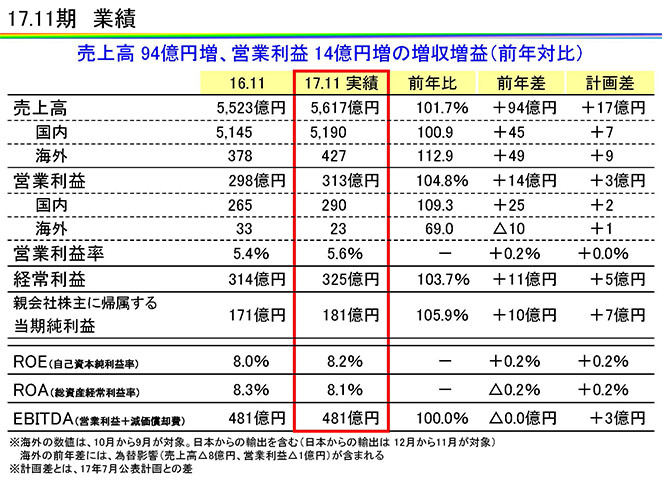
売上高は、5,617億円、前年に対して94億円の増収となりました。
国内は45億円の増収、海外は円高による8億円の為替影響を受けましたが、49億円の増収となりました。営業利益は313億円、前年に対して14億円の増益となりました。
国内は、昨年の会計変更で生じた減価償却の一括償却がなくなることによる28億円の影響を含め、前年に対して25億円の増益となりました。海外は、円高による為替影響1億円や北米のタマゴ事業の苦戦により10億円の減益となりました。 -
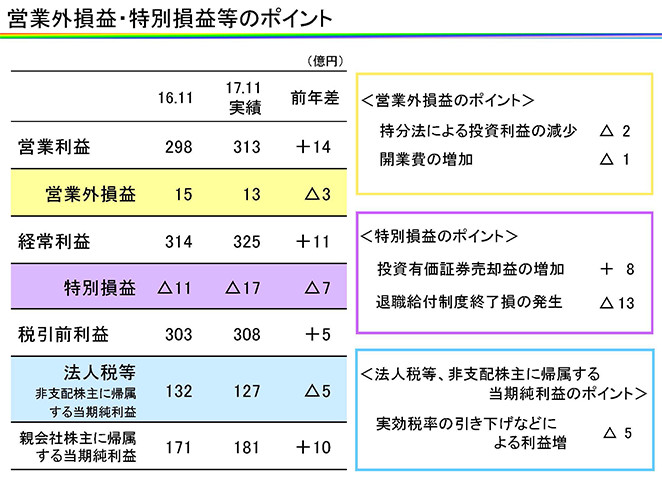
営業外損益は、持分法による投資利益の減少などにより3億円減少し、経常利益は11億円増加の325億円となりました。
特別損益は、海外子会社の退職給付制度終了による損が発生したことなどにより7億円の減少となりました。
親会社株主に帰属する当期純利益は、以上の影響に加え、法人税等の減少などにより、10億円増の181億円となりました。
-
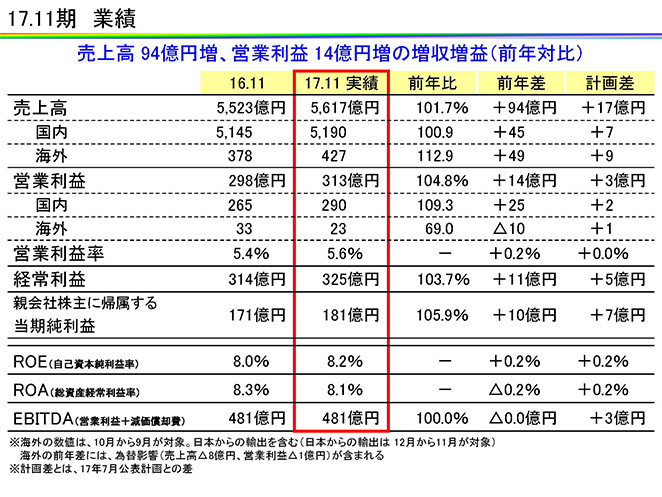
7月の公表計画に対する状況は、売上高、利益ともに達成することができました。
-
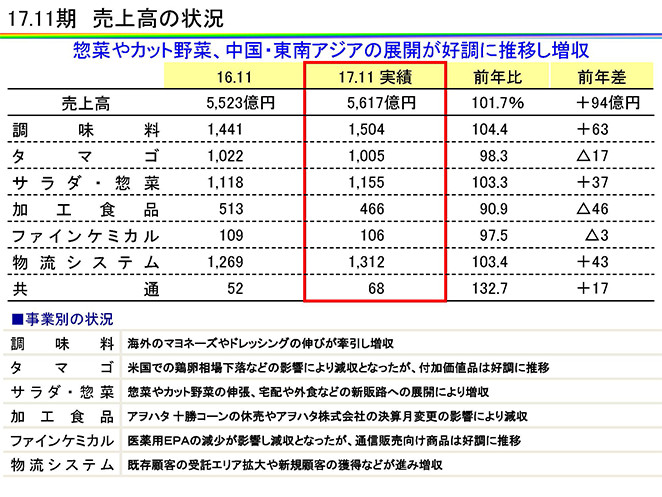
事業別の売上高の状況です。
調味料事業は、海外展開がマヨネーズやドレッシングを中心に56億円増と伸張し、事業全体で63億円の増収となりました。
タマゴ事業は、外食・中食向けの液卵などは増収となりましたが、米国の鶏卵相場の下落影響による12億円の減収などにより、事業全体で17億円の減収となりました。
サラダ・惣菜事業は、宅配や外食などへの展開を進めたことにより惣菜が前年に対して22億円、カット野菜が5億円増加したことなどで、37億円の増収となりました。
加工食品事業は、アヲハタ 十勝コーンの休売による18億円、アヲハタ株式会社の前年の決算月変更の反動などによる25億円の減収などで、46億円の減収となりました。
ファインケミカル事業は、通信販売向け商品は好調に推移しましたが、医薬用EPAの減少が影響し、3億円減収となりました。
物流システム事業は、既存顧客の受託エリアの拡大や、新規顧客の増加などにより、43億円の増収となっています。
共通事業は、食品機械設備の販売増加によるものです。
-
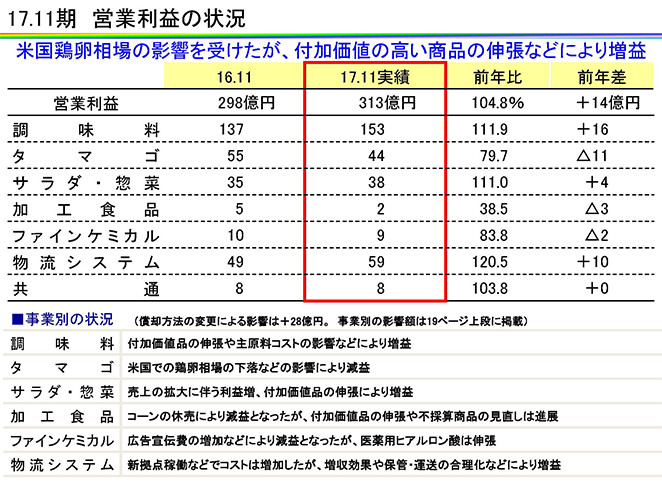
事業別の営業利益の状況です。
調味料事業は、国内で付加価値の高い商品が伸張したことに加え、主原料コストなどが減少し16億円の増益となりました。
タマゴ事業は、米国の鶏卵相場の下落影響9億円などにより、事業全体で11億円の減益となりました。
サラダ・惣菜事業は、売上拡大や付加価値商品の伸張により、4億円の増益となりました。
加工食品事業は、ジャムなどの付加価値商品が伸張したことに加え、不採算商品の見直しなど収益基盤の強化の取り組みを継続しましたが、アヲハタ 十勝コーンの休売などの影響により3億円の減益となりました。
ファインケミカル事業は、ヒアルロン酸の伸張が利益の増加に貢献したものの、通信販売向けの広告宣伝費の増加により、2億円の減益となっています。
物流システム事業は、合理化によるコスト改善を進めたことなどにより10億円の増益となりました。
なお、共通事業は、売上高の増加により増益となりました。
-
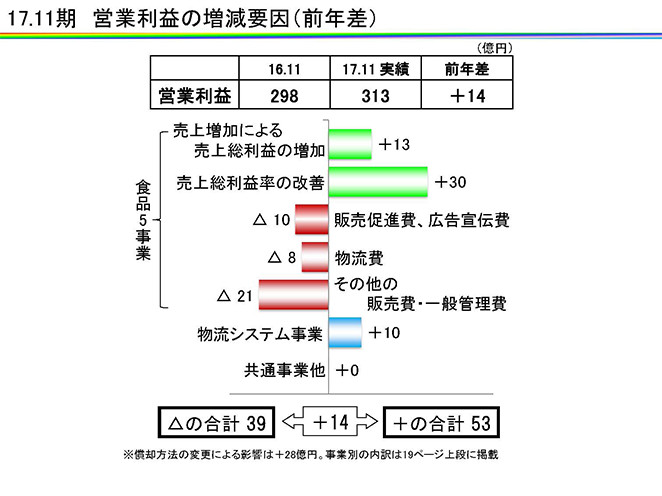
営業利益14億円増の前年差での要因です。
-
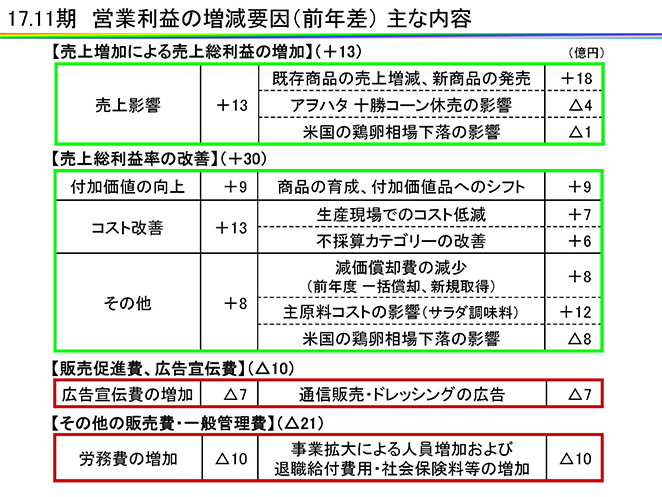
売上増加による売上総利益の増加は、サラダ調味料の拡大やカット野菜・惣菜などで7億円を創出しましたが、十勝コーンの休売などのマイナス要因もあり、合計で2億円となりました。
売上総利益率の改善による利益増の主な内容は、付加価値の高い商品の販売ウエイトを上げていく取り組みで4億円、生産の効率化や不採算カテゴリーの改善などのコスト改善の取り組みで6億円を創出しました。
また、その他の中には、昨年会計変更で生じた減価償却の一括償却がなくなることによる約19億円の利益増も含んでいます。
なお、主原料価格については、食油相場の下落により9億円の益要因となりました。広告宣伝費は、ドレッシングの新商品や通信販売の広告へ投入したことによるものです。
その他の販売費・一般管理費等は、主に事業拡大による人員増加や退職給付費用・社会保険料などの労務費の増加によるものです。
-
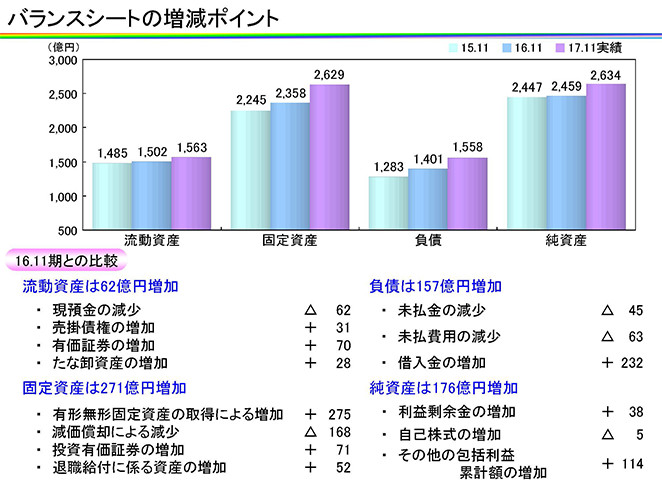
-
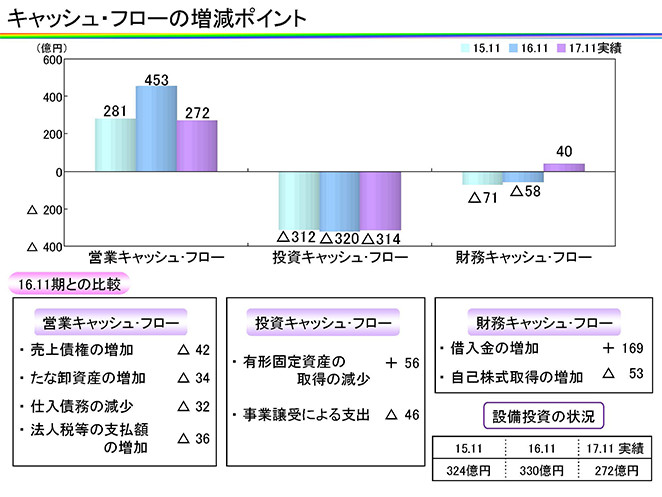
設備投資は、年間で計画していた314億円に対し272億円を実行しました。更新投資の延期など、一部が2018年度にずれ込んでいます。
-

-
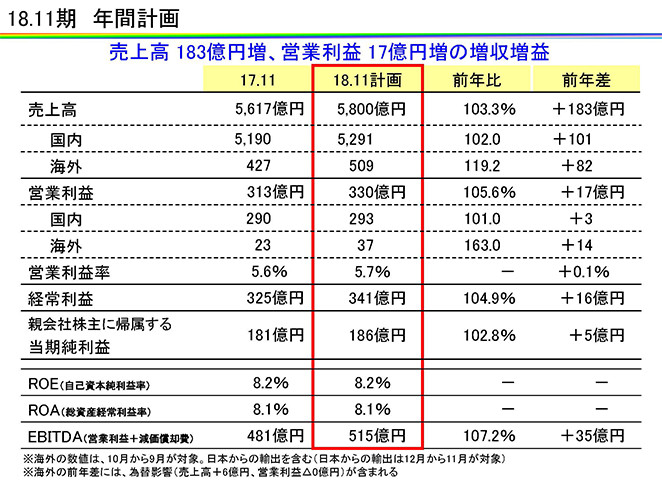
2018年度の売上高は前年差183億円増の5,800億円、営業利益は前年差17億円増の330億円を計画します。
経常利益は前年差16億円増の341億円、当期純利益は5億円増の186億円とします。
-
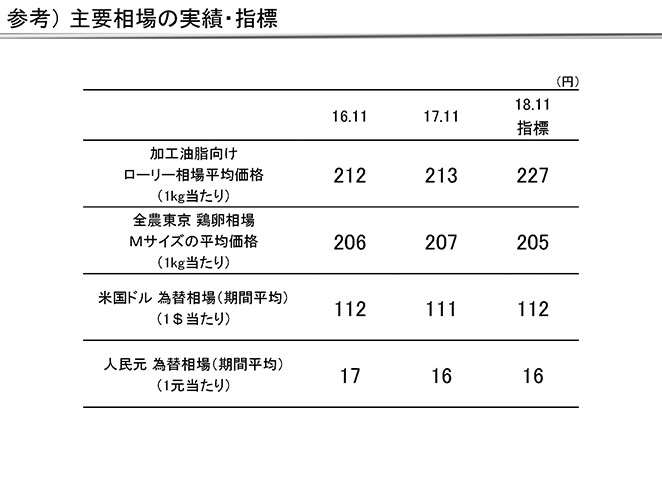
なお為替相場の前提には、昨年よりも若干円安の1ドル=112円で想定しています。
-
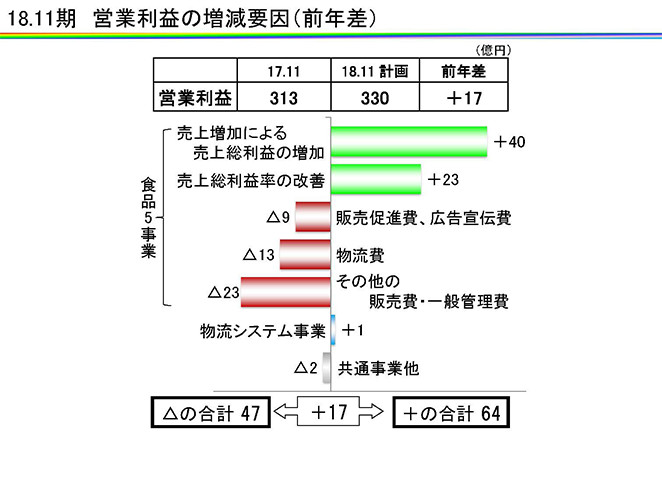
営業利益17億円増の前年差での増減要因です。
食品事業では、売上増加による利益を40億円確保し、売上総利益率の改善で23億円の利益を創出していきます。
-
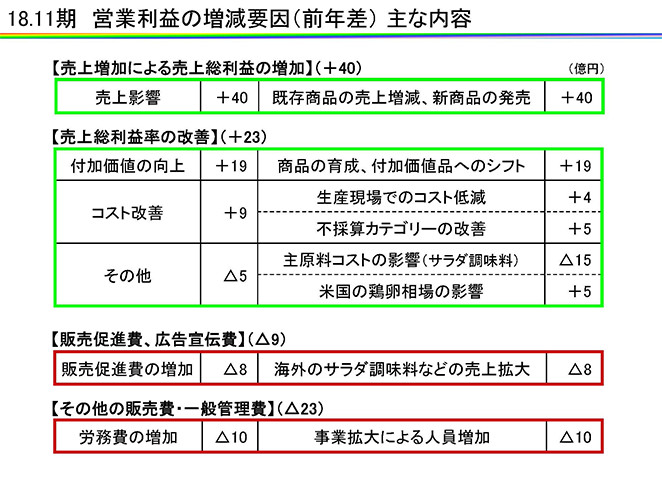
売上増加による売上総利益の増加は、国内外でのサラダ調味料の拡大や新販路での惣菜・カット野菜の拡充などで40億円になります。
売上総利益率の改善による利益増については、付加価値の高い商品の販売ウエイトを上げていく取り組みで19億円、生産の効率化や不採算カテゴリーの改善などのコスト改善の取り組みで9億円を創出していきます。
なお、主原料コストの上昇による15億円のマイナス影響を見込んでいます。
食油につきましては、産地での天候の異変がない限り、年間を通じて現状の相場が継続すると予想しており、年間では昨年に比べ少し上昇すると予想しています。販売促進費については、売上の増加にともなうものであり、その他の販管費は、おもに労務費の増加によるものです。
-

-
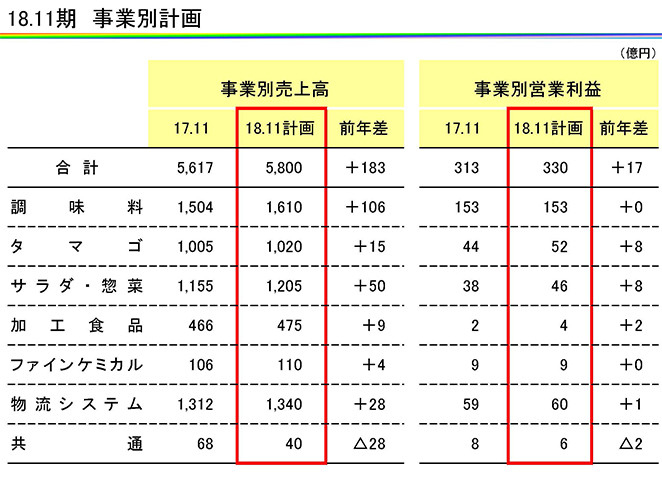
2018年度の事業別売上高と営業利益です。
共通事業を除く全ての事業で増収増益を計画します。
営業利益については、特にタマゴ事業とサラダ・惣菜事業がけん引します。
-
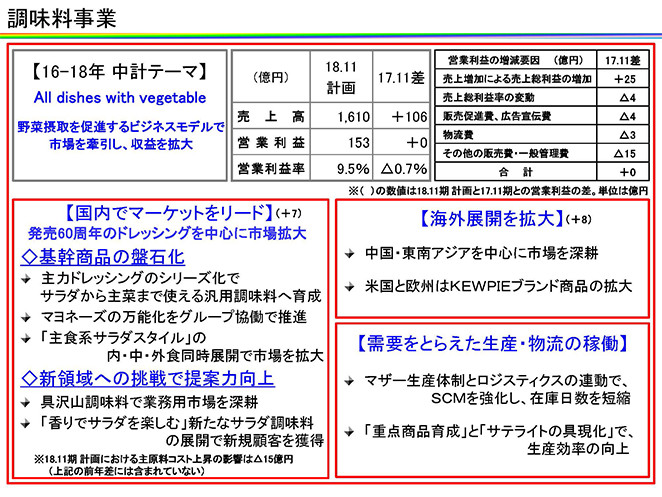
事業別の主な取り組みです。
調味料事業です。
売上高は、前年に対し106億円増の1,610億円、営業利益は、主原料コストの上昇を見込み、前年同様の153億円を計画します。
国内では、発売60周年を迎えるドレッシングを中心に、サラダ調味料市場をリードします。基幹商品の盤石化については、主力商品の深煎りごまドレッシングのシリーズ化で、サラダから主菜まで使える汎用調味料へと育成し、フードサービス市場でも提案していきます。
焼く、炒めるなどというマヨネーズの万能化への取り組みは、キユーピーハーフのテレビCMとSNSによるメニュー情報の拡散を起点にして、グループ協働で展開します。
-
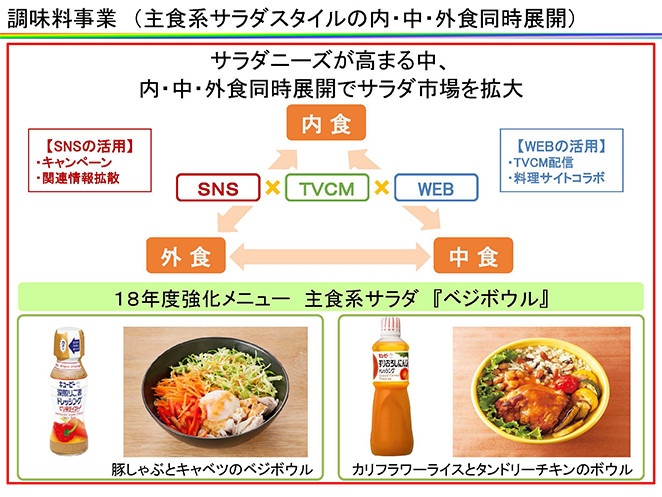
サラダニーズが高まる中、健康感がある主食系サラダスタイルの「ベジボウル」を内食・中食・外食で同時展開し、提案メニューの浸透力を高め、サラダ市場の拡大に努めます。
-
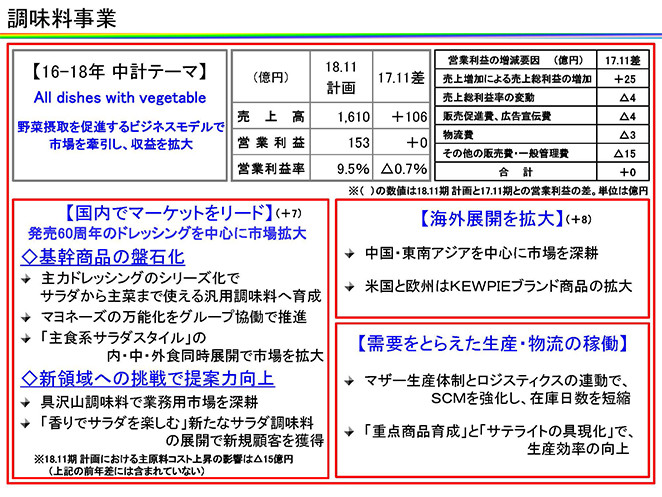
新領域への挑戦について、フードサービス市場では、ユーザーのお困りごとを解決し、市場を深耕します。
具材感と手作り感で本格的なおいしさを実現した具沢山調味料により、調理オペレーションの簡素化とお客様への提供時間の短縮に貢献します。
また、ハーブの香りでサラダを楽しむという新たなサラダ調味料の展開で、野菜本来の味わいを楽しみたいという若年層を中心とした新規顧客の獲得を進めます。
神戸工場が稼働し、茨城の五霞工場と合わせて東西のマザー生産体制を構築しました。今後ロジスティクスとの連動で在庫日数を短縮するなど、利益体質の強化をさらに進めます。
海外については、各国のニーズに合わせた提案力を磨くことで成長し、調味料事業は、国内外でマーケットをリードし続ける事業にしていきます。 -
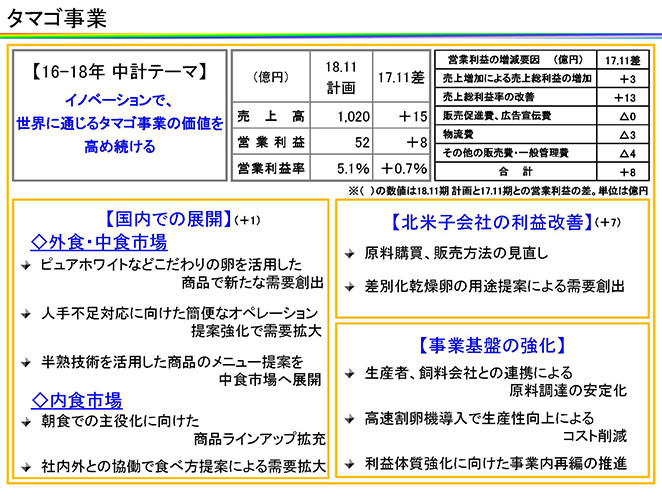
タマゴ事業です。
売上高は前年に対し、15億円増の1,020億円、営業利益は8億円増の52億円を計画します。
国内での展開については、外食・中食市場では、こだわりの卵を活用した商品や技術を活かした商品で需要拡大を図るとともに、人手不足に対応した簡便なオペレーション提案の強化を進めていきます。内食市場では、朝食での主役化に向けて、商品ラインアップの拡充と食べ方の提案を進めていきます。
こだわりの卵「ピュアホワイト」を使用した商品で、イースターを中心に需要創出を進めていきます。また加熱しても凝固しない技術を活用し、メニュー提案による需要を創出していきます。
朝食での主役化では、「ふわとろたまごのスクランブルエッグ」という新商品を導入して、売場作りを進めていきます。北米子会社の利益改善については、原料購買、販売方法の見直しなどを継続し、体質強化を進めていきます。
事業基盤の強化としては、原料調達の安定化や事業内再編の推進などを進めていきます。また、キユーピータマゴ東京工場に高速割卵機を導入しました。現状の最大4倍の割卵能力があり、生産性向上によるコスト削減に努めていきます。
-
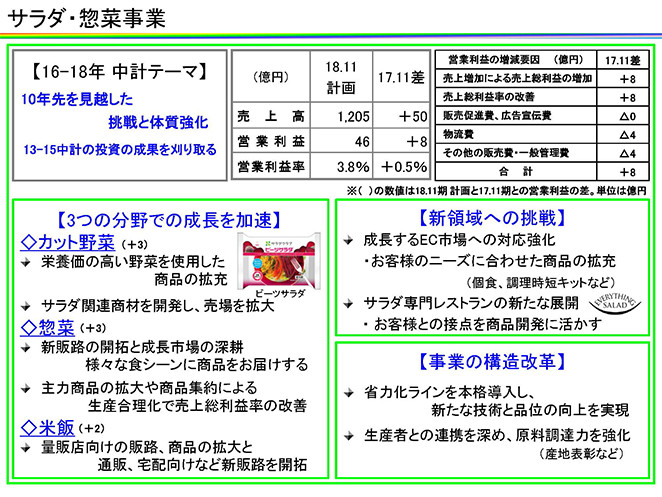
サラダ・惣菜事業です。
売上高は前年に対し50億円増の1,205億円、営業利益は8億円増の46億円を計画します。
引き続き3つの分野での成長を加速していきます。
カット野菜では、お客様のニーズにお応えするため、栄養価の高い野菜を使用したシリーズを展開しており、2017年度はケール、クレソンに次いでビーツを展開し、お客様にもご好評いただきました。今後も新商品を展開していきます。惣菜では、新販路の開拓と深耕、そしてマヨネーズをベースとした主力商品のサラダを拡大するとともに、商品集約や生産合理化で利益改善につなげていきます。
-
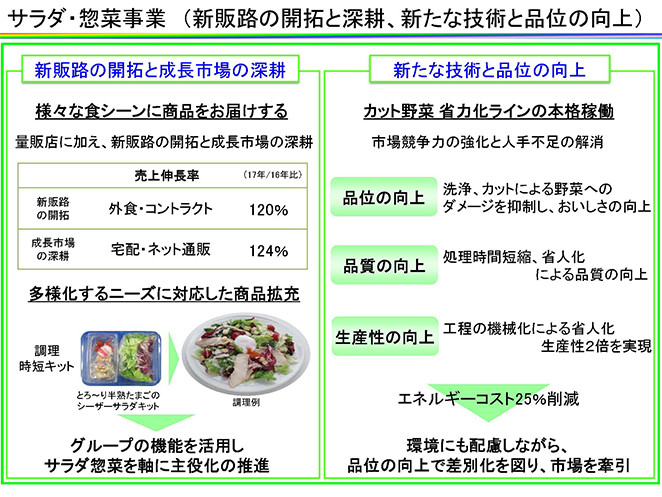
昨年スタートしたネット通販などを中心に、さまざまな食シーンへの展開が拡がっています。これまでのサラダに加え、今後は調理時間短縮キットなどの商品を拡充し、食卓での主役化を推進していきます。
-
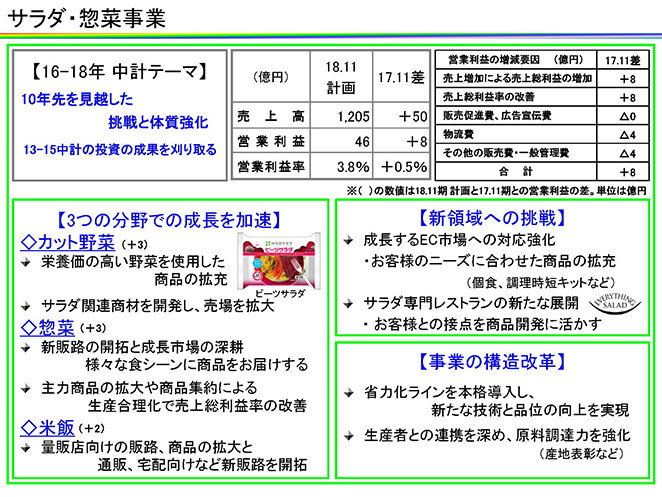
米飯は、量販店向けの拡大に加え、宅配ルートなどの新販路を開拓していきます。
新領域への挑戦については、先ほど説明したEC(イーシー)市場への対応、また昨年オープンしたサラダ専門レストラン「エブリシングサラダ青山」を活用し、お客様から得た情報などを今後の商品開発に活かしていきます。
事業の構造改革として、省力化ラインの本格導入と天候不順などによりますます厳しくなる、野菜原料の安定調達に努めていきます。
-
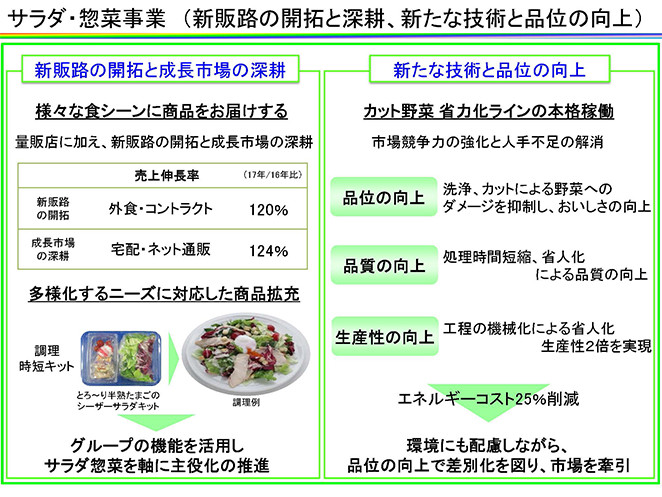
カット野菜で省力化ラインを拡充します。品位、品質、生産性の向上を図ると同時にエネルギーコストを削減し、人手不足の解消につなげていきます。
-
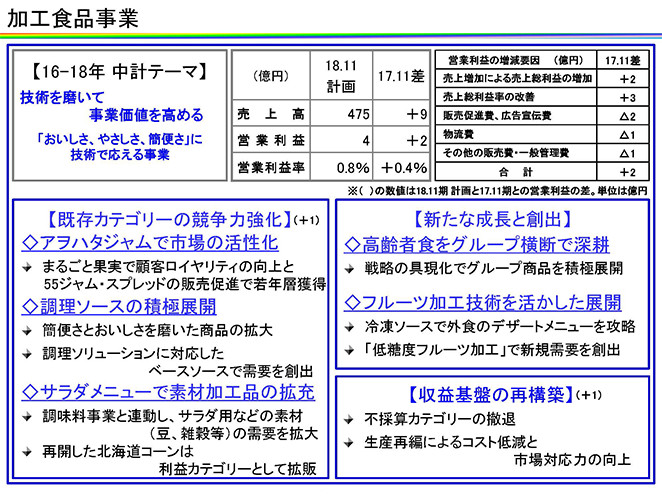
加工食品事業です。
売上高は9億円増の475億円、営業利益は2億円増の4億円を計画します。
既存カテゴリーは、3つの軸で進めます。
1つめは、アヲハタジャムでの市場の活性化です。順調に伸びている「まるごと果実」で主なロイヤル顧客であるシニア層を押さえ、「55ジャム・スプレッド」で若年層を獲得し、将来のアヲハタファンにつなげていきます。2つめの「調理ソースの積極展開」、3つめの「サラダメニューで素材加工品の拡充」については、使いやすさと付加価値の向上を追求し、パウチタイプの調理ソースやスイートコーンなどを拡大します。また、豆や雑穀を、サラダ用などの素材として調味料事業と連動して拡大していきます。
新たな成長と創出は、2つの内容を進めます。
1つは高齢者食をグループ横断で深耕し、高齢者の食のお困りに対応した商品を具現化していきます。
もう1つは、大きくカットしたフルーツの「フレッシュでごろごろ感」がある冷凍ソースや低糖度のフルーツ加工品など、フルーツ加工技術を活かした商品を展開します。そして収益基盤の再構築では、不採算カテゴリーからの撤退や生産の再編を進め、コストの低減と速やかな商品開発など、市場対応力の向上につなげていきます。
-
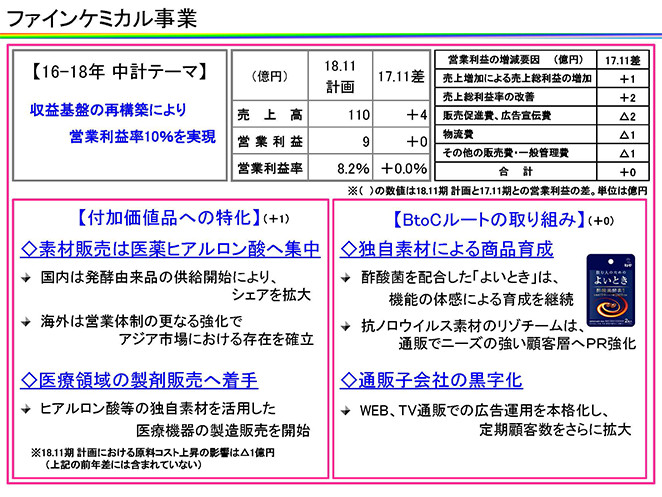
ファインケミカル事業です。
売上高は前年に対し4億円増の110億円、営業利益は9億円を計画します。
この中期経営計画では、素材販売は付加価値品へ特化し収益性を高め、将来への成長の布石としてBtoC(ビー・トゥ・シー)ルートの開拓、育成を掲げています。
付加価値品への特化として、素材販売は医薬用ヒアルロン酸に集中し、さらに収益性を高めていきます。従来、医薬用ヒアルロン酸は鶏冠由来品を中心に販売していましたが、発酵由来品の販売を本格化します。
これにより販路が拡大し、国内シェアのさらなる盤石化と海外市場への展開を推進していきます。
また、昨年度、定款変更並びに製造販売業の取得を行った医療機器は付加価値品と位置付けており、今年度中に発売し、次期中期経営計画の成長につなげていきたいと考えています。BtoCについては、独自素材を配合した2つの商品の成果を出し、通販子会社の黒字化をめざします。
通販子会社の主力商品は『ヒアロモイスチャー240(にひゃくよんじゅう)』です。2015年6月、機能性表示食品制度の第1号商品として発売され、その後順調に成長してきました。
昨年度、発売後2年というスピードで売上高10億円を突破し、今年度は15億円をめざします。 -
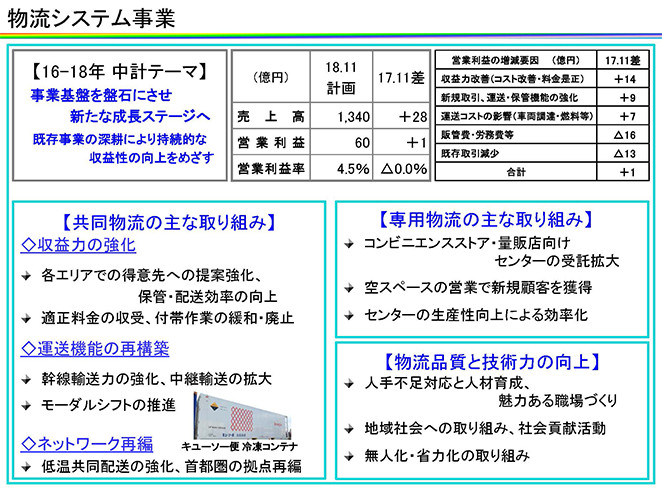
物流システム事業です。
売上高は28億円増の1,340億円、営業利益は1億円増の60億円を計画します。
共同物流では、保管・配送効率の向上に加え、営業強化による取扱量の拡大で、収益力の強化を進めていきます。また、ドライバー不足に対し、長距離運行での中継輸送や、トラックから鉄道へのモーダルシフトの拡大、さらには船舶の活用も視野に入れるなど、運び方を工夫することで、幹線輸送力の強化を進めていきます。
専用物流では、コンビニエンスストアや量販店向けが堅調に推移しており、今後も拡大させていきます。
食品物流業界も、慢性的な人手不足に加え、燃料費の高騰など引き続き厳しい環境を予測しています。
職場環境の整備などにより、女性や高齢者にも、働きやすい職場づくりを推進するなど、持続的な成長と収益向上に向けた事業基盤の確立に取り組んでいきます。 -

-
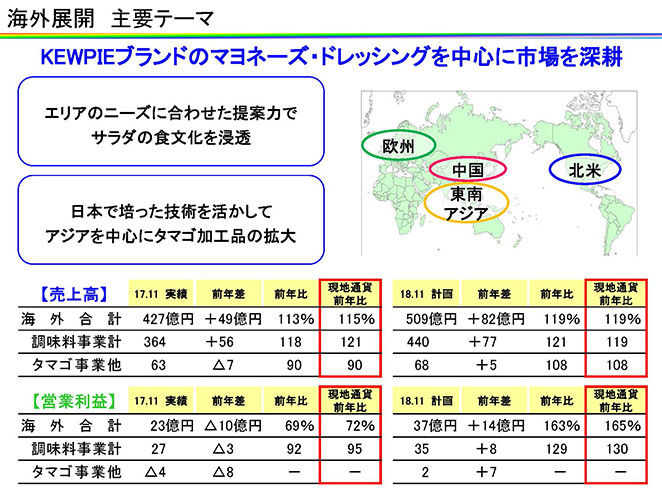
海外展開は、中国、東南アジア、北米、欧州の4つのエリアでマヨネーズ、ドレッシングの拡大に注力しています。
エリアのニーズに合わせ、日本で培った提案力を活かして、各国に貢献していきます。2017年度の売上高は、海外全体で前年に対し113%、49億円増の427億円となりました。北米タマゴ事業の減収影響はありましたが、調味料事業は中国・東南アジア・北米での順調な拡大とポーランドでの展開が寄与し、現地通貨ベースで121%となりました。
営業利益は、海外合計で10億円減の23億円となりました。タマゴ事業の減益と、中国・ポーランドでの新会社稼働に伴う費用が影響しました。
2018年度の売上高は、海外全体で前年に対し82億円増の509億円を計画します。調味料事業がマヨネーズ・ドレッシングを中心に4エリアで順調に拡大し、現地通貨ベースで119%を計画しています。
営業利益は、海外合計で14億円増の37億円を計画します。調味料事業の売上拡大による増益とタマゴ事業の回復が寄与します。
-
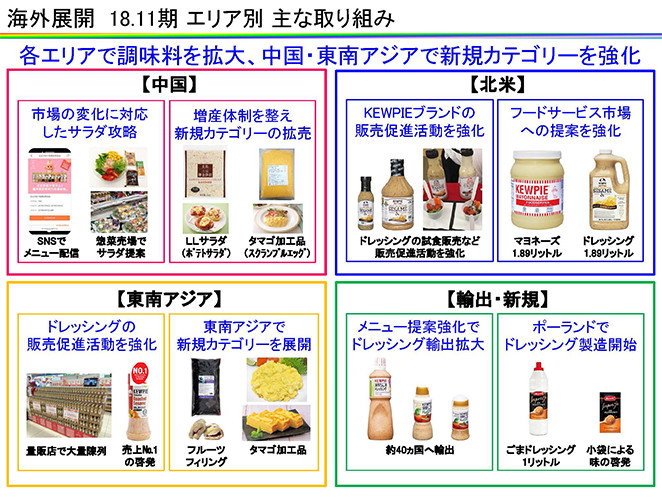
中国では、スマートフォンへのメニュー配信や、惣菜売場でのサラダ提案など、市場の変化に対応した販売促進活動を通じて、家庭用、フードサービスともにサラダの提案を強化していきます。また、昨年増産体制を整えたタマゴ加工品とロングライフサラダの、成長著しい中食及び外食市場への提案を強化していきます。
東南アジアでは、順調に拡大している深煎りごまドレッシングを中心に販売促進活動を強化していきます。2013年に発売したマレーシアでも、この深煎りごまドレッシングがドレッシング市場で売上ナンバーワンとなっています。また、フルーツフィリングやタマゴ加工品など新規カテゴリーの育成も進めていきます。
北米では、キユーピーブランドの深煎りごまドレッシングを中心に家庭用向けの販売を拡大しています。大手量販店への配荷も進みましたので、今後は販売促進活動を強化していきます。また、キユーピーマヨネーズとドレッシングのフードサービスでの採用事例も増えており、使用用途の拡大につながるメニュー提案活動を強化していきます。
輸出では、海外拠点の無いエリアへ、深煎りごまドレッシングの輸出を拡大していきます。
欧州では、ポーランドで12月よりフードサービス向けにドレッシングの製造販売を開始し、市場を開拓していきます。各エリアにてマヨネーズ、ドレッシングを中心に調味料を拡大するとともに、中国・東南アジアでは新規カテゴリーの展開を強化していきます。
-
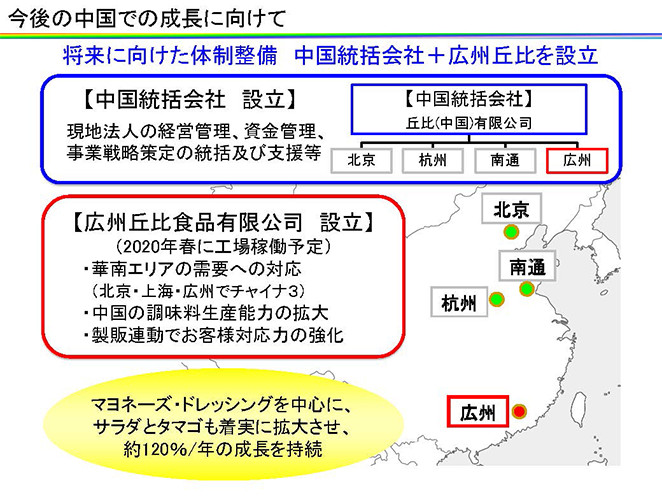
中国での、将来の成長に向けた体制整備については、2017年12月に、現地法人の経営管理や資金管理、事業戦略策定の統括および支援を行う、中国統括会社を設立しました。
そして、華南(かなん)エリアの広東省(かんとんしょう)広州市(こうしゅうし)に、「広州丘比(こうしゅうキユーピー)」を新設し、2020年春に工場の稼働を予定しています。
新工場を設立する華南エリアは、華北(かほく)・華東(かとう)と共に重要な経済圏の1つとされており、新たな生産拠点による生産能力の拡大で、伸長する中国の内食・中食・外食市場の深耕を進めます。
中国統括会社と4か所の生産拠点にて、マヨネーズ・ドレッシングを中心に、サラダとタマゴの事業も着実に拡大させ、現地通貨ベースで、年約120%成長の持続をめざしていきます。
-

-
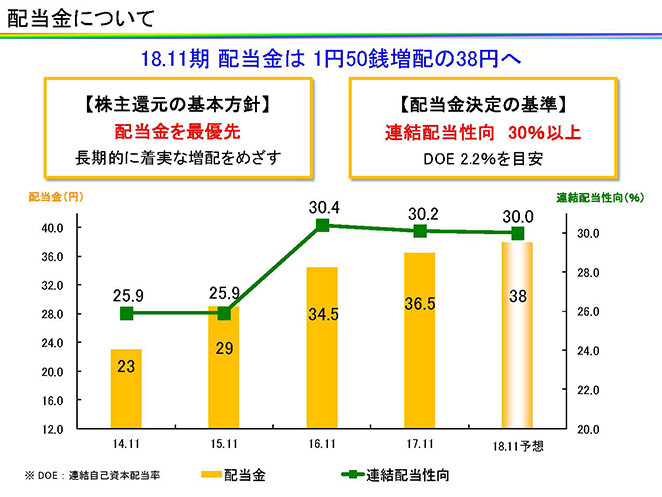
配当金の基準として配当性向30%以上、DOE2.2%を目安としています。
2017年度は、年間で36円を予定していましたが、純利益の計画以上の上昇にともない、計画から50銭、前年から2円増配の36円50銭としました。
2018年度は、1円50銭増配の年間38円を予定します。
今後も、株主還元の持続的な向上を継続していきます。
-

Q&A (Japanese only)
-
Regarding profit growth driven by increased sales, in fiscal year 2017 we faced headwinds such as the temporary suspension of sales of Aohata Corporation Tokachi Corn, the impact on our main prepared delicatessen foods products due to food poisoning at a delicatessen foods store, and a decrease in sales of pre-cut vegetables due to low vegetable prices. In fiscal year 2018, we will focus on selling new products, particularly dressings celebrating their 60th anniversary, and expand our range of high-value-added products such as Kewpie Half and Tasty Dressing, aiming to increase Gross profit.
-
In our efforts to increase added value, condiments business will increase from +400 million yen in FY2017 to +700 million yen in FY2018 through the expansion of Kewpie Half and Tasty Dressing. The egg business did not contribute in FY2017, but will increase by +600 million yen in FY2018 through the expansion of small-capacity frozen eggs. The salad and delicatessen foods business will increase from +200 million yen in FY2017 to +400 million yen in FY2018 by expanding cut vegetables using highly nutritious vegetables and salad kits.
-
In fiscal year 2018, we anticipate a negative impact of 1.5 billion yen on Operating income due to rising purchase prices of edible oil. While the annual average price of edible oil is projected to be 227 yen in fiscal year 2018 compared to 213 yen in fiscal year 2017, the price in the fourth quarter of the previous fiscal year was 219 yen, which is not a significant increase from fiscal year 2017. Therefore, we do not currently plan to revise the prices of mayonnaise and dressings. Amid rising costs in various areas, including persistently high egg prices, rising energy costs due to increased fuel prices, and increased logistics costs due to labor shortages, future price revisions will be considered not only based on the price of edible oil, but also on other raw material costs, expenses, and industry trends.
-
In fiscal year 2017, the domestic food service for salad dressings was affected by factors such as major users cutting menu items and convenience stores moving production in-house. However, in fiscal year 2018, we anticipate that these effects will disappear, and we feel that the market will grow even more than the household market. We have created products that address labor shortages and maintain high quality standards, and these have been well-received by our customers. When we implement price increases for food service salad dressings, we will explain the changes thoroughly to our customers, just as we do for household products, to ensure their understanding and acceptance of the price revisions.
-
We have previously revised prices for products such as sweet corn and boiled quail eggs when raw material prices fluctuated significantly. Future price revisions will be considered in light of rising costs, including logistics expenses.
-
Regarding the salad and delicatessen foods business, since many prepared delicatessen foods items change seasonally, we can adjust the recipe and portion sizes while being mindful of market prices and costs, and set prices accordingly each time.
For our pre-cut vegetables for home use, which have fixed selling prices, we are taking measures to reduce market fluctuations by maintaining a fixed price with our contract farmers. To address the increase in labor costs due to labor shortages, we are promoting initiatives to reduce manpower through robotics and to improve employee retention rates. We will also work to improve profit margins by developing new sales channels and high value-added products.
To address logistics costs, we established a company called Fresh Delica Network, which consolidates the logistics previously handled by each of our salad and delicatessen foods businesses, thereby improving loading efficiency.
We revise the prices of our egg products as needed in response to fluctuations in market prices and costs. For small-volume frozen eggs, we have set two price revision periods per year, in April and October, and we consider the revision details based on market and cost conditions. As we sell liquid eggs in line with market prices, our profits remain constant, but because the purchase price of raw eggs has risen for reasons other than market fluctuations, we raised prices in fiscal year 2017, and were able to cover the increase in purchase prices in the second half of the year. -
In fiscal year 2018, we plan to cover rising raw material procurement costs through price revisions and expand sales of small-volume frozen eggs and products using premium eggs (such as Pure White and Eguroyal). However, due to a significant increase in expenses, including a review of production bases in the Kansai region, we are projecting a profit increase of 100 million yen.
-
Our main focus is on providing convenient products through consumer cooperative home delivery routes, which resulted Net sales 3.8 billion yen in fiscal year 2017. The e-commerce market, which we started in fiscal year 2017, has great potential, and we will be developing Kewpie 's signature products, mainly vegetables and eggs, in this market.
-
In China, Net sales breakdown by channel is 36% for household use and 64% food service, with food service increasing by 4% compared to the end of fiscal year 2017. Overall Net sales in China grew by 121% in local currency terms compared to fiscal year 2017. By product category, mayonnaise increased by 117%, dressings by 136%, the new category of processed egg products by 135%, and long-life salads by 128%. Nantong Qubi, which began operations last year and is responsible for manufacturing the new category, is expected to become profitable in fiscal year 2019 or 2020.
-
As China is growing at approximately 120% per year, Hangzhou's production capacity will be full in fiscal year 2020, so we will start operations at Guangzhou Qubi in the spring of 2020. Beijing's production capacity will be full in fiscal years 2021-2022, so we are planning to start operations at a new factory.
Regarding Guangzhou Qiubi, we will proceed with the aim of achieving profitability in two to three years. -
While these are not official statistical data but rather our own estimates, we estimate the market size for mayonnaise and salad dressings combined to be around 37 billion yen in monetary terms. We estimate that the average annual intake per person in China is 90g, compared to 3,400g in Japan. Compared to this, China has potential, and we believe that sales can increase by approximately 20% annually in the next few years. People in China are eating more raw vegetables in small amounts, and we expect that salad consumption will increase. Recently, competitors have emerged, but we hope to expand the market together with them.
-
In September 2017, a problem arose in Europe where pesticides were mixed into chicken feed, resulting in the mass culling of chickens. This led to the export of dried eggs from the United States to Europe, causing the US dried egg market price to rise. We anticipate an average increase of 1.2 to 1.4 times in fiscal year 2018, which will result in an expected increase of 500 million yen Operating income. By reviewing our raw egg procurement and sales methods, shifting to value-added products, and expanding sales of dried meat, we are transforming our business into one that is more resilient to rising prices, and we expect an overall profit increase of 700 million yen.
-
I believe that the lack of ability to generate the wisdom to overcome the headwinds that have caused us to fall short of our medium-term management plan is the responsibility of top management. Through the serious efforts of each and every employee over many years, we have been able to transform into a profitable company, and we are committed to change with determination. While spirit is important, we will proceed while maintaining a balance.
-
While our 8th medium-term plan included a 90 billion yen investment in capital expenditures, we expect to exceed that by approximately 10 billion yen. We are reviewing our production bases in the Kansai region and will utilize the site of our Itami factory, following the relocation of our condiments factory to Kobe, to strengthen our egg business and salad/ delicatessen foods business. Although we had planned to make these investments from fiscal year 2019 onwards, we are accelerating the process and will begin preparing for our 9th medium-term management plan from fiscal year 2018. Regarding overseas operations, major investments up to fiscal year 2018 have been completed. Depreciation expenses are expected to increase to some extent in fiscal year 2019.
-
In the domestic market, amidst a declining birthrate, an aging population, and overall population decrease, the number of single-person households home-cooked meals the elderly is increasing, and the ready-to ready-made foods market is expected to continue to grow. Rather than relying on our condiments business, which is mainly for home cooking, our egg business and salad/prepared delicatessen foods business, which are expanding into the ready-made foods market, will work in collaboration with other companies to make eggs and salads the main players in ready-made foods market. In our 9th Medium-Term Management Plan, we will launch products that meet market needs so that our businesses in the ready-to-eat food market can drive sales and profits, and make the growth outlined in the 9th Medium-Term Management Plan visible.
-
The growth driver for our domestic condiments business is salad dressing, which is one of the few growth categories within condiments market. Because we face challenges such as responding to rising vegetable prices and cannibalization with other condiments, we aim to achieve growth exceeding the market average by developing salad dressing as a general-purpose condiments.
Regarding mayonnaise, we will maintain our market share by developing products that meet customer needs, ensuring we are the undisputed No. 1 in every aspect and not lose to our competitors.
Adobe Reader が必要です。